The Locus.sh (MARA Labs) seed deck is a concise 11-slide presentation from April 2015 that positions the company as a 'Platform as a Service for Logistics Fulfillment.' The narrative leans heavily on the founders' engineering pedigree at Amazon and their ability to solve the 'inelegant' manual intervention required in modern delivery operations. Rather than relying on theoretical B2B traction, the deck uses a consumer-facing app, RideSafe, to demonstrate the efficacy of their proprietary Route Deviation Detection (R2D2) engine. While the deck lacks a formal 'Ask' slide or detailed financial p…
Key takeaways
- The company identifies a core pain point where 75% of e-commerce customers feel the need for better tracking (Slide 3).
- The solution claims to eliminate 90% of human intervention in order dispatch through intelligent algorithms (Slide 4).
- The founders emphasize their 2-year tenure as engineers at Amazon, specifically in Fraud, ML, and AWS (Slide 2).
- Locus targets a $231 billion logistics industry, noting $1.5 billion invested in the 'Uber for X' economy in 2014 (Slide 7).
- The revenue model is strictly usage-based, charging single-digit cents per API call with free tooling and SDKs (Slide 9).
- Technical validation is provided through the 'RideSafe' B2C app, which generated 220,000+ location points in its first 4 weeks (Slide 10).
- The deck highlights diverse use cases including school bus tracking, food-tech turnaround times, and laundry pick-up (Slide 6).
- The product is positioned as a 'clean API' solution that integrates with existing stacks to avoid high in-house R&D costs (Slide 5).
Introduction and Title Slide
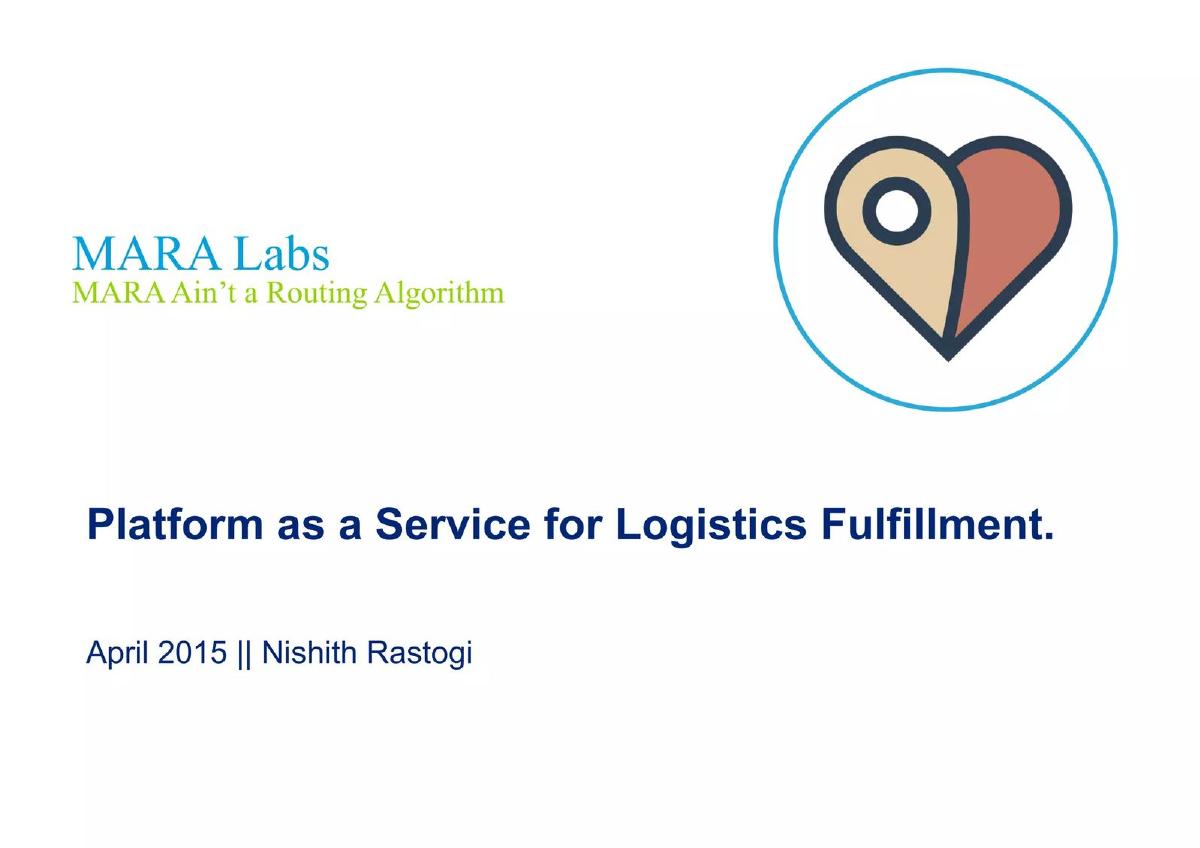
The deck opens on Slide 1 with the original company name, MARA Labs , and a playful recursive acronym: "MARA Ain’t a Routing Algorithm." The subtitle immediately defines the category: "Platform as a Service for Logistics Fulfillment." Dated April 2015 and attributed to Nishith Rastogi, the slide establishes a professional, tech-forward tone with a simple heart-shaped location pin logo.
The Team (Slide 2)
Slide 2 focuses on the founders, Nishith Rastogi (CEO) and Geet Garg (CTO) . The primary value proposition here is their shared history at Amazon. The slide explicitly states they worked together for two years as engineers, building "scalable, externalized, public APIs for Amazon." Their academic credentials from BITS-Pilani and IIT KGP, combined with specific experience in Fraud, ML, and AWS, signal to investors that this is a high-pedigree engineering team capable of handling complex backend infrastructure.
The Problem and Market Pain (Slide 3)
Slide 3 identifies an "Expensive pain point in a Massive Market." It highlights the growing need for better tools in dispatch, resource assignment, and route optimization. The slide calls out that existing solutions are "inelegant & un-optimized," requiring massive manual intervention. A key data point is cited at the bottom: "A staggering 75% of e-commerce customers feel the need for better tracking," providing a clear link between operational inefficiency and poor customer experience.
The Solution (Slide 4)
Slide 4 presents the solution as a "Tool for Automated dispatch, tracking & route optimization." It makes three bold claims: eliminating 90% of human intervention , a 75% reduction in effort when scaling to new cities, and providing live minute-by-minute ETA updates. This slide transitions the deck from identifying a problem to offering a specific, quantifiable efficiency gain.
The Value Proposition (Slide 5)
Slide 5 addresses the "Build vs. Buy" dilemma. Titled "You can’t build this in-house while making financial sense," it argues that MARA Labs absorbs the R&D costs to create high-end algorithms. By offering this as a service with "clean APIs," they allow customers to integrate the solution into their existing stacks without the operational overhead of maintaining a proprietary routing engine.
Use Cases (Slide 6)
Slide 6 uses a hexagonal graphic to illustrate diverse applications for the technology. These include:
Dispatch Assignment: Making station managers obsolete for on-demand delivery. · Tracking of Goods: Using a proprietary route deviation engine. · Schools: Providing live updates and ETAs for school buses to parents. · Food-Tech: Ensuring faster turnaround times for fresh delivery. · Laundry Pick Up: Precise ETAs accounting for live traffic. · E-Commerce: Route optimization for lower costs.
Market Size (Slide 7)
Slide 7 provides "Market Size Indicators." It values the logistics fulfillment industry at $231 billion . It breaks this down geographically, noting a $1.5 billion investment in the US 'Uber for X' economy in 2014 and $400 million invested in Indian food/grocery startups in Q1 2015. It also estimates that just four Indian companies (HealthKart, FabFurnish, YepMe, and Lenskart) account for 10 million deliveries a year, illustrating the sheer volume of transactions available for an API-based service.
Business and Revenue Models (Slides 8-9)
Slide 8 defines the operational flow: Input (locations, times, available drivers) leads to Benefits (optimum routes, task pushing to phones, and live reporting). Slide 9 gets specific about the Revenue Model . The B2B product is branded as "Locus." It uses a subscription model where each API call is charged at a "few (single digit) cents." To reduce friction, the company provides all dashboards and SDKs for free, focusing monetization entirely on the core algorithmic usage.
Proof of Concept: RideSafe (Slides 10-11)
Slide 10 introduces RideSafe , a B2C app built on their B2B APIs to demonstrate the "Realtime Route Deviation Detection (R2D2)" engine. The metrics are impressive for a four-week pilot: 12,000+ KM of usage data and 2,000 users. The slide claims the app ranked #1 on the Play Store in the transport category on Women's Day with zero marketing spend. Slide 11 supports this with a collage of media coverage from Lifehacker, NDTV, and City Express, proving that their core technology has public validation and real-world utility.
What Locus.sh Does Well
The deck excels at establishing Founder-Market Fit . By highlighting their Amazon engineering backgrounds specifically in ML and AWS, the founders position themselves as the exact right people to build a scalable logistics API. The use of a B2C app (RideSafe) as a "reference implementation" is a brilliant way to prove that the technology works in the real world before a single B2B contract is signed. It provides tangible data (220,000 location points) that would otherwise be theoretical in a seed-stage deck.
What is Missing from the Deck
The most notable omission is a specific "Ask" slide . The deck explains what they are building and how they will charge for it, but it does not state how much capital they are seeking or how they intend to deploy those funds. Additionally, there is no competitive landscape slide. While they mention that existing solutions are "inelegant," they do not name specific competitors or explain their technical moat beyond "high-end algorithms." Finally, there are no financial projections or a roadmap showing how they plan to move from a consumer safety app to enterprise logistics contracts.
Founder Takeaways
Founders should emulate the quantified value proposition found on Slide 4. Instead of saying the tool is "fast," Locus claims it "eliminates 90% of human intervention." This gives investors a concrete metric to model. Furthermore, the usage-based revenue model on Slide 9 is explained with extreme clarity—charging per API call while giving away the "wrapper" (SDKs/dashboards) for free is a classic developer-first growth strategy that remains highly effective today. If you are building a B2B infrastructure company, consider building a small B2C "demonstrator" to generate the kind of usage data shown on Slide 10.
Frequently asked questions
- What was the original name of Locus.sh?
- According to Slide 1, the company was originally named MARA Labs, with the acronym standing for 'MARA Ain’t a Routing Algorithm.' The B2B product itself was branded as 'Locus' (Slide 9).
- How does Locus.sh plan to make money?
- Slide 9 outlines a B2B Platform as a Service (PaaS) model. They use a subscription model with a card on file, charging a few single-digit cents per API call. Notably, they provide all dashboards, SDKs, and delivery apps for free to lower the barrier to entry.
- What is the 'R2D2' engine mentioned in the deck?
- As described on Slide 10, R2D2 stands for 'Realtime Route Deviation Detection.' It is their proprietary engine used to alert managers or users when a vehicle veers off its intended path, a feature first validated in their RideSafe consumer app.
- What specific metrics did the company share regarding their proof of concept?
- Slide 10 notes that their reference app, RideSafe, achieved 12,000+ KM of usage data, 2,000 users, and 220,000+ location points within its first four weeks, ranking #1 on the Play Store in the transport category on Women's Day without marketing spend.
- Who are the founders and what is their background?
- Slide 2 introduces Nishith Rastogi (CEO) and Geet Garg (CTO). Both are BITS-Pilani or IIT graduates who worked together for two years as engineers at Amazon, specializing in fraud detection, machine learning, and AWS infrastructure.