Logically’s pitch deck presents a sophisticated, mission-oriented framework for tackling the global crisis of misinformation. By framing their solution around the 'OODA Loop' (Observe, Orient, Decide, Act), the company positions itself as a critical infrastructure layer for governments and social platforms. The deck successfully communicates a sense of urgency, citing real-world crises like COVID-19 and election integrity. However, it lacks specific financial metrics, revenue figures, and a clear breakdown of the 'Ask' in terms of dollar amount. Despite these omissions, the deck effectively s…
Key takeaways
- The company defines its mission as 'Flatten the Curve of Harm caused by Information Threats' on slide 4.
- Logically utilizes a four-stage 'OODA Loop' methodology: Observe, Orient, Decide, and Act, as detailed on slide 5.
- The deck highlights cross-platform coverage including Facebook, Twitter, Reddit, and YouTube on slide 6.
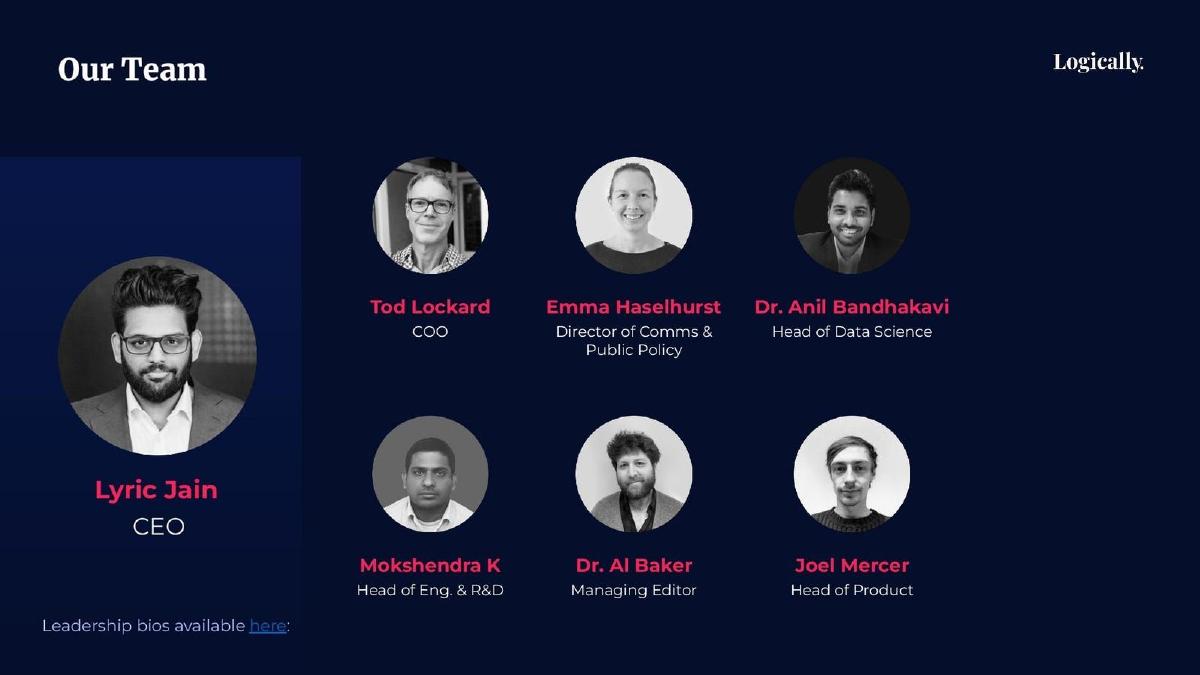
- The team slide (slide 2) showcases a diverse leadership group including a Head of Data Science and a Managing Editor.
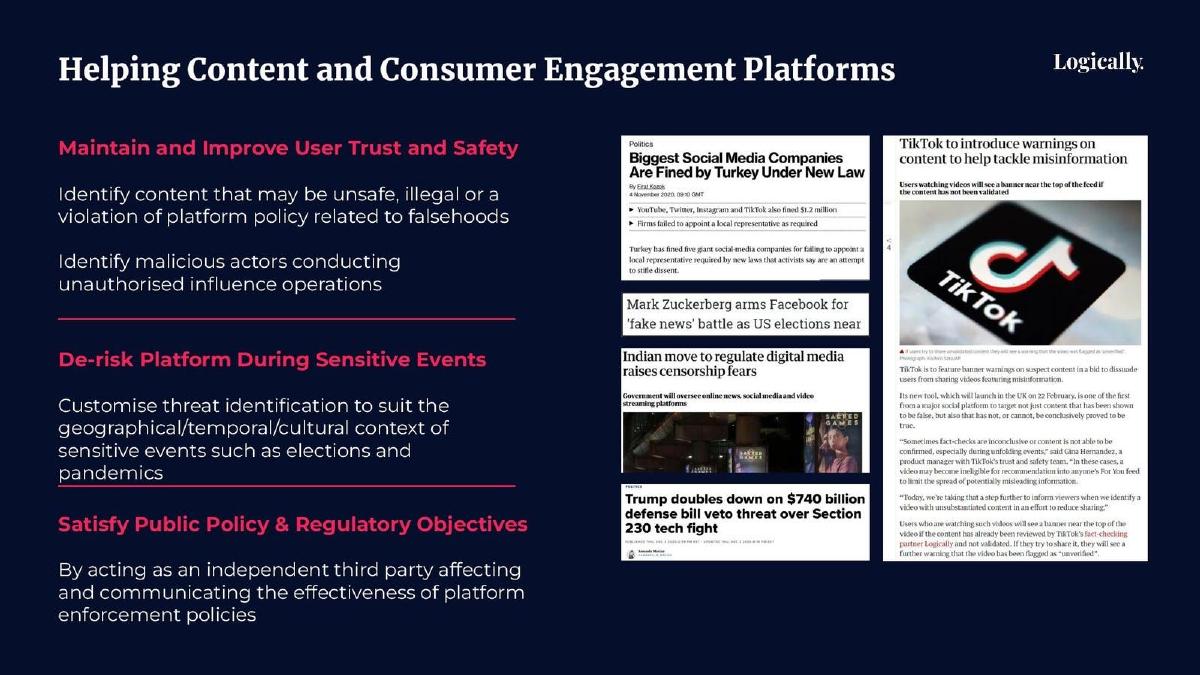
- Slide 3 explicitly targets 'Content and Consumer Engagement Platforms' to help them satisfy regulatory objectives.
- The deck mentions that the company added 25+ team members in 2020 alone on slide 8.
- Slide 7 notes the technology is deployed globally for election integrity in the US and India, and vaccine monitoring in the UK.
- The deck omits specific financial projections, current ARR, and the exact funding amount being sought.
The Mission: Flattening the Curve of Misinformation
Logically enters the market at a time when the 'truth' is a contested commodity. Their pitch deck, while visually minimalist, leans heavily into the gravity of their mission. By using the phrase 'Flatten the Curve'—a term synonymous with the COVID-19 pandemic—they immediately anchor their value proposition in public safety and national security. The deck is less about a software tool and more about a systemic solution to a global crisis.
Slide 1: Title Slide
The opening slide is sparse, featuring the company logo and the text 'Logically briefing: Invitation: IM & Series A.' The use of the word 'Invitation' and 'Confidential' in the top left corner suggests an air of exclusivity. It sets a professional, high-stakes tone without distracting the viewer with unnecessary graphics.
Slide 2: Our Team
Slide 2 introduces the leadership team. Lyric Jain (CEO) is positioned prominently on the left. The rest of the team includes Tod Lockard (COO), Emma Haselhurst (Director of Comms & Public Policy), Dr. Anil Bandhakavi (Head of Data Science), Mokshendra K (Head of Eng. & R&D), Dr. Al Baker (Managing Editor), and Joel Mercer (Head of Product). The inclusion of a 'Managing Editor' and a 'Director of Public Policy' alongside technical roles signals that Logically views misinformation as a socio-political problem as much as a technical one. This balance is a strong indicator of a holistic approach to the sector.
Slide 3: Helping Content and Consumer Engagement Platforms
This slide serves as the 'Problem/Solution' hybrid for the B2B and platform segment. It lists three primary value drivers: maintaining user trust and safety, de-risking platforms during sensitive events (elections, pandemics), and satisfying regulatory objectives. The slide features news clippings about social media companies being fined in Turkey and TikTok introducing warnings on content. This provides immediate real-world validation for why their service is a 'must-have' rather than a 'nice-to-have' for platforms facing increasing legal pressure.
Slide 4: Logically Mission
Slide 4 is the conceptual heart of the deck. It features a graph showing 'Digital and real world harm' increasing over 'Time.' The goal is to 'Flatten the Curve' by reducing the time to action. It defines their purpose as providing tools to 'identify and disarm damaging and misleading information.' Crucially, it lists their KPIs as 'high precision, high recall and low latency.' This is a sophisticated way to speak to technical investors who understand that in the world of AI moderation, speed and accuracy are the only metrics that matter.
Slide 5: The Logically Approach
This slide introduces the 'OODA Loop' (Observe, Orient, Decide, Act). This is a military strategy term adapted for information warfare. Observe: Monitor themed threats across social media. Orient: Assess impact and propagation patterns. Decide: Evaluate countermeasures and latent harm. Act: Deploy countermeasures or request consultancy. This framework gives the product a structured, repeatable feel, moving it away from 'black box' AI and toward a transparent process.
Slide 6: Intelligence - For Proactive Detection
Slide 6 focuses on the technical capabilities of their 'Intelligence' layer. It highlights 'Cross Platform Network Coverage,' showing icons for Facebook, Twitter, Reddit, YouTube, and others. It specifically mentions 'Memetic misinformation,' noting that memes are often overlooked. This is a sharp insight; many automated systems struggle with image-based text and context, so highlighting this capability suggests a technical edge over generic sentiment analysis tools.
Slide 7: A World in Crisis
This slide provides geographic and situational traction. It states that Logically Intelligence is being used for election integrity in the US and India, and for monitoring vaccine narratives in the UK. The visual on the left—a complex network map of nodes—illustrates the scale of the information threats they are tracking. It reinforces the 'Global' nature of the business and the high-stakes environments in which they already operate.
Slide 8: Your Support Will Make It Happen
The final slide in the provided set acts as the 'Ask' and 'Traction' summary. Under 'What we have,' they list 'strong technological and product differentiation,' a 'financially attractive business model,' and the fact that they added 25+ team members in 2020. They also mention 'Supportive Institutional Investors' who provide connections to government decision-makers and the FinTech market. Under 'What we expect,' they look for partners to help break barriers to entry, provide commercial support for new geographies, and back the acceleration of their technology. Notably, there is no specific dollar amount listed on this slide.
What Works in This Deck
Mission-Driven Narrative: The deck does an excellent job of framing misinformation as a public health and national security crisis. By using the 'Flatten the Curve' analogy, they tap into a universal understanding of crisis management, making their complex AI solution feel intuitive and necessary.
Methodological Clarity: The OODA loop (Slide 5) is a brilliant way to explain a complex AI workflow. It gives investors a mental model to understand how the software actually functions in a real-world scenario, moving beyond vague 'AI' buzzwords.
Strategic Team Composition: The team slide is very strong. By including roles like 'Managing Editor' and 'Public Policy,' they demonstrate that they understand the nuances of the misinformation space, which cannot be solved by code alone. This builds significant credibility with investors who are wary of 'pure tech' solutions to social problems.
What is Missing
Financial Data: The most glaring omission is the lack of hard numbers. There is no mention of Annual Recurring Revenue (ARR), customer acquisition costs (CAC), or lifetime value (LTV). While they claim to have a 'financially attractive business model,' they provide no evidence to support it in these slides.
The Specific Ask: While slide 8 outlines what they want from a partner, it does not state how much money they are raising or the valuation they are seeking. For a Series A deck, this is usually a standard requirement.
Competitive Landscape: The deck does not mention competitors. In the rapidly growing 'Trust and Safety' tech sector, investors will want to know how Logically differentiates itself from other players or internal tools built by the platforms themselves.
What a Founder Should Copy
The OODA Loop Framework: If you have a complex, multi-stage product, find a known strategic framework (like OODA) to map your process onto. it makes your product feel more professional and battle-tested.
Contextualizing the Problem: Use real-world news clippings (as seen on Slide 3) to prove that your problem is timely and that the 'cost of doing nothing' is high for your customers. This creates a sense of urgency that a simple bulleted list cannot achieve.
KPI Definition: Clearly defining what success looks like for your AI (precision, recall, latency) as they did on Slide 4 is a great way to show technical maturity. It tells investors you know exactly which levers you need to pull to improve the product.
Frequently asked questions
- What is Logically's core product methodology?
- Logically uses the 'OODA Loop' framework, which stands for Observe, Orient, Decide, and Act. As shown on slide 5, this involves monitoring themed threats, assessing impact and propagation patterns, evaluating countermeasures, and deploying specific interventions to tackle misinformation.
- Who are the primary target customers for Logically?
- According to slides 3 and 4, Logically targets national governments, brands, and social media platforms. They specifically aim to help these entities maintain user trust, de-risk during sensitive events like elections, and satisfy public policy or regulatory requirements.
- Does the deck include financial metrics or growth data?
- No, the deck is notably light on hard financial data. While slide 8 mentions a 'financially attractive business model' and the addition of 25+ team members in 2020, it does not disclose revenue, burn rate, or specific growth percentages.
- What kind of content can Logically's AI detect?
- Slide 6 specifies that their intelligence platform covers text, images, videos, and memes. They place a particular emphasis on 'memetic misinformation,' noting it has been highly effective since 2016 but is often overlooked by other mitigation campaigns.
- What is the 'Ask' in this pitch deck?
- Slide 8 outlines 'What we expect' from partners, including strategic advice, commercial support to enter new geographies, and backing to accelerate product development. However, the deck does not state a specific dollar amount for the Series A round.