Lola raised $37 million in 2019 using a deck that prioritizes executive pedigree and strategic moats over granular financial data. The presentation leans heavily on the reputation of its founders—Paul English (KAYAK) and Mike Volpe (HubSpot)—to establish immediate credibility in the travel and SaaS sectors. A central pillar of the pitch is the five-year exclusive partnership with American Express Global Business Travel (GBT), which Lola frames as a 'sustainable competitive advantage.' While the deck contains several placeholder slides for sensitive metrics, the narrative is clear: Lola is the…
Key takeaways
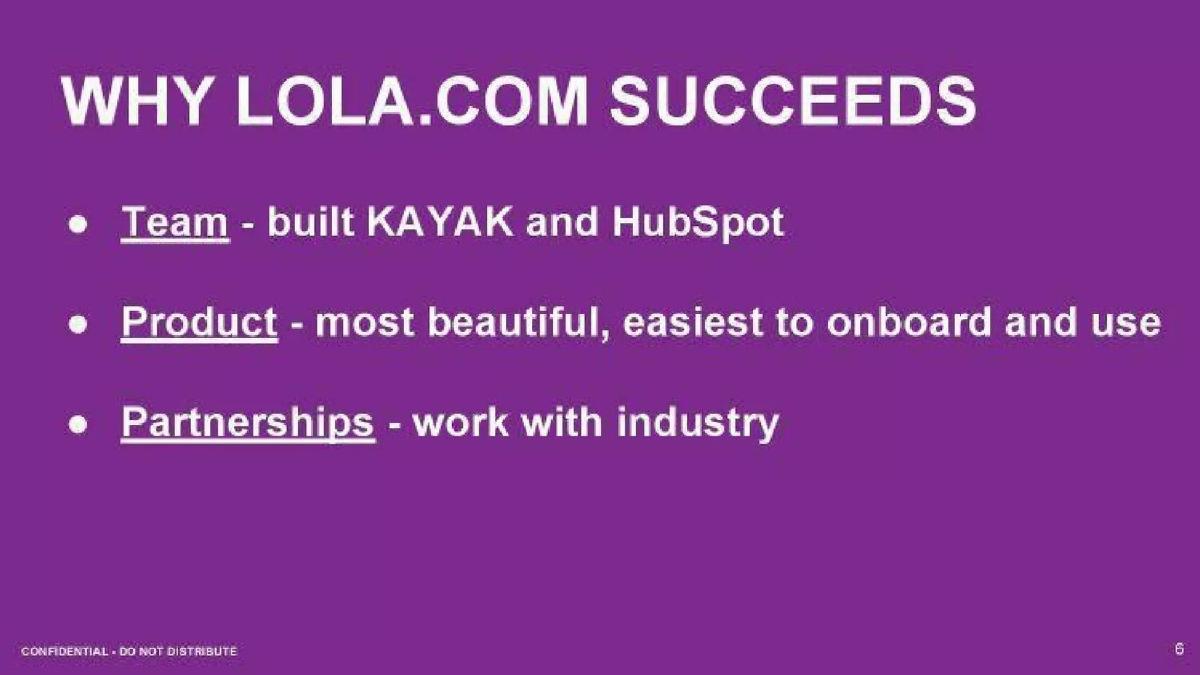
- The leadership team is the primary value proposition, explicitly citing experience building KAYAK and HubSpot on Slide 6.
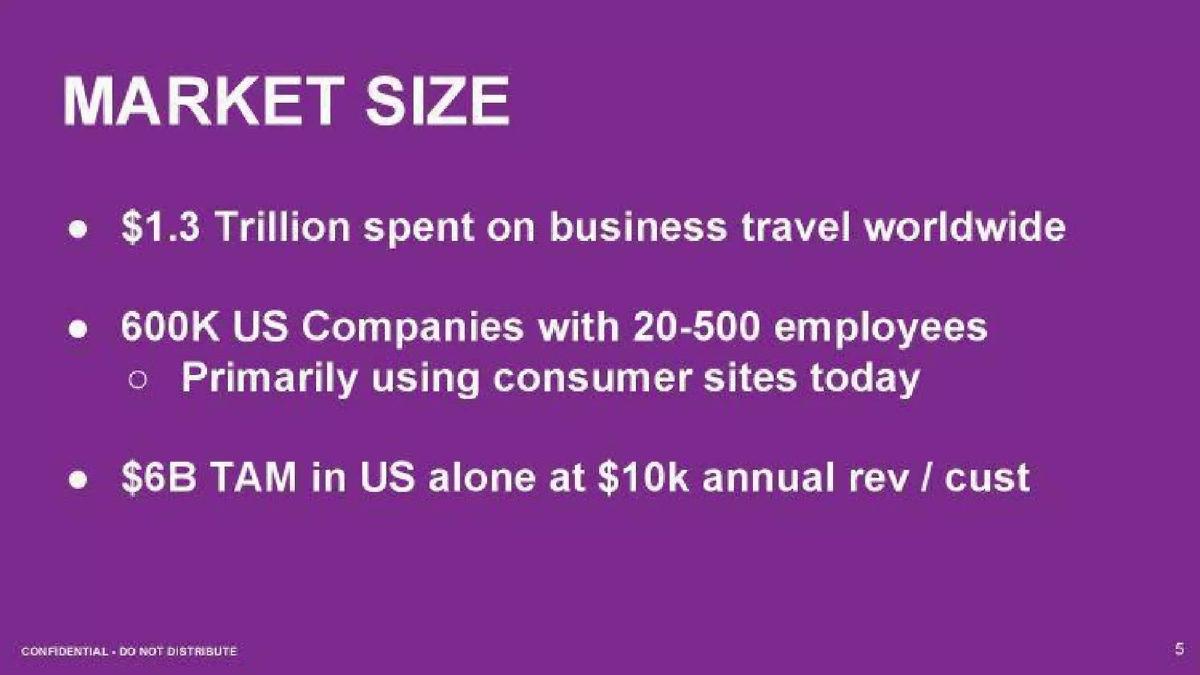
- Lola identifies a specific market gap: 600,000 US companies with 20-500 employees that currently use consumer travel sites (Slide 5).
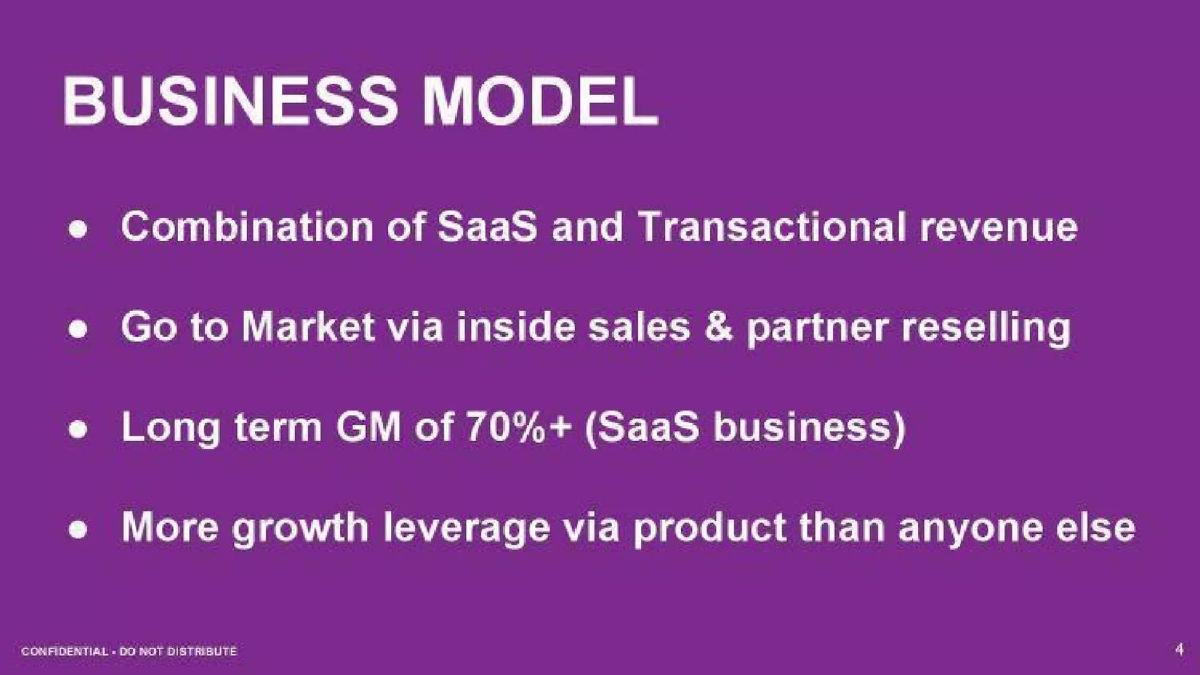
- The business model is a hybrid of SaaS subscription and transactional revenue, targeting a long-term gross margin of 70%+ (Slide 4).
- A 5-year mutually exclusive partnership with AMEX GBT is presented as the company's primary competitive moat (Slide 9).
- Lola uses G2Crowd ratings to claim the 'Highest Rated Product' title, outperforming competitors like TravelPerk and Concur (Slide 11).
- The deck omits specific financial figures on progress slides, using 'XX' placeholders for ARR, run rate, and customer counts (Slide 15).
- The product is segmented by user persona: Finance & Operations, Executive Assistants, and Business Travelers (Slide 3).
- Market activity is used to validate the sector, citing SAP's $8 billion acquisition of Concur as a benchmark (Slide 8).
The Pedigree Play: Lola's Series C Strategy
Lola’s 2019 Series C deck is a fascinating example of a high-pedigree startup moving from the 'vision' stage to the 'execution' stage. At this point in a company's lifecycle, investors are looking for proof of scale and defensibility. Lola provides this not through complex financial modeling in the slides, but through a narrative of elite leadership and a massive, exclusive partnership. The deck is visually clean, utilizing a consistent purple brand color and minimalist layouts that reflect the product's core value proposition: simplicity.
The Foundation: Vision and Product Segmentation
Slide 1: Title Slide The deck opens with the company name, Lola.com, and the date (Q1 2019). The branding is friendly and approachable, featuring a cartoon character with a suitcase, signaling a focus on the human element of travel.
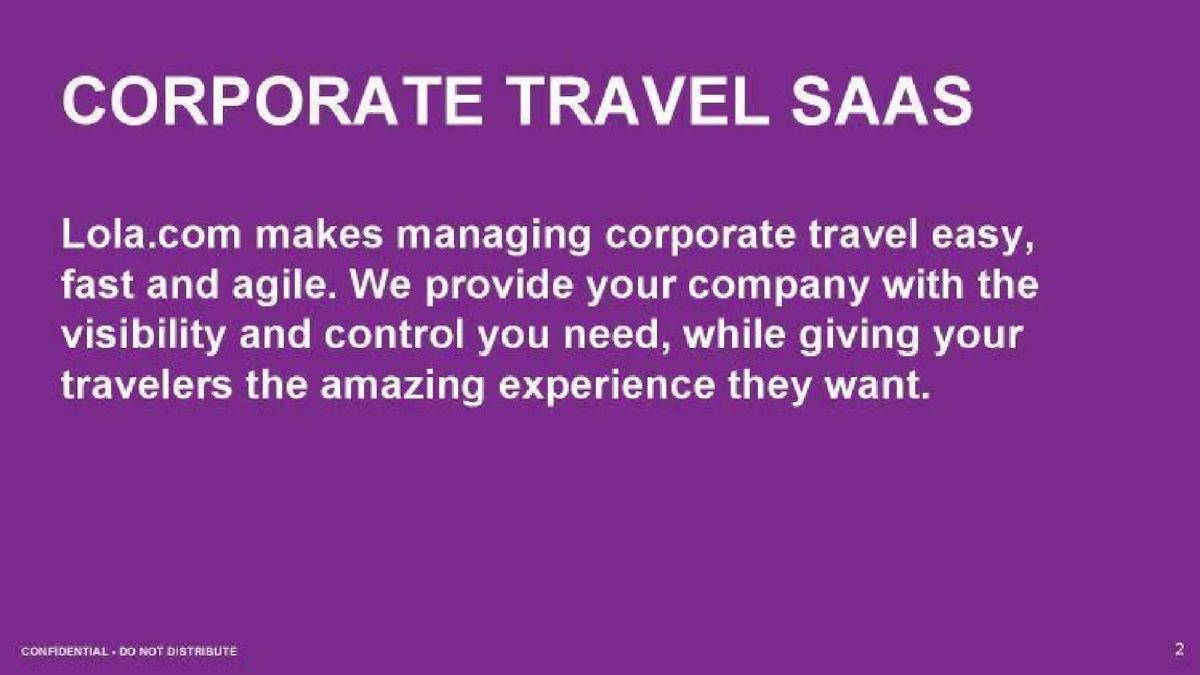
Slide 2: Corporate Travel SaaS This is a classic 'high-concept pitch.' Lola defines itself as making corporate travel 'easy, fast and agile.' It promises visibility and control for the company while providing an 'amazing experience' for the travelers. It establishes the dual-sided nature of the problem: management needs data, and employees need a tool they don't hate using.
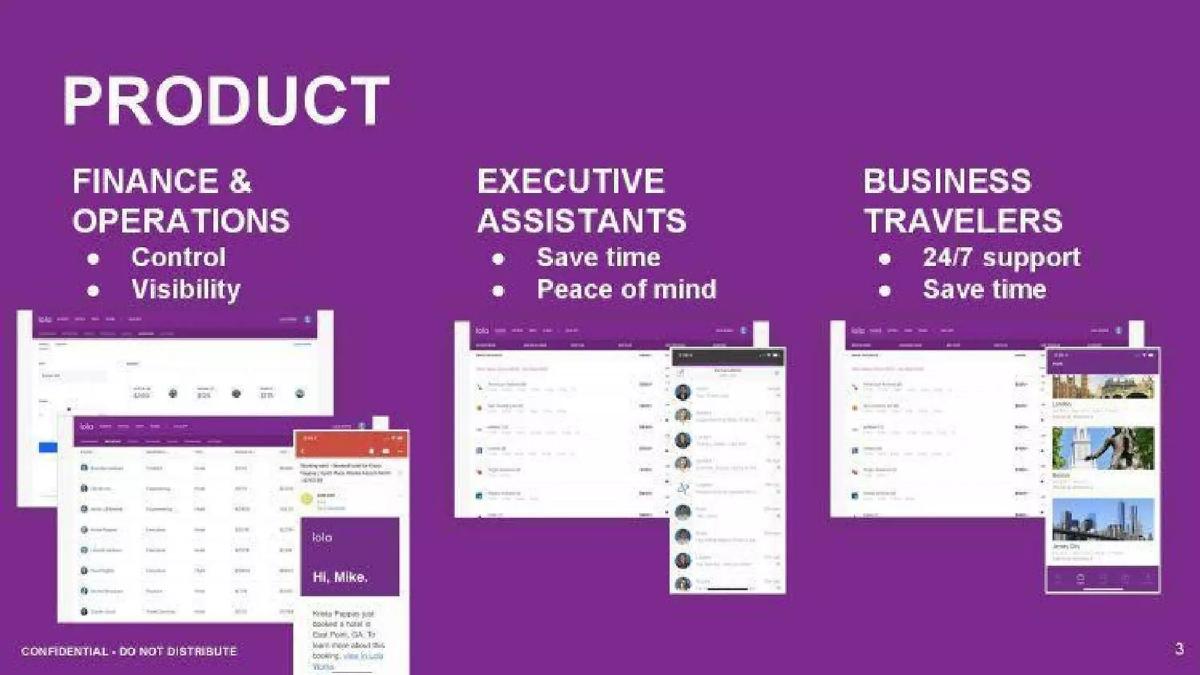
Slide 3: Product Lola breaks down its product value by persona. For Finance & Operations, it offers 'Control' and 'Visibility.' For Executive Assistants, it offers 'Save time' and 'Peace of mind.' For Business Travelers, it provides '24/7 support' and 'Save time.' This segmentation is crucial because the person buying the software (Finance) is often not the person using it (Travelers), and the deck addresses both needs simultaneously.
The Economics: Business Model and Market Opportunity
Slide 4: Business Model Lola outlines a diversified revenue stream: a 'Combination of SaaS and Transactional revenue.' This is a strong model because SaaS provides predictable recurring revenue, while transactional fees allow the company to capture upside as travel volume increases. They project a long-term gross margin of 70%+, which is standard for high-performing SaaS businesses. Notably, they claim 'More growth leverage via product than anyone else,' suggesting a product-led growth (PLG) strategy.
Slide 5: Market Size The deck cites a $1.3 trillion global business travel spend. However, the more important figure is the $6 billion TAM in the US. Lola identifies 600,000 US companies with 20-500 employees as their 'sweet spot.' They note these companies are 'Primarily using consumer sites today,' which represents a clear opportunity to upgrade them to a professional tool.
The Moat: Team and Strategic Partnerships
Slide 6: Why Lola.com Succeeds This slide acts as a summary of their competitive advantages: Team, Product, and Partnerships. It’s a transition slide that sets up the deep dives into these three areas.
Slide 7: Team This is arguably the most important slide in the deck. The roster is exceptional: Mike Volpe (CEO, ex-HubSpot), Paul English (CTO, KAYAK co-founder), Krista Pappas (SVP Biz Dev, ex-Microsoft), Jeanne Hopkins (CMO, ex-HubSpot), and Ryan Ball (VP Sales, ex-HubSpot). For a Series C investor, this team reduces 'execution risk' significantly.
Slide 8: Market Activity To justify a high valuation, Lola points to the broader market. They cite SAP’s $8 billion acquisition of Concur in 2014 and TripActions’ $1 billion valuation in 2018. This tells investors that the 'exit' potential for this space is massive.
Slide 9: AMEX GBT Deal This slide details their 'sustainable competitive advantage.' Lola secured a 5-year mutually exclusive partnership with American Express Global Business Travel (GBT). Since GBT is the largest B2B travel agency ($45B in bookings), this deal provides Lola with a massive, built-in distribution channel that competitors cannot easily replicate.
Validation: Product Excellence and Traction
Slide 10: Product Vision Lola reiterates its core principles: extreme ease of use, speed, gorgeous UI, and collaboration. It’s a reminder that in a world of clunky legacy software (like Concur), design is a weapon.
Slide 11: Highest Rated Product Using G2Crowd ratings, Lola shows it leads the pack with 4.8 stars, beating TravelPerk (4.7), TripActions (4.6), and Concur (4.0). This social proof is vital for proving that their 'gorgeous UI' vision is actually translating into customer satisfaction.
Slide 12: Product-Led Cust Success This slide introduces the concept of product-led success. They claim they had 'zero onboarding / acct mgmt team' in Q4, yet customers were still successful. While the percentages are marked as 'XX%,' the narrative is that the software is so intuitive it doesn't require a heavy service component to scale.
The Gaps: Placeholder Slides and Missing Data
Slides 13-18: The 'Missing' Data Slides 13 (Long Term Product Vision), 14 (Competition), 15 (Progress in Last 6 Months), 16 (Progress Charts), 17 (Financial Projections), and 18 (Series C) are largely placeholders or contain redacted information ('$X' and 'XX%'). This is common in public versions of pitch decks. In a real pitch, Slide 15 would show the exact ARR and run rate, while Slide 16 would show the upward trajectory of customer growth and bookings.
Slide 19: Thank You The deck concludes with contact information for Mike Volpe and Paul English, maintaining the personal, founder-led feel of the presentation.
What Works in the Lola Deck
The Pedigree: Most startups cannot claim to have the founders of KAYAK and the marketing leadership of HubSpot. Lola leans into this perfectly. By Slide 7, most investors would already be convinced that the team is capable of building a unicorn.
The Distribution Moat: The AMEX GBT deal is a masterstroke of business development. In a crowded SaaS market, having the world's largest travel agency as an exclusive reseller is a 'unfair advantage' that justifies a Series C investment.
The SME Focus: By targeting the 20-500 employee segment, Lola avoids a direct, bloody war with Concur (which owns the enterprise) and consumer sites (which own the individual). They found a 'Goldilocks' zone of companies that are big enough to need control but small enough to value ease of use.
What is Missing from the Lola Deck
Unit Economics: Even for a redacted deck, there is no mention of Customer Acquisition Cost (CAC), Lifetime Value (LTV), or payback periods. While the AMEX deal suggests low CAC, investors at the Series C stage usually want to see the efficiency of the direct sales engine as well.
Churn and Retention: There is no mention of net revenue retention (NRR) or logo churn. In SaaS, these are the 'health' metrics that determine if a company is a 'leaky bucket' or a compounding machine.
The 'Ask' Details: Slide 18 is titled 'Series C' but contains no text. A standard deck should specify how much is being raised and, more importantly, what the 'milestones' are for that capital (e.g., 'This $37M will take us to $50M ARR').
What a Founder Should Copy
Persona-Based Product Slides: Copy the layout of Slide 3. Don't just show screenshots; explain exactly what value each specific stakeholder gets from the product. This shows you understand the internal politics of a B2B sale.
Competitive Benchmarking: Slide 11 is a great way to handle competition. Instead of a 'feature checklist' where you give yourself all the checkmarks, use third-party review sites like G2 or Capterra. It’s much more credible to an investor.
Market Validation via M&A: Use Slide 8 as a template. If you are in a 'boring' or 'crowded' sector, show the big exits that have happened recently. It proves there is 'liquidity' in the market and that big incumbents are willing to pay for innovation.
The 'Moat' Slide: If you have a partnership, an exclusive patent, or a unique data set, give it its own slide like Lola did with Slide 9. Don't bury your biggest advantage in a bullet point on a summary slide.
Frequently asked questions
- Why are there so many slides with 'XX' instead of numbers?
- In later-stage fundraising (Series C), decks are often shared widely. Founders use placeholders like 'XX' on slides 12, 15, and 16 to protect sensitive data like ARR, churn, and transaction volume. These figures are typically disclosed in a secure data room or during in-person partner meetings once a non-disclosure agreement is in place.
- How does Lola define its Total Addressable Market (TAM)?
- Lola calculates a $6 billion TAM in the US alone (Slide 5). This is based on 600,000 target companies (SMEs with 20-500 employees) and an estimated annual revenue of $10,000 per customer. This specific targeting helps investors see a clear path to capture rather than just looking at the global $1.3 trillion travel spend.
- What is the significance of the AMEX GBT deal in this pitch?
- The AMEX GBT partnership is the deck's 'killer feature.' As noted on Slide 9, GBT is the largest B2B travel agency with $45 billion in bookings. By securing a 5-year exclusive deal where GBT resells Lola, the company essentially outsourced a massive portion of its customer acquisition to a market leader, creating a significant barrier to entry for competitors.
- Who are the key people behind Lola according to the deck?
- The deck highlights a 'powerhouse' executive team on Slide 7. This includes CEO Mike Volpe (formerly CMO of HubSpot), CTO Paul English (co-founder of KAYAK), and other veterans from Farecast, Microsoft, and CarGurus. This level of pedigree is often enough to secure meetings with top-tier VCs regardless of the specific slide content.
- What is Lola's core product differentiation?
- Lola differentiates through design and ease of use. Slide 10 lists 'Extreme ease of use' and 'Gorgeous user interface' as core principles. Slide 11 backs this up with social proof, showing a 4.8-star G2Crowd rating, which is higher than established incumbents like Concur (4.0 stars).