Lola.com’s Series C deck from Q1 2019 is a study in institutional credibility. Rather than focusing on granular feature sets, the presentation centers on a 'mutually exclusive' five-year partnership with American Express Global Business Travel (AMEX GBT), the world's largest B2B travel agency. The deck highlights a leadership team with deep roots at HubSpot and KAYAK, signaling to investors that the company has the operational muscle to scale. While the provided slides redact specific financial figures (using '$X' placeholders for ARR and run rate), the narrative is clear: Lola is positioning…
Key takeaways
- The deck identifies a $1.3 trillion global business travel market, specifically targeting 600k U.S. companies with 20-500 employees (Slide 5).
- Lola calculates a $6B TAM in the U.S. based on a $10k annual revenue per customer model (Slide 5).
- The team slide features significant pedigree, including a CEO from HubSpot and a CTO who co-founded KAYAK (Slide 7).
- A 5-year mutually exclusive partnership with AMEX GBT is presented as a 'sustainable competitive advantage' (Slide 9).
- Lola claims the 'Highest Rated Product' status with a 4.8-star G2Crowd rating, outperforming competitors like TravelPerk and Concur (Slide 11).
- The company recently transitioned to a subscription pricing model, moving away from purely transactional revenue (Slide 15).
- The deck uses a 'Progress in Last 6 Months' slide to highlight three major executive hires and the closing of the AMEX deal (Slide 15).
- Several key slides, including 'Long Term Product Vision' and 'Financial Projections,' are included as headers but contain no content in this version (Slides 13, 17).
Lola.com: The Series C Narrative of Credibility
The Lola.com pitch deck from Q1 2019 represents a company at a pivotal transition point. Moving from a travel-booking app to a comprehensive B2B SaaS platform, the deck is designed to prove that the company has outgrown its 'startup' phase and is ready for institutional scale. By leaning heavily on executive pedigree and a massive strategic partnership, Lola attempts to de-risk the investment for Series C participants.
Slide 1: Title and Branding
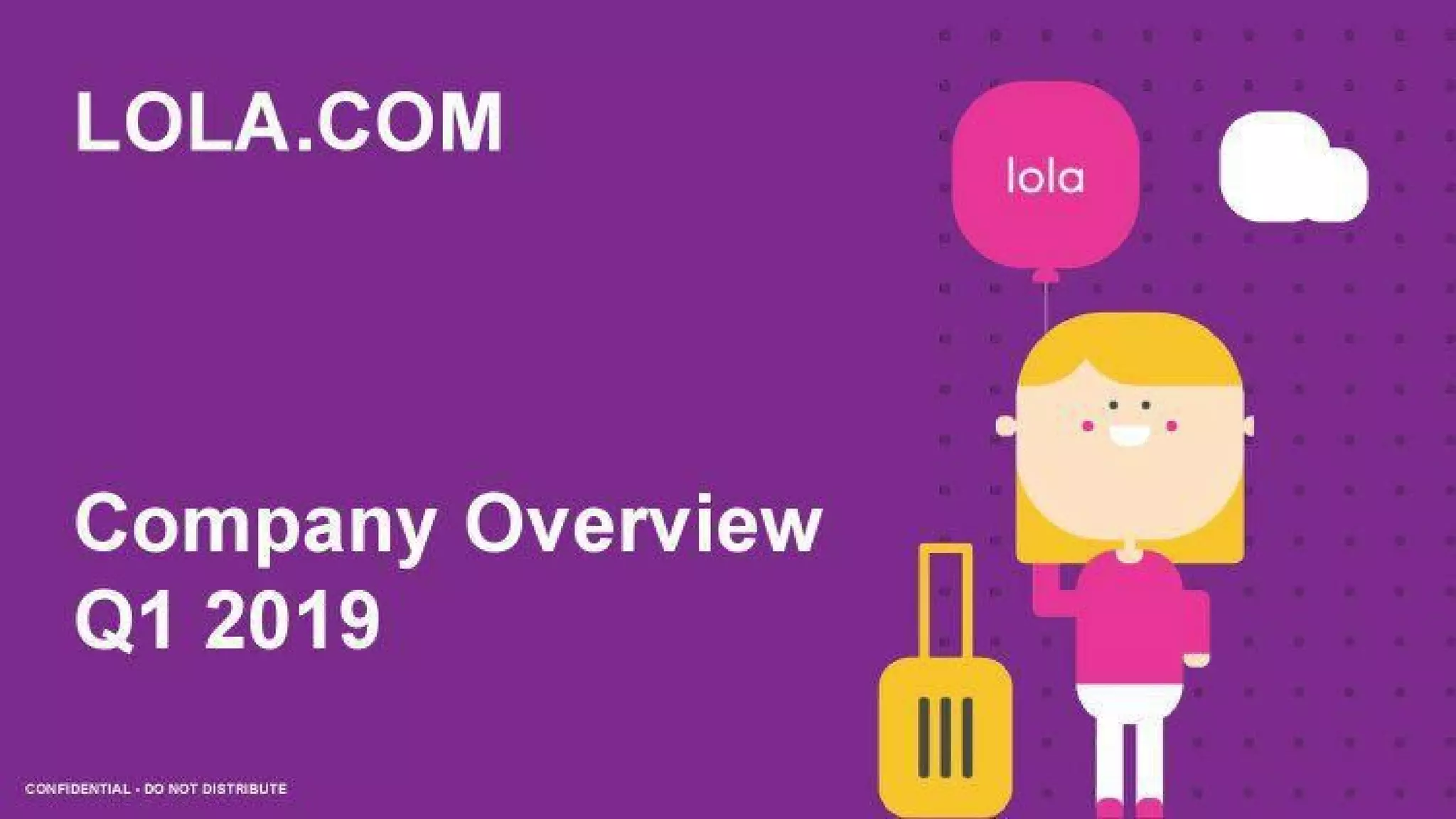
The cover slide is minimalist, featuring the Lola.com logo and a playful illustration of a traveler. It clearly states 'Company Overview Q1 2019' and includes a 'Confidential - Do Not Distribute' footer. The purple branding is consistent throughout the deck, establishing a strong visual identity that feels more consumer-friendly than traditional enterprise software.
Slide 3: Product Segmentation
Slide 3 breaks down the product value proposition into three distinct buckets: Finance & Operations, Executive Assistants, and Business Travelers. For Finance, the focus is on Control and Visibility . For Assistants, it is Saving Time and Peace of Mind . For Travelers, it is 24/7 Support . This slide is effective because it acknowledges that in B2B travel, the buyer, the booker, and the user are often three different people with different pain points.
Slide 5: Market Size and TAM
Lola defines the global business travel spend at $1.3 Trillion . However, they quickly narrow the focus to a serviceable market: 600,000 US companies with 20-500 employees. By applying a $10k annual revenue per customer assumption, they arrive at a $6B TAM in the US alone. This is a grounded way to present market size, moving from a 'big scary number' to a calculated, reachable target.
Slide 7: The 'All-Star' Team
This is arguably the strongest slide in the deck. The roster includes Mike Volpe (CEO) , formerly of HubSpot, and Paul English (CTO) , the co-founder of KAYAK. The inclusion of other leaders from Farecast, Microsoft, and CarGurus reinforces the message that this is a 'second-time founder' style team with the experience to handle rapid scaling. The HubSpot connection is particularly notable, suggesting a high-velocity B2B sales engine.
Slide 9: The AMEX GBT Strategic Moat
Slide 9 focuses entirely on the AMEX GBT Deal . It describes GBT as the largest B2B travel agency with $45B in annual bookings . The key takeaway here is the 5-year mutually exclusive partnership . In a crowded market, this slide serves to tell investors that Lola has already won the most important distribution battle, creating what they call a 'sustainable competitive advantage.'
Slide 11: Competitive Benchmarking
Under the heading 'Highest Rated Product,' Lola compares its G2Crowd ratings against three major competitors. Lola.com leads with 4.8 stars , followed by TravelPerk (4.7), TripActions (4.6), and the legacy incumbent Concur (4.0). Using third-party validation rather than self-proclaimed superiority is a smart tactical move to build trust.
Slide 13: The Vision Gap
Slide 13 is titled 'Long Term Product Vision' but is entirely blank in this version of the deck. In a live pitch, this would likely be a placeholder for a verbal explanation or a high-level roadmap graphic. In a teardown context, its emptiness represents a missed opportunity to show where the company goes after conquering the mid-market travel space.
Slide 15: Recent Momentum
The 'Progress in Last 6 Months' slide acts as a checklist of success. It highlights the hiring of the CEO, CMO, and VP of Sales, the implementation of subscription pricing, and the signing of the AMEX deal. Notably, points 6, 7, and 8 use '$X' placeholders for the number of companies, subscription ARR, and revenue run rate. While the specific numbers are hidden, the structure shows that Lola is tracking both SaaS metrics (ARR) and marketplace metrics (transactional rev).
Slide 17: Financial Projections
Similar to the vision slide, Slide 17 is a blank header for 'Financial Projections.' For a Series C deck, this is usually the most scrutinized section. The absence of data here suggests this version of the deck was intended for a general overview rather than a deep-dive due diligence session.
Slide 19: Contact and Closing
The deck concludes with direct email addresses for the CEO and CTO. The imagery of a laptop and a plant maintains the 'modern office' aesthetic established on the cover.
What Lola.com Does Well
Lola excels at narrative authority . By highlighting the AMEX GBT deal and the HubSpot/KAYAK leadership, they move the conversation away from 'can this product work?' to 'how big can this team take this partnership?'
The TAM calculation on Slide 5 is also a highlight. Many startups fail by claiming a trillion-dollar market without explaining how they get a piece of it. Lola’s math ($10k/year 600k companies) is simple, transparent, and defensible.
What is Missing from the Deck
The most glaring omission is Unit Economics . While the deck mentions a shift to subscription pricing, it does not provide Customer Acquisition Cost (CAC), Lifetime Value (LTV), or churn rates. For a Series C round, investors typically demand to see that the 'money-in, money-out' machine is efficient.
Additionally, the Product Vision (Slide 13) and Financial Projections (Slide 17) are empty. Without these, the deck is a strong marketing brochure but an incomplete investment case. There is also no mention of the 'Ask'—how much capital they are raising and what the specific milestones for that capital will be.
Founder's Playbook: What to Copy
Third-Party Validation: Use G2Crowd or similar ratings to compare yourself to incumbents. It is much more powerful than a feature-comparison checklist. · Persona-Based Value Props: If your software is used by multiple departments, follow Lola’s lead on Slide 3 and list specific benefits for each stakeholder. · Strategic Moats: If you have an exclusive partnership, give it its own slide. Don't bury it in a 'traction' list. Explain why that partnership makes it harder for others to compete. · Pedigree Alignment: If your team has worked at relevant 'unicorn' companies (like HubSpot for B2B or KAYAK for travel), highlight those logos prominently. It signals that the team knows what 'good' looks like at scale.
Frequently asked questions
- What is Lola.com's primary target market according to the deck?
- Lola.com targets the mid-market segment, specifically defined on slide 5 as U.S. companies with 20 to 500 employees. The deck notes there are approximately 600,000 such companies, most of which currently rely on consumer travel sites rather than dedicated corporate booking tools. They estimate this specific U.S. niche represents a $6 billion Total Addressable Market (TAM).
- How does Lola.com differentiate itself from competitors like Concur?
- Lola uses customer satisfaction as its primary wedge. On slide 11, they display G2Crowd ratings where Lola.com holds 4.8 stars, compared to Concur's 4.0 stars. The deck also segments the product's value proposition by user type: providing 'control and visibility' for finance teams, 'peace of mind' for executive assistants, and '24/7 support' for the travelers themselves.
- What is the significance of the AMEX GBT deal mentioned in the deck?
- The AMEX GBT partnership is presented as a cornerstone of their growth strategy on slide 9. As the largest B2B travel agency with $45 billion in annual bookings, AMEX GBT acts as a massive distribution channel by re-selling Lola.com to their existing customers. The five-year exclusivity of this deal is framed as a 'sustainable competitive advantage' that prevents rivals from accessing the same scale.
- Who are the key leaders driving the company?
- The team (Slide 7) is exceptionally high-profile for a Series C startup. It includes CEO Mike Volpe (formerly CMO of HubSpot), CTO Paul English (co-founder of KAYAK), and other executives with backgrounds at Farecast, Microsoft, and CarGurus. This 'HubSpot-heavy' leadership team suggests a focus on B2B SaaS marketing and sales excellence combined with deep travel-tech expertise.
- What recent business model changes did Lola implement before this deck?
- According to the 'Progress in Last 6 Months' list on slide 15, Lola recently 'Implemented Subscription Pricing.' This indicates a shift from a purely transactional model (earning commissions on bookings) to a predictable SaaS revenue model. The slide also mentions they have reached specific (though redacted) milestones for subscription ARR and total revenue run rate.