Rewind’s Series A pitch deck is a masterclass in identifying a specific, underserved niche within a massive, growing market. By differentiating between 'platform-level' and 'account-level' backups, Rewind effectively creates a sense of urgency for a problem many SMBs don't realize they have until data is lost. The deck successfully highlights a clear business model with tiered pricing for E-commerce and Accounting verticals, supported by a team with deep technical and marketing experience. While the deck lacks a specific 'Ask' slide or detailed financial projections, its focus on market posit…
Key takeaways
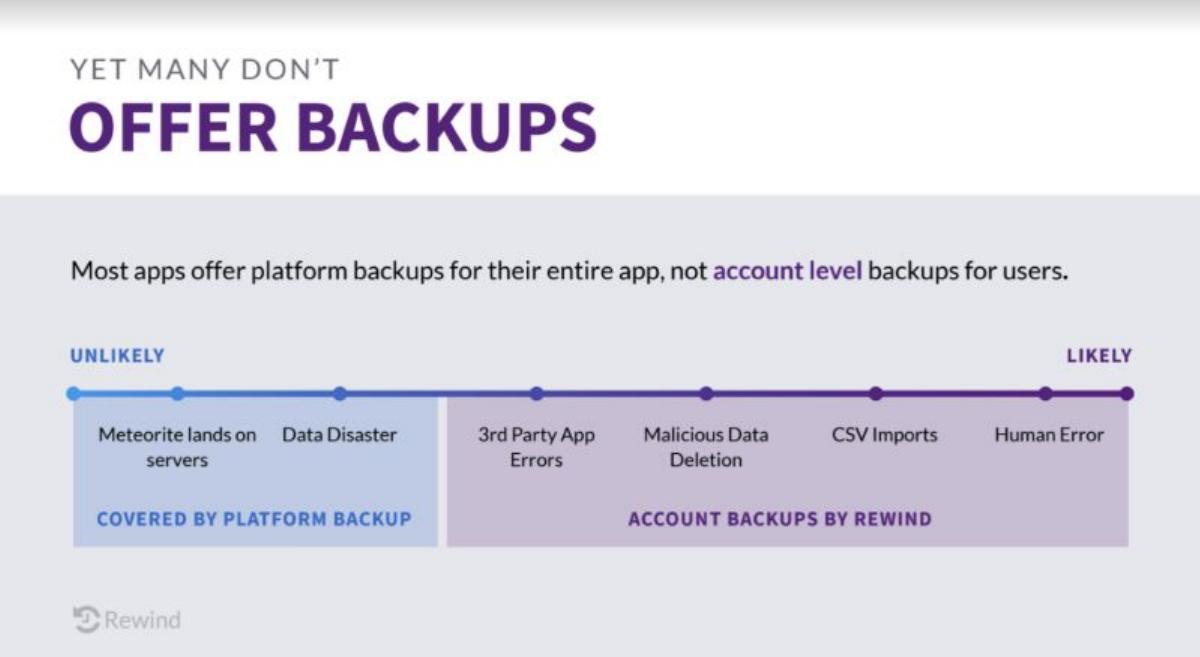
- The deck identifies a critical market gap: SaaS platforms protect their own servers, but not individual user accounts (Slide 4).
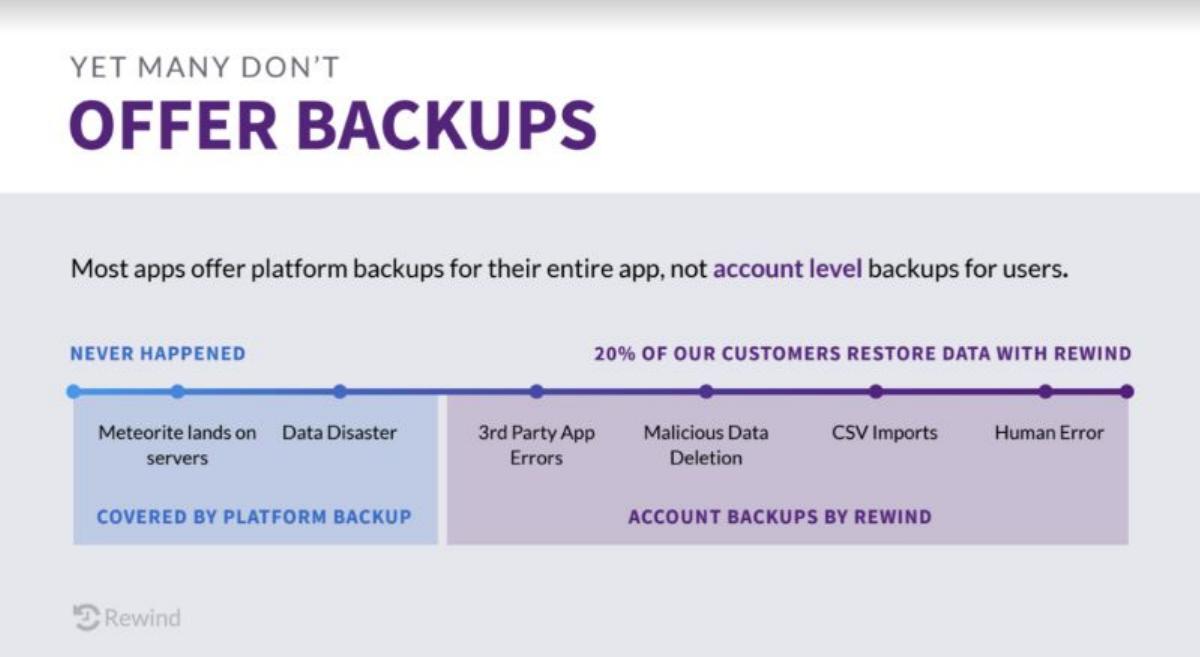
- Rewind claims that 20% of their customers have already had to restore data, proving the frequency of the problem (Slide 5).
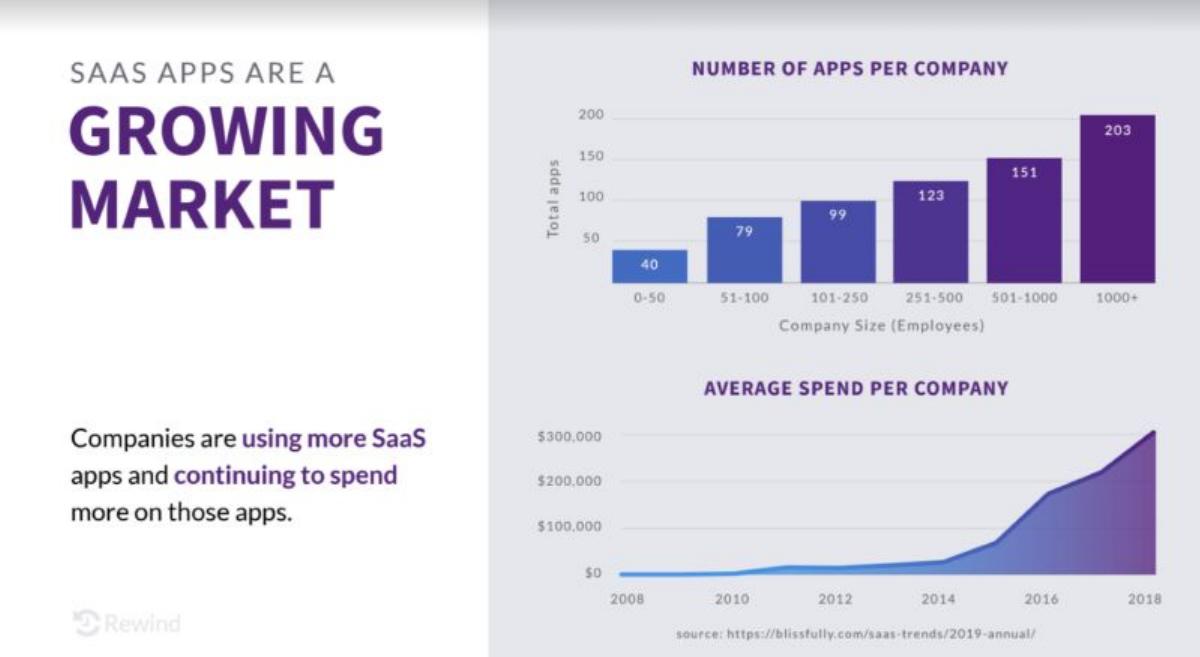
- The market size is supported by data showing companies with 1000+ employees use an average of 203 apps (Slide 3).
- The business model is clearly segmented into E-commerce ($3 to $299/month) and Accounting ($9/account/month) (Slide 8).
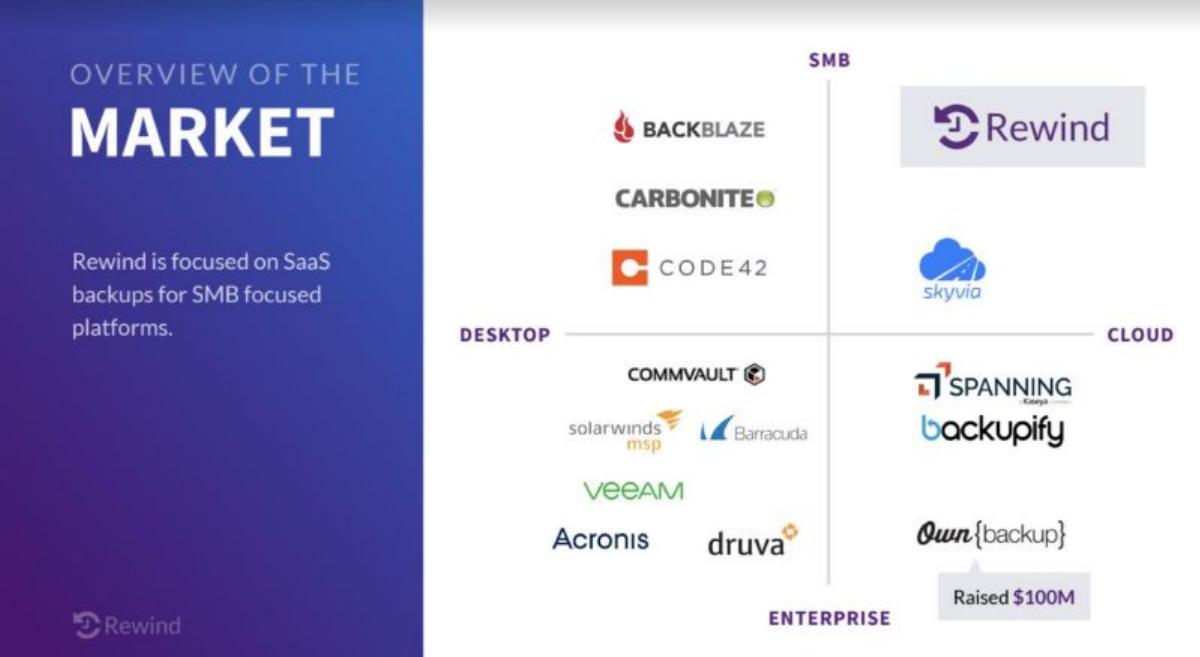
- Competitive positioning places Rewind uniquely in the SMB + Cloud quadrant, away from enterprise-heavy competitors like OwnBackup (Slide 6).
- The team slide emphasizes deep experience, including a CEO with 20+ years in development and product management (Slide 9).
- The company leverages regional and industry recognition, including being named the 49th fastest-growing company in Canada (Slide 10).
- The deck omits a specific funding 'Ask' or a breakdown of how the $15M will be deployed (Slide 12).
The Narrative of the Unseen Risk
Rewind’s 2021 Series A deck is built on a simple, powerful premise: your SaaS data is not as safe as you think it is. In 13 slides, the company moves from a broad mission to a specific market failure, positioning themselves as the only logical insurance policy for small and medium-sized businesses (SMBs) living in the cloud. This teardown explores how they used a $15M round to turn a technical utility into a must-have business continuity category.
Slide 1: Title Slide
The deck opens with a clean, professional image of a user working on a laptop, immediately grounding the product in a real-world business context. The subtitle, "BACKUPS FOR SAAS," is a direct value proposition. It identifies the 'what' (backups) and the 'where' (SaaS) without unnecessary jargon. Mike Potter, CEO, is the only name listed, establishing clear leadership from the outset.
Slide 2: The Rewind Mission
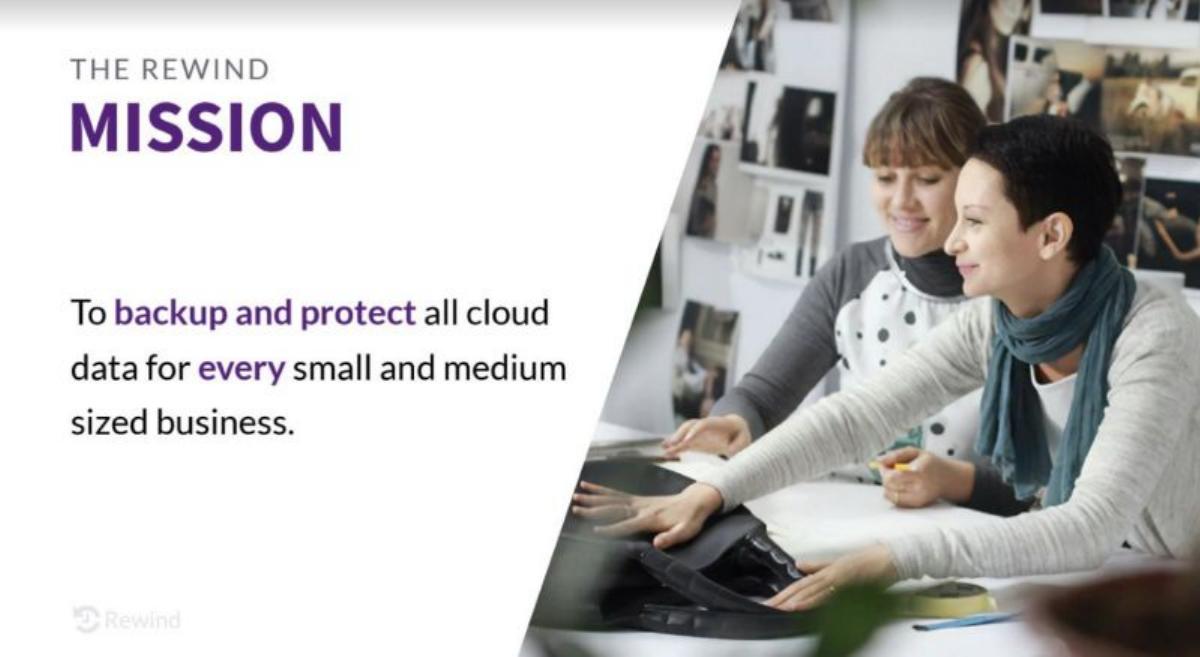
The mission statement is ambitious yet focused: "To backup and protect all cloud data for every small and medium sized business." By specifying "small and medium sized business," Rewind avoids the trap of trying to be everything to everyone. This focus is a recurring theme throughout the deck and serves as a strategic moat against enterprise-focused giants.
Slide 3: SaaS Apps are a Growing Market
This slide provides the macro-economic justification for Rewind's existence. Using data from Blissfully, it shows two key trends: the number of apps per company and the average spend per company. Notably, it highlights that companies with 1000+ employees use 203 apps on average (Slide 3). The 'Average Spend Per Company' graph shows an exponential curve starting around 2014, suggesting that the problem Rewind solves is getting more expensive and complex every year.
Slide 4 & 5: The Market Gap and Customer Proof
These two slides are the 'Aha!' moment of the deck. Slide 4 introduces a spectrum of risk. It distinguishes between "Platform Backups" (which cover unlikely events like a meteorite hitting a server) and "Account Backups" (which cover likely events like human error). Slide 5 then overlays a powerful statistic: "20% OF OUR CUSTOMERS RESTORE DATA WITH REWIND." This moves the conversation from a theoretical insurance policy to a practical tool that one in five customers actually uses. It effectively counters the objection that "SaaS platforms already have backups."
Slide 6: Overview of the Market
The competitive matrix is a standard pitch deck staple, but Rewind uses it effectively to carve out a unique quadrant. They plot competitors on two axes: Desktop vs. Cloud and SMB vs. Enterprise. Rewind sits alone in the SMB + Cloud quadrant. They acknowledge heavyweights like OwnBackup but note they raised "$100M" (Slide 6) and focus on the Enterprise, implying that Rewind is the more agile and accessible choice for the smaller market.
Slide 7: Backups are Essential
Social proof is delivered via a testimonial from Julia Friesen at KNIX.com. The quote focuses on "peace of mind" and "confidence." Below the quote, logos for Badgley Mischka, MVMT, Endy, and Knix are displayed. This demonstrates that Rewind is already trusted by recognizable, high-growth e-commerce brands, validating their product-market fit in a specific vertical.
Slide 8: Business Model
The business model is refreshingly transparent. Rewind breaks its revenue streams into two categories:
E-COMMERCE: Based on the number of orders, ranging from $3 to $299 / month . · ACCOUNTING: Based on the number of accounts managed at $9 / account / month .
This slide tells investors that the company has figured out how to price its service across different industries with varying data needs.
Slide 9: Meet Our Team
The team slide emphasizes longevity and domain expertise. CEO Mike Potter is credited with 20+ years in development and product management, while CTO James Ciesielski has 12+ years . The inclusion of a Human Resources Manager (Kirsi Maharaj) and a Director of Technical Operations (Dave North) who holds 4 patents suggests a company that is already scaling its internal operations and protecting its IP.
Slide 10: A List of Awards
This slide serves as a final layer of credibility. It lists several accolades, including being the "49th fastest growing company in Canada" and a 2-time winner of the "Employees' Choice Awards" (Slide 10). For a Series A investor, these awards signal that the company is not just growing, but is also a stable and attractive place for talent.
Slide 11: Core Values
While often considered 'fluff' in early-stage decks, the Core Values slide here (including "Delight Our Customers" and "Be Comfortable Being Uncomfortable") suggests a mature corporate culture. In a Series A context, investors are looking for a team that can transition from a scrappy startup to a structured organization.
Slide 12 & 13: Closing and Contact
The deck ends with a simple "Thank You" and the CEO's email address. It is important to note what is missing here: there is no slide detailing the $15M ask, the valuation, or the specific milestones they intend to hit with the new capital. While this information is often handled in the verbal pitch or a separate data room, its absence in the primary deck is a notable omission for a teardown.
What Works in This Deck
The Problem Distinction: Differentiating between platform-level and account-level backups is the strongest part of the deck. It educates the investor while simultaneously creating a market for the product. · Vertical Specificity: By showing different pricing models for E-commerce and Accounting, Rewind proves they understand the nuances of their target customers. · The '20%' Stat: Quantifying the frequency of data restoration (Slide 5) turns a boring utility into a high-frequency necessity.
What is Missing
The Ask: There is no mention of how much money is being raised or what it will be used for (e.g., hiring, new integrations, international expansion). · Financial Performance: For a Series A, investors typically expect to see a slide on MRR growth, churn rates, or Customer Acquisition Cost (CAC). This deck relies entirely on market potential and social proof rather than hard financial metrics. · Product Roadmap: The deck mentions E-commerce and Accounting, but doesn't explicitly state which SaaS platforms they plan to tackle next (e.g., CRM, HRIS, or Creative suites).
What Founders Should Copy
The Competitive Quadrant: If you are entering a crowded market, use the axes to find a 'lonely' quadrant where you are the clear leader for a specific segment (Slide 6). · The 'Likely vs. Unlikely' Risk Chart: This is a brilliant way to visualize why your product is necessary even if a 'good enough' solution already exists (Slide 4). · Clear Pricing: Don't hide your business model. Showing simple, scalable pricing tiers builds trust and demonstrates a path to revenue (Slide 8).
Frequently asked questions
- What is the core problem Rewind is solving?
- Rewind addresses the 'Shared Responsibility Model' in SaaS. While cloud providers like Shopify or QuickBooks ensure their platforms stay online, they generally do not offer granular restoration for individual user errors, malicious deletions, or bad CSV imports. Rewind provides account-level backups that allow users to undo specific mistakes without needing a platform-wide rollback.
- How does Rewind differentiate itself from competitors like OwnBackup or Carbonite?
- According to Slide 6, Rewind differentiates through its target market and environment. While competitors like OwnBackup focus on the Enterprise Cloud space and companies like Carbonite focus on Desktop backups for SMBs, Rewind positions itself specifically as the Cloud backup leader for the SMB segment.
- What are the specific pricing tiers mentioned in the deck?
- The business model on Slide 8 shows two primary tracks. For E-commerce, pricing is based on order volume, ranging from $3 to $299 per month. For Accounting, the model is a flat $9 per account per month. This suggests a scalable, usage-based approach tailored to the specific data density of different industries.
- Is there evidence of product-market fit in the deck?
- Yes, Slide 5 states that 20% of their customers have used the service to restore data, indicating high utility. Furthermore, Slide 7 features a testimonial from Julia Friesen at KNIX.com, and Slide 10 lists several growth awards, including being one of Deloitte’s 'Companies to Watch' in 2019.
- What critical fundraising information is missing from the slides?
- The deck is notably missing an 'Ask' slide detailing the amount being raised and the intended use of funds. It also lacks a 'Roadmap' slide showing future product integrations or a 'Financials' slide with historical revenue growth or CAC/LTV metrics, which are standard for a Series A pitch.