Richpanel’s 2020 seed deck is a concise, 10-slide presentation that leans heavily into problem validation and product solutioning. Rather than leading with market size or founder pedigree, the deck focuses on the granular inefficiencies of customer support agents, citing a Gartner study to show that 24.10% of productivity loss stems from system interaction. The narrative centers on reducing the '7-8 screens' agents typically use to a single dashboard integrated with e-commerce data. While the deck successfully communicates a clear value proposition—eliminating 60% of tickets through self-serv…
Key takeaways
- The deck identifies a specific pain point where agents use 7-8 different screens to perform basic order actions (Slide 2).
- Third-party validation is used effectively, citing a Gartner study of 5,000 reps to prove that reps deal with 8.2 different tools on average (Slide 3).
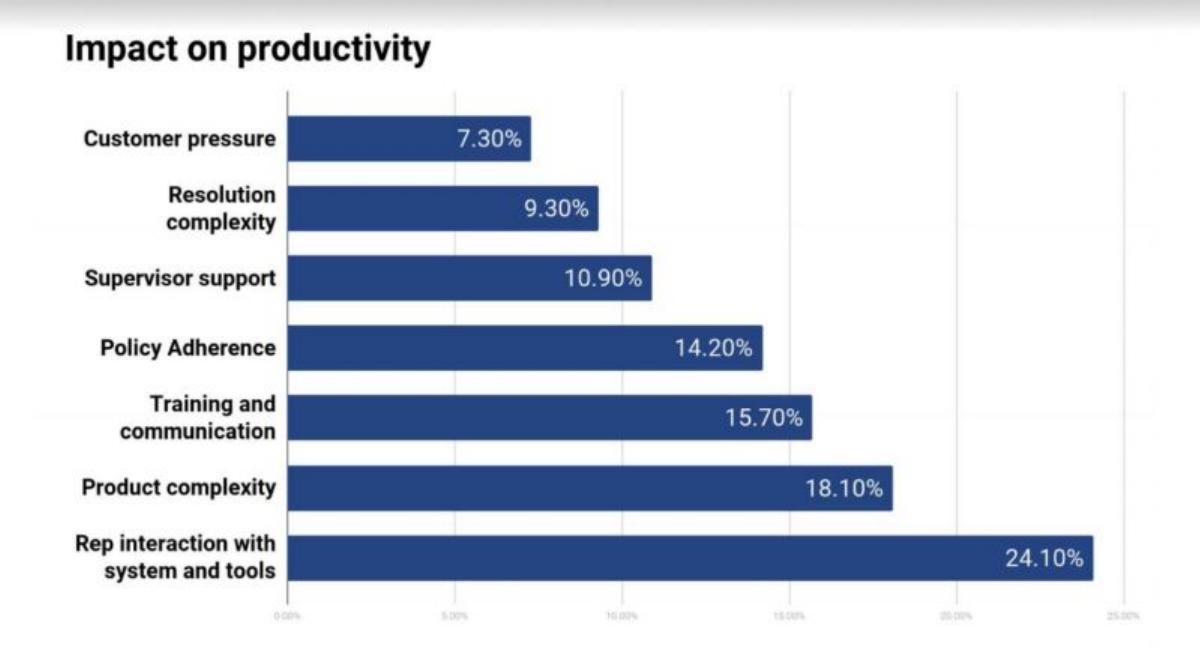
- Productivity loss is quantified, with 'Rep interaction with system and tools' accounting for 24.10% of the impact (Slide 4).
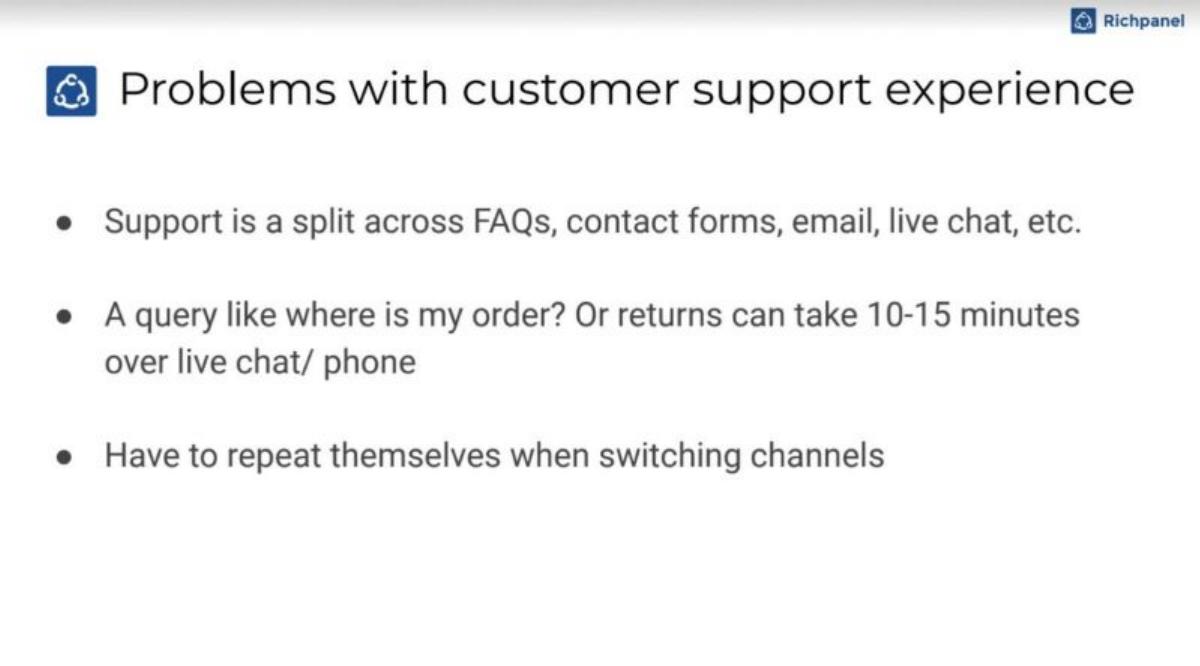
- The solution targets a specific time-sink: reducing the 10-15 minutes it takes to answer 'where is my order?' queries (Slide 5).
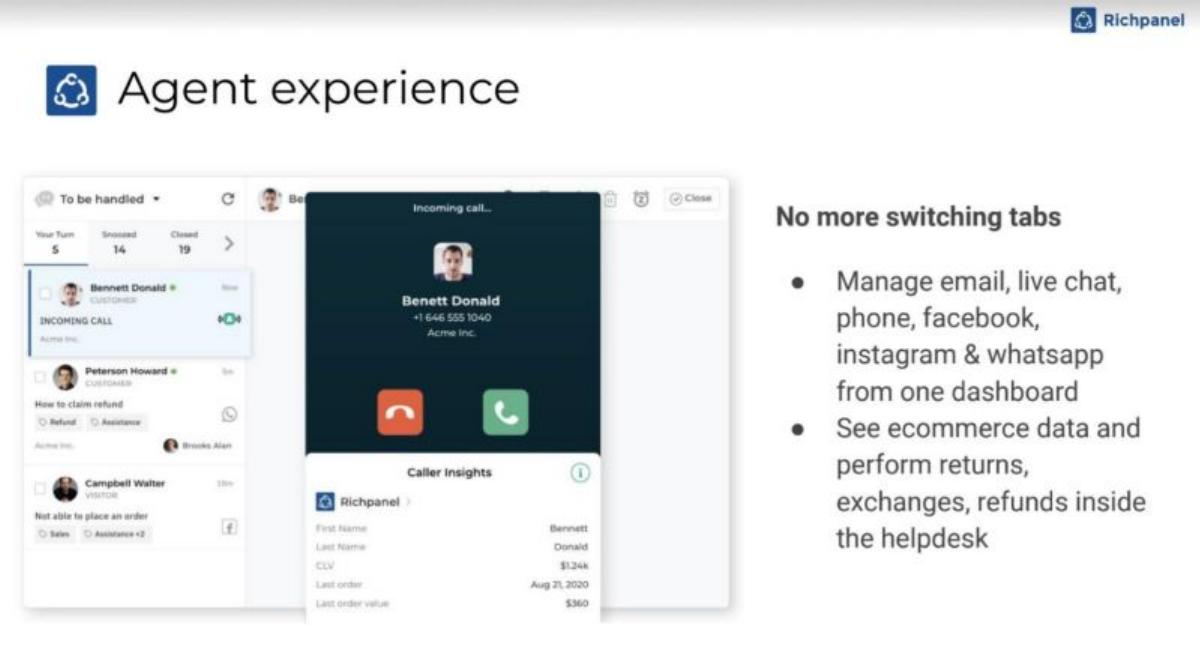
- The product UI is showcased to demonstrate a 'no more switching tabs' workflow that integrates email, live chat, and social media (Slide 6).
- Richpanel claims their self-service portal can eliminate 60% of support tickets by automating returns and exchanges (Slide 7).
- The deck completely omits a team slide, leaving the founders' backgrounds and expertise unknown to the reader.
- There is no mention of current revenue, growth metrics, or the specific dollar amount being raised in this round.
The Product-First Approach to E-commerce Support
Richpanel’s seed deck is a study in narrow focus. In an era where many SaaS decks attempt to claim they are the 'operating system' for an entire industry, Richpanel stays firmly rooted in the specific frustrations of the helpdesk agent. The deck, used to raise a $2M seed round in 2020, is remarkably short at only 10 slides, one of which is a title slide and another an external resource slide. By focusing on the 'Life of a customer support agent,' the founders attempt to build empathy with the investor before showing the solution.
Slide 1: Title Slide
The deck opens with a simple value proposition: Effortless Customer Service Starts Here. The visual features a mobile device showing a 'Helpcenter' interface. This immediately signals that the company is focused on the end-user experience (the customer) as much as the backend (the agent).
Slide 2: The Problem - Agent Frustration
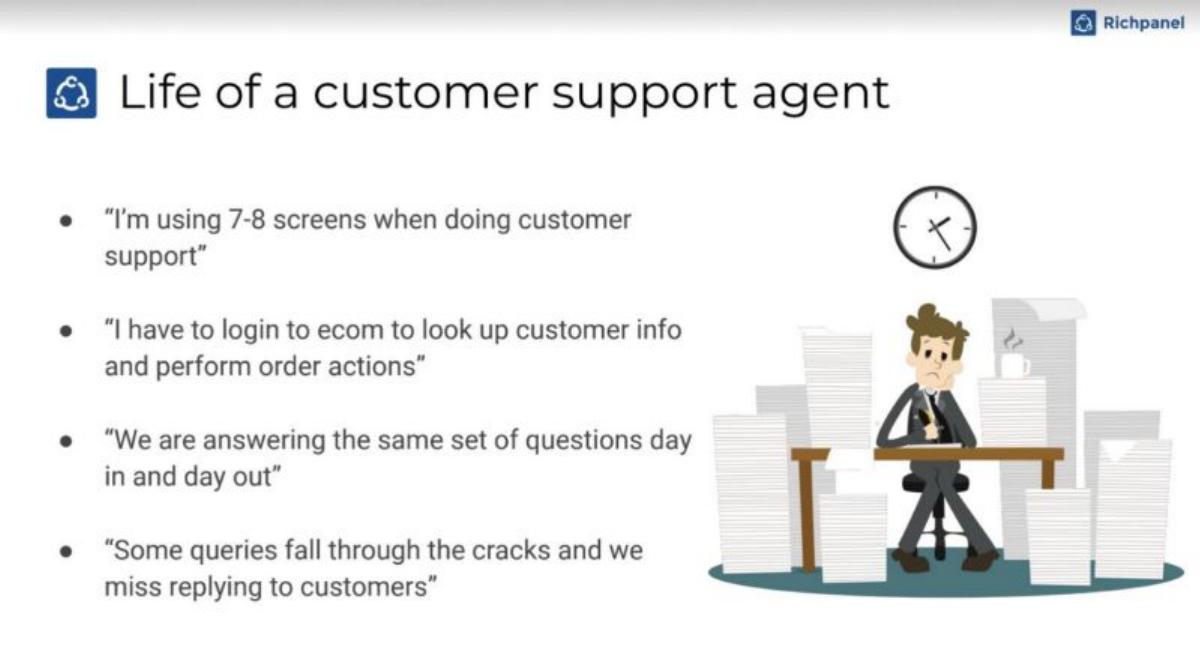
Slide 2, titled Life of a customer support agent , uses bullet points to describe a chaotic workflow. It highlights that agents use 7-8 screens, must log in to e-commerce platforms separately to perform order actions, and frequently answer the same repetitive questions. This slide sets the stage for a 'consolidation' play, suggesting that the current toolset is fragmented and inefficient.
Slide 3: External Validation via Gartner
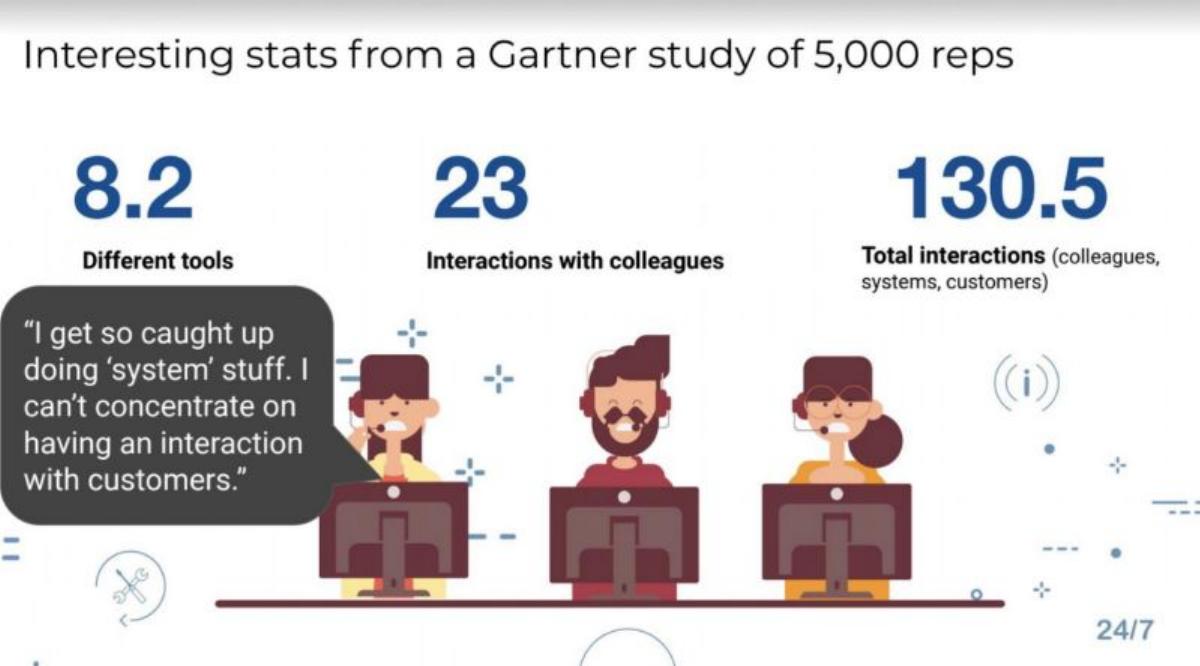
To move from anecdotal evidence to market reality, Slide 3 cites a Gartner study of 5,000 reps . It presents three key metrics: 8.2 different tools used, 23 interactions with colleagues, and 130.5 total interactions per day. A speech bubble quote—'I get so caught up doing system stuff. I can't concentrate on having an interaction with customers'—humanizes the data. This is a strong use of third-party data to validate that the problem identified on the previous slide is a widespread industry standard.
Slide 4: Quantifying Productivity Impact
Slide 4 provides a bar chart showing the Impact on productivity . It ranks various factors, with 'Rep interaction with system and tools' at the bottom (meaning the largest impact) at 24.10%. This is higher than product complexity (18.10%) or training (15.70%). By quantifying the problem, Richpanel makes a financial case for their software: if you solve the tool fragmentation, you reclaim nearly a quarter of your labor costs.
Slide 5: The Customer Experience Gap
While the previous slides focused on the agent, Slide 5 shifts to the Problems with customer support experience . It notes that support is split across FAQs, email, and chat, and that a simple 'where is my order?' query takes 10-15 minutes. This slide bridges the gap between agent inefficiency and customer dissatisfaction, showing that the current system fails both sides of the transaction.
Slide 6: The Solution - Unified Agent Experience
Slide 6 introduces the Agent experience within Richpanel. The key takeaway is 'No more switching tabs.' The slide shows a dashboard where email, live chat, phone, and social media (Facebook, Instagram, WhatsApp) are integrated. Crucially, it mentions that agents can 'perform returns, exchanges, refunds inside the helpdesk.' This is the 'aha' moment of the deck—moving from a communication tool to a transactional tool.
Slide 7: The Self-Service Vision
Slide 7, Amazon-like customer experience , presents the most aggressive claim in the deck: Eliminate 60% of your tickets. It argues that 60-80% of e-commerce tickets are repetitive. By allowing customers to track orders and handle returns themselves through a mobile-optimized interface, the company promises 'instant resolution' and increased CSAT (Customer Satisfaction) scores. This is a powerful value prop for e-commerce brands looking to scale without linearly increasing their support headcount.
Slide 8: Transition Slide
Slide 8 is a simple blue break slide titled About Richpanel . In a standard deck, this would usually lead into the team, the company history, or the traction metrics.
Slide 9: Call to Action and Social Proof
Instead of a team or financial slide, Slide 9, See it in action , provides a link to a 5-minute platform demo and a link to G2 reviews. While providing a demo is helpful, using a slide for this in a 10-slide deck usually indicates that the deck is intended to be sent ahead of a meeting rather than presented live. The inclusion of the G2 link serves as a proxy for traction and customer validation.
Slide 10: BestPitchDeck.com Attribution
The final slide is an attribution slide for the source of the deck and does not contain company information.
What Richpanel Does Well
Richpanel excels at problem definition . Many founders struggle to explain why their specific SaaS niche matters, but Richpanel uses a combination of agent empathy and hard Gartner data to prove that the 'tab-switching' problem is a multi-million dollar productivity drain. By the time the investor sees the product on Slide 6, the need for it has been thoroughly established.
The deck also does a great job of quantifying the value proposition . The claim that 24.10% of productivity is lost to tool interaction and that 60% of tickets can be eliminated provides a clear ROI (Return on Investment) framework for a potential buyer or investor. They aren't just selling 'better chat'; they are selling 'labor efficiency.'
What is Missing from the Richpanel Deck
Despite raising $2M, this specific deck is missing several elements that are considered 'mandatory' in modern fundraising:
Team Slide: There is no mention of who is building this. Investors at the seed stage generally invest in people first. The lack of a team slide is a glaring omission. · Traction and Revenue: There are no charts showing MRR (Monthly Recurring Revenue), customer growth, or churn rates. While the G2 link implies customers exist, the lack of hard numbers makes it difficult to judge the company's momentum. · Market Size (TAM): The deck does not address the Total Addressable Market. While e-commerce support is a large category, investors need to see that the founders understand the scale of the opportunity. · Competition: The helpdesk space is crowded with giants like Zendesk, Gorgias, and Intercom. Richpanel does not explain how they specifically win against these incumbents beyond the 'Amazon-like' self-service feature. · The Ask: A fundraising deck should tell the investor how much money is needed and what it will be used for (e.g., 'Raising $2M to expand the engineering team and launch outbound sales').
Founder's Summary
If you are a founder in a crowded SaaS space, copy Richpanel’s use of third-party data . Citing a reputable source like Gartner to validate your problem statement adds immediate credibility. However, do not follow their lead in omitting the team and traction slides. Unless you are a multi-time successful exit founder whose name precedes you, you must sell your team's unique ability to execute on the vision. Richpanel's deck is a great 'Product Teaser,' but it requires a significant amount of verbal context or a secondary 'Data Room' to be a complete investment case.
Frequently asked questions
- What is the primary problem Richpanel aims to solve?
- Richpanel focuses on the inefficiency of the customer support agent experience, specifically in e-commerce. According to Slide 2 and Slide 3, agents are overwhelmed by using 8.2 different tools and 7-8 different screens to handle one customer. This fragmentation leads to 24.10% of productivity being lost to 'system and tool' interactions rather than actual customer service.
- How does Richpanel plan to reduce the volume of support tickets?
- On Slide 7, the company introduces an 'Amazon-like customer experience' that allows customers to perform self-service actions. By providing a portal where users can track orders, exchange items, or request refunds without an agent, Richpanel claims it can eliminate 60% of total support tickets, which are typically repetitive in nature.
- Does the deck provide any information on the founding team?
- No. The 10-slide deck provided does not include a team slide. There is no information regarding the founders' names, previous professional experience, or technical expertise. This is a significant omission for a seed-stage deck where team quality is usually a primary factor for investors.
- What market data does Richpanel use to validate their claims?
- Richpanel relies on a Gartner study of 5,000 representatives to validate the problem. Slide 3 and Slide 4 use this data to show that reps have 130.5 total interactions daily across systems and colleagues, and that product complexity and tool interaction are the largest drains on agent productivity.
- What is the 'Ask' in this pitch deck?
- The deck does not include a formal 'Ask' slide. It does not state the amount of capital being raised, the valuation, or the intended use of funds. Instead, Slide 9 directs potential investors to a YouTube demo and G2 reviews, suggesting this version of the deck may be intended as an introductory teaser.