The BRD pitch deck is a masterclass in using existing B2C traction to justify a high-margin B2B expansion. Founded in 2015, the company used this 23-slide presentation to seek up to $50 million in growth capital. At the time of the deck, BRD boasted $6 billion in assets under protection and a presence in over 170 countries. The narrative centers on 'Blockset,' their enterprise API designed to reduce blockchain development costs by 50%. By showcasing a shrinking CAC and an LTV that accelerated with each new cohort, BRD presented a mathematically sound argument for scaling. The deck successfull…
Key takeaways
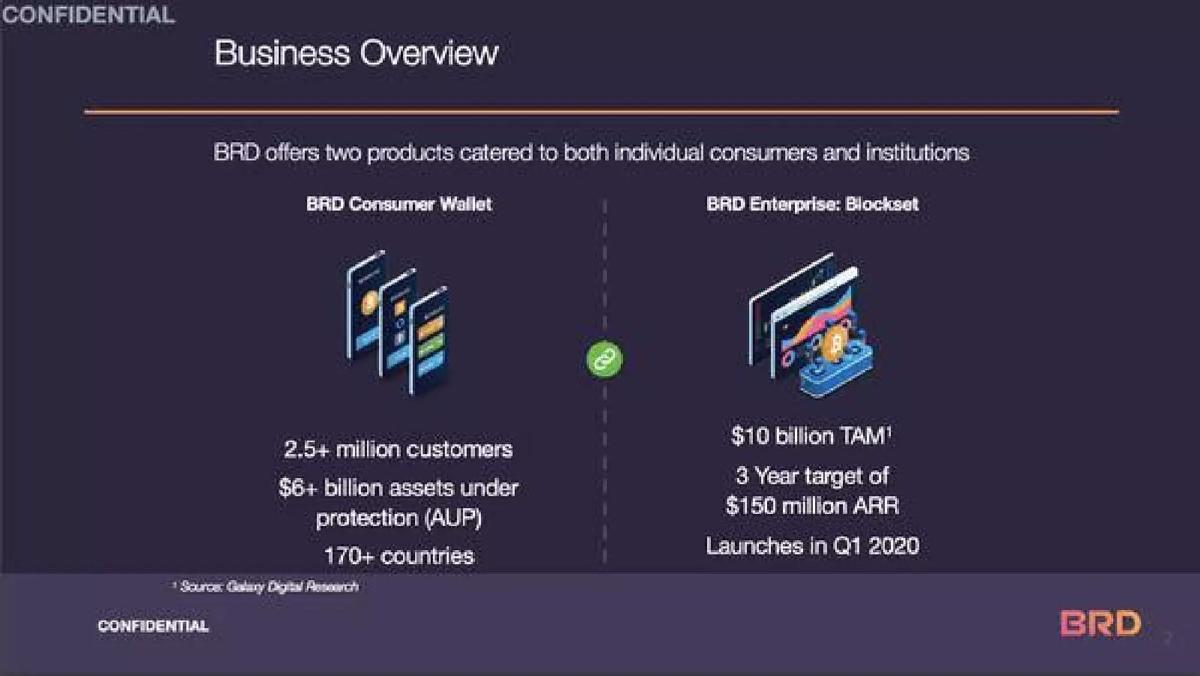
- BRD reported over $6 billion in assets under protection (AUP) across 2.5 million customers on slide 2.
- The company set an ambitious three-year target of $150 million ARR for its enterprise product, Blockset, as stated on slide 2.
- Revenue per user saw a significant 600% increase, rising from $2.44 to $17.03 between January 2018 and June 2019, according to slide 14.
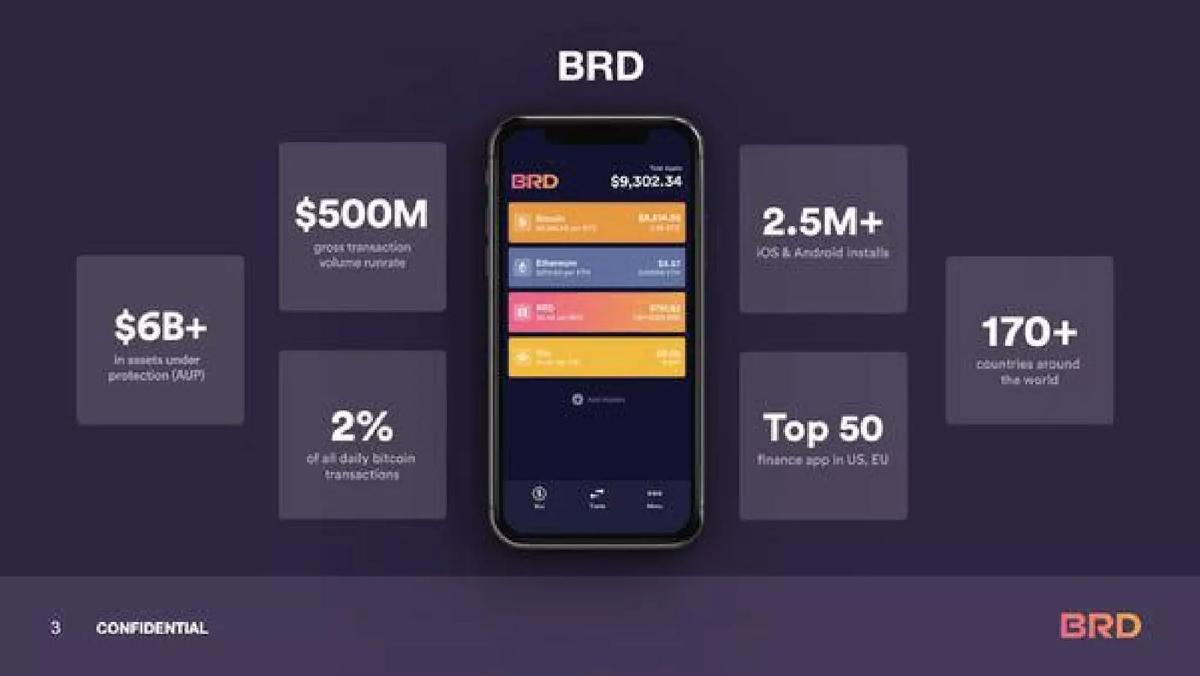
- The deck claims BRD handled 2% of all daily bitcoin transactions globally by the time of the presentation, shown on slide 3.
- Blockset was positioned to save enterprises over 50% on development costs and accelerate time-to-market by 75%, as detailed on slide 13.
- The financing slide (22) reveals a previous capital structure of $23M in equity and a $32M token sale.
- User acquisition costs (CAC) were projected to fall below LTV within six months of the deck's publication, illustrated on slide 16.
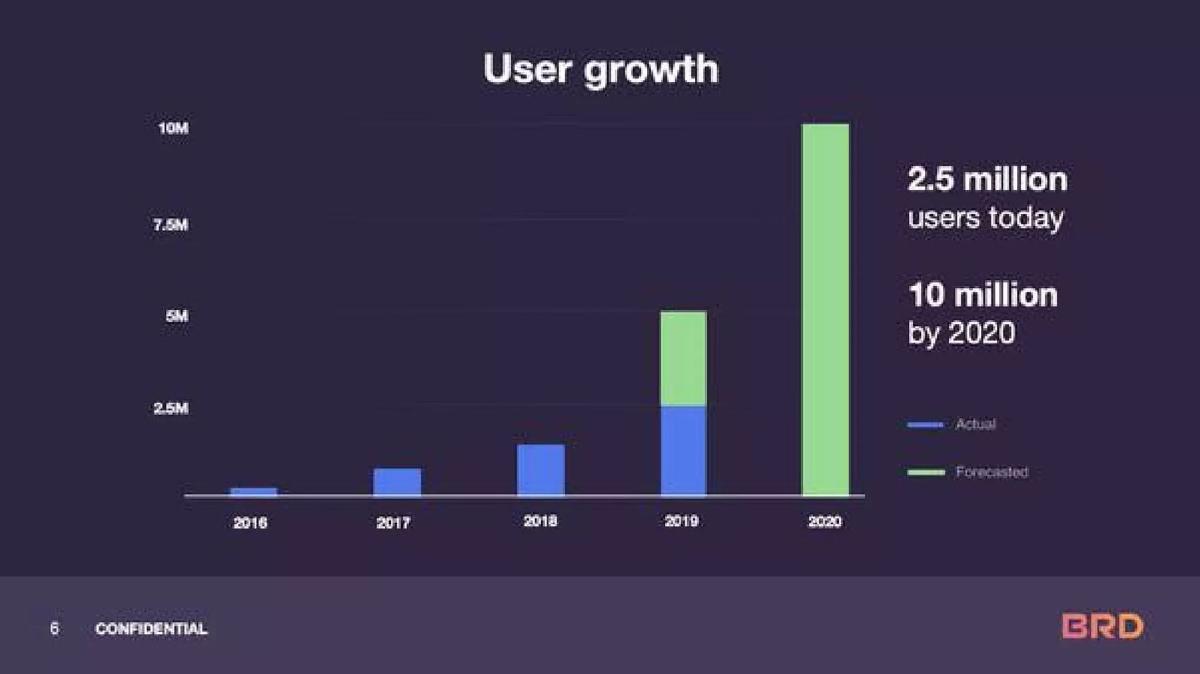
- The roadmap on slide 18 targets $1 billion in transaction volume and 10 million users by the end of 2020.
Executive Summary and The Dual-Product Strategy
The BRD pitch deck opens with a clear, high-level overview of a company that has already achieved significant scale. Unlike early-stage decks that sell a dream, this deck sells a proven engine. Slide 2, titled Business Overview , immediately bifurcates the company into two distinct value propositions: the BRD Consumer Wallet and BRD Enterprise (Blockset). This is a strategic move to show investors that while they have a massive, active consumer base (2.5+ million customers), they are also targeting a $10 billion TAM in the enterprise sector with a target of $150 million in ARR.
Slides 1-3: The Hook and The Traction
Slide 1 is a minimalist title slide featuring the logo and the tagline "Move your money forward." Slide 2 sets the stage for the entire presentation by contrasting the consumer side ($6+ billion assets under protection) with the enterprise side (launching Q1 2020). By slide 3, the deck hits the investor with a "wall of traction." It lists six key figures: $6B+ in assets under protection, $500M gross transaction volume runrate, 2% of all daily bitcoin transactions, 2.5M+ installs, presence in 170+ countries, and a Top 50 finance app ranking. This establishes immediate credibility; the founders aren't asking for money to build a product, but to pour fuel on an existing fire.
Slides 4-8: Consumer Growth and Market Resilience
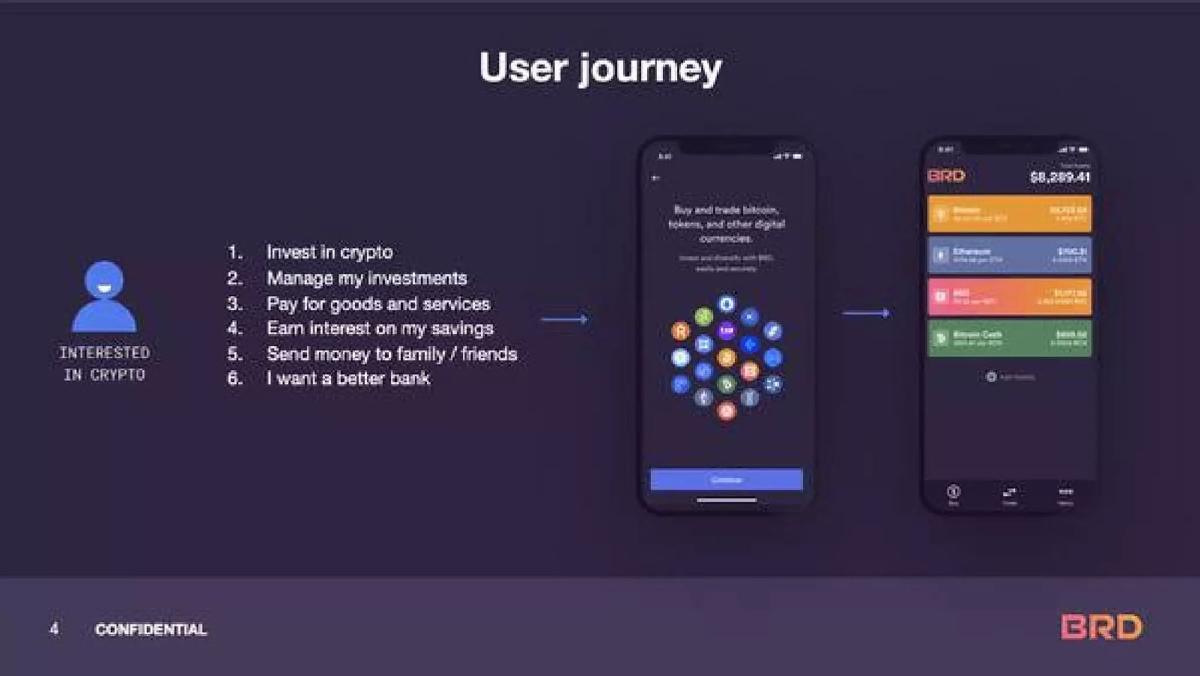
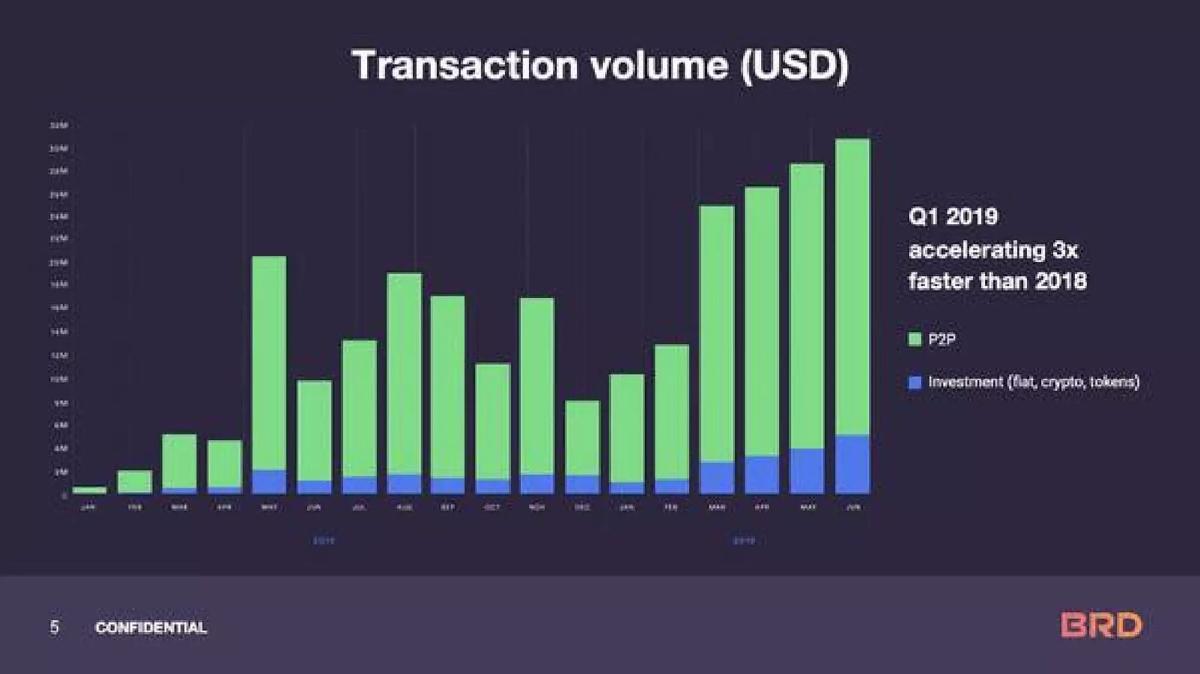
Slide 4 outlines the User Journey , listing six reasons people use the app, ranging from investing in crypto to wanting a "better bank." This slide is light on text but uses mobile mockups to show the UI/UX. Slide 5 introduces Transaction Volume (USD) , showing a bar chart where Q1 2019 is accelerating 3x faster than 2018. The chart distinguishes between P2P and Investment (fiat, crypto, tokens), showing a healthy mix of activity.
Slide 6 and 8 are identical User Growth charts, showing a steep climb from 2016 to a forecasted 10 million users by 2020. Slide 7 is one of the most important in the deck: Active Users . It overlays active user growth against the Bitcoin price. While the price of Bitcoin fluctuated wildly in 2018, BRD's active users continued to climb. The slide explicitly compares BRD to a major competitor, stating "Coinbase grew 67% in 2018" while "BRD grew 116%." This suggests that BRD's user base is stickier and less dependent on market hype than the industry leader.
Slides 9-13: The Pivot to B2B (Blockset)
Slide 9 provides an Industry Timeline , positioning 2014-2017 as the B2C era and 2019 onwards as the B2B era. This justifies the launch of Blockset. Slide 10 introduces the B2B business , describing it as a "unified data layer for any blockchain application." The most significant piece of evidence here is the mention of SBI Holdings, a large Japanese bank, as the first signed client. This is a massive validation point for a startup moving into the enterprise space.
Slides 11, 12, and 13 dive into the specifics of Blockset . Slide 12 breaks the product down into three components: Wallet Kit, BlockchainDB, and ChainOps. Slide 13 presents the Value Proposition in a clear "Customer Challenges vs. Blockset Solutions" format. It claims Blockset saves over 50% on development costs and allows companies to get to market 75% faster. These are quantifiable benefits that appeal to enterprise buyers and the investors who fund the sales cycles to reach them.
Slides 14-16: Unit Economics and Profitability Path
This section is the "math" of the deck. Slide 14, Key Metrics , shows three critical growth figures between Jan 2018 and June 2019: Monthly Active Users grew 303% (40k to 161k), Revenue Per User grew 600% ($2.44 to $17.03), and Volume Per User grew 292% ($488 to $1,917.28). These are impressive numbers that suggest the company is learning how to monetize its users more effectively as it matures.
Slide 15, User Lifetime Value , shows cohort analysis. Each successive cohort (represented by different colored lines) has a steeper LTV curve than the one before it. This proves that the product is getting better at extracting value over time. Slide 16, Acquisition cost of paying users , shows the intersection of CAC and LTV. The projected CAC-3 is shrinking fast and was expected to be lower than LTV within six months. This is the "holy grail" chart for growth investors, showing that the business model is becoming sustainable.
Slides 17-20: Future Vision and Brand
Slide 17, Your money app , shows a mobile device surrounded by features. It splits these into "Today" (Invest, Manage, Pay) and "Tomorrow" (Direct deposit, ATM card, Stocks, Lending). This illustrates the roadmap toward becoming a full-service neobank. Slide 18 is a more formal Roadmap , showing transaction volume targets and feature releases through H2 2020, ending with a $1B transaction volume goal.
Slide 19 covers Architecture , emphasizing that the app is "fully decentralized" and "non-custodial," which are key selling points in the crypto space for security-conscious users. Slide 20, Broad adoption is beyond demographics, it's generational , is a lifestyle slide featuring high-quality photography and the word "Untethered." This is the only slide that leans into emotional branding rather than hard data.
Slides 21-23: The Team and The Ask
Slide 21, Team BRD , shows the leadership. It lists three co-founders (Adam Traidman, Aaron Voisine, Aaron Lasher) and other C-suite members. The bottom of the slide features logos for Apple, Facebook, Alibaba, Google, and Amazon, indicating the pedigree of the 40+ employees. Slide 22, Financing , is the final data point. It notes $23M in equity and $32M in a token sale already raised. The "Current round" is listed as "Up to $50M in growth capital." It also lists notable investors like Liberty City Ventures and East Ventures. Slide 23 is a repeat of the title slide.
What Works in the BRD Pitch Deck
1. Data-Driven Narrative: The deck is exceptionally heavy on metrics. By including cohort analysis (Slide 15) and CAC vs. LTV projections (Slide 16), BRD proves they have a deep understanding of their business's unit economics. This is far more persuasive to growth-stage investors than vague market size claims.
2. The B2C to B2B Bridge: The deck successfully argues that their consumer success is the proof of concept for their enterprise product. By mentioning a major bank (SBI Holdings) as a client, they bridge the gap between being a "crypto app" and a "fintech infrastructure provider."
3. Competitive Context: Slide 7's comparison to Coinbase is a bold and effective way to show that they are outperforming the market leader in terms of growth percentage, even during a bear market. It reframes market volatility as a strength rather than a threat.
What is Missing from the BRD Pitch Deck
1. Detailed Use of Funds: While the deck asks for $50M, it doesn't explicitly break down how that money will be spent. Will it go toward B2B sales teams, consumer marketing, or R&D for the "Tomorrow" features mentioned on Slide 17? A growth round usually requires a more granular spending plan.
2. Regulatory Landscape: Given that the company operates in 170+ countries and is moving into lending and stocks (Slide 17), the deck is surprisingly silent on regulatory compliance and licensing. In the crypto and fintech space, this is often a major hurdle for investors.
3. Detailed Competitor Analysis for Blockset: While they compare the wallet to Coinbase, they don't mention competitors for the Blockset B2B product (like Alchemy or Infura). Investors would want to know how Blockset stacks up against other blockchain infrastructure providers.
What a Founder Should Copy
1. The "Customer Challenges vs. Solutions" Slide: Slide 13 is a perfect template for any B2B product. It identifies the pain point, offers a specific solution, and attaches a quantifiable benefit (e.g., "Save over 50% on development costs").
2. Cohort LTV Visualization: If you have the data, copying the style of Slide 15 is highly recommended. Showing that each new group of users is more valuable than the last is the strongest possible evidence of product-market fit and continuous improvement.
3. Pedigree Logos: Slide 21 uses big-tech logos (Apple, Google, etc.) to validate the team's quality without needing long bios. This is a standard but highly effective way to communicate talent density at a glance.
Conclusion BRD's deck is a sophisticated presentation for a later-stage company. It moves quickly past the "what is crypto" stage and focuses entirely on the "how we make money and scale." By grounding their $50M ask in rigorous unit economics and a clear strategic expansion into B2B, they created a compelling case for growth-stage investment.
Frequently asked questions
- What was the primary goal of this pitch deck?
- The primary goal was to secure up to $50 million in growth capital to scale both the consumer wallet and the newly launched B2B enterprise platform, Blockset. The deck emphasizes the transition from a pure-play consumer app to a diversified infrastructure provider, using the consumer data to prove the reliability of their underlying technology.
- How did BRD demonstrate their market traction?
- BRD used high-level metrics on slide 3, including 2.5 million installs, a top 50 ranking in finance apps in the US and EU, and a presence in 170+ countries. They also included a competitive growth comparison on slide 7, claiming 116% growth compared to Coinbase's 67% in 2018, specifically highlighting their resilience during Bitcoin price fluctuations.
- What is Blockset and why was it central to the pitch?
- Blockset is BRD's B2B offering, described on slides 11 and 12 as a platform to accelerate blockchain product development. It consists of a Wallet Kit, BlockchainDB, and ChainOps. It was central to the pitch because it represented a massive TAM expansion ($10 billion) and a path to high-margin recurring revenue ($150M ARR target) compared to transactional consumer fees.
- What financial data did the deck provide regarding user value?
- Slide 14 and 15 provided granular unit economics. Revenue per user jumped 600% in 18 months, and volume per user grew 292% to $1,917.28. Slide 15 showed that newer cohorts had significantly higher LTV curves than older ones, suggesting that product improvements were successfully driving higher monetization over time.
- Who were the key investors and clients mentioned?
- Slide 22 lists SBI Holdings, Liberty City Ventures, East Ventures, and Saison Ventures as existing backers. Crucially, slide 10 identifies SBI Holdings, a large bank in Japan, as the first signed client for the B2B business, providing essential enterprise validation for their new product line.