The Brandvertisor pitch deck, presented for a Founder Institute Demo Day, introduces a 'Transparency Advertising Marketplace' aiming to address issues in digital advertising. The deck identifies a problem where ad networks mark up costs by 50% and proposes a direct marketplace solution. It features a product demo, highlights competitive advantages for both advertisers and publishers, and outlines a commission-based business model with a fixed 10% fee. Early traction includes 780 subscribers, $350 in direct sales, and 5000 premium publishers. The team slide introduces two co-founders and two a…
Key takeaways
- The company is named Brandvertisor and positions itself as a 'Transparency Advertising Marketplace' (Slide 1).
- The core problem identified is that ad networks mark up costs by 50% (Slide 2, Slide 3).
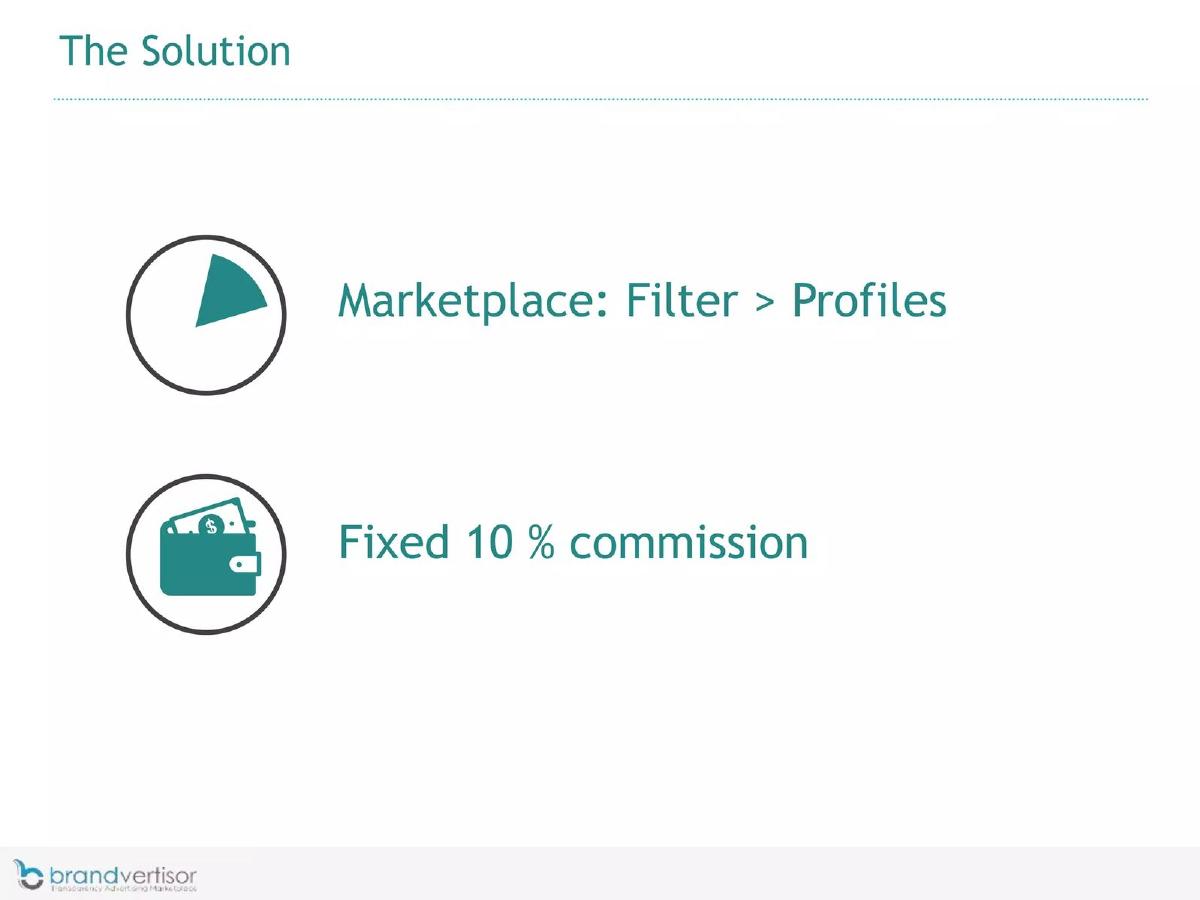
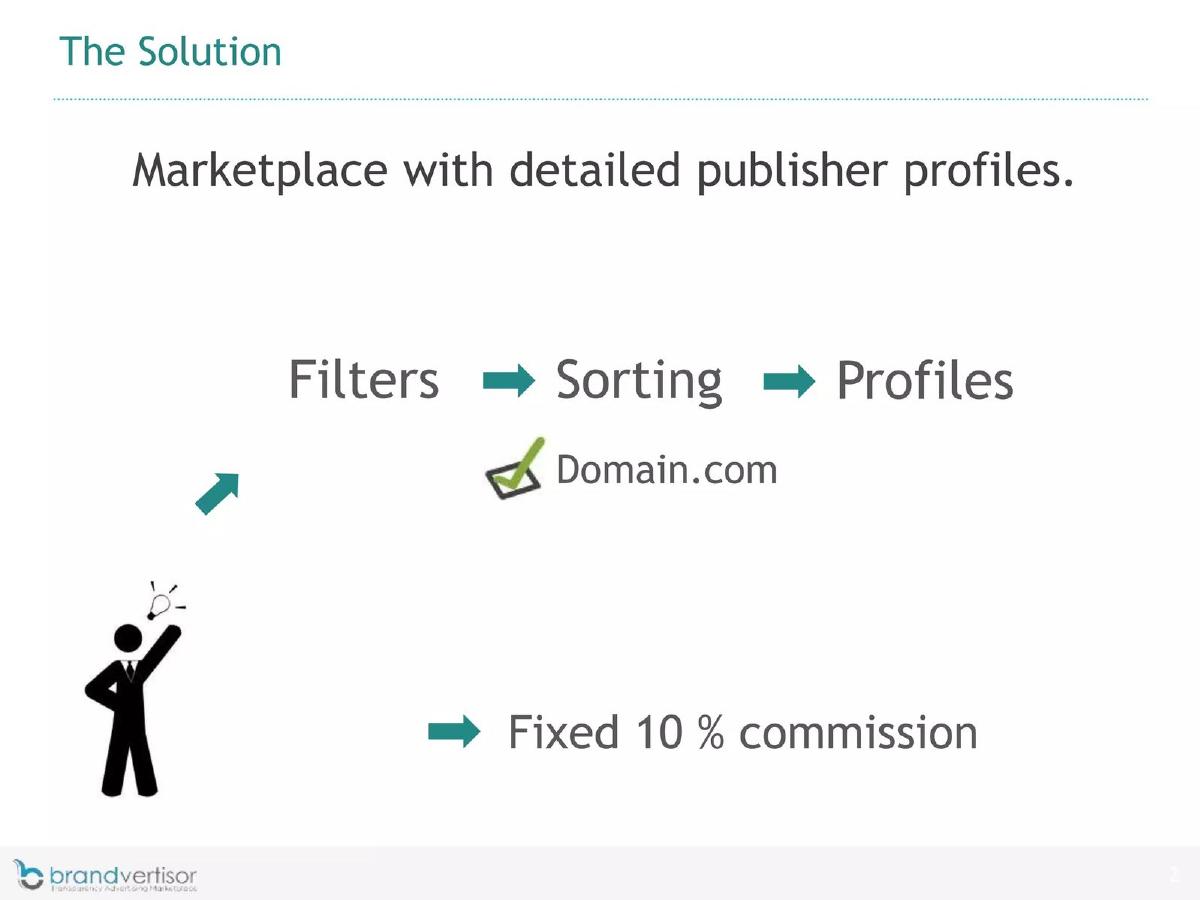
- The product is a marketplace allowing advertisers to search and filter for specific publishers and browse their profiles (Slide 4, Slide 5).
- Competitive advantages include premium publishers, matching filters, and profile statistics for advertisers, and an advertising page, RTB synchronization, and a fixed 10% commission for publishers (Slide 6).
- The business model is commission-based, with a fixed 10% commission, and a breakeven point of 80 paying users per month (Slide 8).
- Traction includes 780 subscribers, $350 in direct sales, and 5000 premium publishers, alongside an 'MVP Clickable Demo' (Slide 9).
- The team consists of Nedko Nedkov (CEO) and Petar Telbiyski (CTO), with an advisory board including Radoy Stoyanov and Eran Eyal (Slide 10).
- The deck provides market validation points, stating '2,7 mm SMBs' spend '$300/month online ads' and '76 % Marketers' used paid advertising in 2015 (Slide 7).
Brandvertisor Pitch Deck Teardown: A Marketplace for Transparent Ad Placement
This teardown analyzes the Brandvertisor pitch deck, presented for a Founder Institute Demo Day. The deck introduces Brandvertisor as a 'Transparency Advertising Marketplace' aiming to disrupt traditional digital advertising models. The analysis will proceed slide-by-slide, detailing the content presented, followed by sections on what works well, what is missing, and key takeaways for other founders.
The deck is composed of 10 slides, which is a partial set of the total 20 slides mentioned in the source listing. This analysis is based solely on the provided slides.
Slide 1: Title Slide
The first slide features the company logo, 'brandvertisor,' prominently displayed in the center. Below the company name, the tagline 'Transparency Advertising Marketplace' is included. The logo itself incorporates a stylized 'b' within a circular graphic element. The overall design is clean, with a white background. The company name and tagline are repeated in a smaller font at the bottom left of the slide, serving as a consistent footer across the deck.
Slide 2: The Problem (Part 1)
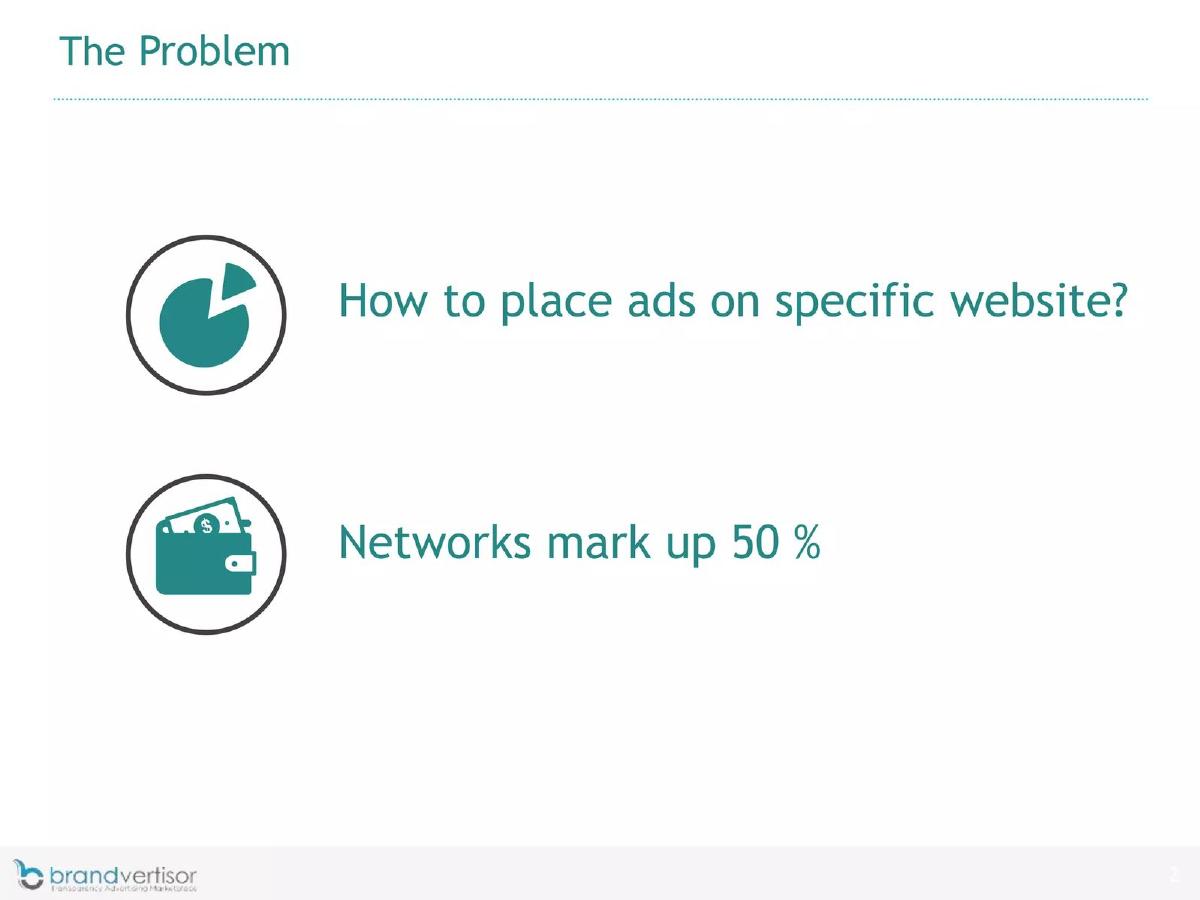
Titled 'The Problem,' this slide presents two key issues in digital advertising, each accompanied by an icon. The first problem, represented by a pie chart icon, is phrased as a question: 'How to place ads on specific website?' The second problem, indicated by a wallet icon with a dollar sign, states: 'Networks mark up 50 %.' This slide concisely introduces the core challenges Brandvertisor aims to address, focusing on transparency and cost efficiency.
Slide 3: The Problem (Part 2)
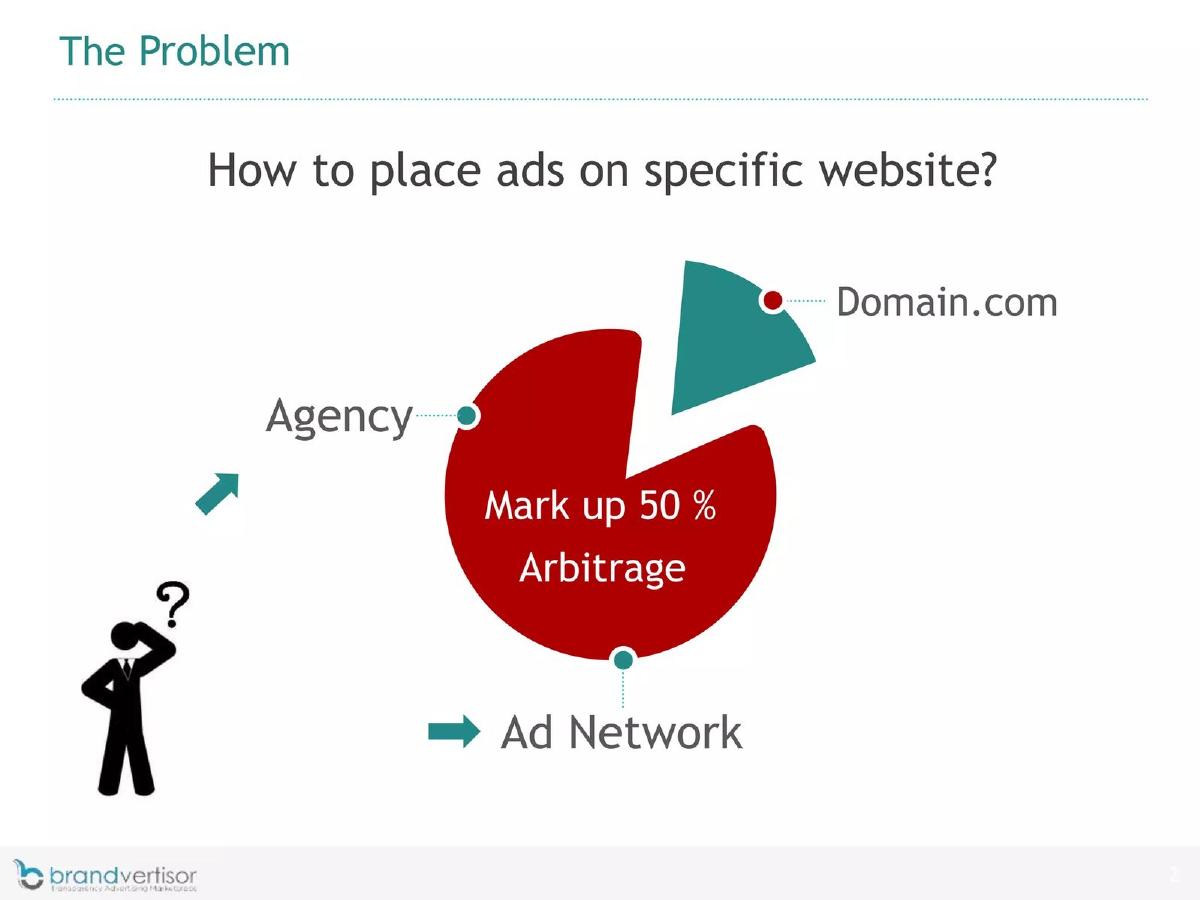
This slide continues the 'The Problem' section, providing a visual elaboration of the issues introduced on the previous slide. It features a large pie chart, where a significant red portion is labeled 'Mark up 50 % Arbitrage.' A smaller green slice is labeled 'Domain.com,' representing the actual website. Arrows point from a stick figure icon labeled 'Agency' and an 'Ad Network' to the pie chart, indicating their involvement in the markup. This visual reinforces the 50% markup by networks and the role of intermediaries, further illustrating the lack of transparency for advertisers seeking to place ads on specific domains.
Slide 4: Product Demo (Search & Filters)
This slide, titled 'Product Demo,' displays a screenshot of what appears to be the Brandvertisor platform interface, presented within a laptop screen graphic. The interface shows navigation tabs for 'PUBLISHERS,' 'MOBILE,' 'NETWORKS,' and 'BRANDS.' A search bar is visible with the prompt 'Describe your target audience,' and an example input 'startup magazines.' Below this, a 'Search' button is present. An arrow points to the search bar area with the text 'Search & Filters,' highlighting this functionality. The screenshot suggests a user-friendly interface for discovering advertising opportunities.
Slide 5: Product Demo (Browse Profile)
Continuing the 'Product Demo,' this slide presents another screenshot of the Brandvertisor platform, again within a laptop graphic. This view shows a detailed profile page for 'Mashable,' with its website 'mashable.com' listed. The profile includes sections for 'Audience' (listing interests like 'Startups, Venture funding,' and 'Accelerators,' and location as 'International'), 'Ratings' (showing 'User Rating: [five green squares]' and 'Alexa 1,091'), and 'Networks' (displaying logos for 'brandvertisor,' 'Google AdWords,' and 'PayPal'). 'Traffic Stats' are also shown, with graphs for 'Monthly Visits: Last 6 Months' from SimilarWeb and 'Monthly Unique Visitors: Last 6 Months' from Quantcast. An arrow points to the 'Ratings' section with the text 'Browse Profile,' emphasizing the detailed information available for publishers.
Slide 6: Competitive Advantages
Titled 'Competitive Advantages,' this slide outlines the benefits Brandvertisor offers to two distinct user groups: Advertisers and Publishers. For 'Advertisers,' three advantages are listed with icons: 'Premium Publishers' (checklist icon), 'Matching Filters' (gears icon), and 'Profile Statistics' (megaphone icon). For 'Publishers,' three advantages are also listed with icons: 'Advertising Page' (checked box icon), 'RTB Synchronization' (network icon), and 'Fixed 10 % Commission' (dollar sign icon). This slide clearly delineates the value proposition for both sides of the marketplace.
Slide 7: Market Validation
This slide, titled 'Market Validation,' presents two statistics to support the market opportunity. On the left, it states '2,7 mm SMBs' with '$300/month online ads,' citing 'BrightLocal.com' as the source. On the right, it notes '76 % Marketers' 'Used paid advertising in 2015,' with 'MarketingLand.com' as the source. These figures aim to quantify the target market and demonstrate the prevalence of paid advertising among marketers.
Slide 8: Business Model
The 'Business Model' slide states 'Commission based: Fixed 10 %.' Below this, three icons with labels further describe the model: 'Commission 10 %' (dollar sign icon), 'Marketplace' (interconnected squares icon), and 'Cross-Monetization' (network icon). At the bottom of the slide, a key metric is provided: 'Breakeven: 80 paying users per month.' This slide clearly defines how Brandvertisor generates revenue and its operational efficiency target.
Slide 9: Traction
Titled 'Traction,' this slide presents a line graph showing growth over time. Key milestones and metrics are highlighted at various points on the graph. These include '$350 Direct Sales' early on, '780 Subscribers' at a mid-point, and '5000 Premium Publishers' later in the timeline. The graph also indicates 'MVP Clickable Demo' at a recent point. The y-axis is not labeled, but the increasing line suggests cumulative growth in an unspecified metric. This slide visually communicates the company's progress and achievements.
Slide 10: Our Team
The final provided slide is 'Our Team.' It introduces two core team members with their photos, names, titles, and brief descriptions. 'Nedko Nedkov' is listed as 'CEO,' with a description 'Co-founder in PPC Network SEO & Marketing' and an email address. 'Petar Telbiyski' is listed as 'CTO,' described as 'Front-end Senior Developer,' also with an email address. Below the core team, an 'Advisory board' section lists two individuals: 'Radoy Stoyanov,' described as 'Marketing Manager Societe Generale Bulgaria,' and 'Eran Eyal,' listed as 'CEO at Springleap Techstars, TEDx.' This slide provides essential information about the leadership and guidance behind Brandvertisor.
What Works Well
The Brandvertisor pitch deck effectively communicates its core value proposition and addresses a clear problem in the digital advertising space. The problem slides (Slide 2 and Slide 3) are concise and impactful, immediately highlighting the 50% markup by ad networks, which is a significant pain point for advertisers. The visual representation of this problem on Slide 3 with the pie chart makes it easily understandable. The product demo (Slide 4 and Slide 5) is well-executed, providing clear screenshots of the platform's functionality, such as search and filters, and detailed publisher profiles. This helps investors visualize the solution and its user experience. Highlighting competitive advantages for both advertisers and publishers on Slide 6 demonstrates a balanced understanding of the marketplace dynamics and value creation for all stakeholders. The business model (Slide 8) is straightforward and transparent, with a fixed 10% commission, and the inclusion of a breakeven point (80 paying users per month) provides a clear operational target. The traction slide (Slide 9) is a strong point, showcasing early achievements like subscribers, direct sales, and premium publishers, which indicates early market acceptance and execution capability. The team slide (Slide 10) introduces key personnel with relevant experience, lending credibility to the venture, and the inclusion of an advisory board further strengthens this impression.
What Is Missing
Despite its strengths, the Brandvertisor pitch deck has several notable omissions that would be crucial for a comprehensive investor presentation. Most significantly, the deck lacks any financial projections. There are no revenue forecasts, profit margins, or detailed unit economics beyond the 10% commission and breakeven point. This makes it difficult for investors to assess the potential scale and profitability of the business. A detailed market size analysis, beyond the two validation points on Slide 7, is also absent. While 2.7 million SMBs spending $300/month is a good start, a total addressable market (TAM), serviceable available market (SAM), and serviceable obtainable market (SOM) breakdown would provide a clearer picture of the opportunity. There is no clear 'ask' slide, which is fundamental for a pitch deck. Investors need to know how much capital is being sought, what it will be used for, and what milestones it will achieve. The competitive landscape is not explicitly addressed; while competitive advantages are listed, a direct comparison to existing solutions or competitors would be beneficial. The deck also omits a roadmap or future plans, which would give investors insight into the company's strategic direction and growth trajectory. Finally, with only 10 out of 20 slides provided, it is possible some of these missing elements were in the latter half of the original deck, but based on the available content, they are not present.
What a Founder Should Copy
Founders can learn several valuable lessons from the Brandvertisor pitch deck. Firstly, the clear and concise articulation of the problem on Slide 2 and Slide 3, especially the visual representation of the 50% markup, is highly effective. Identifying a specific pain point with a quantifiable impact immediately grabs attention. Secondly, the product demo slides (Slide 4 and Slide 5) are excellent examples of how to showcase a product visually without overwhelming the audience with text. Using screenshots with clear annotations helps investors quickly understand the user experience and key features. Thirdly, the structure of the 'Competitive Advantages' slide (Slide 6), which clearly delineates benefits for different user segments (advertisers and publishers), is a smart way to demonstrate a comprehensive understanding of a two-sided marketplace. Fourthly, the 'Traction' slide (Slide 9) effectively uses a simple line graph to illustrate progress and highlight key milestones, providing tangible evidence of early success. Lastly, the 'Business Model' slide (Slide 8) is commendable for its clarity regarding the revenue mechanism (fixed 10% commission) and the inclusion of a breakeven point, which offers a practical insight into operational efficiency. These elements contribute to a deck that is easy to follow and quickly conveys the core aspects of the business.
Frequently asked questions
- What problem does Brandvertisor aim to solve?
- Brandvertisor aims to solve the problem of high markups by ad networks in digital advertising. The deck states that networks mark up costs by 50%, making it difficult for advertisers to place ads on specific websites transparently and efficiently. The company proposes a marketplace to bypass these intermediaries.
- What is Brandvertisor's business model?
- Brandvertisor operates on a commission-based business model. It charges a fixed 10% commission on transactions facilitated through its marketplace. The deck also mentions 'Cross-Monetization' as part of its model, though without further detail. The breakeven point is stated as 80 paying users per month.
- What traction has Brandvertisor achieved?
- As of the time of this deck, Brandvertisor reports several traction metrics. These include 780 subscribers, $350 in direct sales, and 5000 premium publishers. The deck also notes the development of an 'MVP Clickable Demo,' indicating progress in product development and early user acquisition.
- Who are the key members of the Brandvertisor team?
- The core team presented includes Nedko Nedkov as CEO, who is also a co-founder in a PPC Network with expertise in SEO & Marketing. Petar Telbiyski is the CTO, described as a Front-end Senior Developer. The advisory board includes Radoy Stoyanov (Marketing Manager at Societe Generale Bulgaria) and Eran Eyal (CEO at Springleap, Techstars, TEDx).
- What competitive advantages does Brandvertisor highlight?
- Brandvertisor highlights distinct competitive advantages for both advertisers and publishers. For advertisers, these include access to premium publishers, matching filters, and profile statistics. For publishers, advantages are an advertising page, RTB synchronization, and a fixed 10% commission, suggesting a more favorable revenue share compared to traditional networks.