Breathe Easy is a medical technology startup focused on empowering children with asthma through a smart sensor device. The deck positions the product as the 'Nike+ Sensor for kids with asthma,' emphasizing a gamified approach to respiratory health. The company targets a massive U.S. market characterized by 9.6 million children with asthma and $12 billion in annual costs. While the team boasts strong academic and medical credentials, including a first-prize win at the 2012 MIT Health and Wellness Innovation Competition, the financial ask is aggressive. They are seeking $7.2 million in converti…
Key takeaways
- The startup identifies a U.S. market of 9.6 million children with asthma, resulting in 14 million missed school days annually (Slide 2).
- Breathe Easy claims to be the only solution offering 'Medication Volume' tracking and an 'Incentives Platform' compared to competitors Asthmapolis and Smartinhaler (Slide 4).
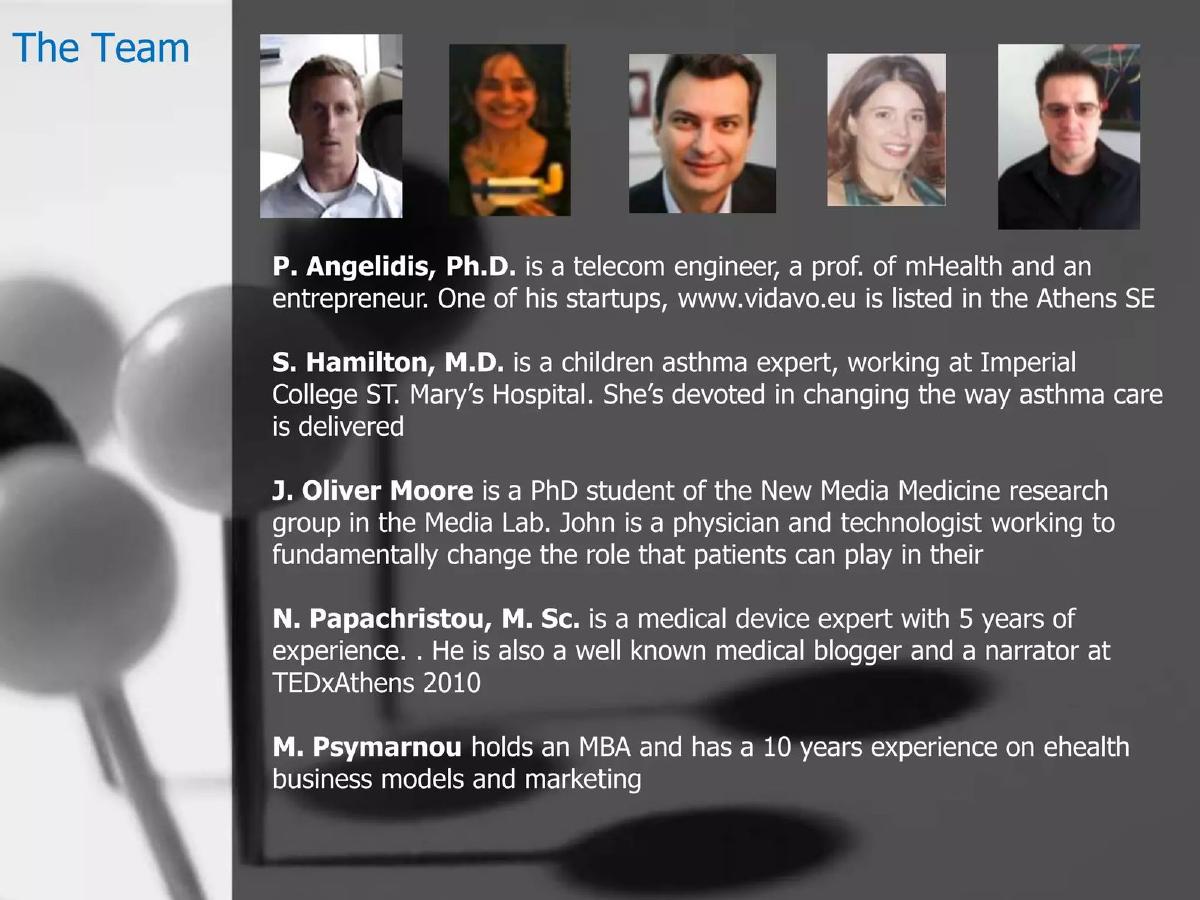
- The team includes a telecom engineer with a company listed on the Athens Stock Exchange and an asthma expert from Imperial College (Slide 3).
- The company won First Prize at the MIT Health and Wellness Innovation Competition in 2012 (Slide 7).
- The distribution strategy is multi-channel, targeting the pharma industry, insurers, drug retail stores, and direct sales (Slide 5).
- The funding ask is $7.2 million via convertible debt with a 20% discount and a $36 million valuation cap (Slide 6).
- The deck lacks specific unit economics, manufacturing costs, or a detailed breakdown of how the $7.2 million will be spent over 36 months.
- The product is described as a 'proven concept,' though no clinical trial data or pilot results are provided in the available slides (Slide 7).
Slide-by-Slide Analysis
Slide 1: Title and Product Visual
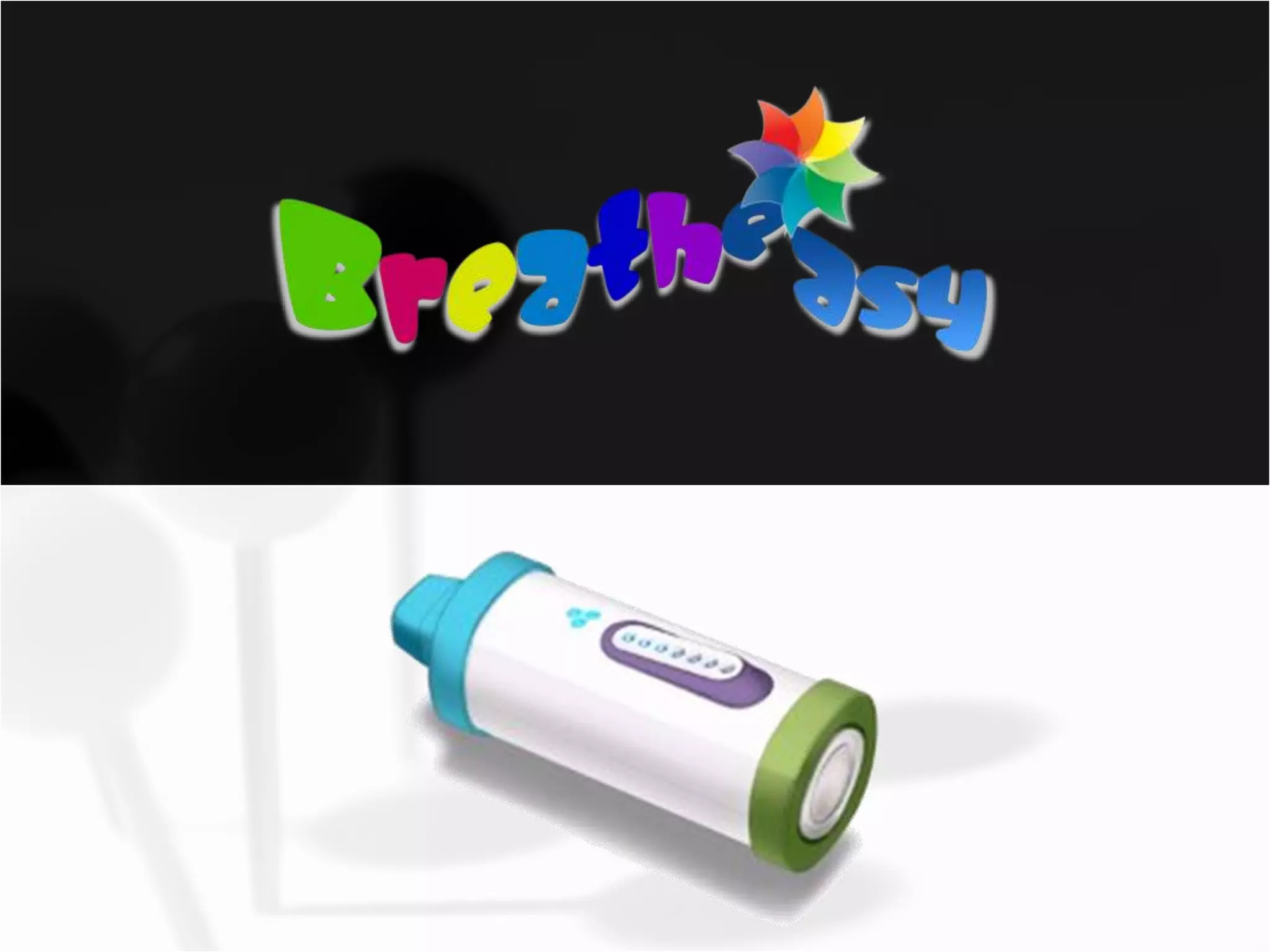
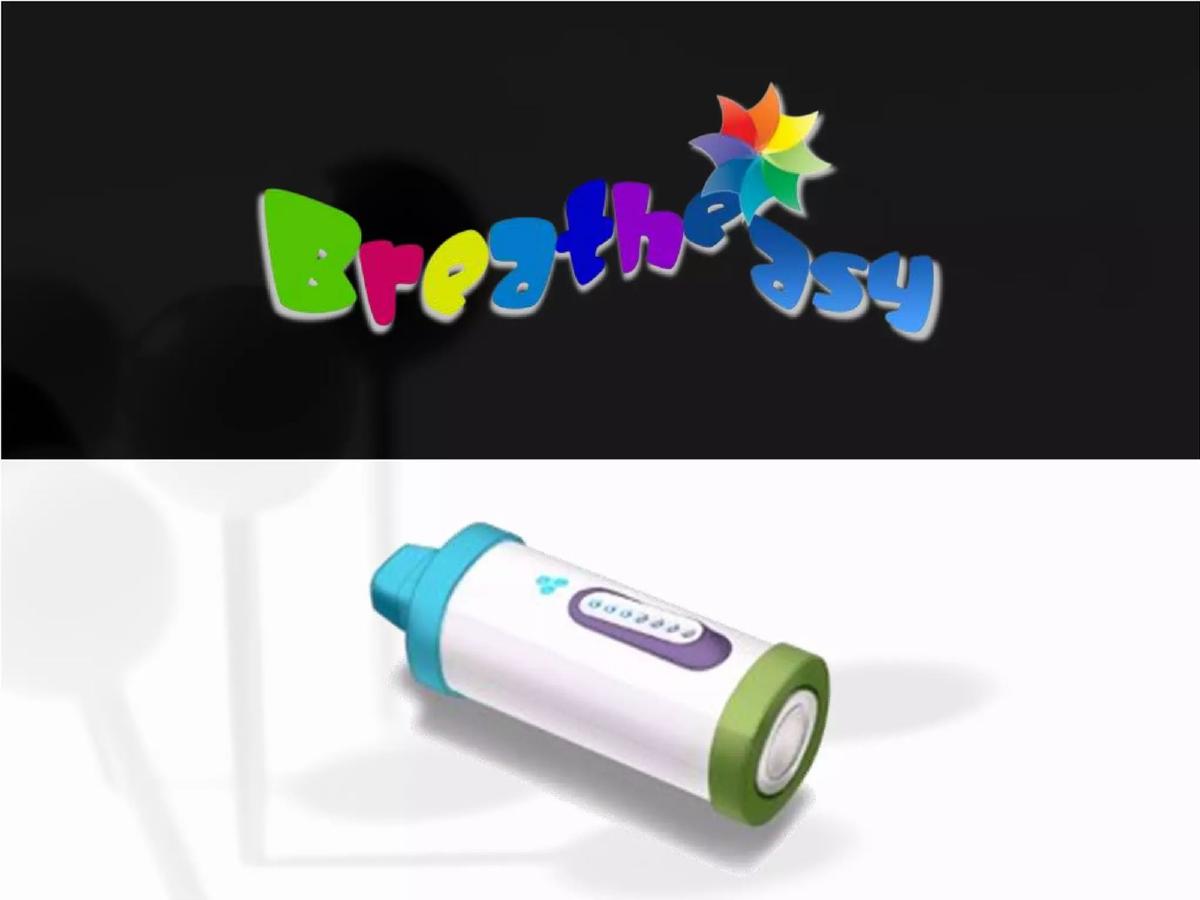
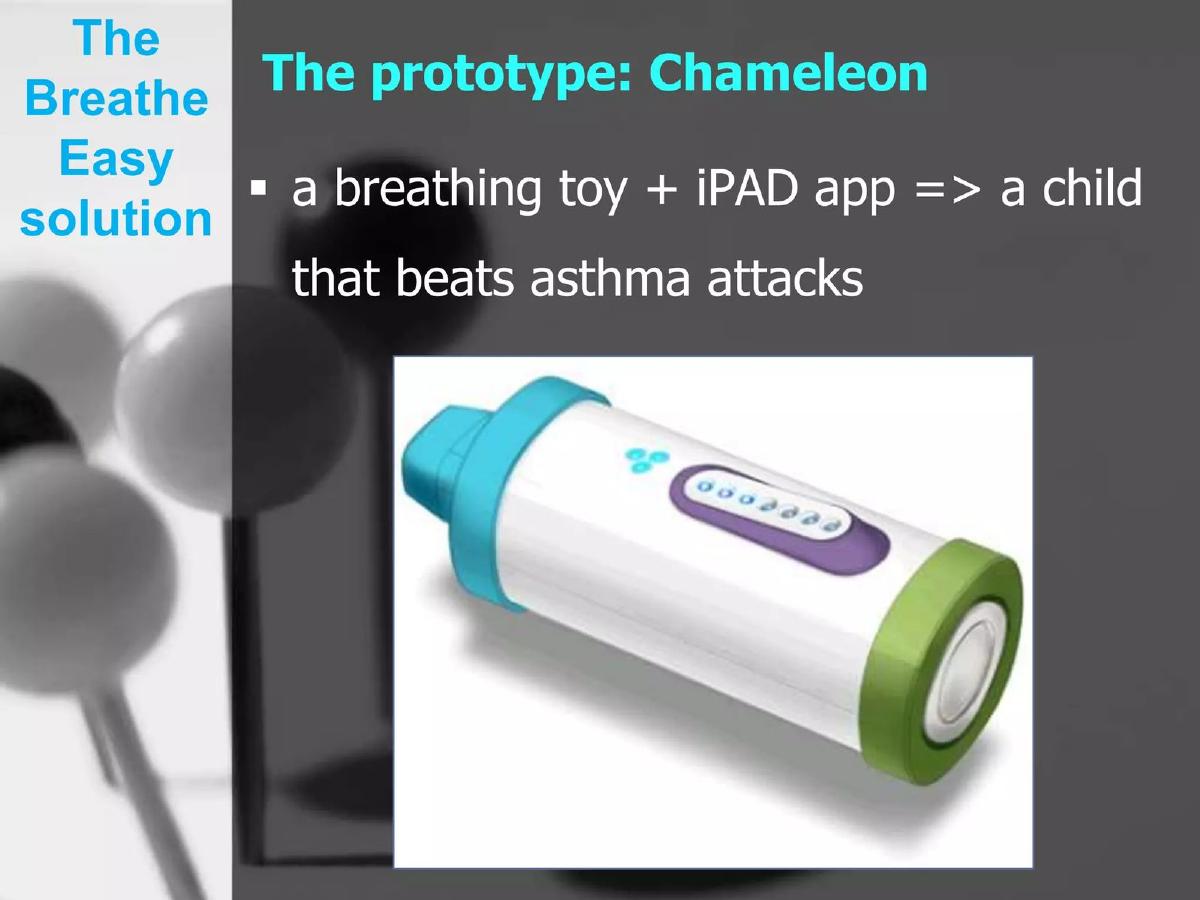
The cover slide features the Breathe Easy logo, which uses a multi-colored, playful font and a pinwheel icon. Below the logo is a high-fidelity 3D render of the device. The device appears to be a sleeve or attachment for a standard metered-dose inhaler (MDI), featuring a small digital display and a color scheme of white, blue, and green. The visual design clearly signals a focus on a younger demographic.
Slide 2: The Problem (Children + Asthma + USA)
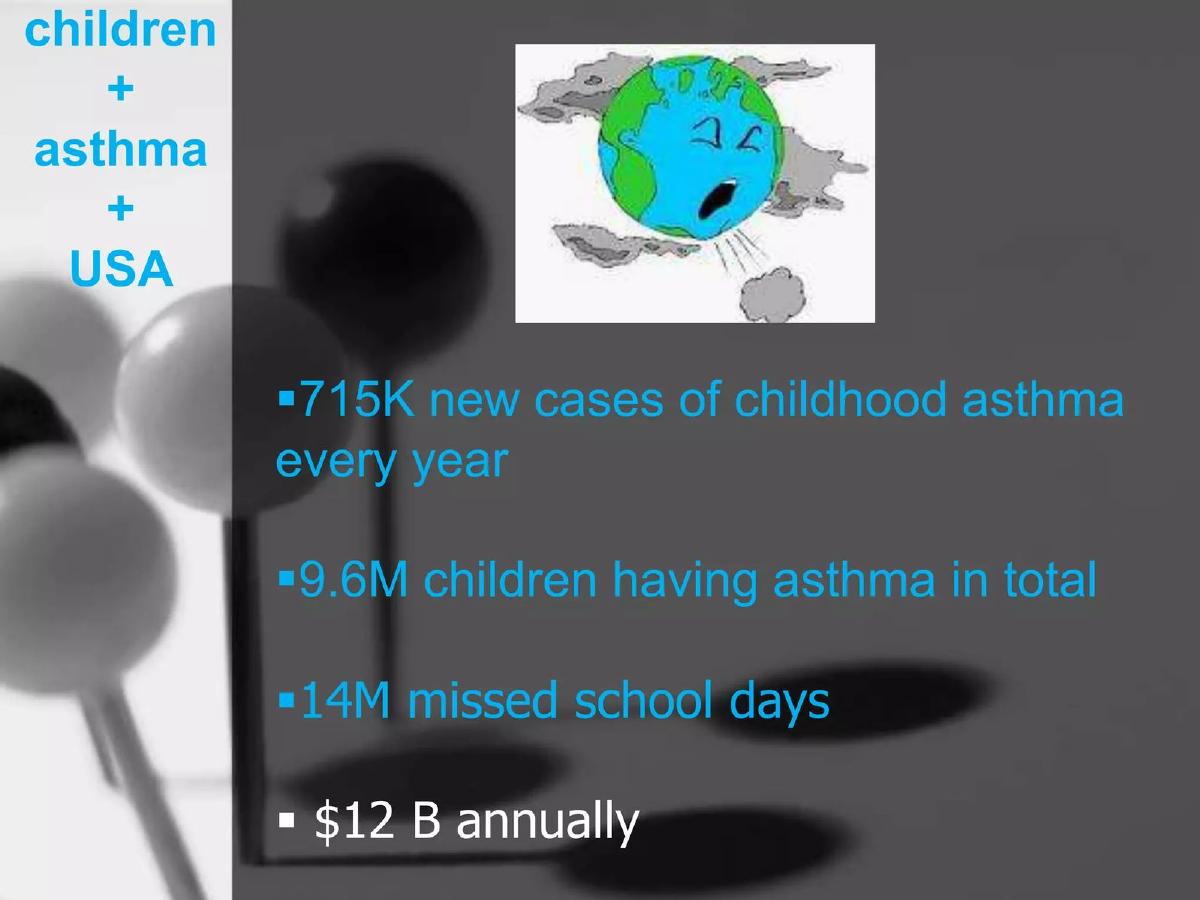
This slide establishes the market need using four key statistics. It notes 715,000 new cases of childhood asthma annually and a total of 9.6 million children currently affected in the U.S. The slide highlights the social and economic impact: 14 million missed school days and a $12 billion annual cost. The use of a 'crying Earth' cartoon graphic reinforces the focus on a pediatric and global health issue, though the data is specific to the United States.
Slide 3: The Team
The team slide presents five members with a mix of technical, medical, and business backgrounds. P. Angelidis, Ph.D., provides entrepreneurial credibility, noting his previous startup is listed on the Athens Stock Exchange. S. Hamilton, M.D., provides clinical authority as a children's asthma expert at Imperial College. J. Oliver Moore links the project to the MIT Media Lab. N. Papachristou and M. Psymarnou round out the team with expertise in medical devices and e-health business models. This is a high-pedigree team for an early-stage medtech company.
Slide 4: Competition Matrix
The founders compare Breathe Easy against two known competitors: Asthmapolis (now Propeller Health) and Smartinhaler (now Adherium). The matrix claims Breathe Easy is the only solution that tracks 'Medication Volume' and offers an 'Incentives Platform.' It also lists 'Fun to use' as a unique selling point. The slide uses question marks for competitors in the 'Collaborative Space' category, suggesting a lack of transparency or known features in rival products regarding social or shared data features.
Slide 5: Revenue & Distribution Channels
This slide outlines a multi-pronged go-to-market strategy. The company identifies four primary channels: the Pharma Industry, Insurers, Drug Retail Stores, and Direct Sales. The diagram places Breathe Easy at the center of these stakeholders. While it identifies who will buy or distribute the product, it does not specify which channel is the primary focus for the '1st stage' mentioned later in the deck.
Slide 6: The Ask
The company is raising $7.2 million. The slide specifies this is for the 'full way to sales,' estimating a 36-month timeline. The investment vehicle is convertible debt with a 20% discount and a $36 million valuation cap. This is a significant ask for a company that, based on the slides, appears to be in the pre-revenue, pre-sales phase. The 36-month runway suggests a long lead time for R&D, clinical validation, or FDA clearance.
Slide 7: Proven Concept
The final slide in this set focuses on validation. It highlights a 'First Prize' win at the 2012 MIT Health and Wellness Innovation Competition. It also uses a 'Nike+ Sensor' analogy to describe the product’s function—positioning it as a wearable/IoT device for health rather than just a medical tool. The inclusion of the Nike and Apple logos is intended to evoke the success of the Nike+ ecosystem, though no formal partnership is claimed.
What Works
Strong Team Pedigree: The combination of a physician from Imperial College, a PhD from the MIT Media Lab, and an entrepreneur with a publicly traded company creates a high level of founder-market fit. In medtech, the presence of an M.D. and a Ph.D. is often a prerequisite for investor interest.
Clear Differentiation: The competition matrix identifies a specific technical gap—medication volume tracking. Most smart inhalers track 'if' and 'when' a dose was taken; tracking 'how much' medication remains or was delivered is a harder technical challenge that offers clear value to parents and doctors.
Market Sizing: The problem slide uses 'hard' numbers (missed school days and total annual cost) that resonate with both impact investors and traditional VCs. It frames asthma not just as a health issue, but as an economic burden.
What is Missing
Regulatory Path: For a $7.2 million ask in the medical device space, the absence of a slide detailing the FDA (or CE Mark) pathway is a major omission. Investors need to know if this is a Class II medical device and what the specific hurdles are for clearance.
Unit Economics: There is no mention of the Cost of Goods Sold (COGS) or the target retail price. For a hardware-enabled service, understanding the margin on the device versus the potential recurring revenue from a platform is critical.
Use of Funds: A $7.2 million round is large. The deck states it is for the 'full way to sales,' but does not break down how much goes to manufacturing, clinical trials, marketing, or staffing.
Clinical Evidence: While the MIT award is a strong signal of innovation, the deck lacks data from pilots or user studies. For a device claiming to be 'fun to use' and 'empowering,' evidence of improved adherence rates would be a powerful addition.
Founder Takeaways
The Power of Analogy: Using the 'Nike+ for Asthma' analogy is an effective way to communicate a complex IoT value proposition in a single sentence. It immediately tells the investor that the product involves a sensor, a mobile app, and a gamified user experience.
Be Specific with Terms: Many early-stage decks are vague about their 'ask.' Breathe Easy is explicit about the amount ($7.2M), the instrument (convertible debt), the discount (20%), and the cap ($36M). This transparency helps qualify investors quickly.
Visualizing the Ecosystem: The distribution slide (Slide 5) is a good example of how to show a complex B2B2C market. By showing insurers and pharma as stakeholders, the founders demonstrate they understand that the end-user (the child) is rarely the one paying for the medical device.
Frequently asked questions
- What is the primary problem Breathe Easy is solving?
- Breathe Easy addresses the high burden of childhood asthma in the USA, which affects 9.6 million children and costs $12 billion annually. The deck focuses on the 14 million missed school days, suggesting that poor management and lack of engagement are the core issues their smart inhaler aims to fix through tracking and incentives.
- How does the product differentiate itself from other smart inhalers?
- According to the competition matrix on slide 4, Breathe Easy differentiates itself by offering medication volume tracking, an incentives platform, a collaborative space, and a 'fun to use' interface. Competitors like Asthmapolis and Smartinhaler are noted for tracking time and reminders but lack the gamification and volume-sensing features Breathe Easy claims to provide.
- What are the terms of the investment being sought?
- The company is seeking $7.2 million in the form of convertible debt. The note includes a 20% discount for investors and a valuation cap of $36 million. This capital is intended to cover a 36-month period to bring the product to the point of generating sales.
- Who are the key members of the leadership team?
- The team is led by P. Angelidis, Ph.D., a telecom engineer and entrepreneur; S. Hamilton, M.D., a pediatric asthma expert; J. Oliver Moore, a physician and technologist from MIT Media Lab; N. Papachristou, M.Sc., a medical device expert; and M. Psymarnou, who handles marketing and business models.
- What is the significance of the MIT award mentioned in the deck?
- Breathe Easy won first prize at the MIT Health and Wellness Innovation Competition in 2012. This serves as the primary 'proven concept' validation in the deck, signaling that the technology and business case were vetted by a prestigious academic and innovation panel early in the company's lifecycle.