HubUX positions itself as a specialized project management system for the consumer insights industry, aiming to reduce the 'hundreds of hours' researchers spend on operations rather than analysis. The deck is notably sparse, relying on large-scale brand validation from companies like Nestlé, Microsoft, Adobe, and Facebook to establish credibility. While it successfully demonstrates early momentum—citing 73,050 downloads and a $1.5m funding close in February 2020—it lacks traditional depth in areas such as unit economics, competitive landscape, and team biographies. The presentation serves mor…
Key takeaways
- The company defines its niche as the only project management system specifically for consumer insights on slide 7.
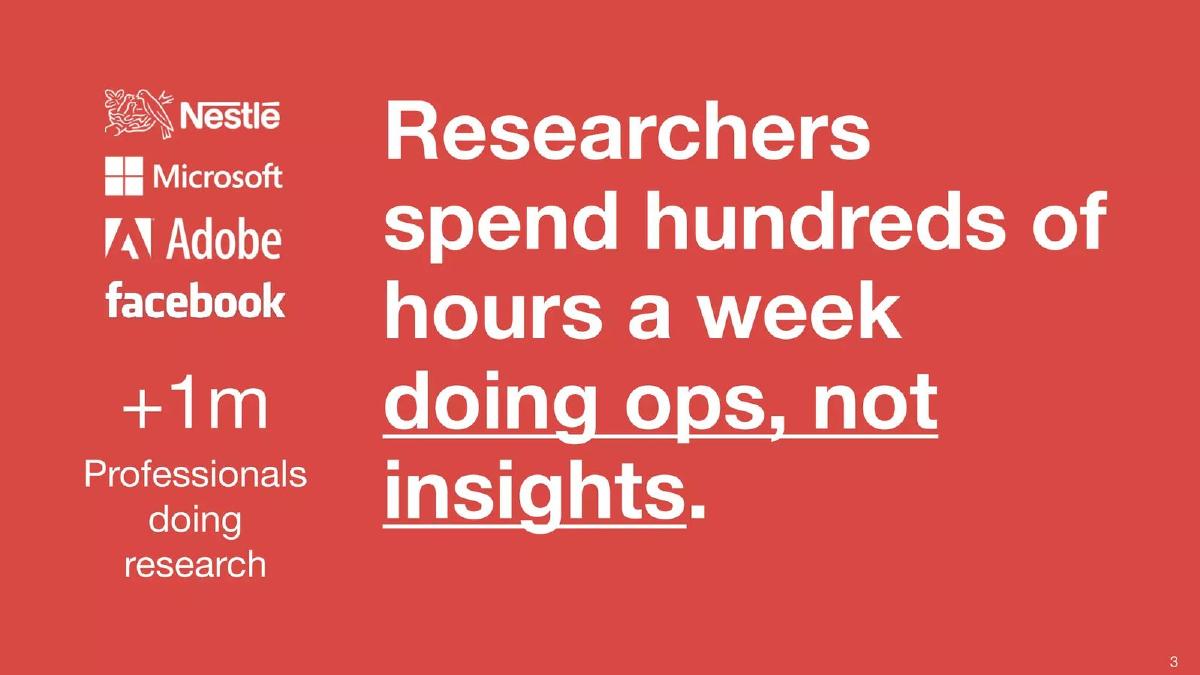
- HubUX identifies a market of over 1 million professionals doing research who are bogged down by operational tasks on slide 3.
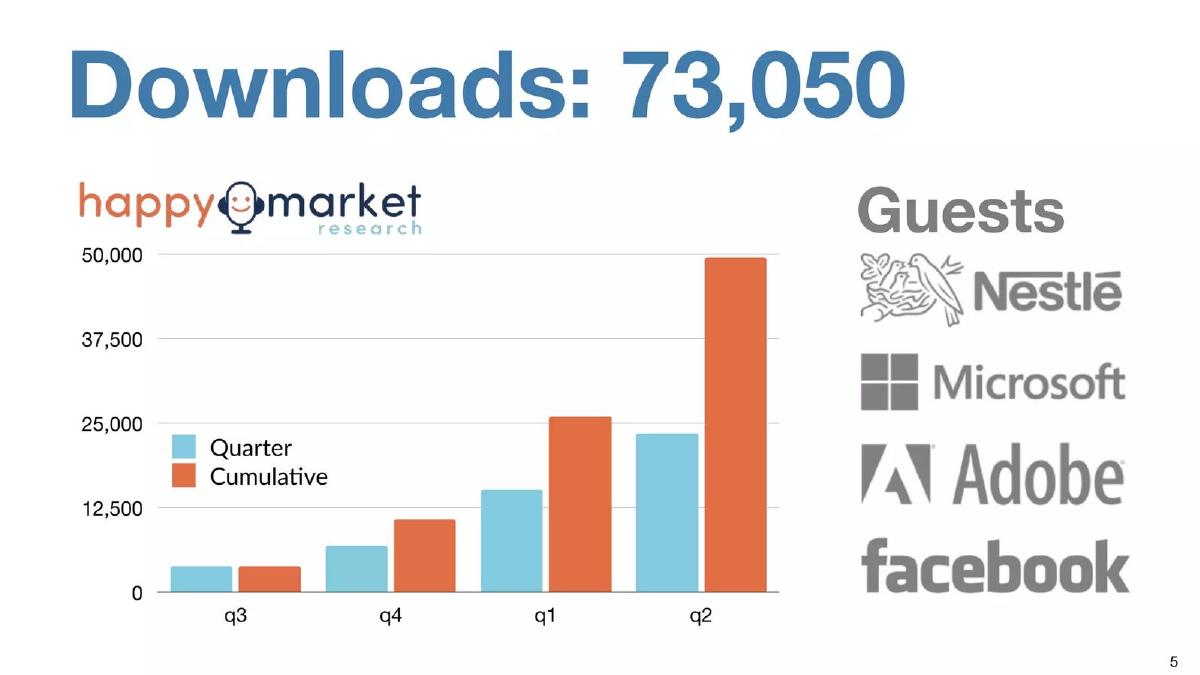
- Traction is demonstrated through a cumulative download count of 73,050 as shown on slide 5.
- The deck leverages enterprise logos including Nestlé, Microsoft, Adobe, and Facebook for social proof on slides 3 and 5.
- A funding milestone of $1.5m was closed in February 2020 according to the timeline on slide 9.
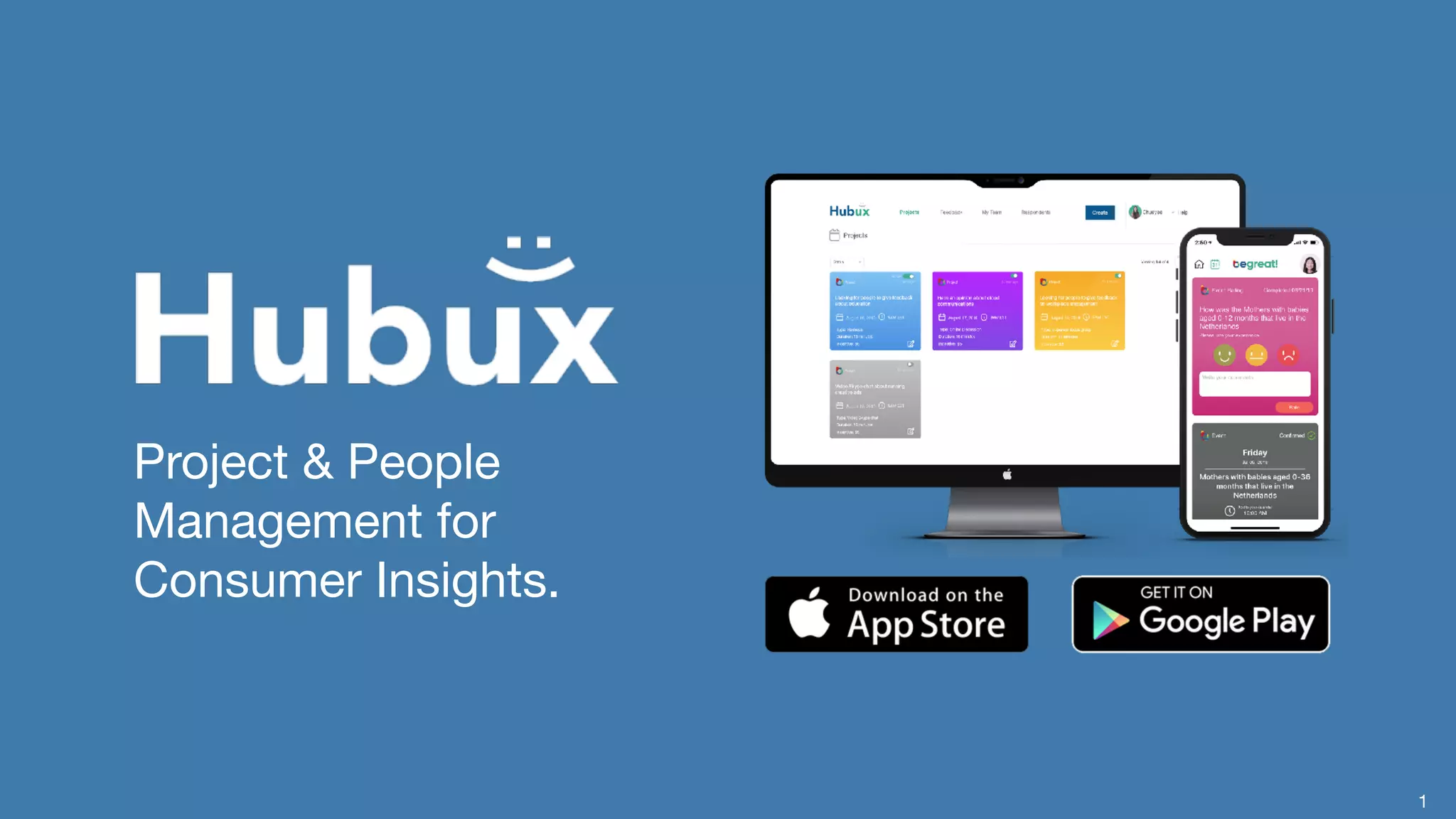
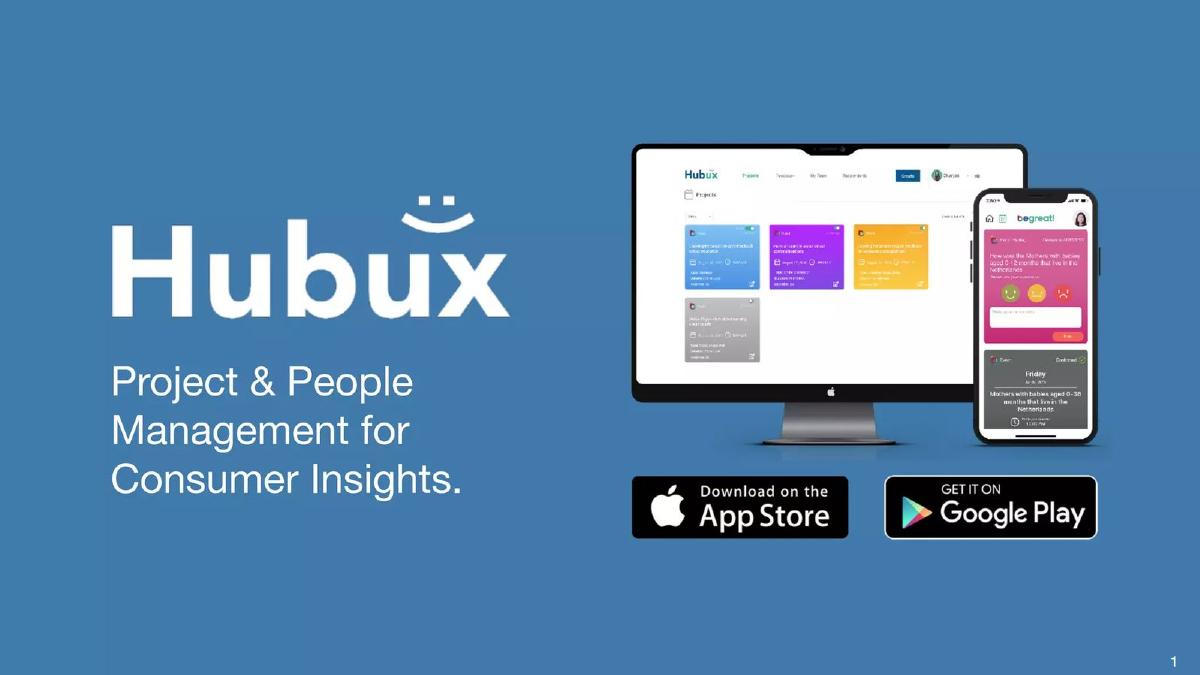
- The product is cross-platform, featuring both desktop and mobile interfaces (App Store and Google Play) as seen on slide 1.
- The deck omits a dedicated team slide, business model details, and a specific current 'ask' or valuation.
- Beta testing in November 2019 involved approximately 600 users from Adobe and Facebook, per slide 9.
HubUX: The Minimalist Approach to Research Ops
The HubUX investor deck is a study in brevity. With only 11 slides total, the presentation avoids the dense, text-heavy pitfalls of many early-stage decks, opting instead for bold claims and high-contrast visuals. The company targets the market research and consumer insights industry, a sector that has historically relied on fragmented tools like Excel, email, and specialized recruitment platforms. HubUX attempts to unify these workflows into a single project management system.
Slide 1: Title and Product Vision
The cover slide establishes HubUX as 'Project & People Management for Consumer Insights.' The visual hierarchy is dominated by the logo and a clean product mockup showing both a desktop dashboard and a mobile application. The inclusion of App Store and Google Play badges immediately signals that this is a cross-platform solution, catering to both the researchers (desktop) and the research participants (mobile). The branding is friendly, utilizing a 'smile' motif in the logo, which aligns with the 'Happy Market Research' branding seen later in the deck.
Slide 3: The Problem Statement
HubUX skips the traditional 'industry overview' and goes straight to the pain point. The slide states that 'Researchers spend hundreds of hours a week doing ops, not insights.' This is a classic productivity-gap argument. By quantifying the audience—over 1 million professionals—and listing high-tier logos like Nestlé and Microsoft, HubUX suggests that even the most sophisticated companies in the world suffer from this operational drag. The use of underlining for 'doing ops, not insights' emphasizes the displacement of high-value work by low-value administrative tasks.
Slide 5: Traction and Validation
This slide serves two purposes: demonstrating growth and providing social proof. The headline figure is 73,050 downloads. A bar chart shows quarterly and cumulative growth, with a significant spike in Q2. To the right, the deck lists 'Guests' from Nestlé, Microsoft, Adobe, and Facebook. It is important to note that the deck uses the term 'Guests,' which may imply these are users or participants rather than paying enterprise-wide contracts. The 'Happy Market Research' logo also appears here, suggesting a connection to a podcast or media property of the same name, which likely served as a top-of-funnel lead generation tool for the software.
Slide 7: The Unique Value Proposition
Slide 7 is a single-sentence claim: 'HubUX is the only Project Management System for consumer insights.' By underlining 'only,' the company is making a bold stake in a crowded SaaS landscape. They are not competing with general tools like Asana or Trello; they are positioning themselves as a vertical-specific solution that understands the unique nuances of research operations, such as respondent screening and project lifecycles.
Slide 9: Company Timeline and Milestones
The timeline provides a clear history of the company's velocity. Starting in April 2019, the company moved to a beta with Adobe and Facebook by November 2019, involving roughly 600 users. The most critical data point for investors is the February 2020 entry: 'Close $1.5m.' This indicates that the deck was likely used either to secure that round or immediately following it to report progress. The final milestone in April 2020 focuses on scaling the team across sales, marketing, and development, which is a standard post-funding objective.
Slide 11: Contact Information
The deck concludes with a simple contact slide for Jamin Brazil. The inclusion of a Twitter handle (@jaminbrazil) and a direct email suggests a founder-led sales and fundraising approach. There is no 'thank you' slide or 'Q&A' slide shown in this selection; it ends abruptly on the call to action.
What HubUX Does Well
The HubUX deck excels at clarity of purpose . Within three slides, a reader understands exactly who the product is for and what problem it solves. The use of large, bold fonts makes the deck highly readable, even on mobile devices or in a fast-paced pitch environment. Social proof is used effectively; by placing logos like Facebook and Microsoft on multiple slides, the founders create an aura of inevitability and enterprise readiness. The traction chart on slide 5 is also a highlight, showing a clear upward trajectory that suggests product-market fit or at least a successful acquisition strategy.
What is Missing from the Deck
While the deck is visually clean, it leaves several critical questions unanswered for a sophisticated investor:
Team Slide: There is no slide detailing the founders' backgrounds or the expertise of the engineering team. In early-stage investing, the 'who' is often as important as the 'what.' · Business Model: The deck does not explain how HubUX makes money. Is it a per-seat SaaS model, a per-project fee, or a marketplace model based on respondent incentives? · Competition: Claiming to be the 'only' solution is a bold move that usually requires a competitive matrix to defend. The deck ignores incumbents and adjacent tools. · Unit Economics: There is no mention of Customer Acquisition Cost (CAC), Lifetime Value (LTV), or churn rates, which are vital for a platform claiming 70k+ downloads. · The Ask: Slide 9 mentions a $1.5m close, but the deck does not specify if they are currently raising more capital or what the terms of a new round might be.
Founder's Guide: What to Copy
Founders should emulate the visual economy of this deck. HubUX avoids the 'wall of text' that kills investor interest. The way they framed the problem—'ops vs. insights'—is a perfect example of a binary value proposition that is easy to remember. Additionally, the use of a milestone timeline (Slide 9) is an excellent way to show execution speed. If you can show that you went from 'Started' to 'Beta' to 'Funded' in under a year, you demonstrate a level of momentum that is highly attractive to VCs. Finally, the strategy of using a content brand (Happy Market Research) to drive software downloads is a 'media-first' growth hack that more B2B founders should consider.
Frequently asked questions
- What is the primary problem HubUX is trying to solve?
- According to slide 3, HubUX addresses the fact that researchers spend hundreds of hours a week on 'ops' (operations) instead of 'insights.' The company targets the 1 million+ professionals in the research field who are currently inefficient due to manual project management and people management tasks.
- What evidence of market traction does the deck provide?
- Slide 5 shows a bar chart of downloads reaching a cumulative total of 73,050. The chart indicates significant growth from Q3 to Q2. Additionally, slide 9 notes that the company had approximately 600 users during its beta phase with Adobe and Facebook in late 2019.
- Who are the target customers for this platform?
- The deck repeatedly highlights large enterprise clients. Slide 3 and slide 5 list Nestlé, Microsoft, Adobe, and Facebook as either 'guests' or organizations where professionals are using the tool. The broader target is the global pool of over 1 million research professionals.
- What is the current funding status of HubUX based on these slides?
- Slide 9 indicates that HubUX closed a $1.5 million funding round in February 2020. The timeline suggests that following this close, the company moved into staffing for sales, marketing, and further development in April 2020. No newer 'ask' is listed in this specific slide sequence.
- Does the deck explain how the software actually works?
- The deck is light on technical specifics. Slide 1 shows a mockup of a dashboard with project cards and a mobile app interface for respondents. Slide 7 characterizes the software as a 'Project Management System for consumer insights,' but there are no slides detailing specific features like recruitment, incentive handling, or data analysis.