Nexi.me presents a solution for Small and Medium Businesses (SMBs) to bypass traditional job boards and expensive recruiting agencies by incentivizing employee social referrals. The deck, dating from approximately 2012, focuses on the friction of hiring 'high skilled' talent and proposes a platform that uses a 'suggestion algorithm' to identify potential candidates within an employee's social network. With 15 pilot companies in a closed beta at the time of the deck, the startup emphasized a pay-per-job model rather than a pay-per-user model. While the deck successfully identifies a clear pain…
Key takeaways
- The company targets SMBs with up to 500 employees that are currently using ATS systems like Taleo, Kenexa, or PeopleSoft (Slide 8).
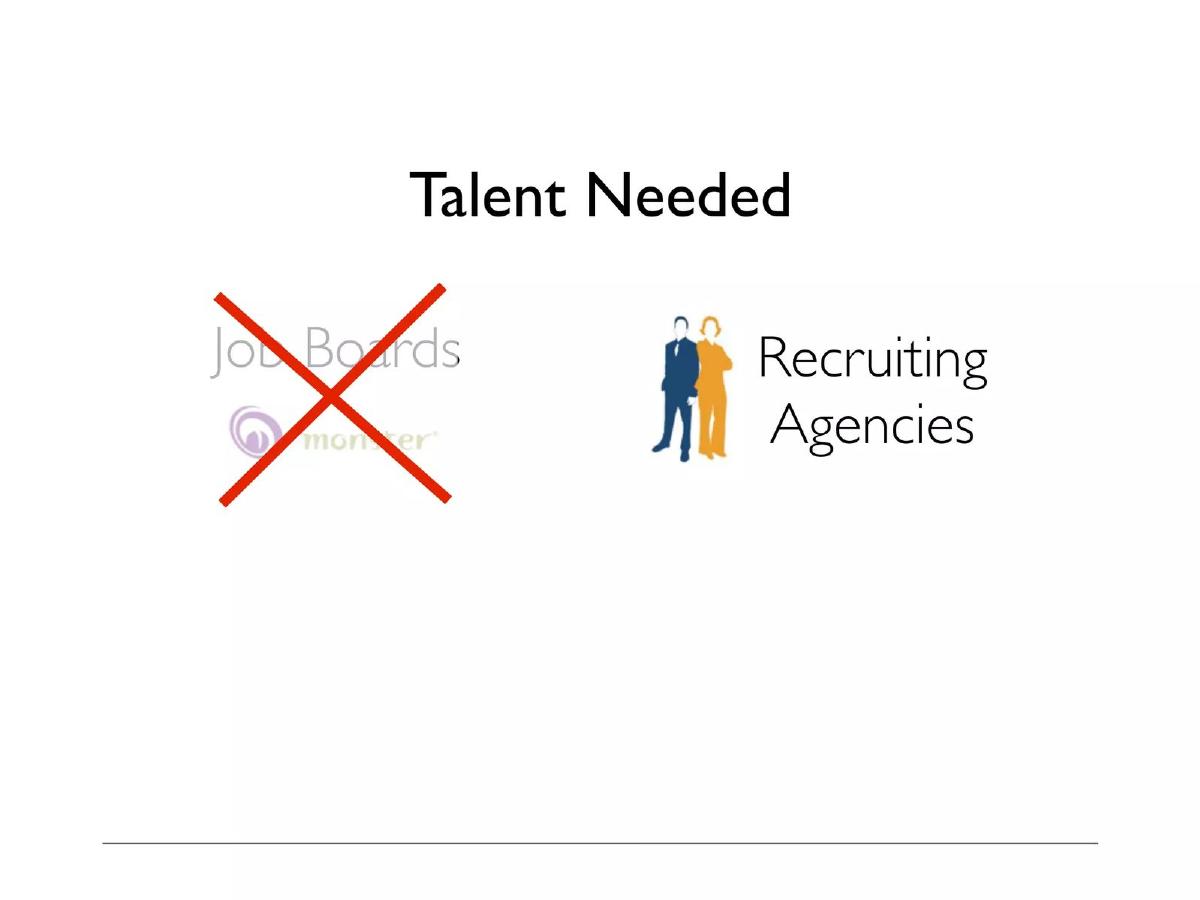
- Nexi.me positions itself as a replacement for traditional job boards, recruiting agencies, and standard employee referral programs (Slides 2-4).
- The platform incentivizes referrals with rewards such as $1000, iPads, or vacations (Slide 5).
- Early traction is demonstrated by 15 pilot companies in a closed beta, including Adneom, Postcron, and Greenfish (Slide 7).
- The founding team consists of Cristian Andreica (CEO) and Ciprian Mardare (CTO), both with backgrounds at balaur.ro (Slide 9).
- The startup is backed by Rockstart Accelerator and angel investor Alexandre Almajeanu (Slide 9).
- Nexi.me differentiates itself from competitors like Gooood Job and Social Referral by charging per job rather than per user (Slide 10).
- A core value proposition is a 5-star rated 'suggestion algorithm' compared to 1 or 2 stars for competitors (Slide 10).
Nexi.me: The Social Referral Pivot
The Nexi.me deck is a classic example of early 2010s 'social' disruption. During this era, many startups sought to take existing business processes—in this case, recruitment—and overlay a social graph to improve efficiency. The deck is structured to highlight the failure of the old guard (job boards and agencies) before introducing a modern, algorithmically-driven alternative.
Slides 1-4: The Problem and the 'X' Factor
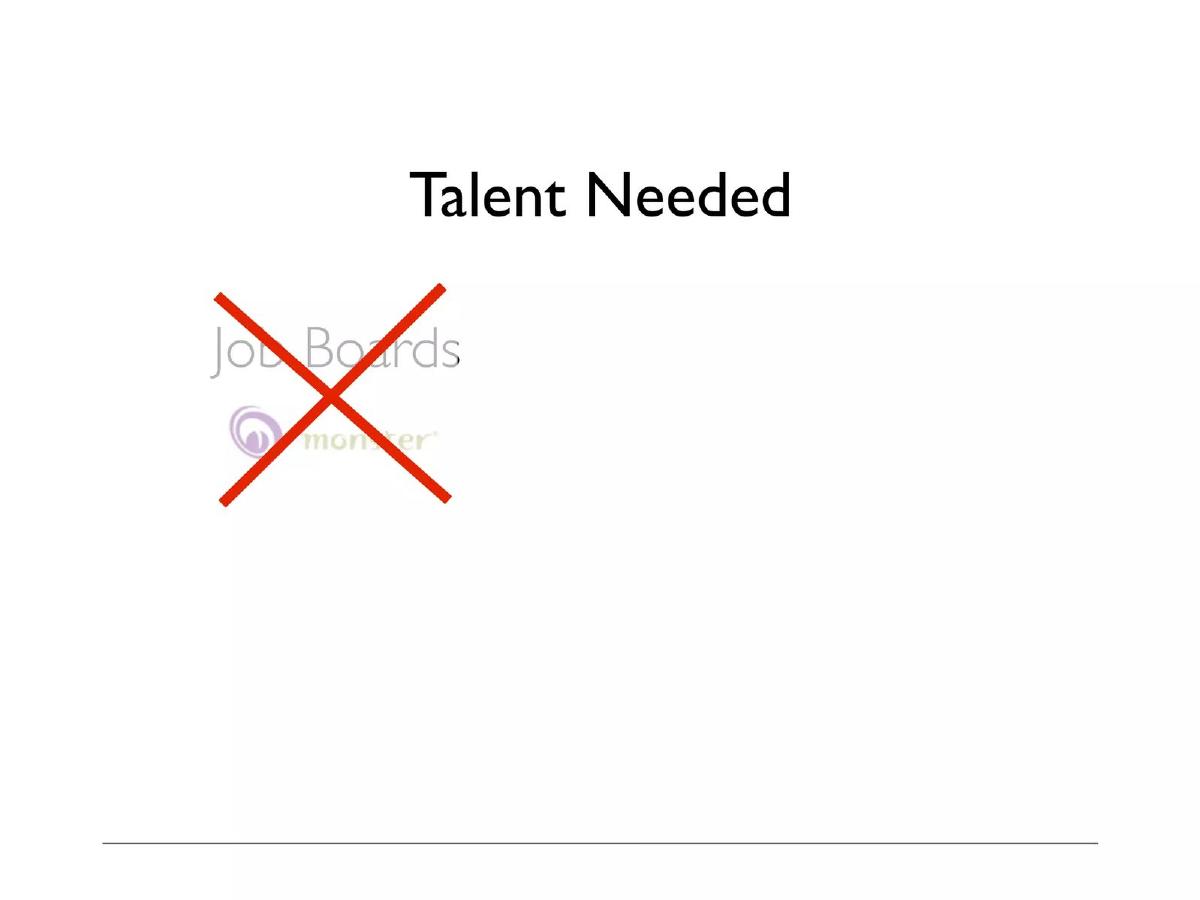
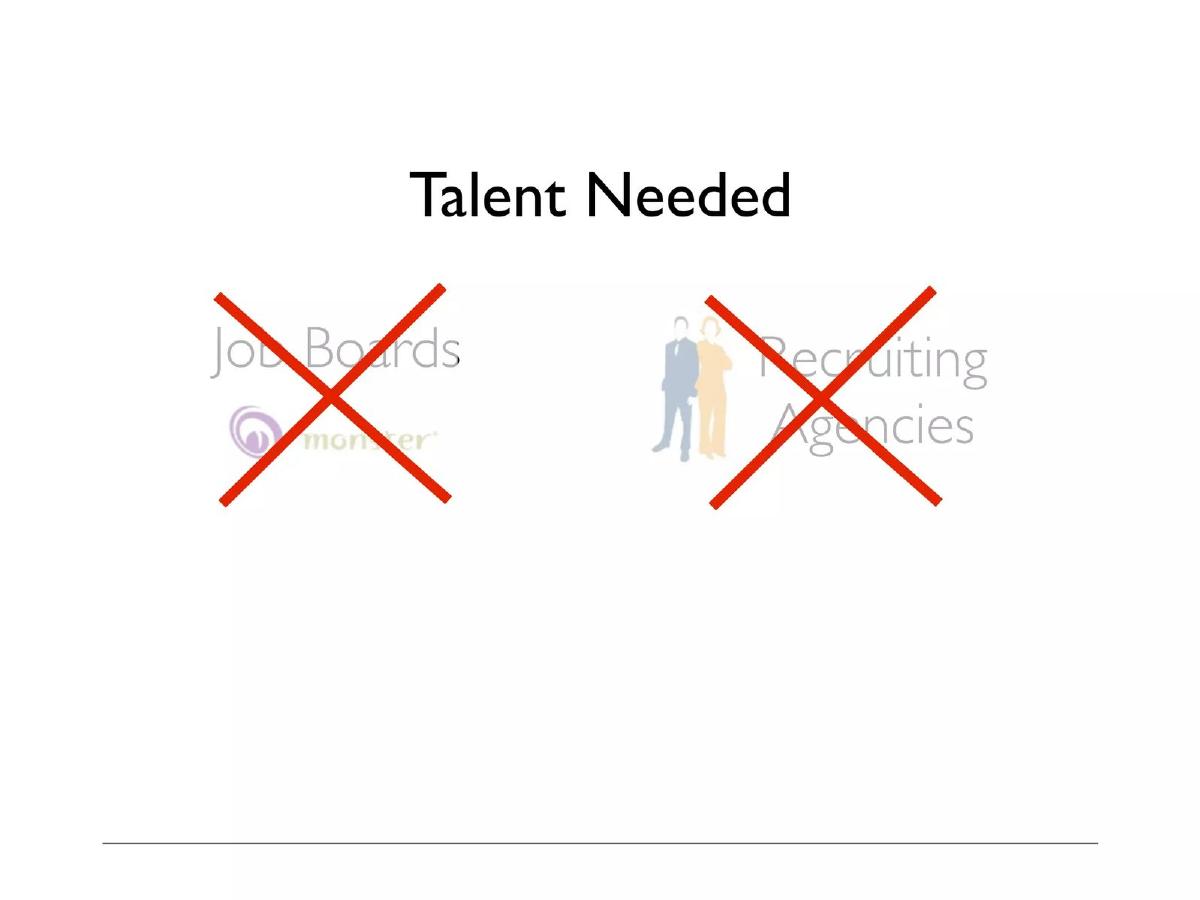
Slide 1 introduces the company with the tagline 'changes the way businesses hire top talents.' It includes social media handles for Twitter and Facebook, signaling its identity as a social-first platform. Slides 2, 3, and 4 use a progressive disclosure technique to eliminate traditional hiring channels. They place large red 'X' marks over logos for Monster (Job Boards), recruiting agencies, Glassdoor, LinkedIn, BranchOut, and even traditional Employee Referral Programs. This is a bold, if somewhat reductive, way to frame the market: everything you are currently doing is wrong or insufficient.
Slide 5: The Solution - Social Referrals
Slide 5 presents the core solution: 'Recruit through social referrals from your employees.' The slide uses a simple diagram showing a 'New position' being shared through a central employee to their social networks (Facebook, LinkedIn, Twitter). It also introduces the concept of Rewards , listing '$1000, iPad, vacation' as examples of incentives to drive employee participation. This slide attempts to quantify the reach, showing percentages like '96%' and '94%', though the specific context of these numbers is not defined on the slide.
Slide 6: Product Interface and Social Proof
Slide 6 shows a mockup of the candidate feed. It highlights specific candidates (Mihai Corlan, Mihai Tabără, Matías Gentiletti) and includes a 'referred by' section. This emphasizes the trust element of the platform. For example, one candidate is 'Rated as top 10' and includes a personal note from the referrer stating, 'Mihai is a great developer. He even taught me how to code Action Script.' This slide effectively demonstrates how the platform captures qualitative data that a standard resume might miss.
Slide 7: Traction and Beta Testing
Slide 7 claims '15 pilot companies - closed beta.' It displays logos for Adneom, Postcron, Greenfish, Pacer, and Ingima. Testimonials from Alejandro Rigatuso (CEO Postcron) and Vincent Van Der Meijden (Manager Pacer) provide early validation. Rigatuso specifically mentions that 'Nexi provides great candidate suggestions,' which supports the company's claim of having a functional algorithm rather than just a sharing tool.
Slide 8: Target Market and Integration
Slide 8 defines the Ideal Customer Profile (ICP). Nexi.me targets SMBs with 'up to 500 employees.' They specifically look for companies hiring 'engineers' and 'high skilled' talent. Crucially, they identify that these companies are already 'Using ATS' like Taleo, Kenexa, and PeopleSoft. This suggests that Nexi.me is designed to sit on top of or integrate with existing HR tech stacks rather than replacing the entire back-end system.
Slide 9: Team, Investors, and Advisors
Slide 9 introduces the founders. Cristian Andreica (CEO) is noted as the technical lead of balaur.ro and co-founder of xtwip.com with 6 years of product development experience. Ciprian Mardare (CTO) is also a developer from balaur.ro with 'strong algorithmic skills' and prizes in national competitions. The deck lists Rockstart Accelerator and Alexandre Almajeanu as investors. The advisors include Stefan Fountain (founder of Soocial.com), Hans Ten Hove (Managing Director at IPSoft), and Koen Wagemakers (Corporate Finance).
Slide 10: Competitive Landscape (Appendix A)
Slide 10 is a comparison table. Nexi.me compares itself to Gooood Job and Social Referral . The three key differentiators highlighted are: 1) A 5-star 'Suggestion algorithm' compared to 1 or 2 stars for competitors, 2) A focus on 'SMBs' (whereas Social Referral focuses on Corporate), and 3) A pricing model where the customer pays for each 'JOB' instead of each 'USER'.
What Works in This Deck
Clear Differentiation: The competitive matrix on Slide 10 is very effective. By highlighting the 'Pay for each JOB' model, Nexi.me presents a lower barrier to entry for SMBs who might be hesitant to pay per-user seats for a referral tool. The emphasis on the 'Suggestion algorithm' also moves the product from a simple 'share button' to a 'matching engine,' which is a higher-value proposition.
Targeted Focus: Instead of trying to be everything to everyone, the deck specifically calls out SMBs (up to 500 employees) and high-skilled engineering roles. This focus makes the traction with 15 pilot companies feel more significant because it implies a concentrated testing ground.
What Is Missing
Financials and Unit Economics: The deck is entirely silent on the cost of acquisition (CAC) for these SMBs and the expected lifetime value (LTV). While they mention a 'pay per job' model, they do not state what that price is. Investors would need to know if the revenue per job covers the cost of the rewards ($1000, iPads) and the platform's overhead.
The Ask: There is no slide indicating how much money the company is looking to raise, the valuation they are seeking, or the specific milestones they intend to hit with the new capital. This is a critical omission for a fundraising deck.
Market Size: While they identify the target customer, they don't quantify the Total Addressable Market (TAM). How many SMBs fit this profile, and what is the total spend on recruitment in this segment?
Founder Takeaways
The Power of the 'X': If you are entering a crowded market, visually 'killing' the old way of doing things (as seen in Slides 2-4) is a strong narrative device to reset the investor's perspective. · Validate the 'Secret Sauce': Nexi.me claims a superior algorithm. They back this up not with code, but with a testimonial from a pilot CEO who specifically praises the 'candidate suggestions.' If you claim a technical advantage, get a customer to vouch for it. · Pricing as a Feature: Sometimes your business model is your best competitive advantage. By switching from 'per user' to 'per job,' Nexi.me aligns its costs directly with the value the customer receives (a hire).
Frequently asked questions
- What is the primary problem Nexi.me is trying to solve?
- Nexi.me addresses the difficulty SMBs face when trying to hire top, high-skilled talent. The deck argues that traditional methods—job boards like Monster, recruiting agencies, and even standard referral programs—are ineffective or outdated. By using social referrals, they aim to tap into the trusted networks of current employees to find better candidates more efficiently.
- How does the Nexi.me business model differ from its competitors?
- According to Slide 10, Nexi.me differentiates its pricing strategy by charging 'per JOB' rather than 'per USER.' This is contrasted with competitors like Gooood Job and Social Referral, who charge per user. Additionally, Nexi.me claims a superior suggestion algorithm to help employees identify which of their social contacts are the best fit for open roles.
- Who is the target audience for this platform?
- The deck explicitly targets Small and Medium Businesses (SMBs) with up to 500 employees. Specifically, it looks for companies that are already using Applicant Tracking Systems (ATS) such as Taleo, Kenexa, or PeopleSoft and are looking to hire 'engineers' and 'high skilled' experienced people.
- What kind of traction did Nexi.me have at the time of this deck?
- Nexi.me was in a 'closed beta' phase with 15 pilot companies. The deck lists logos for Adneom, Postcron, Greenfish, Pacer, and Ingima. It also includes specific testimonials from the CEO of Postcron and a manager at Pacer to validate the product's utility during the pilot stage.
- What information is missing from this pitch deck?
- The provided slides lack several critical components for a full investment evaluation: there are no financial projections, no detailed breakdown of unit economics (CAC/LTV), no roadmap for future product development, and no specific 'Ask' slide detailing how much capital is being raised or how it will be deployed.