Huboo’s Series B deck is a masterclass in presenting a complex operational business as a scalable software-enabled platform. By framing their fulfillment services as 'Full Stack eCommerce,' the company shifts the investor's perspective from a traditional logistics play to a high-margin technology business. The deck highlights a rapid organizational growth from 2 to 300 members in just two years (Slide 5) and outlines a clear path to dominating the European market by 2023 (Slide 11). While the deck is light on specific unit economics and financial tables, it leans heavily on the 'micro-warehou…
Key takeaways
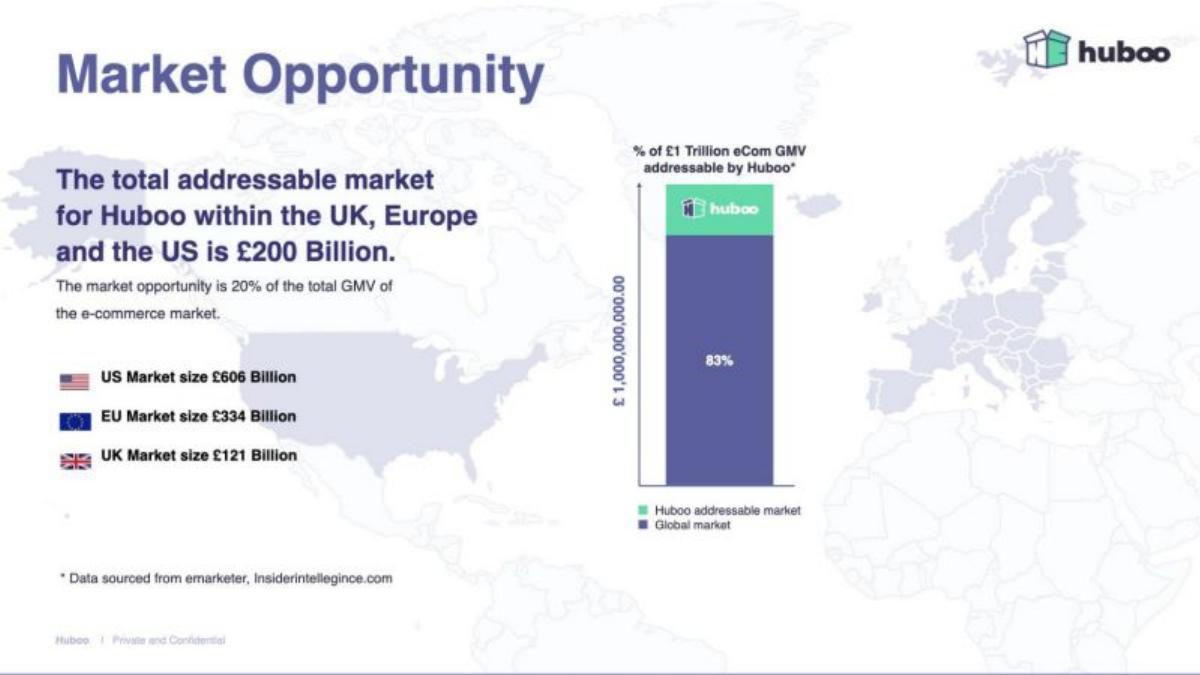
- The total addressable market is defined as £200 Billion, representing 20% of the total eCommerce GMV in the UK, Europe, and US (Slide 4).
- Huboo utilizes a unique 'low capex, instantly deployable, micro-warehousing model' to differentiate from traditional fulfillment (Slide 2).
- The company grew from 2 to 300 team members in just two years, demonstrating significant scaling velocity (Slide 5).
- Huboo's business plan involves moving from 'Full Stack fulfillment' to 'Full Stack e-Commerce' by adding high-margin software and service layers (Slide 8).
- The roadmap targets presence in 20 countries by 2023, completing the European rollout (Slide 11).
- The 'HubStore' is positioned as a value-add layer that creates transaction multipliers and increases the client's footprint (Slide 9).
- The deck highlights 'Battle Tested' resilience, specifically mentioning successful operations during Covid-19 lockdowns, the French Blockade, and Brexit (Slide 5).
- The operational model is described as 'headless,' facilitating rapid global expansion with vertically integrated software (Slide 5).
The Series B Narrative: From Logistics to Platform
Huboo’s 2021 pitch deck is a concise 12-slide presentation that successfully raised $81M. At this stage, a company is expected to prove that its model is not just working, but is ready for aggressive international replication. Huboo achieves this by framing logistics—a traditionally low-margin, high-capex industry—as a 'full-stack' technology play. The deck uses clean, isometric illustrations to simplify complex supply chain concepts, making the business appear modular and scalable.
Slide 1: Cover and Visual Identity
The opening slide establishes the brand and the geographic scope. An isometric map of Europe is dotted with Huboo-branded fulfillment centers, connected by logistics lines. Floating UI elements represent 'Multi Channel' (eBay, Amazon, Shopify), 'Transactional Multipliers,' and 'SaaS' metrics. This immediately signals to the investor that while the company moves physical boxes, its brain is digital. The logo is prominent, and the aesthetic is modern and tech-focused.
Slide 2: Full Stack eCommerce
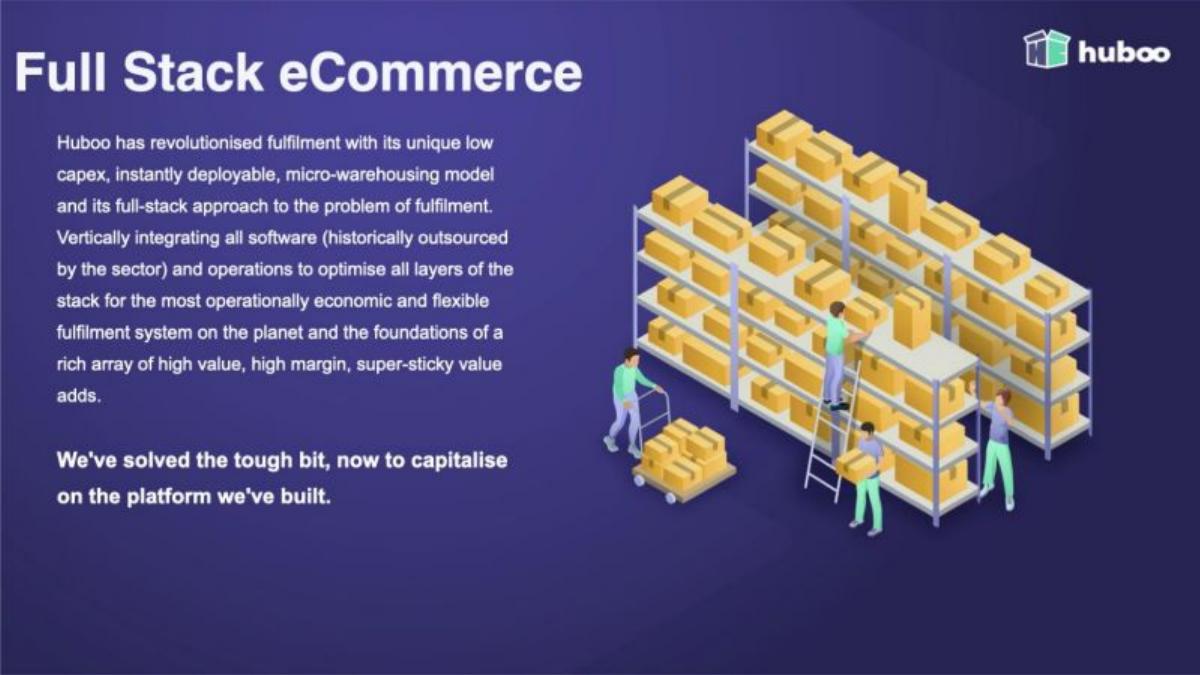
Slide 2 introduces the core innovation: the 'micro-warehousing model.' Huboo claims to have 'revolutionised fulfilment' by vertically integrating all software and operations. The text emphasizes that this model is 'low capex' and 'instantly deployable.' By calling it 'Full Stack,' they borrow terminology from the software world to describe their control over every layer of the fulfillment process. The slide ends with a confident call to action: 'We’ve solved the tough bit, now to capitalise on the platform we’ve built.'
Slide 3: Progress and Highlights
This is a purely visual slide that uses an isometric illustration to show the ecosystem Huboo has built. It depicts the flow from online shops (WooCommerce, Shopify, Amazon, eBay) to a Huboo fulfillment center, and then out via carriers like Royal Mail, DPD, and Maersk. It visually confirms that the 'tough bit'—the integrations and physical infrastructure—is already operational and handling international shipping via air and sea.
Slide 4: Market Opportunity
Huboo defines its Total Addressable Market (TAM) as £200 Billion. They arrive at this figure by taking 20% of the £1 Trillion eCommerce GMV across the UK, Europe, and the US. The slide provides a helpful breakdown of market sizes: US at £606B, EU at £334B, and UK at £121B. The use of a bar chart showing Huboo’s addressable market as a slice of the global total helps investors visualize the 'room to grow' in a massive sector.
Slide 5: Investment Highlights
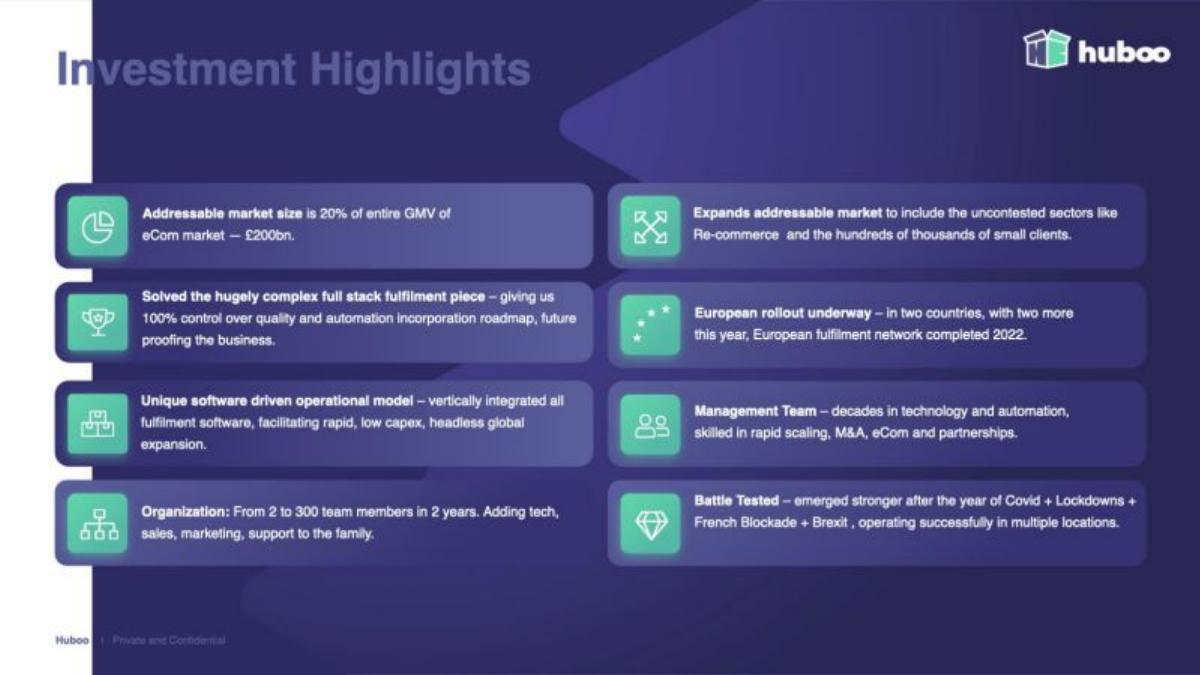
This slide serves as a summary of the company’s strengths. Key points include:
Organization: Growing from 2 to 300 team members in 2 years. · Operational Model: Unique software-driven, vertically integrated, and 'headless.' · European Rollout: Network completion targeted for 2022. · Management Team: Decades of experience in technology and automation. · Battle Tested: Explicit mention of surviving Covid-19, lockdowns, the French Blockade, and Brexit.
This slide is designed to de-risk the investment by showing both historical resilience and a clear path forward.
Slide 6: Huboo Journey
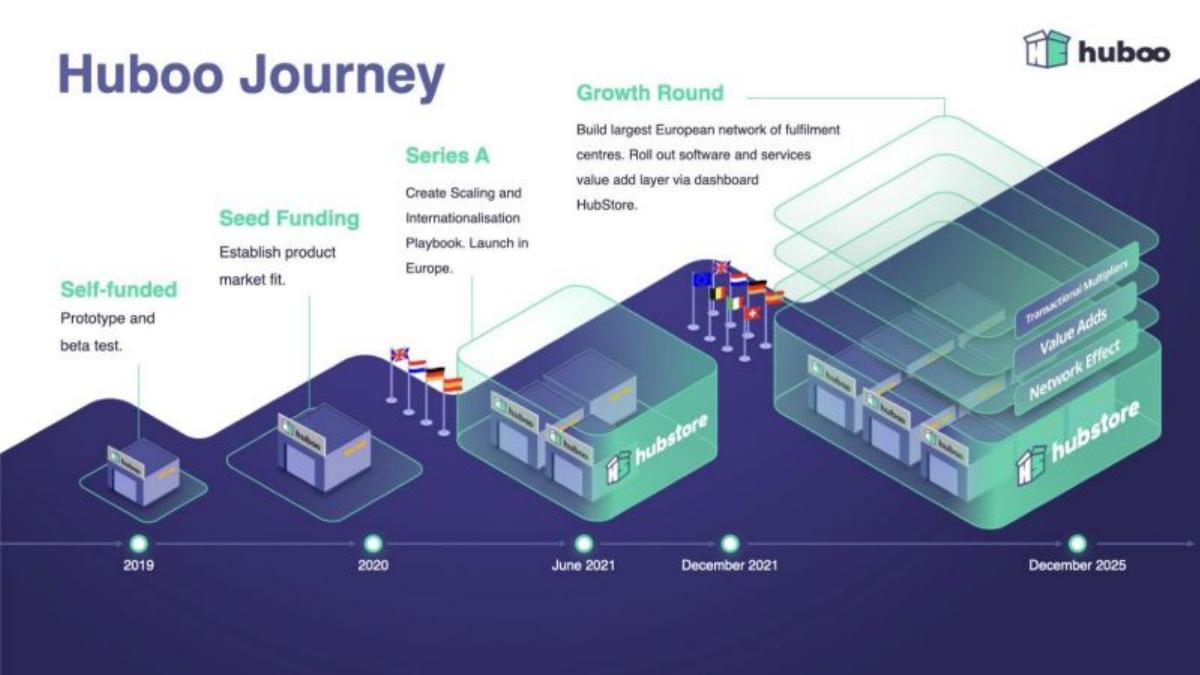
The timeline slide tracks the company from its self-funded prototype phase in 2019 through Seed and Series A rounds. It highlights the 'Growth Round' (this Series B) as the catalyst to build the 'largest European network of fulfilment centres.' The timeline extends to December 2025, projecting the addition of 'Value Adds,' 'Network Effects,' and 'Transactional Multipliers' through the 'HubStore' platform. It’s a clear visualization of how the company intends to evolve from a service provider to a platform.
Slide 7: Technology and Software Enabled
This slide reinforces the 'Full Stack' message with a simple visual of a worker at a computer terminal in front of warehouse shelving. The subtitle 'Technology and software enabled' is the key takeaway here, ensuring investors don't mistake Huboo for a traditional 3PL (Third Party Logistics) company that relies on manual processes or third-party software.
Slide 8: Business Plan
Solve Fulfilment: Rebuilding the process with software and automation for better margins. · Expand Service Offering: Moving into high-margin 'sticky' products like gift wrapping and software products that increase the transactional footprint. · Pan European Sales: Rapidly rolling out the platform across Europe.
This slide effectively communicates the strategy of 'land and expand'—first secure the fulfillment, then upsell the software and services.
Slide 9: Solve Fulfilment
This slide dives deeper into the operational model. It describes the solution as 'fully self-service,' which reduces support costs. It also mentions the ability to 'own the roadmap,' allowing Huboo to implement automation tech as it becomes 'commoditised in price.' The mention of a 'revolutionary operational model' that is 'Automation Ready' suggests that while the current model might be human-centric, the infrastructure is built for a robotic future.
Slide 10: Expand Service Offering
Here, Huboo explains how they will grow revenue per customer. They describe software products as 'transaction multipliers' that unlock growth for clients with a single click. The slide mentions 'Physical Value Adds' and 'Pan-European Distribution' as layers built on top of the core fulfillment service. This is the 'Moat' slide, arguing that their full-stack approach makes it harder for traditional competitors to keep up.
Slide 11: Pan-European Sales
The final content slide is a map of Europe showing the expansion roadmap. It lists milestones: 4 countries in 2021, 8 countries in 2022, and 20 countries by 2023. It notes that the 'PLAY BOOK for global rollout' and the 'HEADLESS OPS MODEL' have already been created. This is a classic Series B 'pour fuel on the fire' slide, showing exactly where the $81M will be spent.
Slide 12: Closing
The deck ends with a standard call to browse more examples on the source website. Note: The actual deck concludes without a specific 'Ask' slide or contact page in this version, which is common for decks shared publicly after a round closes.
What Huboo Does Well
Huboo excels at rebranding a physical commodity service as a scalable tech platform . By using terms like 'Full Stack,' 'Headless Ops,' and 'SaaS,' they align themselves with high-valuation software companies rather than low-valuation logistics firms. The use of consistent isometric illustrations throughout the deck makes the business feel modular, clean, and easy to understand. They also do a great job of addressing macro-economic hurdles (Brexit, Covid) as 'battle testing' rather than liabilities, which builds significant founder credibility.
What is Missing from the Deck
The most notable omission is detailed financial data . There are no slides covering:
Unit Economics: We don't see the contribution margin per order or the payback period on a new micro-warehouse. · Revenue Growth: While they mention headcount growth, they don't provide a graph of MRR or ARR. · Customer Metrics: There is no mention of Churn, Net Promoter Score (NPS), or Customer Acquisition Cost (CAC). · The Competition: The deck mentions 'existing fulfilment competitors' generally but does not name them or provide a feature-by-feature comparison.
While these details were almost certainly in the data room, their absence in the pitch deck suggests the narrative was focused entirely on the 'how' and 'where' of expansion.
What Founders Should Copy
Founders in 'unsexy' or operationally heavy industries should copy Huboo’s modular visualization strategy . If you are building something complex, don't show photos of warehouses; show isometric diagrams that emphasize the system . Also, the 'Investment Highlights' slide (Slide 5) is an excellent template for a Series B pitch—it summarizes the market, the product-market fit, the team, and the resilience of the business in one glance. Finally, the 'Huboo Journey' slide (Slide 6) is a great way to show how a company’s identity evolves from a 'prototype' to a 'platform' over time.
Frequently asked questions
- What is Huboo's core value proposition?
- Huboo provides a 'full-stack' fulfillment solution using a micro-warehousing model. Unlike traditional logistics providers that outsource software, Huboo vertically integrates all technology and operations. This allows for low-capex, rapid deployment of fulfillment centers that are 'automation ready' and capable of supporting small to mid-sized eCommerce merchants with high-margin value-added services.
- How does Huboo define its market opportunity?
- Huboo claims a £200 billion addressable market across the UK, EU, and US. They calculate this as 20% of the total £1 trillion eCommerce Gross Merchandise Volume (GMV). Slide 4 breaks this down further, noting the US market at £606B, the EU at £334B, and the UK at £121B.
- What is the 'HubStore' mentioned in the deck?
- The HubStore is presented as a dashboard-driven marketplace for value-added services. It allows Huboo to move beyond simple picking and packing into 'transactional multipliers.' These include physical upsells like gift wrapping and inserts, as well as software integrations that help clients manage multiple sales channels with a single click.
- What was Huboo's expansion strategy at the time of this raise?
- The strategy was aggressive European saturation. By the time of the Series B, they had established four centers in the UK and one in the Netherlands. The roadmap on Slide 11 projected expanding to 8 countries in 2022 and completing a 20-country European network by 2023.
- Does the deck include financial projections or unit economics?
- No. This specific deck focuses on the operational model, market size, and expansion roadmap. It lacks detailed financial tables, CAC/LTV metrics, or specific revenue figures. It relies on the 'Investment Highlights' slide to mention high-margin potential and the 'Huboo Journey' slide to show the progression of funding rounds.