SickWeather’s 2017 pitch deck is a masterclass in 'traction-first' storytelling. Eschewing the traditional problem/solution framework, the deck leads with a massive logo wall of enterprise partners like Pfizer and IBM, immediately establishing credibility. The core value proposition is speed: the platform claims to identify outbreaks two weeks before the CDC with 91% accuracy. Financially, the company showed strong momentum with $42k MRR and 85% margins, driven by 100% inbound interest. While the deck is light on specific product mechanics and competitive analysis, it leans heavily on social…
Key takeaways
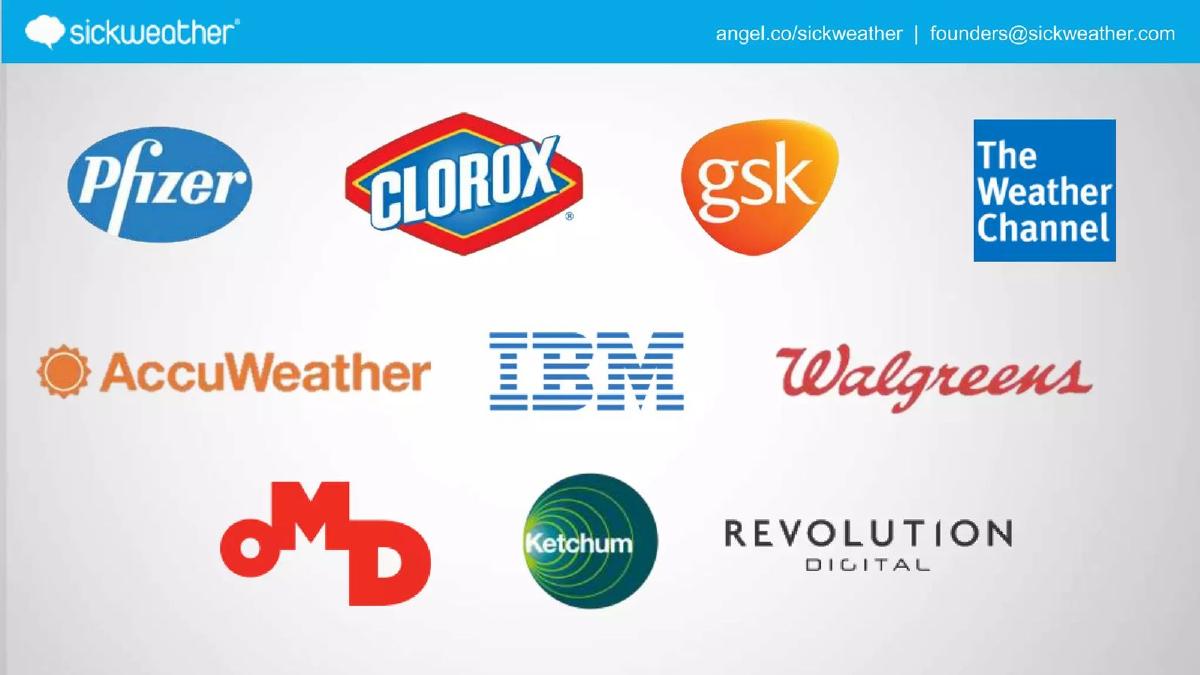
- The deck leads with an impressive logo wall featuring Pfizer, Clorox, GSK, and The Weather Channel to establish immediate enterprise trust (Slide 2).
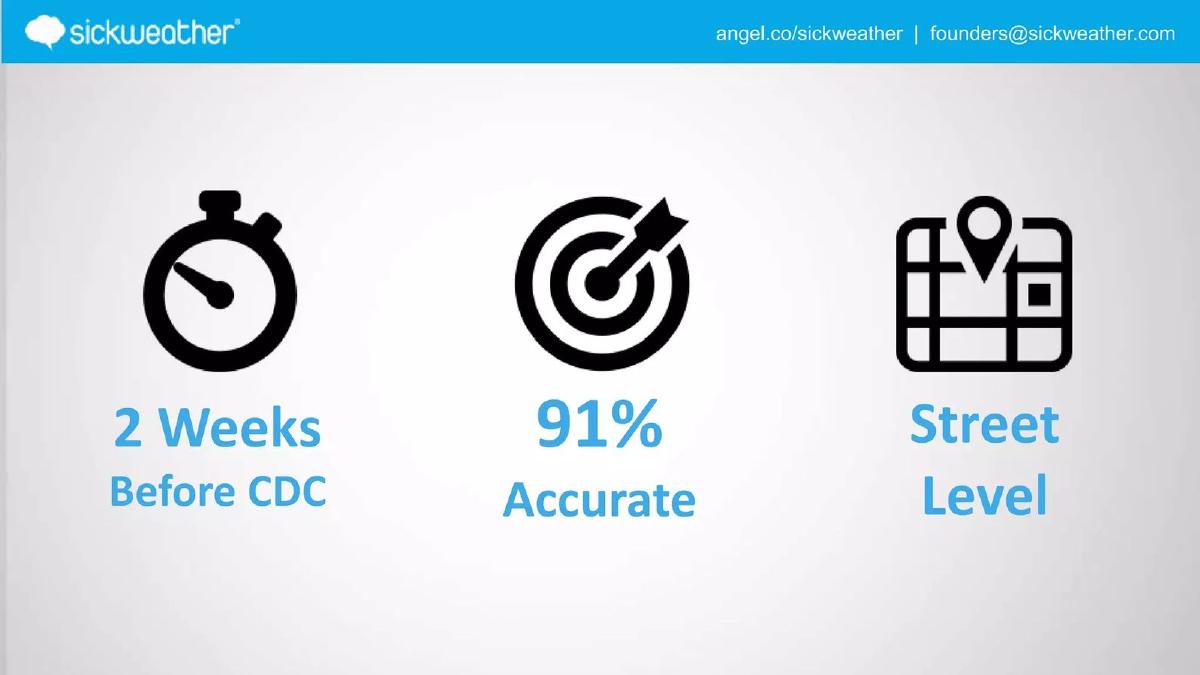
- SickWeather claims a significant speed advantage, identifying outbreaks 2 weeks before the CDC at a 'street level' (Slide 3).
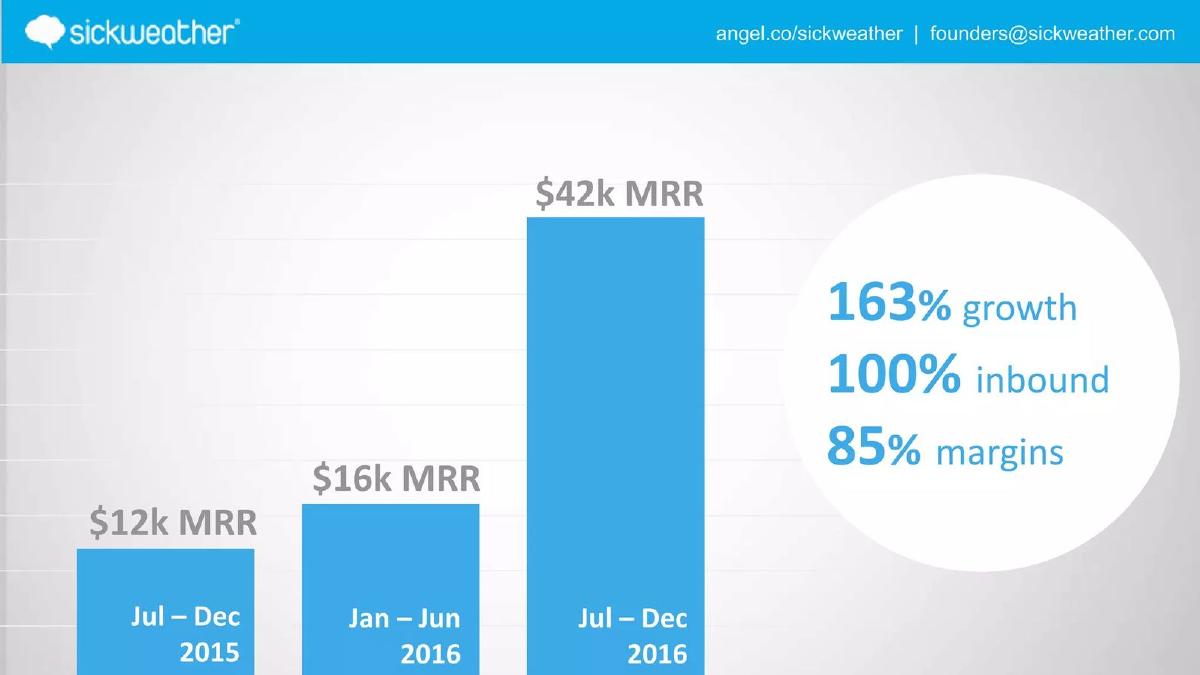
- Financial performance was robust at the time of the pitch, showing a jump from $12k MRR in late 2015 to $42k MRR by late 2016 (Slide 4).
- The business model benefits from high efficiency, reporting 85% margins and 100% inbound sales leads (Slide 4).
- The team slide highlights deep institutional pedigree with logos from the CDC, WHO, NIH, and Johns Hopkins (Slide 7).
- The platform's versatility is shown through integrations with Johnson & Johnson and Clorox, proving its B2B2C utility (Slide 9).
- The total addressable market is framed as a $12 billion health data market targeting 76 million people (Slides 10-11).
- Third-party validation from FierceMarkets highlights the AI's ability to predict flu outbreaks 15 weeks in advance (Slide 12).
The 'Weather Channel' for Germs: A 13-Slide Teardown
SickWeather positions itself as a hyperlocal illness data platform. By the time this deck was circulated in 2017, the company had already established significant enterprise traction. This teardown examines how they used a lean, visual-heavy approach to secure $525K in a bridge or seed-extension style round, eventually totaling over $2.6M in funding.
Slides 1-3: Credibility and the Core Value Prop
Slide 1: Title Slide The deck opens with a clean logo and the tagline "population health forecasting." It includes contact info and an AngelList link, which was common for startups in the mid-2010s to signal transparency and existing investor interest.
Slide 2: The Logo Wall Most decks put the 'Partners' slide at the end. SickWeather puts it second. This is a power move. By showing Pfizer, Clorox, GSK, The Weather Channel, IBM, and Walgreens immediately, they eliminate the 'risk' question. If these giants are working with them, the data must be valuable. This slide acts as a surrogate for a 'Problem' slide, implying that these companies have a problem that only SickWeather’s data can solve.
Slide 3: The Three Pillars This slide defines the product's superiority in three metrics: Speed ("2 Weeks Before CDC"), Accuracy ("91% Accurate"), and Granularity ("Street Level"). It is a highly effective slide because it addresses the three main concerns any health data buyer would have: Is it faster than the government? Is it right? And can I target a specific zip code?
Slides 4-6: Traction and Emotional Hook
Slide 4: Financial Growth The bar chart shows a clear upward trajectory in Monthly Recurring Revenue (MRR).
Jul – Dec 2015: $12k MRR · Jan – Jun 2016: $16k MRR · Jul – Dec 2016: $42k MRR
The callout bubble adds three critical context points: 163% growth, 100% inbound (meaning zero CAC or sales spend), and 85% margins. For an investor, 85% margins on an inbound-only sales model is the definition of a scalable software business.
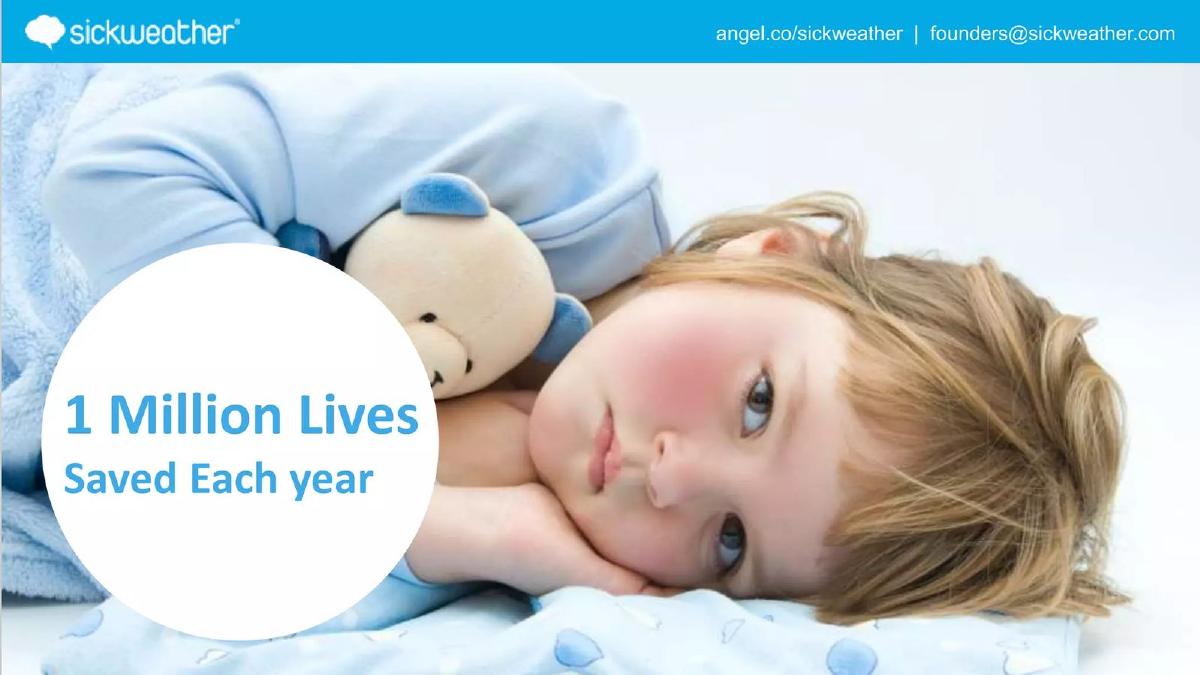
Slide 5 & 6: The Human Element Slide 5 is a full-bleed photo of a sick child. Slide 6 adds the text "1 Million Lives Saved Each year." This is a significant pivot from the cold, hard data of the previous slides. It reminds the investor that while this is a data play, the end result is a social good. It attempts to quantify the 'Impact' of the technology, though the deck does not provide a methodology for how that '1 Million' figure was calculated.
Slides 7-9: The Team and Product Integration
Slide 7: The Team The team slide is exceptionally strong for a healthcare startup. It features the three co-founders: Graham Dodge (CEO), James Sajor (COO), and Michael Belt (CTO). More importantly, it lists specialized roles like "Lead Data Scientist & Epidemiologist" and "Epidemiologist & Public Health Policy." The bottom of the slide is a second logo wall featuring the CDC, WHO, NIH, and Johns Hopkins, indicating where the team members were educated or previously employed. This builds 'Founder-Market Fit.'
Slide 8: Consumer Validation This slide shows the mobile app interface with a quote from the TODAY show: "It’s really great if you’re a parent!" This demonstrates that the product has mainstream appeal and has been featured in national media, which helps with organic user acquisition.
Slide 9: B2B2C Integrations This slide shows how SickWeather’s data is white-labeled or integrated into other apps. We see a "Sick Score" on a Clorox-branded map and a "Cold & Flu" tracker "Powered by Theraflu" (a GSK brand). This confirms the revenue model hinted at earlier: SickWeather is the 'Intel Inside' for illness tracking across the pharmaceutical and cleaning supply industries.
Slides 10-13: Market Size and Technical Proof
Slide 10 & 11: Market Opportunity The deck uses two slides to define the market. Slide 10 identifies the target as "76 Million People" (likely referring to parents in the US). Slide 11 values the "Health Data Market" at "$12 Billion." These are standard TAM (Total Addressable Market) figures, though they are somewhat broad. The deck doesn't break down how much of that $12B is actually serviceable by a social-listening platform.
Slide 12: Technical Validation This slide features a quote from FierceMarkets: "Sickweather’s A.I. accurately predicted late flu season outbreak 15 weeks in advance." It shows a complex graph from their 'pro' dashboard. This is the only slide that mentions "A.I." and provides a glimpse into the professional-grade analytics they sell to enterprises. The "15 weeks" claim is even more aggressive than the "2 weeks" claim on Slide 3, suggesting that for specific types of outbreaks, their lead time is massive.
Slide 13: Closing A repeat of the title slide. Notably, there is no 'Ask' slide. The deck does not state how much they are raising, the valuation, or the use of proceeds.
What Works in This Deck
Immediate Social Proof: By placing the enterprise logo wall on Slide 2, SickWeather bypasses the need to explain why their data is valuable. The market has already decided it is.
Metric-Driven Value: The comparison to the CDC is the strongest selling point. In the world of epidemiology, speed is everything. Claiming a 2-week lead time is a 'hair on fire' solution for health organizations.
High Margins: Highlighting 85% margins and 100% inbound sales is music to a VC's ears. It suggests that the product-market fit is so strong that the company doesn't need a massive, expensive sales force to grow.
What is Missing
The Ask: This is a major omission. A pitch deck is a tool to get a check. Without an 'Ask' slide, the investor doesn't know if the company is looking for $500k or $5M, or what they plan to do with the money.
Competitive Landscape: SickWeather isn't the only company doing social listening or health data. There is no mention of Kinsa (smart thermometers) or other digital health competitors. Investors want to know why SickWeather’s data moat is defensible.
The 'How': The deck is very high-level. It mentions A.I. and social listening but doesn't explain the proprietary nature of their algorithms. How do they filter out people joking about being 'sick' on Twitter versus actual reports? A 'Secret Sauce' slide would have added technical depth.
What a Founder Should Copy
The 'Three Pillars' Slide: Slide 3 is perfect. It uses simple icons and three bold stats to define the product's competitive advantage. Every founder should have a version of this slide that answers: Why you? Why now? How much better?
Pedigree Alignment: If your team has worked at the 'gold standard' institutions in your field (like the CDC or NIH), put those logos on your team slide. It transfers the authority of those institutions to your startup.
Integration Visuals: Showing your product inside the UI of a major partner (like the Clorox and J&J examples on Slide 9) is much more powerful than just saying "we have a partnership." It makes the business model tangible.
Final Thoughts
The SickWeather deck is a 'momentum' deck. It relies on the fact that the company is already moving fast, already making money, and already working with the biggest names in the industry. While it lacks the structural rigor of a traditional Sequoia-style deck, its focus on traction and credibility was clearly enough to satisfy investors in 2017.
Frequently asked questions
- How does SickWeather generate its data?
- While the deck doesn't provide a technical deep dive, it mentions 'social listening' and 'crowdsourced data' on slides 9 and 12. Specifically, it references using Twitter data within an 80% confidence interval to model illness reports. This allows them to bypass the lag time inherent in clinical reporting systems used by government agencies.
- What is the primary revenue model for SickWeather?
- The deck implies a B2B data licensing or API model. Slide 4 highlights 'MRR' (Monthly Recurring Revenue), and Slide 9 shows the technology 'Powered by' or integrated into the apps of major brands like Johnson & Johnson and Clorox. This suggests they sell their hyperlocal illness forecasting as a service to pharmaceutical and consumer goods companies.
- Who is the target audience for this pitch?
- The deck balances two audiences: enterprise investors and consumer-facing partners. It uses emotional imagery of sick children to appeal to the 'parent' demographic (Slide 5-6) while providing hard data on accuracy and margins to satisfy institutional investors looking for a scalable data-as-a-service (DaaS) play.
- What are the most significant gaps in the SickWeather deck?
- The deck completely omits a 'Competition' slide and a specific 'The Ask' slide. It does not state how much money is being raised in this specific round or how the funds will be allocated. Additionally, there is no detailed roadmap or explanation of the sales cycle, despite mentioning 100% inbound growth.
- How does SickWeather compare itself to the CDC?
- SickWeather positions itself as a faster, more granular alternative to the CDC. Slide 3 explicitly states they are '2 Weeks Before CDC' and provide 'Street Level' data. This framing suggests that while the CDC is the gold standard for official records, SickWeather is the gold standard for real-time actionable intelligence.