Slope’s 2021 Series A pitch deck is a masterclass in identifying a high-friction, unsexy problem—clinical trial supply chain management—and presenting a software-led solution. With only 11 slides, the company successfully raised $20M by highlighting that 80% of clinical trials run behind schedule due to operational complexity. The deck leans heavily on the 'outsider' perspective of its founders, who brought supply chain expertise from Amazon and Google to the pharmaceutical world. By quantifying the time saved—over 13 hours per patient visit—Slope moved beyond vague promises of 'efficiency' t…
Key takeaways
- The deck identifies that 80% of clinical trials are more than a month behind schedule due to operational complexity (Slide 2).
- Slope positioned its founders as 'pharma outsiders' with supply chain experience from Amazon and Google (Slide 3).
- The problem is quantified by the fact that 77% of research sites are routinely unprepared for patient enrollments (Slide 4).
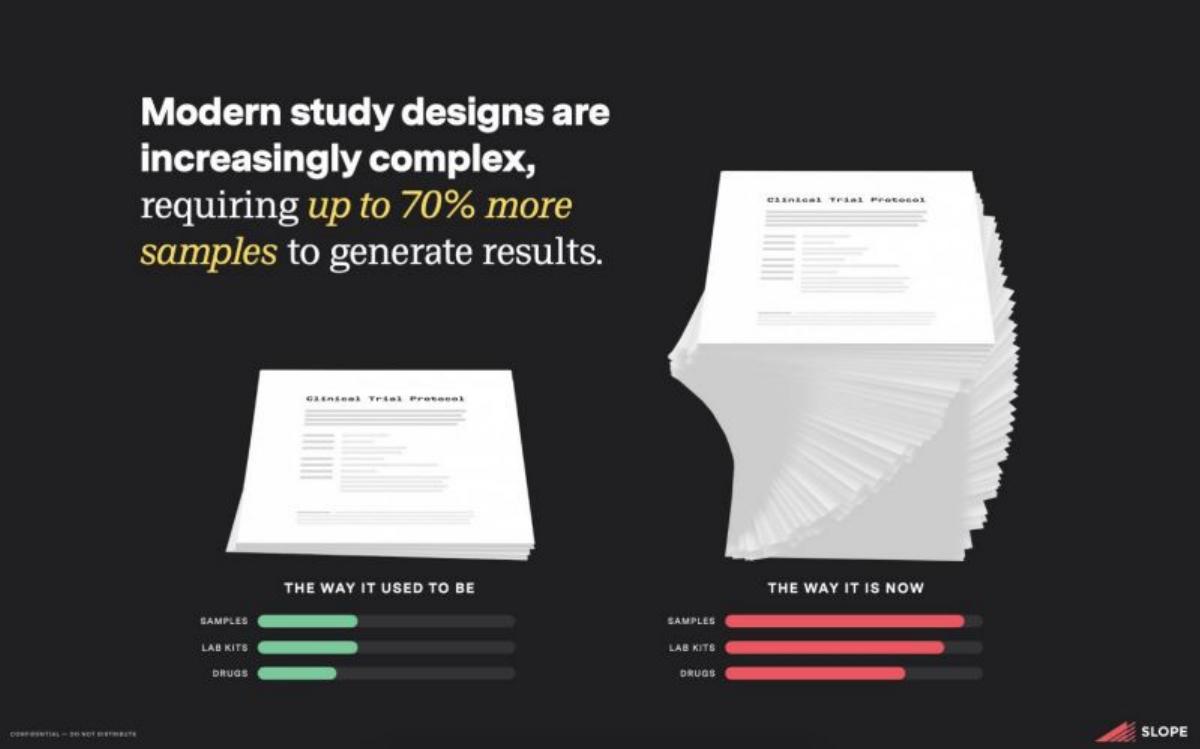
- Modern study designs are shown to require up to 70% more samples than in the past, increasing logistical burden (Slide 5).
- Slope reports significant traction with 4,500+ global users and 660 research sites already on the platform (Slide 8).
- The business model is diversified across software fees, fulfillment fees for lab kits, and project management support (Slide 9).
- The platform claims to save over 13 hours per patient visit across all study stakeholders (Slide 10).
- The financing ask is clearly stated as a $20M Series A to accelerate growth and expand the executive team (Slide 2).
The $20M Argument for Making Clinical Trials 'Boring'
Slope’s Series A pitch deck is a focused, 11-slide presentation that successfully raised $20M in 2021. The deck’s primary strength lies in its ability to take a highly technical, back-office problem—clinical trial supply chain management—and frame it as a critical bottleneck for the entire pharmaceutical industry. By using the tagline 'We make clinical trials boring,' Slope signals that their value is in removing the high-stakes drama of missing supplies and delayed patient visits.
Slide 1: The Hook
The cover slide is minimalist, featuring the Slope logo and the provocative sub-headline: "We make clinical trials boring." This is a sophisticated positioning move. In an industry where 'exciting' usually means risky or volatile, 'boring' implies reliability, automation, and the elimination of crises. The slide also includes a small chat bubble from CEO Rust Felix, adding a personal touch to a digital deck.
Slide 2: Executive Summary
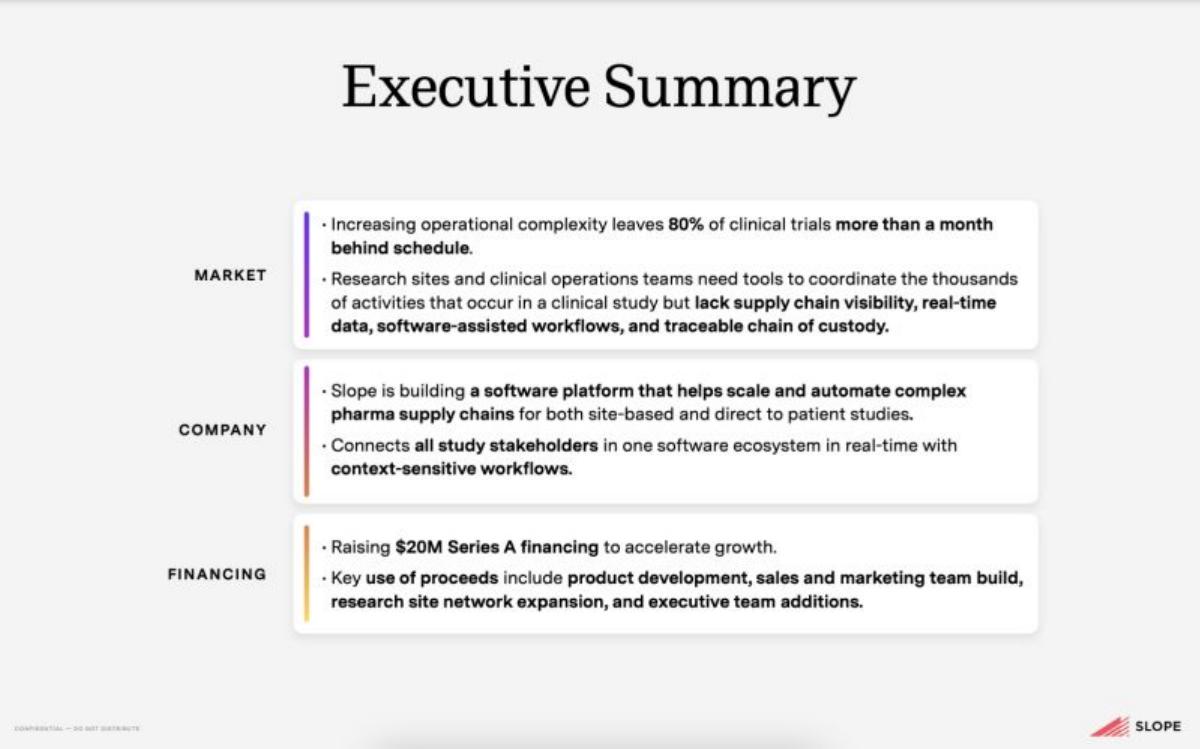
Slope chooses to put its 'Ask' and high-level metrics upfront. This slide is divided into three sections: Market, Company, and Financing. Slide 2 states that 80% of clinical trials are more than a month behind schedule. It identifies the company as a software platform that connects all stakeholders in real-time. Most importantly, it explicitly states the goal: Raising $20M Series A financing to accelerate growth, specifically for product development and sales team expansion.
Slide 3: Company Snapshot and Team
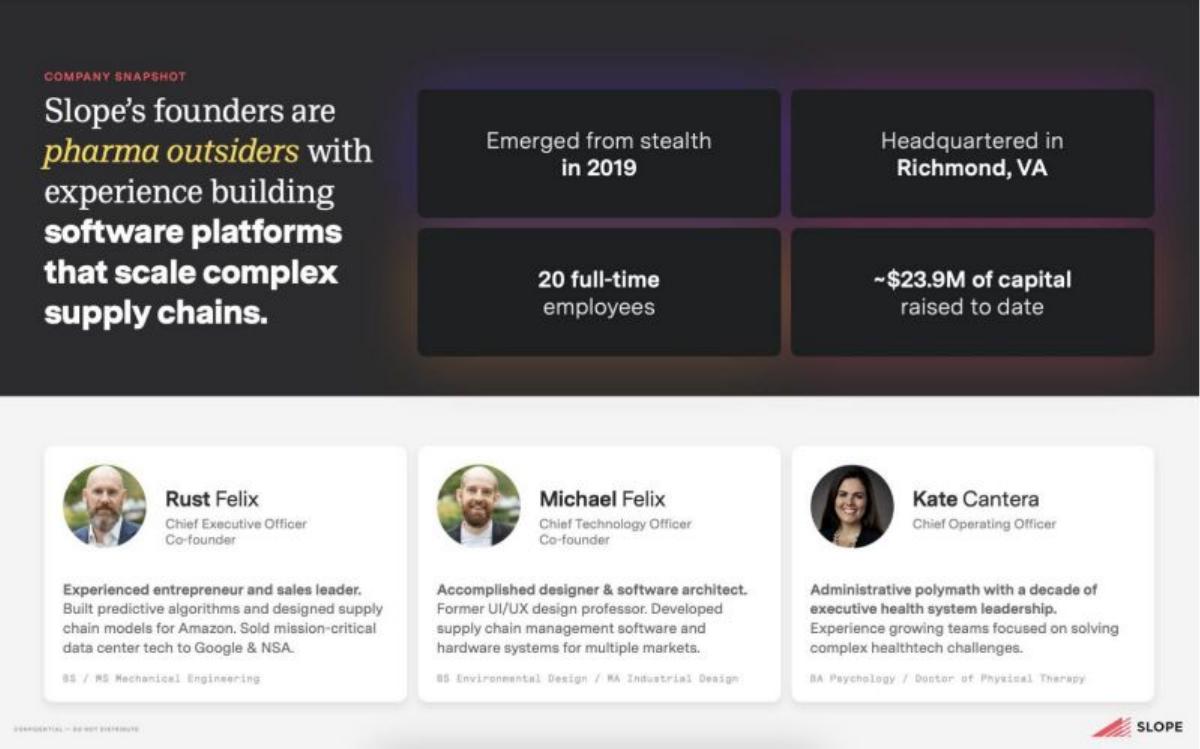
This slide tackles the 'Why Us' question by leaning into their status as "pharma outsiders." It lists the company's headquarters in Richmond, VA, its 20 full-time employees, and the ~$23.9M of capital raised to date. The team bios emphasize supply chain expertise over medical expertise. CEO Rust Felix is credited with building predictive algorithms for Amazon, while CTO Michael Felix is a former UI/UX professor. This suggests that the solution is a software and logistics problem, not a biological one.
Slide 4: The Patient Impact
Slope connects logistical failure to human consequences. Slide 4 claims that 77% of sites are routinely unprepared for enrollments. The text describes a scenario where a patient travels a long distance only to be turned away because the site lacks a specific sample kit or drug. The visual aid shows a 3D warehouse rack with missing items, highlighting the 'Samples,' 'Lab Kits,' 'Drugs,' and 'Devices' that Slope tracks.
Slide 5: Increasing Complexity
This slide explains why the problem is getting worse. It uses a simple visual comparison of 'The way it used to be' versus 'The way it is now.' According to Slide 5 , modern study designs require up to 70% more samples to generate results. The graphic shows a massive stack of paper protocols and increased bars for samples and lab kits, justifying the need for a digital solution to manage the sheer volume of data and physical assets.
Slide 6: The Status Quo (The Enemy)
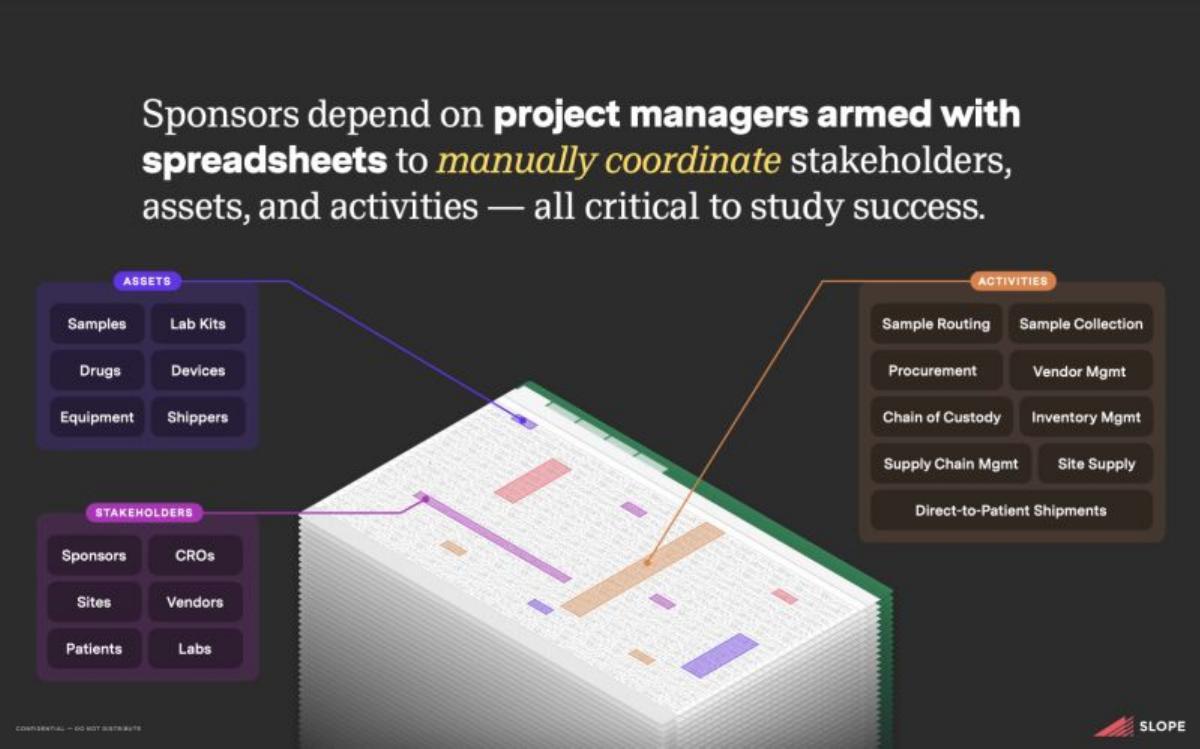
Slope identifies its primary competitor not as another startup, but as spreadsheets . The slide illustrates a massive stack of spreadsheets used to manually coordinate assets (samples, drugs, equipment), stakeholders (sponsors, CROs, patients), and activities (procurement, chain of custody, site supply). By visualizing the 'spreadsheet hell' that project managers face, Slope makes their automated platform feel like an inevitable necessity.
Slide 7: The Solution Architecture
This slide shows how Slope acts as a central hub. On the left, 'Study documents transform into structured workflows.' In the center, the Slope logo connects five stakeholder groups (Sponsors, CROs, Patients, Sites, Labs) to five asset types (Samples, Lab Kits, Drug, Devices, Equipment). On the right, a laptop screen shows the resulting 'real-time visibility' and 'chain of custody.' It is a clear 'Before and After' architectural map.
Slide 8: Market Momentum
Traction is presented through three key figures on Slide 8 : 4,500+ global users , 660 research sites , and 50,000+ managed samples and lab kits . The slide also includes icons for the physical goods they manage, reinforcing that their software is deeply integrated with the physical world of clinical research.
Slide 9: Business Model
Slope presents a transparent, three-pillar revenue model: Software, Fulfillment, and Support . Slide 9 details that they charge one-time startup fees and monthly fees per site/vendor for the software. For fulfillment, they charge per lab kit and shipping fee. For support, they charge project management and procurement fees. This 'fee structure that scales with studies' shows investors multiple ways the company can capture value as a trial grows in size or duration.
Slide 10: The Value Proposition (ROI)
The final content slide quantifies the efficiency gains. It breaks down workflows for the Research Site, Sponsor/CRO, Lab, and Kitting Services. The headline claim is that Slope can save over 13 hours per patient visit across all stakeholders. By showing an 'Automation Factor' ranging from 33% to 100% for specific tasks like 'Ship Sample' or 'Process Site Orders,' Slope provides the data necessary for a CFO or lead investor to justify the platform's cost.
Slide 11: Closing
The final slide is a standard call to action, though in this version of the deck, it appears to be a promotional slide for a pitch deck library. In a live fundraising environment, this would typically be the Q&A slide with contact information.
What Works in the Slope Deck
Specific Quantification: Slope avoids vague claims of 'better' or 'faster.' Instead, they cite specific percentages (80% of trials behind schedule, 77% of sites unprepared) and specific time savings (13 hours per patient visit). This level of detail builds immediate credibility with institutional investors.
The 'Outsider' Narrative: By highlighting their experience at Amazon and Google, the founders position themselves as experts in 'scale' and 'supply chain,' which are the exact pain points they identified in the pharma industry. It turns a potential weakness (lack of pharma background) into a competitive advantage.
Visualizing the 'Mess': Slides 5 and 6 do an excellent job of visualizing the complexity of the current system. The stack of spreadsheets and the growing pile of protocols make the viewer feel the weight of the problem before the solution is even presented.
What is Missing from the Slope Deck
Competitive Landscape: The deck assumes that spreadsheets are the only competition. While spreadsheets are the incumbent 'tool,' there are other clinical trial management systems (CTMS) and eClinical suites. A slide addressing how Slope integrates with or replaces these existing systems would have been valuable.
Unit Economics: While the business model is clear, the deck does not provide information on Customer Acquisition Cost (CAC), Lifetime Value (LTV), or gross margins. For a Series A, investors usually look for these 'engine' metrics to see how efficiently the $20M will be converted into revenue.
Market Size (TAM): There is no mention of the Total Addressable Market. While the problem is clearly large, the deck doesn't quantify the dollar value of the clinical trial logistics market, which is a standard requirement for most venture pitches.
Founder Takeaway: Copy This
The Executive Summary Slide: Every founder should include a slide like Slide 2 . It summarizes the market problem, the company's solution, and the financing ask in one place. If an investor only looks at one slide, they should understand the entire deal.
The ROI Table: Slide 10 is a masterclass in proving value. If your software saves time, don't just say 'it saves time.' Create a table that lists specific tasks, the current time taken, the 'automation factor,' and the resulting savings. It transforms your product from a 'nice-to-have' into a measurable financial asset.
The 'Boring' Positioning: If you are solving a back-office or infrastructure problem, don't try to make it sound 'sexy.' Lean into the reliability and the removal of friction. Slope's 'We make clinical trials boring' is one of the most effective taglines in recent fundraising history because it speaks directly to the customer's deepest desire: peace of mind.
Company: Slope · Sector: Healthcare / Logistics · Stage: Series A · Year: 2021 · Amount: $20M · Slides: 11
Frequently asked questions
- What specific problem does Slope solve in the healthcare sector?
- Slope addresses the 'chaos' of clinical trial logistics. According to Slide 4, 77% of research sites are unprepared for patient visits because they lack the correct sample kits, drugs, or devices. The deck argues that as trials become more complex—requiring 70% more samples (Slide 5)—manual coordination via spreadsheets becomes impossible, leading to delays and patient turnover.
- How does Slope generate revenue according to the deck?
- Slope utilizes a multi-layered business model detailed on Slide 9. This includes 'Software' revenue (one-time startup fees and monthly fees per site/vendor), 'Fulfillment' revenue (lab kit and shipping fees based on activity), and 'Support' revenue (monthly project management and procurement fees). This structure allows them to capture value from both the software platform and the physical logistics.
- Who are the founders and what is their background?
- The founders, Rust Felix (CEO) and Michael Felix (CTO), are described on Slide 3 as 'pharma outsiders.' Rust Felix previously built supply chain models for Amazon and sold tech to Google and the NSA. Michael Felix is a former UI/UX design professor. They are joined by COO Kate Cantera, who brings a decade of executive health system leadership.
- What traction had Slope achieved at the time of this Series A deck?
- Slide 8 highlights significant market momentum, reporting over 4,500 global users and 660 research sites. Additionally, the platform was managing over 50,000 samples and lab kits. The company had already raised approximately $23.9M in capital prior to or including this round's close, as noted in the company snapshot on Slide 3.
- What is missing from the Slope pitch deck?
- The deck is notably missing a dedicated competitor slide or a market map. It assumes the primary competition is 'manual spreadsheets' (Slide 6). It also lacks a detailed financial projection or a specific breakdown of the $20M use of proceeds beyond general categories like 'product development' and 'sales and marketing' (Slide 2).