Rippling's Series F deck, which secured $200M in 2024, deviates from standard visual-heavy pitches by utilizing a text-dense 'Investor Memo' format. The core thesis centers on the 'compound startup'—the idea that building multiple integrated products on a shared employee data primitive creates insurmountable advantages over 'point-SaaS' competitors. The deck provides empirical evidence that Rippling customers require half the administrative headcount of non-customers and demonstrates a massive CAC advantage, with cross-sell payback periods as low as 8 months. By positioning itself as the 'Sal…
Key takeaways
- The deck uses an unconventional long-form memo format rather than a visual slide deck, signaling a high-conviction, intellectual pitch (Slide 1).
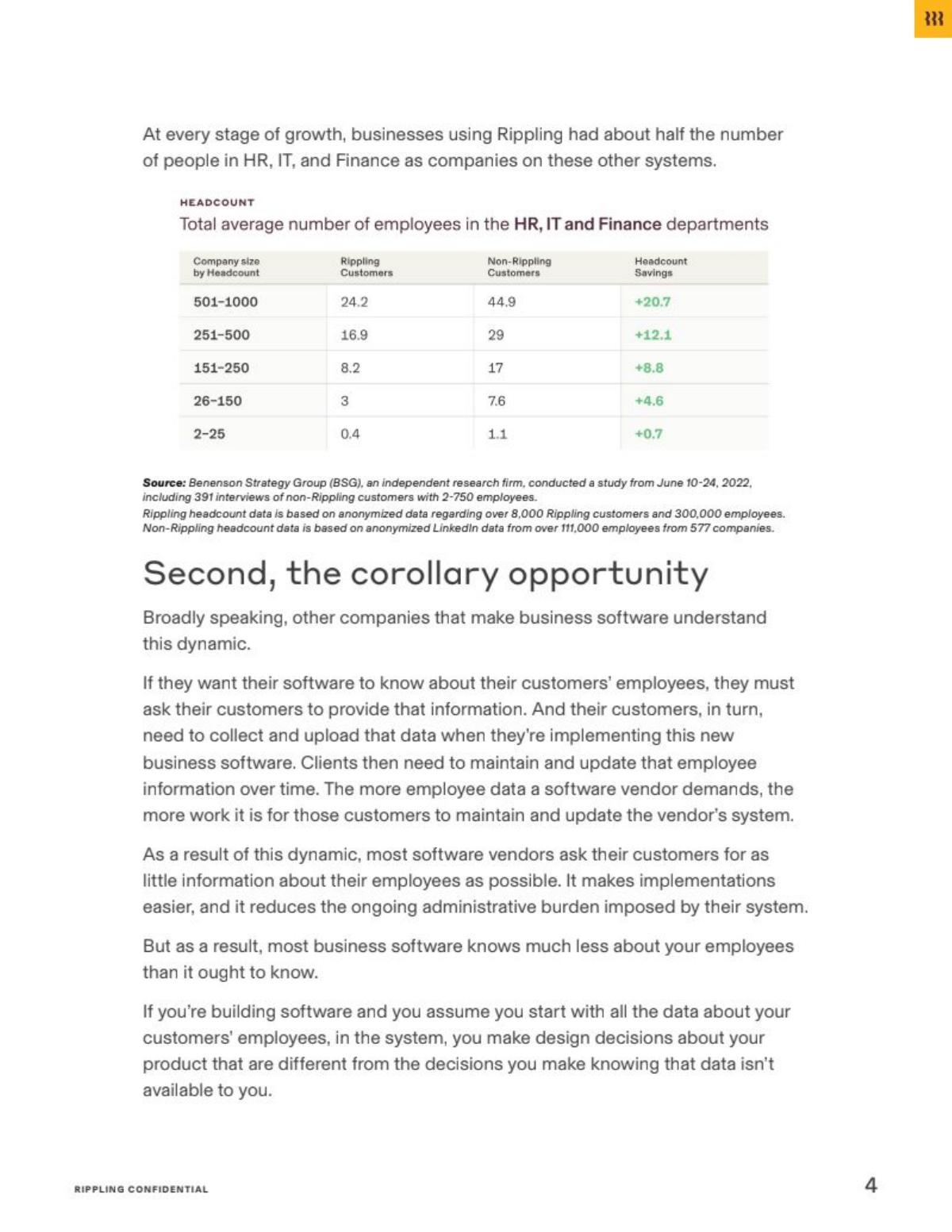
- Rippling claims its customers need half the headcount in HR, IT, and Finance compared to those using competitors (Slide 3).
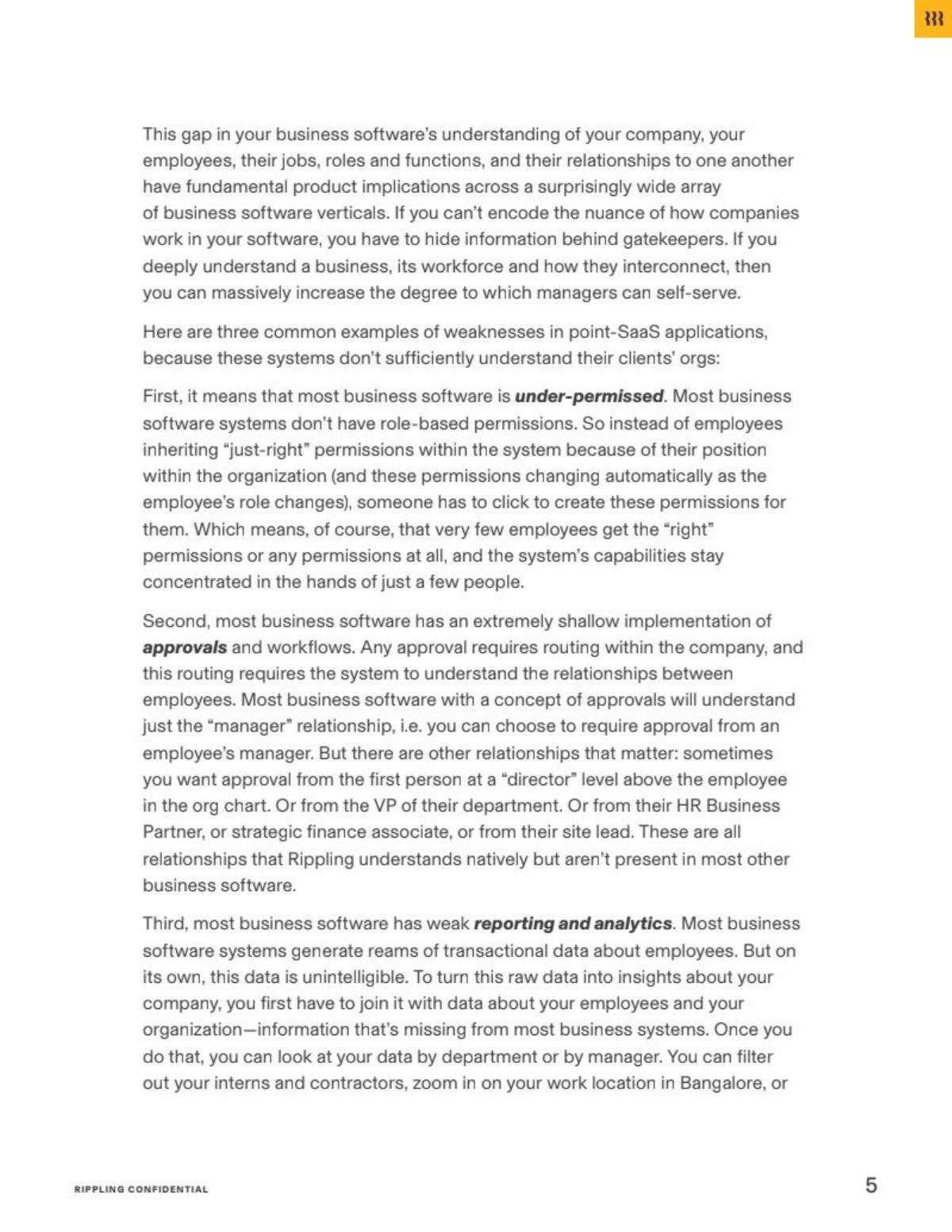
- The 'Employee Graph' is presented as the central primitive that allows Rippling to outperform point-solutions in permissions, workflows, and reporting (Slide 5).
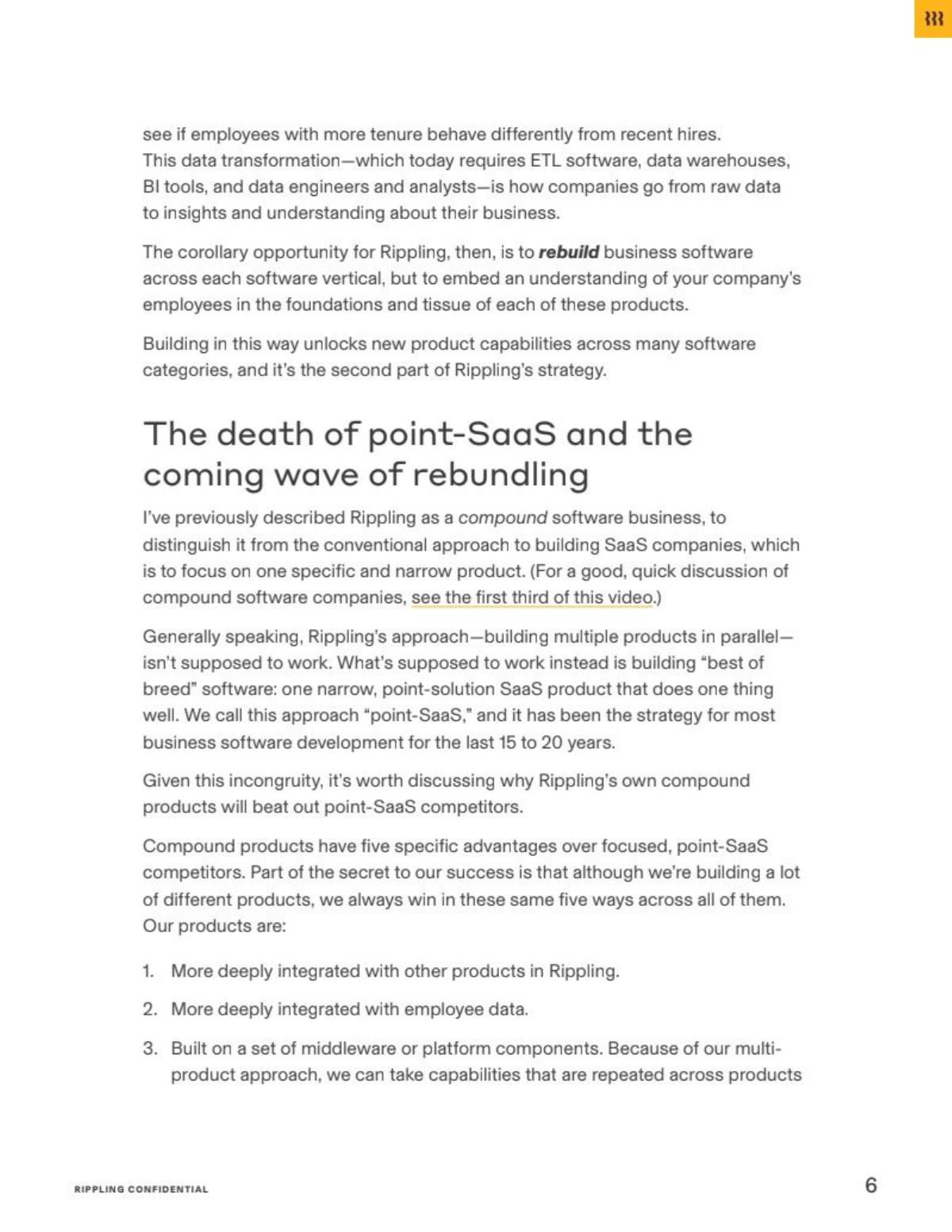
- Management explicitly rejects the 'best of breed' SaaS trend, arguing that bundled pricing and integrated middleware will lead to a 'rebundling' of the industry (Slide 6).
- The deck includes a detailed win-rate table showing Rippling wins 31% to 70% of deals when displacing specific incumbent categories like Spend Management and Global Payroll (Slide 10).
- Rippling justifies a high R&D spend (projected at 67-82% of revenue including stock-based comp) as an investment in shared platform components (Slide 12).
- Unit economics are the star: Rippling reports a 17-month blended CAC payback, which drops to just 10 months for cross-sell deals (Slide 14).
- The deck lacks a traditional team slide, competition grid, or specific 'Ask' slide, focusing entirely on the business thesis and unit economics.
The Series F Shift: From Slides to Strategy
Rippling’s Series F deck is not a deck in the traditional sense. It is a 15-page Investor Memo . By the time a company reaches a Series F and raises $200M from firms like Coatue and Founders Fund, the 'problem/solution' narrative is usually well-understood. This document is designed to address the structural 'Why' of the business model. It is a manifesto on the 'Compound Startup'—a term popularized by founder Parker Conrad to describe a company that builds many integrated products simultaneously rather than one 'best-of-breed' solution.
Slide 1-2: The Thesis of the Employee Primitive
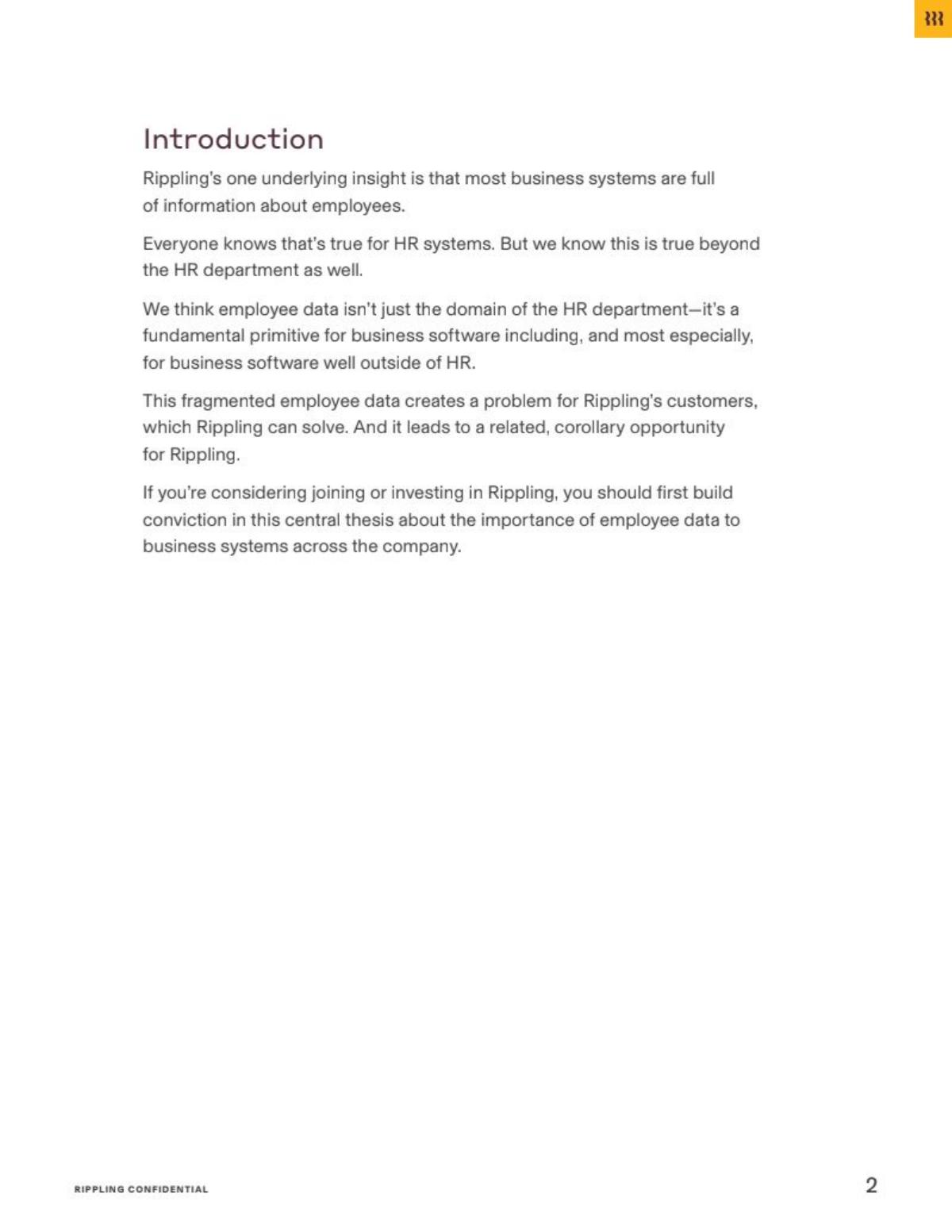
The document opens with a Disclaimer on Slide 1 and moves immediately into an Introduction on Slide 2. The core insight is stated plainly: employee data is a 'fundamental primitive' for business software, even outside of HR. Rippling argues that because most business systems are fragmented, they contain redundant, inconsistent employee data. The pitch starts not with a feature list, but with a philosophical stance on data architecture.
Slide 3-4: Quantifying the Administrative Burden
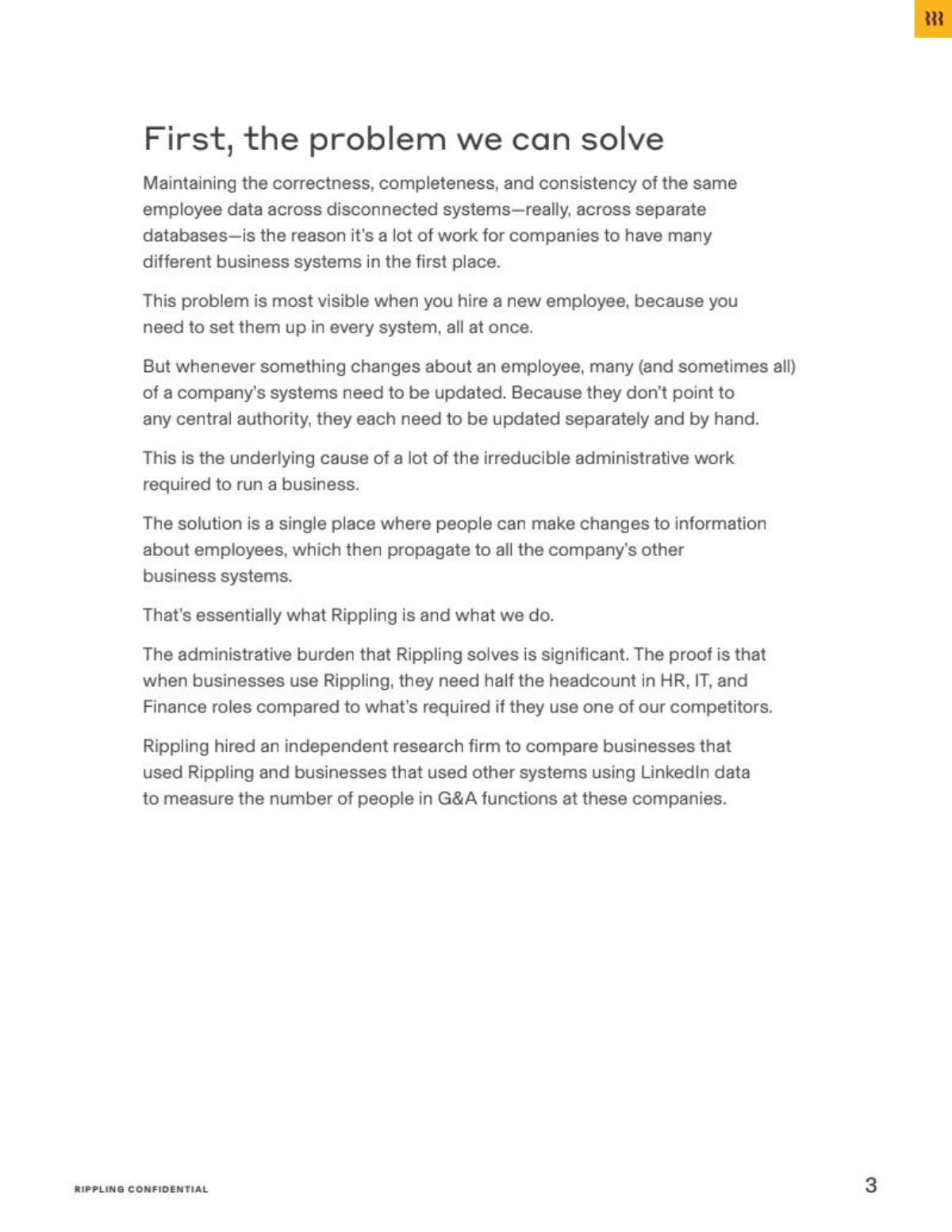
On Slide 3, Rippling introduces the 'Problem we can solve.' They define the problem as the 'irreducible administrative work' required to update disconnected systems. They offer a bold proof point: businesses using Rippling need half the headcount in HR, IT, and Finance compared to those using competitors. Slide 4 provides a data table to back this up, citing a study by Benenson Strategy Group. For a company with 501-1000 employees, Rippling customers average 24.2 G&A employees, while non-Rippling customers average 44.9 . This is a powerful 'Efficiency' argument for late-stage investors.
Slide 5-6: The Failure of Point-SaaS
Slide 5 dives into the technical weaknesses of 'point-SaaS' applications. Rippling argues that because standalone apps don't understand the 'org chart,' they are under-permissible , have shallow workflows , and weak reporting . They claim that Rippling understands relationships natively—like who a site lead or a strategic finance associate is—allowing for better automation. Slide 6 introduces the 'death of point-SaaS,' arguing that the industry is moving toward 'rebundling.' This is a direct challenge to the 'best-of-breed' mantra that dominated the 2010s.
Slide 7-9: The Salesforce Comparison
Slide 7 and 8 position Rippling as the next great platform company. They explicitly compare themselves to Salesforce . Just as Salesforce built a platform on top of 'customer data,' Rippling is building one on 'employee data.' Slide 8 features a diagram of 'Rippling Unity,' showing an HR Cloud, IT Cloud, and Finance Cloud all sitting on top of an Employee Graph . Slide 9 reinforces this 'inward-facing' vs 'outward-facing' data model, suggesting that Rippling and Salesforce are 'two sides of the same coin.'
Slide 10-11: Win Rates and Second-Mover Advantage
Slide 10 is perhaps the most valuable for a fundraising analyst. It lists Win Rates against incumbent solutions . Rippling shows they win 56% of deals against 'Spend Mgmt Company 1' and 70% against 'GP & EOR Company 3.' Interestingly, they don't name the competitors in the table, but the text on Slide 9 mentions names like Gusto, ADP, Workday, Brex, and Deel. Slide 11 introduces a 'second-mover advantage,' arguing that because the market for products like 'corporate cards' is mature, Rippling doesn't have to innovate on the 'how'—they just have to match the features and win on the integration .
Slide 12-13: The R&D Paradox
Slides 12 and 13 address the 'anomalous' finances of the company. Rippling admits to spending 46% of revenue on R&D (cash basis), which jumps to 67-82% when including stock-based compensation. They contrast this with public peers like Paycom (10%) and Paylocity (11%). Their defense is that they are building 'a dozen or more businesses' at once. They argue that their 'platform' teams build shared capabilities (analytics, permissions) that every new application can reuse, eventually leading to massive R&D efficiency as they scale.
Slide 14-15: The Unit Economics of Rebundling
The memo concludes with a deep dive into CAC (Customer Acquisition Cost) . Slide 14 shows a scatter plot of CAC Payback vs. Operating Margins for public SaaS companies. Rippling claims a 17-month blended CAC payback , significantly better than the 28-month public average. The 'secret weapon' is revealed on Slide 15: US Cross-Sell CAC Payback is only 10 months . The deck ends with a definitive statement: they will stop building new products only when they no longer have a cross-sell CAC advantage. The final line, 'Rippling is going to follow behind, eating software,' is a play on Marc Andreessen’s famous quote.
What Rippling's Deck Does Exceptionally Well
It sells a 'System of Logic' rather than a 'System of Features.' By the Series F, investors aren't looking for a demo; they are looking for a reason why this company will be worth $50B or $100B. Rippling provides a structural reason: the 'Compound Startup' model. By proving that their cross-sell CAC is drastically lower than their new-logo CAC, they make the case that their expansion is mathematically inevitable.
It uses 'Anomalous' data as a strength. Most founders try to hide high R&D spend or complex product maps. Rippling leans into them. They explain why the R&D is high and why the complexity is a moat that 'point-SaaS' competitors cannot afford to replicate. This transparency builds immense credibility with sophisticated investors.
What is Missing from the Rippling Deck
No Team Slide: There is no mention of the leadership team or their backgrounds. At Series F, the track record of the company speaks for itself, but it is still a notable omission for a standard pitch deck template.
No Specific Use of Funds: The deck does not specify how the $200M will be spent. It is assumed the capital will fuel the R&D engine described in Slide 12, but there is no 'The Ask' slide detailing milestones or hiring plans.
No Competitor Names in Data Tables: While the text mentions competitors, the specific win-rate data on Slide 10 anonymizes them (e.g., 'Spend Mgmt Company 1'). While common in shared decks, it leaves the investor to map the win rates to the market landscape themselves.
Founder's Guide: What to Copy from Rippling
The 'Primitive' Argument: If you are building in a crowded space, identify the 'data primitive' that everyone else is ignoring. Rippling didn't say 'we have better payroll'; they said 'everyone else has fragmented employee data.' Find your version of the 'Employee Graph.'
The Cross-Sell Metric: If you have multiple products, you must track and present your cross-sell CAC separately from your new-logo CAC. Showing a 10-month payback on expansion (Slide 15) is the most convincing way to justify a multi-product roadmap.
The Memo Format: For late-stage rounds or complex B2B products, consider a memo. It allows you to control the narrative and ensure the investor understands the structural advantages of your business, not just the surface-level UI.
Frequently asked questions
- Why did Rippling use a text-heavy memo instead of a visual deck?
- At the Series F stage, investors are buying into a complex, multi-product thesis rather than just a simple product idea. The memo format allows Parker Conrad to lay out a sophisticated philosophical argument for 'compound startups.' It forces investors to engage with the logic of the 'employee data primitive' and the structural advantages of rebundling, which are harder to convey through bullet points and icons.
- What is the 'Compound Startup' thesis mentioned in the deck?
- The thesis argues that the last 20 years of 'point-SaaS' (one product for one problem) is ending. Rippling believes that by building many products on a single middleware layer (the 'Employee Graph'), they can offer better permissions, reporting, and pricing than standalone competitors. This allows them to amortize R&D and sales costs across many SKUs, eventually outcompeting specialized vendors on both price and functionality.
- How does Rippling justify its extremely high R&D spending?
- Rippling spends 46% of cash revenue on R&D, which is significantly higher than public peers like Paycom (10%) or Paylocity (11%). They argue this is a temporary 'multiple' of what a point-SaaS company spends because they are building a dozen businesses at once. They claim that as the shared 'platform' components mature, the marginal cost to build new applications will decrease, leading to superior long-term margins.
- What are the specific unit economics disclosed in the Series F deck?
- The deck highlights a blended CAC payback period of 17 months. However, the most compelling figure is the 10-month payback for cross-selling to existing customers. If you only look at the marginal cost of the cross-sell (excluding underlying marketing overhead), that payback drops to 8 months. This efficiency is the core engine of their growth strategy.
- Who does Rippling consider its primary competition?
- The deck lists a wide range of competitors depending on the segment: Gusto and ADP for small businesses; Paylocity and Workday for mid-market; and point-solutions like Brex (Spend), Greenhouse (ATS), and Deel (EOR). However, the memo concludes that their true long-term competitors are not point-SaaS companies, but other 'thick platform' companies like Salesforce, Microsoft, Oracle, and ServiceNow.