Roadrunner’s 11-slide deck for their $70M Series D round is a masterclass in high-level narrative and market positioning. Rather than drowning investors in technical specifications, the deck focuses on the systemic failure of the $80 billion waste industry, which is dominated by five companies dependent on landfills for profit. The company highlights significant traction, including $40M+ saved for businesses and 160K+ tons recycled. By contrasting their 'direct routing' model against the 'traditional approach' of inefficient compaction trucks and contaminated landfills, Roadrunner positions i…
Key takeaways
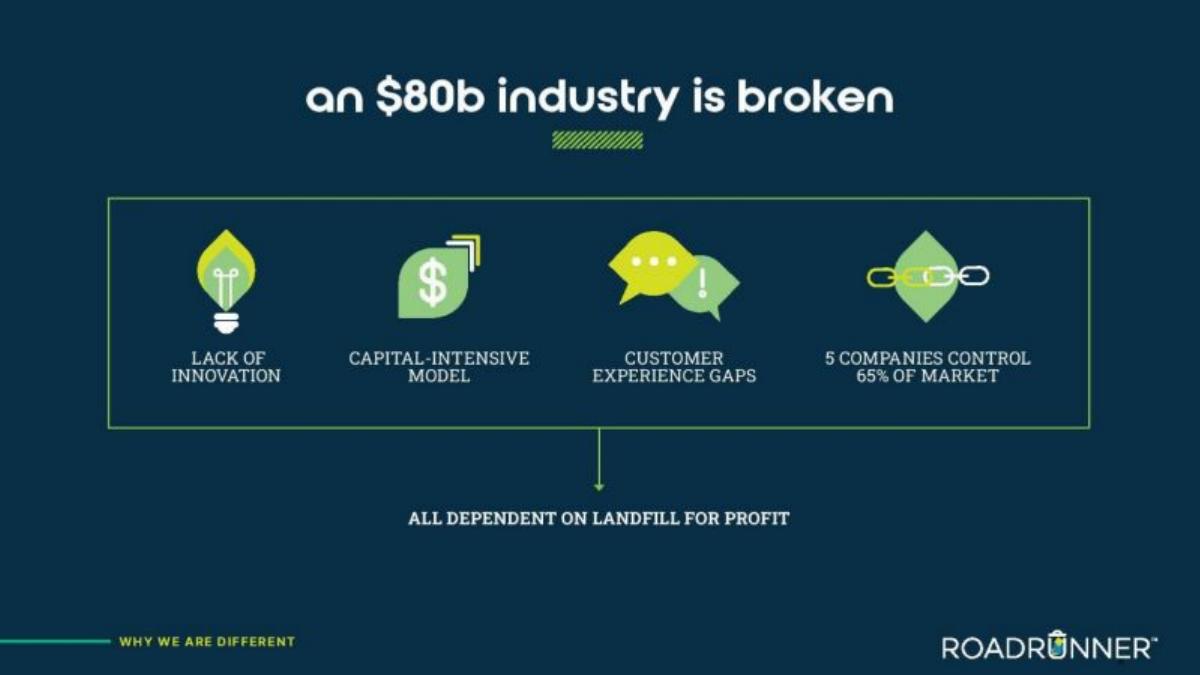
- The waste management industry is valued at $80 billion, with 65% of the market controlled by just five companies (Slide 6).
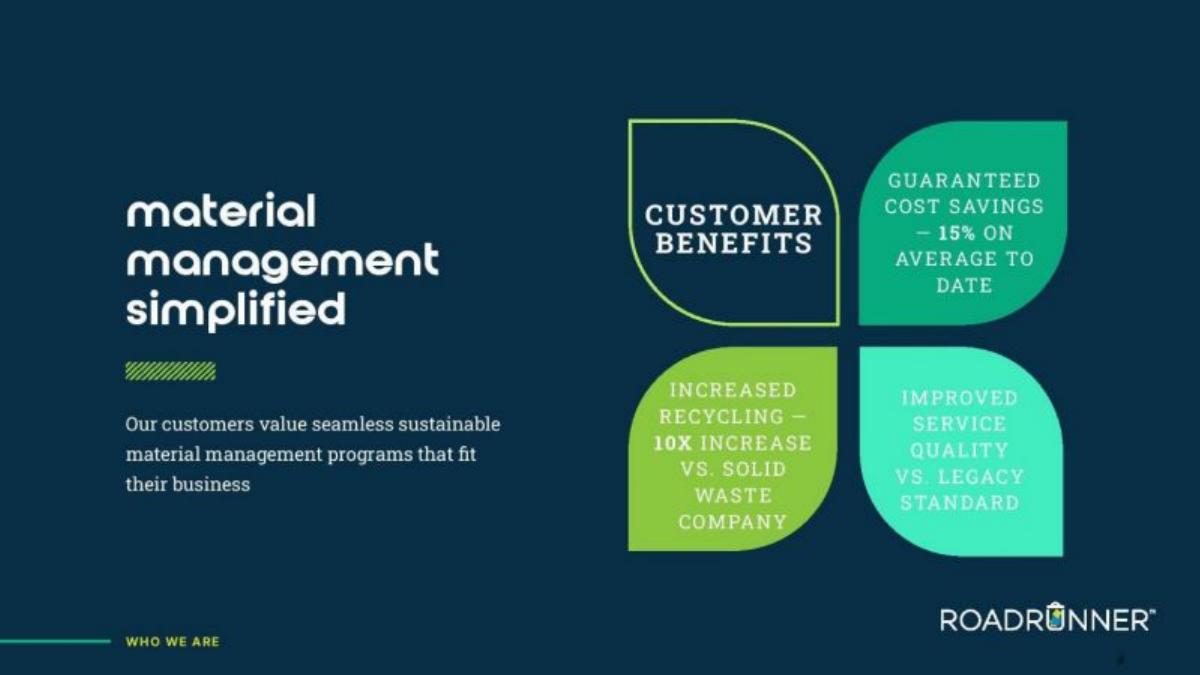
- Roadrunner claims to save customers an average of 15% on waste expenses to date (Slide 3).
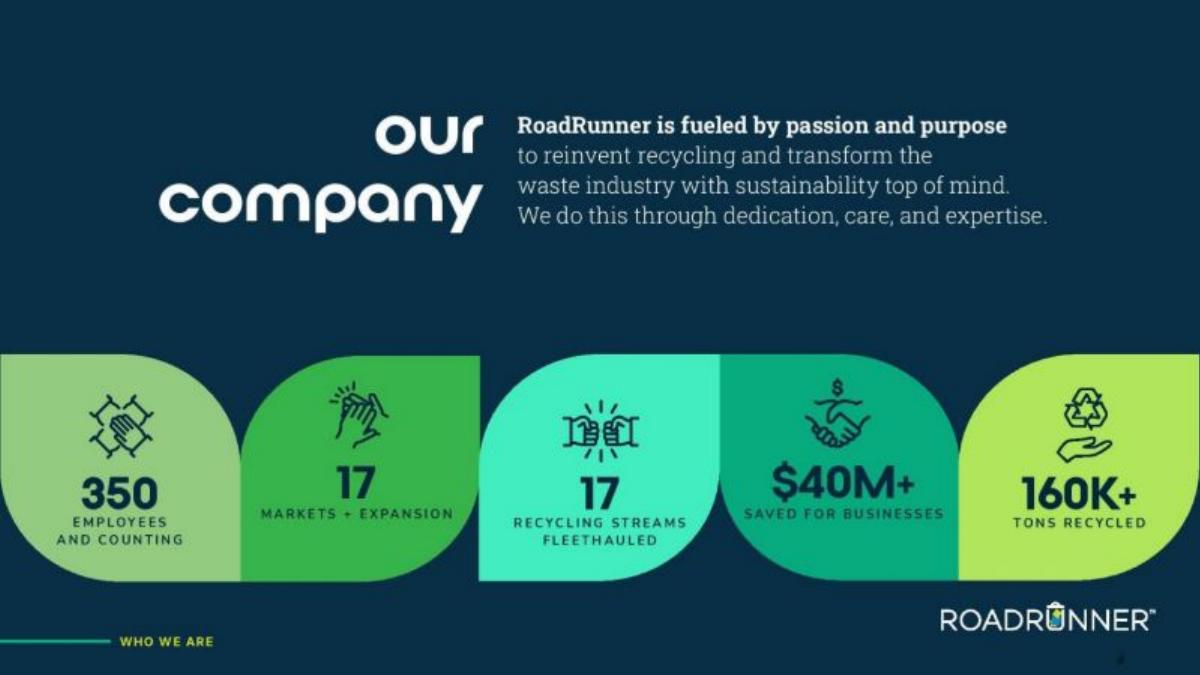
- The company has achieved significant scale with 350 employees and operations in 17 markets (Slide 4).
- Roadrunner’s effective recycling rate is 40%, which is 10x the national average of 4% (Slide 8).
- The business has saved over $40 million for its customers and recycled more than 160,000 tons of material (Slide 4).
- The deck identifies a massive shift in corporate behavior, noting that Fortune 500 companies with carbon goals grew 6x between 2016 and 2020 (Slide 7).
- The 'Roadrunner approach' replaces traditional $90/ton sorting facilities with pre-sorting and direct routing to improve margins (Slide 9).
- The deck omits a traditional executive team slide, choosing instead to list marketing, PR, and creative contacts on the final slide (Slide 10).
The Narrative of Market Disruption
Roadrunner’s Series D deck is a concise, 11-slide presentation that prioritizes market sentiment and high-level operational differences over granular data. At the Series D stage, investors are typically looking for a proven engine of growth and a clear path to market dominance. Roadrunner addresses this by framing the waste management industry as a broken, stagnant monopoly ripe for technological intervention.
Slide 1: Title and Introduction
The deck opens with a minimalist 'hello' and the company name. It is labeled as a 'Partner Support Reference,' suggesting this version of the deck may have been used for both investors and strategic partners. The branding is clean, utilizing a dark blue and green palette that reinforces the 'green' nature of the business without relying on clichéd environmental imagery.
Slide 2: The Mission Statement
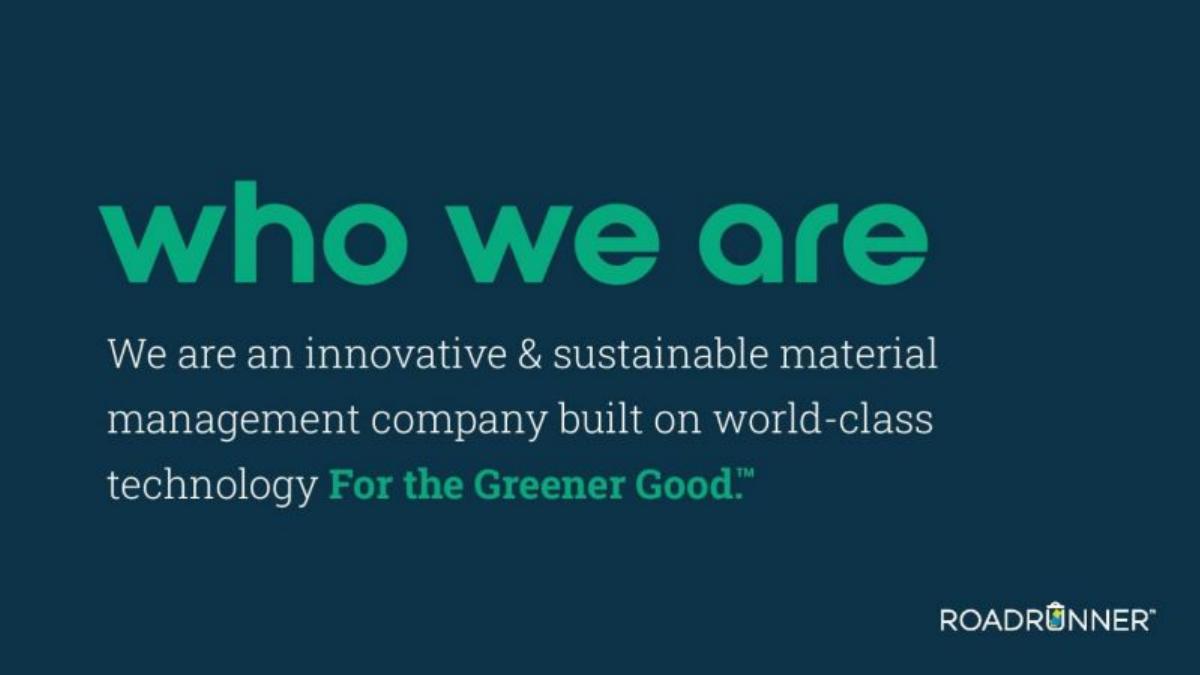
Slide 2 defines Roadrunner as an 'innovative & sustainable material management company.' The use of the term 'material management' instead of 'waste management' is a subtle but important linguistic shift. It positions the company as part of the circular economy rather than just a trash collector. The tagline 'For the Greener Good' is trademarked, indicating a mature brand identity.
Slide 3: Customer Benefits and Value Prop
This slide gets straight to the ROI. Roadrunner claims 'Guaranteed Cost Savings — 15% on average to date.' This is a powerful hook for enterprise sales. They also claim a '10x increase' in recycling versus traditional solid waste companies. By quantifying these benefits early, the company justifies its existence as a value-add service rather than a commodity expense.
Slide 4: Traction and Scale
Slide 4 provides the 'hard' numbers that back up the mission. The company lists:
350 Employees and counting. · 17 Markets + expansion. · 17 Recycling Streams fleet-hauled. · $40M+ Saved for businesses. · 160K+ Tons recycled.
This slide proves that Roadrunner has successfully scaled its operations across multiple geographies and is handling significant volume.
Slide 5 & 6: The Problem — A Broken $80B Industry
Slide 6 is the 'villain' slide. It identifies an $80 billion industry that is 'broken.' The deck lists four key pain points: lack of innovation, capital-intensive models, customer experience gaps, and the fact that '5 companies control 65% of the market.' The most damning indictment is at the bottom: 'All dependent on landfill for profit.' This creates a clear 'us vs. them' narrative where Roadrunner is the only player whose incentives align with the customer's sustainability goals.
Slide 7: The Market Opportunity (ESG Tailwinds)
Roadrunner uses Slide 7 to show that the market is moving in their direction. They cite $35+ trillion in global investment and show a graph where the percentage of Fortune 500 companies with carbon goals grew 6x between 2016 and 2020. This slide tells investors that Roadrunner isn't just a waste company; it's a tool for the world's largest corporations to meet their mandatory ESG targets.
Slide 8: The Impact Gap
This slide visualizes the efficiency of their model. It contrasts the 4% national average effective recycling rate with Roadrunner’s 40% average . It then points toward a 'future state' of 100% circularity. This 10x improvement is the core of their technological and operational moat.
Slide 9: The Operational 'How'
Slide 9 is the most technical slide in the deck, comparing the 'Traditional approach' to the 'Roadrunner approach.' It highlights the inefficiencies of traditional haulers:
Inefficient trucks getting less than 3 mpg. · $90/ton direct sorting costs at facilities. · Only 20% of volume actually recycled due to contamination.
Roadrunner’s counter-model emphasizes pre-sorting and direct routing using smaller, less expensive vehicles. They claim this allows 99% of original volume to be recycled. This slide explains how they achieve the 15% cost savings mentioned on Slide 3: they remove the expensive, inefficient middle-man (the sorting facility).
Slide 10: Contact and Conclusion
The deck ends with a 'thanks' and contact information for Marketing, PR, and Creative leads. Interestingly, there is no mention of the CEO, COO, or CFO here. This reinforces the idea that this specific deck may have been a general-purpose 'About Us' or 'Partner' deck used during the Series D roadshow rather than the primary investor pitch.
What Roadrunner Does Well
Quantifiable Value: The deck is excellent at putting numbers to its claims. The 15% cost savings and 10x recycling rate are clear, memorable, and highly attractive to both customers and investors.
Industry Critique: By pointing out that the incumbents are 'dependent on landfill for profit,' Roadrunner exposes a fundamental conflict of interest in the traditional waste industry. This makes their 'innovative' approach seem like the only logical choice for a modern business.
Visual Storytelling: Slide 9 is a perfect example of how to explain a complex operational shift using simple icons and flowcharts. It makes the 'Roadrunner approach' look cleaner, simpler, and more efficient than the status quo.
What is Missing from the Deck
The Team: For a Series D round of $70M, the absence of a team slide is highly unusual. Investors at this stage want to see a world-class executive bench with experience in logistics, waste management, and scaling technology companies.
Financials: There is no mention of Revenue, Gross Margin, or EBITDA. While they mention $40M saved for customers, they don't disclose how much of that value Roadrunner captures as revenue.
The Technology: The deck mentions being 'built on world-class technology' (Slide 2), but never explains what that technology actually is. Is it a routing algorithm? A marketplace for haulers? A sensor-based waste tracking system? The 'how' of the technology is left entirely to the imagination.
The Ask: There is no slide detailing how much they are raising (though we know from external facts it was $70M) or what the funds will be used for (e.g., geographic expansion, R&D, or acquisitions).
What Other Founders Should Copy
The 'Villain' Narrative: Founders in stagnant industries should copy Roadrunner’s approach to Slide 6. Identifying the specific reasons why an industry is 'broken'—especially when those reasons involve misaligned incentives—is a powerful way to justify a new market entrant.
The ROI Hook: If your product saves money, put the percentage on the first three slides. Roadrunner’s '15% average savings' is the strongest part of their pitch because it turns a 'nice-to-have' sustainability goal into a 'must-have' financial decision.
Comparative Diagrams: Use the 'Traditional vs. Our Approach' format seen on Slide 9. It is the most effective way to communicate operational innovation without getting bogged down in technical jargon.
Frequently asked questions
- What is Roadrunner's core value proposition to businesses?
- According to Slide 3, Roadrunner offers three primary benefits: guaranteed cost savings averaging 15%, a 10x increase in recycling compared to solid waste companies, and improved service quality over legacy standards. This dual-track value proposition appeals to both the CFO (cost reduction) and the Chief Sustainability Officer (ESG goals).
- How does Roadrunner's operational model differ from traditional waste haulers?
- Slide 9 illustrates that traditional haulers use inefficient compaction trucks (less than 3 mpg) and send mixed materials to sorting facilities with $90/ton costs, often resulting in only 20% of volume being recycled. Roadrunner emphasizes pre-sorting at the collection point and uses smaller, less expensive vehicles for direct routing, claiming that 99% of original volume is recycled.
- What market tailwinds is the company leveraging for its Series D?
- Slide 7 points to a 'sustainability is now required vs. preferred' trend. It cites $35+ trillion in global investment and a 6x increase in Fortune 500 companies setting aggressive carbon goals. This suggests that Roadrunner is positioning itself not just as a waste company, but as a critical infrastructure partner for the ESG movement.
- What are the key traction metrics shared in the deck?
- Slide 4 provides a snapshot of the company's scale: 350 employees, 17 markets, 17 recycling streams fleet-hauled, $40M+ saved for businesses, and 160K+ tons recycled. These figures demonstrate that the company has moved well beyond the proof-of-concept stage into significant regional expansion.
- What is missing from this pitch deck that an investor might expect?
- The deck is notably light on financial specifics and team pedigree. There is no slide detailing the founders' backgrounds, no breakdown of Revenue/ARR, and no explicit 'Ask' slide detailing how the $70M will be allocated. It functions more as a high-level strategic overview than a granular financial model.