Roam and Wander’s 13-slide deck is a masterclass in visual storytelling and social proof. Eschewing dense text for high-impact photography, the company illustrates a clear problem—children glued to screens—and offers a 'phygital' solution: plush toys that integrate with mobile devices. The deck highlights a team with pedigree from Apple, Pixar, and Disney, while proving product-market fit through retail placements in global chains like Apple and Toys 'R' Us. Despite a lack of detailed financial projections or a specific 'ask' slide, the deck successfully communicates a brand-first strategy th…
Key takeaways
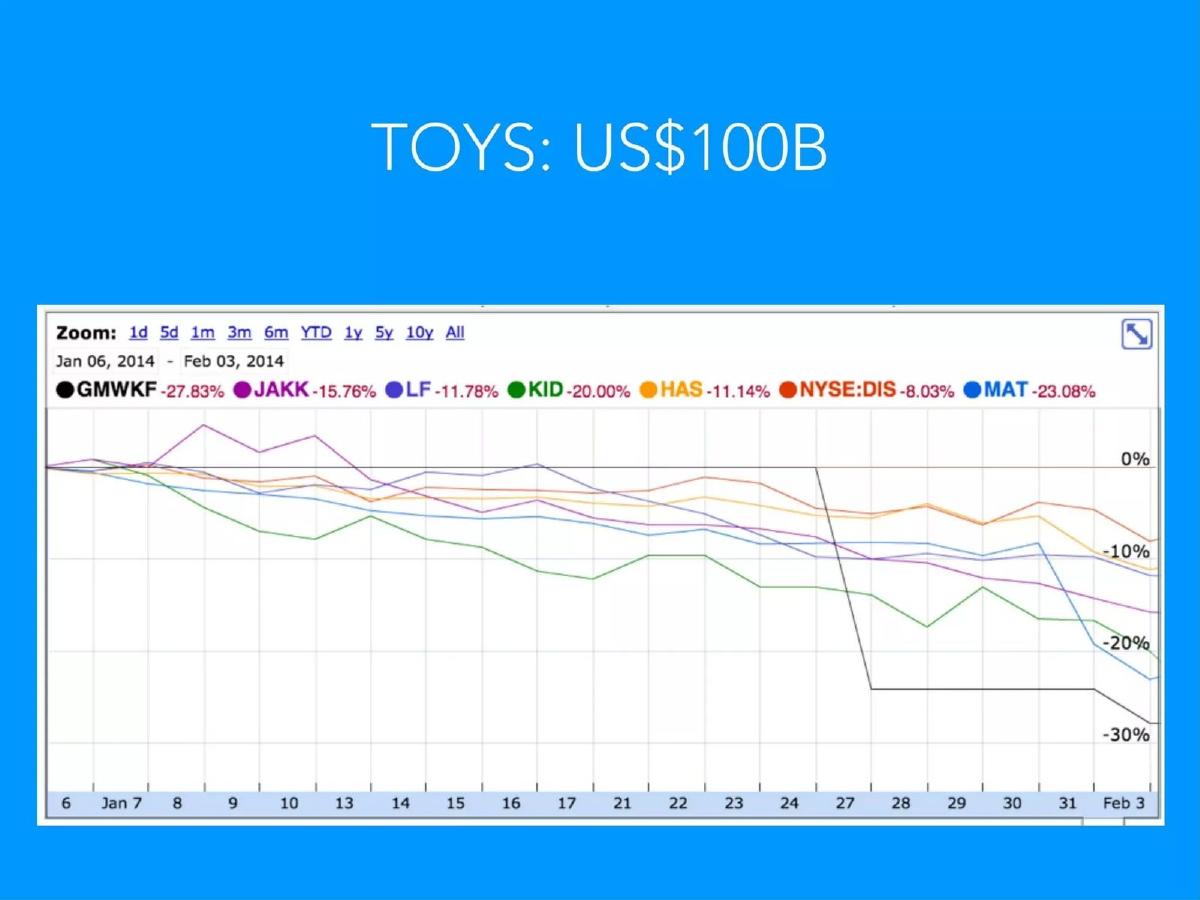
- The company identifies a massive $100 billion toy market opportunity while showing a decline in traditional toy stock performance (Slide 4).
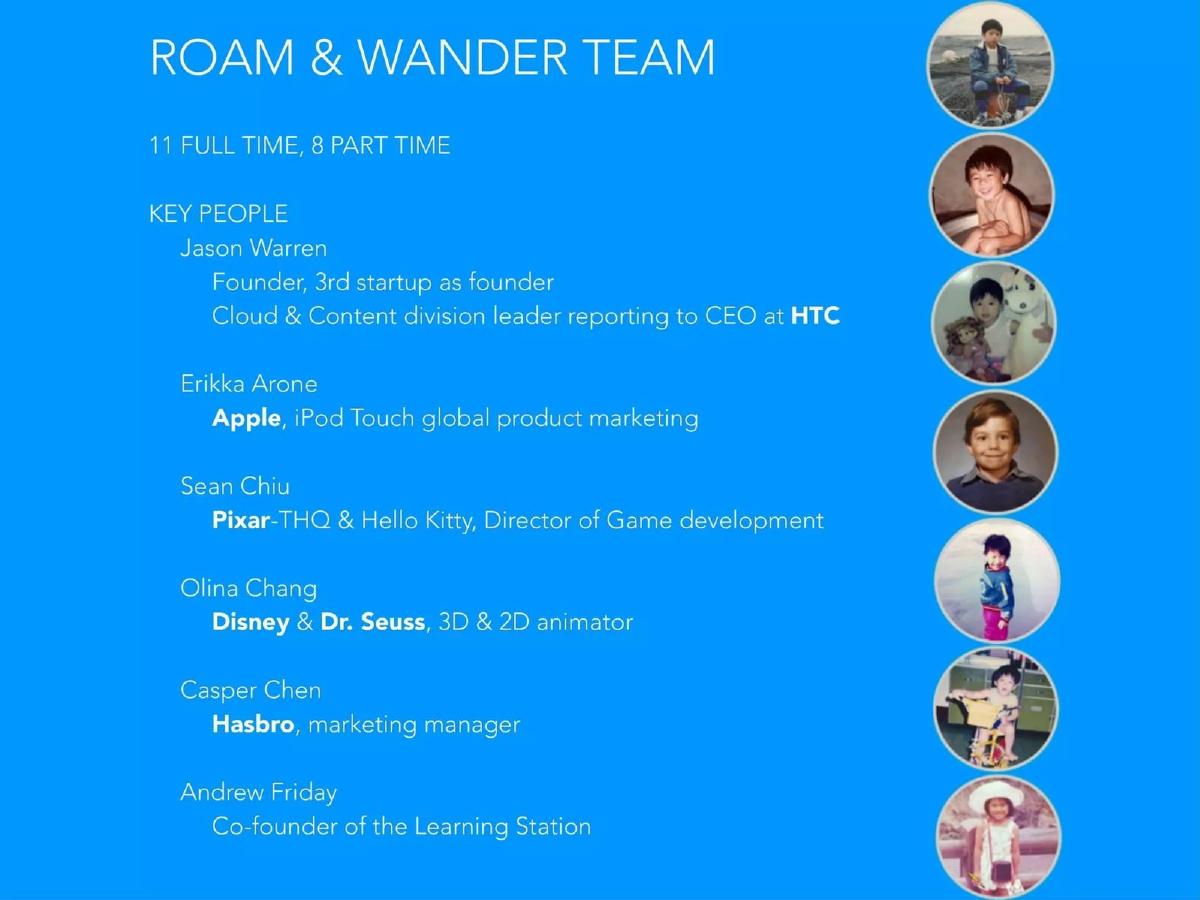
- The team boasts significant industry experience from blue-chip companies including Apple, Pixar, Disney, and Hasbro (Slide 6).
- Product lines are divided into three categories: Toys, Games, and Books, centered around the TuTu and DiDi characters (Slide 7).
- The deck provides visual evidence of retail distribution in premium locations like the Apple Store and Toys 'R' Us (Slides 8-9).
- Retail presence grew from near zero to approximately 17 stores between January and April (Slide 11).
- The company reported $130,000 in revenue and achieved a #1 kids game ranking in Hong Kong and Taiwan (Slide 12).
- Roam and Wander received the 'Best Toy of 2014' award from the Toy Industry Association (Slide 12).
- The deck lacks a formal 'ask' slide, financial forecasts, or a detailed breakdown of unit economics.
Introduction: The Phygital Toy Frontier
The Roam and Wander pitch deck, used for their 2012 fundraise, is a succinct 13-slide presentation that prioritizes brand identity and retail traction over complex financial modeling. At a time when the 'Internet of Toys' was just beginning to emerge, Roam and Wander sought to bridge the gap between traditional plush toys and the burgeoning world of mobile applications. By leveraging a team with deep roots in both Silicon Valley and the global toy industry, the company positioned itself as a modern successor to traditional toy giants.
Slide 1-3: Setting the Scene and the Problem
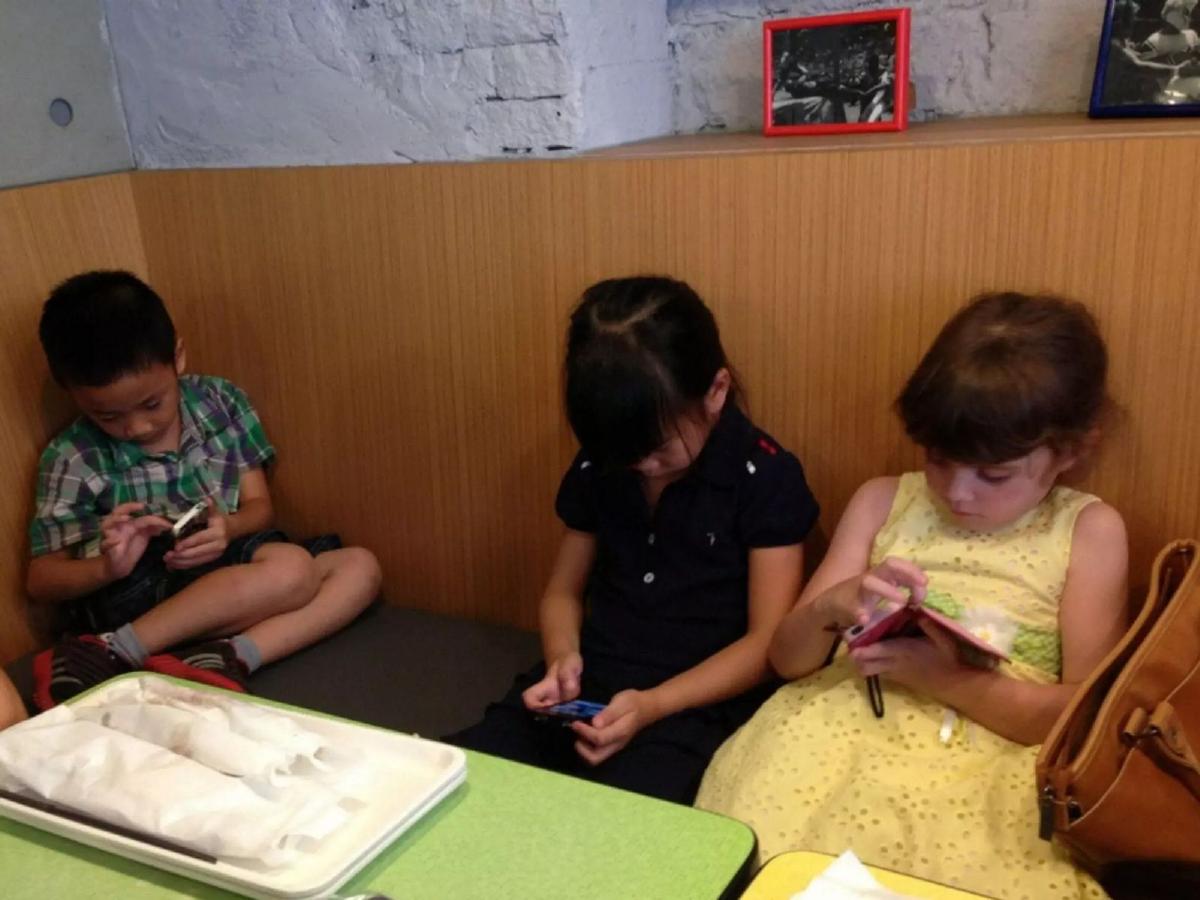
The presentation opens with a minimalist title slide featuring the company logo—an astronaut surfing through space—establishing a playful, adventurous brand tone. Slide 2 and 3 move immediately into the 'Problem' phase of the pitch, though they do so without a single word of text. Slide 2 shows a young child holding a small pink object, while Slide 3 shows three children sitting in a booth, each completely absorbed in a mobile device. This visual narrative speaks to the 'screen time' dilemma: children are increasingly drawn to digital entertainment, often at the expense of physical play. The implication is that traditional toys are losing the battle for children's attention.
Slide 4-5: The Market Opportunity and Mission
Slide 4 provides the macro-economic context for the pitch. It features the headline 'TOYS: US$100B' and a stock chart comparing several major toy and entertainment companies (including Hasbro, Mattel, and Disney) from January to February 2014. The chart shows a downward trend for most of these incumbents, with some stocks dropping over 20%. This suggests that while the market is massive, the current leaders are struggling to adapt to changing consumer habits. Slide 5 introduces the solution: 'Roam & Wander is reimagining the way apps and toys come together.' This is the company's core value proposition—the integration of physical and digital play.
Slide 6: A Heavy-Hitting Team
Slide 6 is one of the strongest in the deck, detailing a team with significant pedigree. The company lists 11 full-time and 8 part-time employees. Key personnel include:
Jason Warren: Founder, on his 3rd startup, previously a division leader at HTC reporting to the CEO. · Erikka Arone: Formerly of Apple, focused on iPod Touch global product marketing. · Sean Chiu: Formerly of Pixar-THQ and Hello Kitty, Director of Game Development. · Olina Chang: Formerly of Disney and Dr. Seuss, 3D & 2D animator. · Casper Chen: Formerly of Hasbro, marketing manager. · Andrew Friday: Co-founder of the Learning Station.
By highlighting logos like Apple, Pixar, Disney, and Hasbro, the deck communicates that the team has the specific domain expertise required to execute a complex hardware-software hybrid product.
Slide 7: The Product Ecosystem
Slide 7 introduces the 'R&W Brands,' specifically TuTu (a pink rabbit-like character) and DiDi (a brown bear). The slide categorizes their offerings into three pillars: Toys, Games, and Books. The images show physical plush toys designed with a slot to hold a smartphone or tablet, which then acts as the character's 'face' or an interactive screen. This 'phygital' approach allows the company to monetize through physical hardware sales, digital app engagement, and potentially licensed content (books).
Slides 8-10: Proof of Retail Traction
The middle section of the deck (Slides 8, 9, and 10) is dedicated to social proof through retail distribution. Instead of listing potential partners, the company shows actual photos of their products on shelves. Slide 8 shows a TuTu toy in a display case at an Apple Store . Slide 9 shows a dedicated end-cap and shelf space at Toys 'R' Us , and Slide 10 shows a large, branded interactive display at FNAC . These images are powerful because they prove that the company has already cleared the significant hurdles of manufacturing, logistics, and retail negotiation with world-class partners.
Slides 11-13: Growth, Stats, and Conclusion
Slide 11 presents a line graph titled 'RETAIL STORE POP GROWTH.' The chart shows a steady climb from January to April, ending at approximately 17 store locations. While the absolute number is small, the trajectory is clear. Slide 12, titled 'ROAM & WANDER STATS,' provides the hard data: '$130K in revenue,' the '#1 ranked kids game in HK, TW,' and the 'Best Toy of 2014 from Toy Industry Association.' These metrics validate that the product is not just on shelves, but is also generating revenue and receiving critical acclaim. The deck concludes on Slide 13 with a repeat of the logo and astronaut imagery, maintaining brand consistency.
What Works in This Deck
The primary strength of the Roam and Wander deck is its visual evidence. In the hardware and toy space, investors are often wary of 'vaporware' or products that will never make it to market. By including high-quality photographs of their products in prestigious retail environments like the Apple Store and Toys 'R' Us, the founders effectively de-risked the investment. The team slide is also exceptionally strong; it doesn't just list names, it lists 'power logos' that are directly relevant to the product they are building. Finally, the problem-solution narrative is handled elegantly through imagery rather than bullet points, making the pitch feel more like a brand story than a corporate report.
What Is Missing From This Deck
Despite its visual appeal, the deck is missing several critical components typically found in a 'Later' stage pitch (as categorized in the catalogue). There is no 'Ask' slide ; it is unclear how much money they are raising or what the specific use of funds will be. There is also a complete absence of financial projections or unit economics. While they mention $130k in revenue, they do not disclose their margins, customer acquisition costs, or the split between hardware and software revenue. Additionally, there is no competition slide . The toy market is notoriously crowded, and failing to mention how they differ from other 'smart toy' competitors or tablet-based games is a notable omission. Finally, the roadmap is missing; investors are left wondering what the next characters or product categories will be after TuTu and DiDi.
What a Founder Should Copy
Founders should emulate the 'Show, Don't Tell' approach to traction. If you have a physical product, showing it in a customer's hands or on a retail shelf is worth more than ten slides of theoretical market sizing. The clean, brand-centric design is also worth copying; it uses a consistent color palette (the bright blue background) and high-quality imagery that reflects the 'fun' nature of the product. Lastly, the concise team descriptions —focusing only on the most impressive and relevant previous roles—is a great way to build immediate credibility without cluttering the slide with long biographies.
Frequently asked questions
- How much did Roam and Wander raise with this deck?
- According to the catalogue data, Roam and Wander raised $1,000,000 in 2012. The deck itself focuses on traction and team rather than the specific terms of the round.
- What is the core product of Roam and Wander?
- The company creates 'phygital' toys—physical plush characters like TuTu and DiDi that are designed to hold or interact with mobile devices (iPhones/iPads) to run integrated games and educational apps.
- Who are the key members of the Roam and Wander team?
- The team includes founder Jason Warren (formerly of HTC), Erikka Arone (Apple), Sean Chiu (Pixar-THQ), Olina Chang (Disney), and Casper Chen (Hasbro), representing a mix of tech, animation, and toy marketing expertise.
- Where were Roam and Wander products sold?
- The deck shows photographic proof of retail placement in the Apple Store, Toys 'R' Us, and FNAC, indicating a strong international retail strategy early in the company's lifecycle.
- What metrics are included in the deck?
- The deck cites $130,000 in revenue, a #1 ranking for kids' games in Hong Kong and Taiwan, and a growth chart showing retail store presence increasing to 17 locations over four months.