Full-Time vs Part-Time Founders in a Pitch Deck: How
Investors want to know who works on the startup full time. Five real team slides, from per-person full-time labels to a team of students.
Founder Commitment on the Team Slide: Show Who Is Full Time, and Since When
One of the first questions an investor asks about an early team is simple: who is working on this full time? A strong list of past employers means less if the founders still have other jobs, and a part-time co-founder changes how fast the company can move. Founders ask whether to say this in the deck, and how to say it without weakening the team slide. This guide uses six slides from six startup decks to show how founders present commitment, from a clear label under each name to a team where it is impossible to tell.
TL;DR
Say on the team slide who is full time and who is not, and if anyone moved to full time recently or will do so on funding, give the date or the trigger. Bretzel & Co does this most simply: "Full-time" under both co-founders and "Part-time" under its designer. AdPushup puts the decision on its milestone timeline ("Jan 2014 – Founders commit full-time."), between a weekend project and a beta launch. Tracer dates the CEO's move: "Full Time CEO | Jan 2020", leaving a senior role at the agency it came from. Roam & Wander gives a total ("11 full time, 8 part time") without saying which key people are which. AssistMe describes all five people as "Full-time MBA Student", which tells an investor where their time goes, and it isn't the company.
Five team slides that show commitment, read in full
Each example shows how the slide states who is full time, what it gets right and what to change. Quotes are taken from the slide images at full size.
Bretzel & Co team slide — slide 11
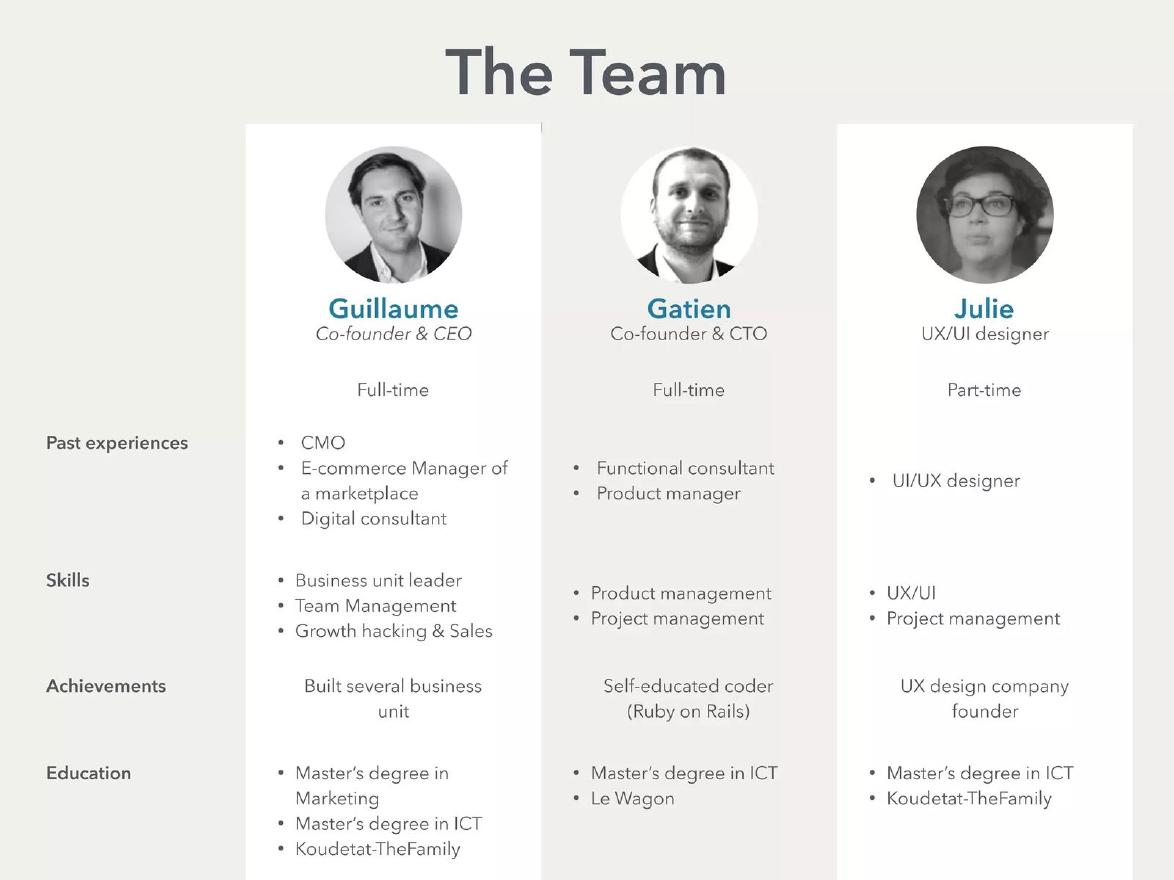
Early-stage startup team table titled "The Team".
Bretzel & Co deck, slide 11. Exact stored slide matched to this analysis.
Our analysis: One label under each name makes commitment obvious.
Evidence and limitation: Self-reported status.
What a founder can adapt: Add when any part-time person goes full time.
Supporting analysis
What the deck claims: "Guillaume, Co-founder & CEO" "Full-time"; "Gatien, Co-founder & CTO" "Full-time"; "Julie, UX/UI designer" "Part-time"; rows for past experience, skills, achievements, education.
Presentation choice: Openly listing a part-timer makes the slide more credible.
When it does not fit: Labelling some people and not others.
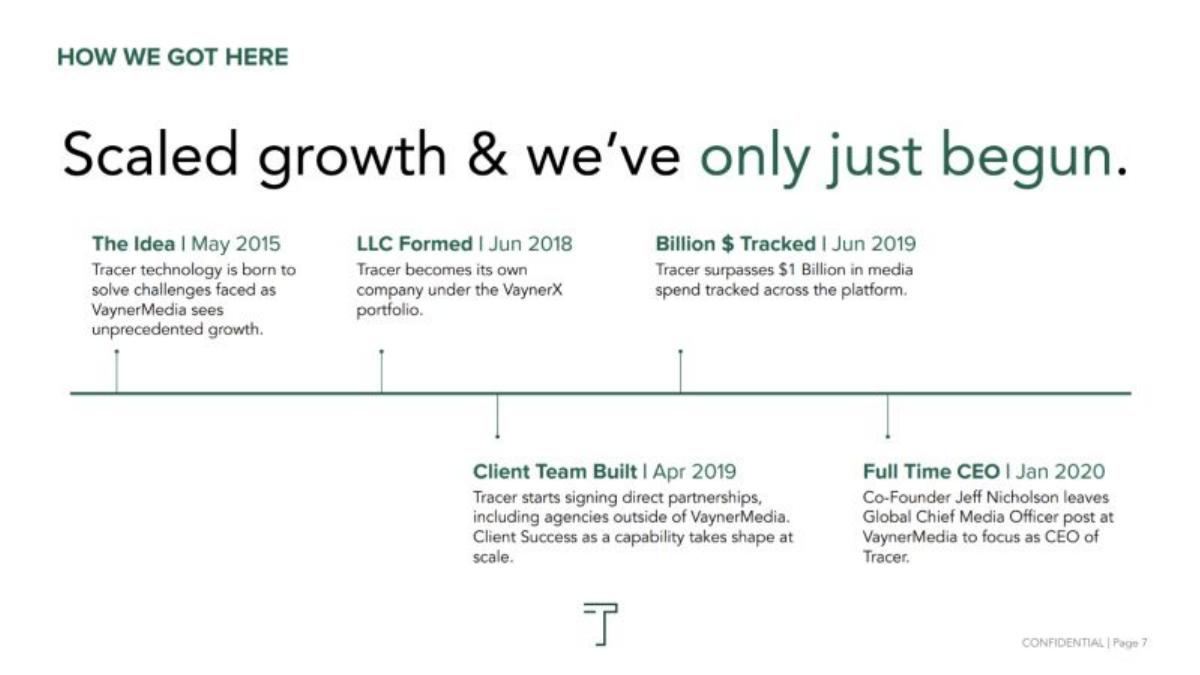
Advertising analytics company that grew out of VaynerMedia. Timeline titled "How we got here".
Tracer deck, slide 6. Exact stored slide matched to this analysis.
Our analysis: Dates the CEO's move and names the role given up.
Evidence and limitation: Company timeline.
What a founder can adapt: Say who led the company before the full-time move.
Supporting analysis
What the deck claims: "LLC Formed | Jun 2018"; "Client Team Built | Apr 2019"; "Billion $ Tracked | Jun 2019"; "Full Time CEO | Jan 2020 – Co-Founder Jeff Nicholson leaves Global Chief Media Officer post at VaynerMedia to focus as CEO of Tracer."
Presentation choice: Answers whether a spin-out's leader still works for the parent.
When it does not fit: Leaving the earlier leadership period unexplained.
Roam & Wander deck, slide 6. Exact stored slide matched to this analysis.
Our analysis: Total split given, but not for the named people.
Evidence and limitation: Headcount and employers self-reported.
What a founder can adapt: Add a label beside each key person.
Supporting analysis
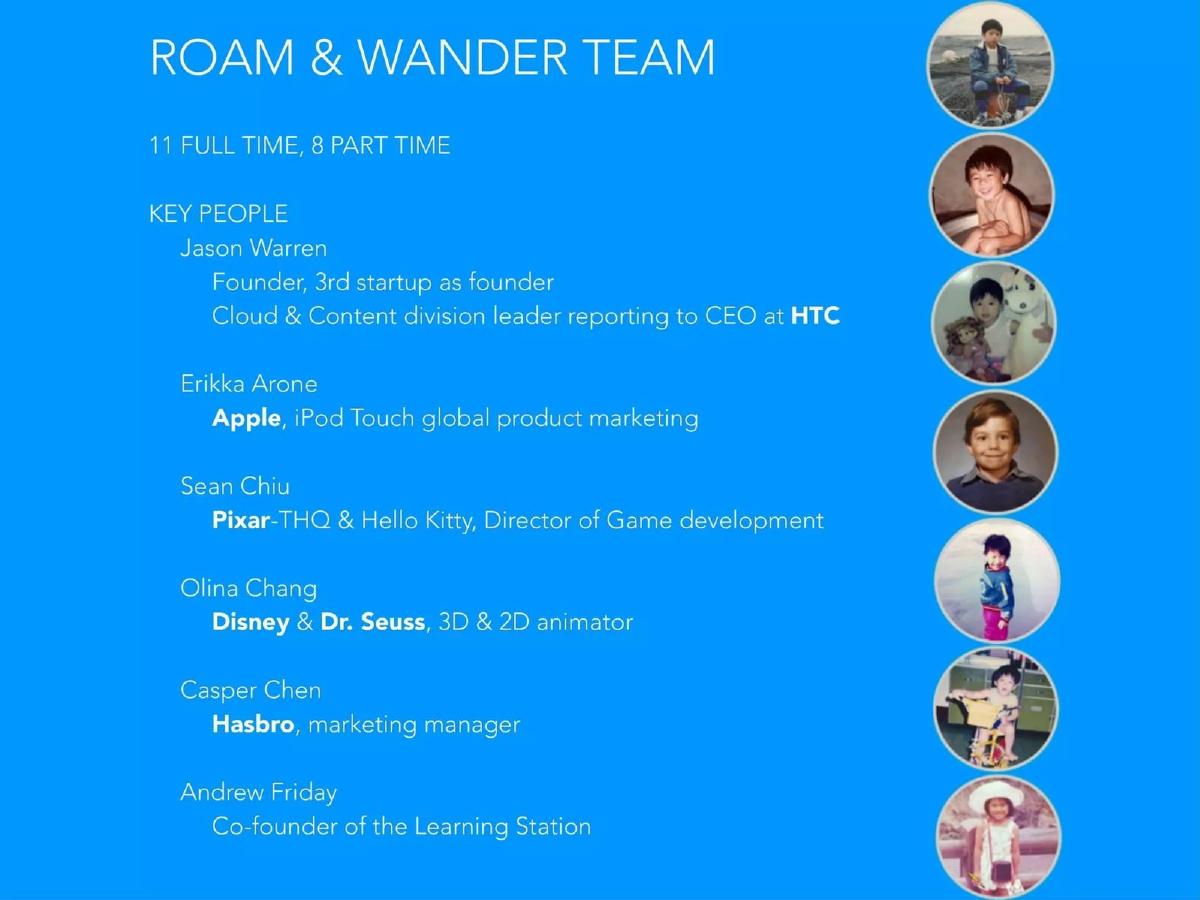
What the deck claims: "11 full time, 8 part time"; key people with Apple, Pixar-THQ, Disney, Hasbro and HTC backgrounds; founder "3rd startup as founder".
Presentation choice: Investors will ask whether the key names are full time.
When it does not fit: A headcount disconnected from the people shown.
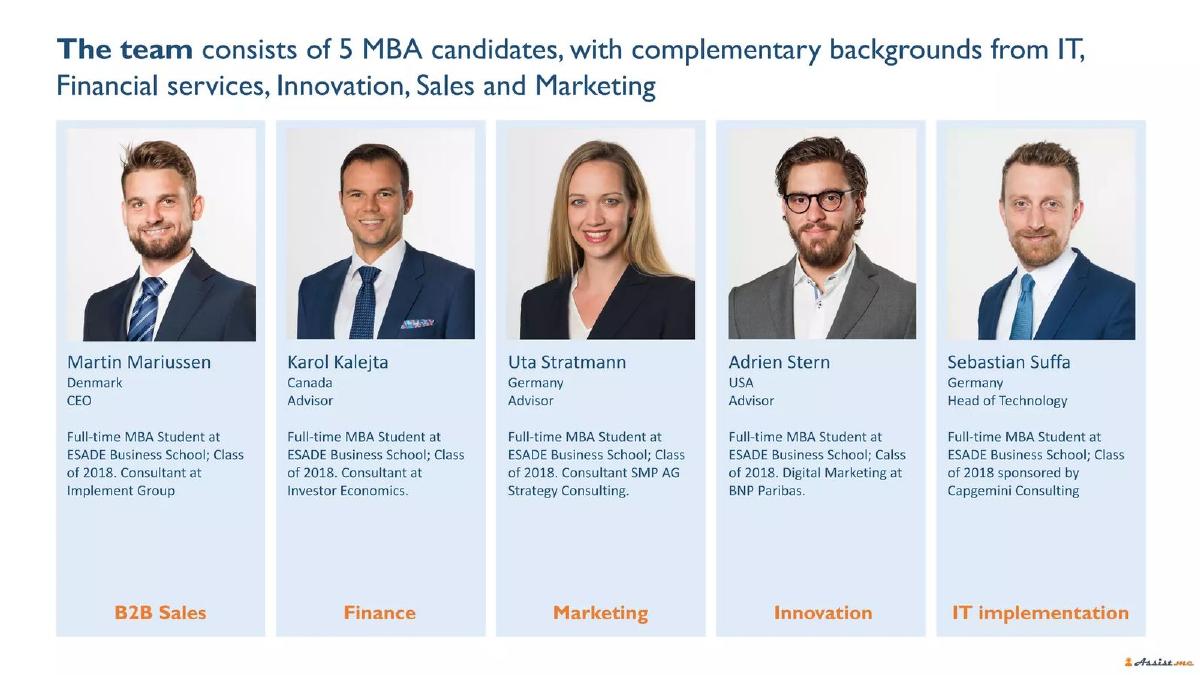
AI sales assistant. Team slide headlined "The team consists of 5 MBA candidates".
AssistMe deck, slide 2. Exact stored slide matched to this analysis.
Our analysis: Candid, but the full-time commitment is to study.
Evidence and limitation: Self-reported.
What a founder can adapt: State who goes full time and from when.
Supporting analysis
What the deck claims: Each profile: "Full-time MBA Student at ESADE Business School; Class of 2018"; titles CEO, Head of Technology and three "Advisor".
Presentation choice: Shows the question investors will ask about student teams.
When it does not fit: Calling most of the founding team advisors.
Whether each slide labels individuals, dates the move to full time and separates staff from advisors.
Example
Per-person label
Date of commitment
Staff and advisors separate
Bretzel & Co
Yes
No
Yes
AdPushup
No
Yes, Jan 2014
Not shown
Tracer
CEO only
Yes, Jan 2020
Not shown
Roam & Wander
No, total only
No
Not shown
AssistMe
Students, not company
No
No
Key Takeaways
Label each founder full time or part time.
Date any move to full time.
Give the trigger if someone joins on funding.
Separate staff from board and advisors.
Don't let a headcount hide who is committed.
State your team's commitment
Fill one line per person on the operating team.
Status. Is this person full time or part time on the company today?
Since. When did they go full time, and what did they leave?
Trigger. If part time, what date, amount or milestone makes them full time?
Grouping. Are board members and advisors in a separate section?
Progress. What has the team achieved since going full time?
Copyable framework: [Name], [role] – full time since [month year] (previously [role] at [company]). [Name], [role] – part time; full time from [trigger].
Illustrative example 1 — written by us
Before: Team: Ana (CEO), Ben (CTO), Carla (Advisor).
After: Ana, CEO – full time since March, previously product lead at a logistics firm. Ben, CTO – part time; full time on closing this round. Advisor: Carla, former VP Sales, two hours a month.
What improved: Our illustrative rewrite; names and details are invented for the example. It labels each person, dates the commitment, gives the trigger for the part-time founder and separates the advisor.
The question this guide answers
Founders ask whether a pitch deck should say which team members work on the company full time, and how to handle a co-founder who is still part time. The main team guide in this library covers backgrounds, relevant experience and roles, and warns against padding the slide with part-time contractors. The advisors and board guides cover people outside the day-to-day team. None of them answers how to show commitment itself: who is full time, since when, and what would change that.
Investors care for practical reasons. Early progress depends on hours, and a part-time founder signals either that the idea is not yet proven enough to quit for, or that the founder is not yet convinced. Neither is fatal, but hiding it is. Diligence will surface it, and a fact found late reads worse than a fact stated early.
How we chose and read the examples
We searched the extracted text of the slide library for "full-time", "full time", "part-time" and "part time" near founder, CEO or team words, removed public companies, mining and resource companies, listed-company presentations, non-profits, deck templates and slides where the phrase described customers or hiring plans, and viewed the remaining candidates. We kept six slides from six startup decks, each showing a different way to present commitment. Every slide was rendered from the original deck at full size and read in full before we wrote about it; the Tracer timeline, which has small type, was enlarged further.
We quote what is visible on each slide. We have not checked anyone's employment status against other sources, and we make no claim that showing or hiding commitment affected any company's fundraising.
Put a label under every name
Bretzel & Co's team slide is a table with three columns: "Guillaume, Co-founder & CEO", "Gatien, Co-founder & CTO" and "Julie, UX/UI designer". Directly under each title is one word or two: "Full-time", "Full-time", "Part-time". Rows below cover past experience, skills, achievements and education.
This is the simplest and clearest approach in the set. A reader sees in one glance that both founders are committed and that the third person contributes part of their time. Because the label sits next to the title, it reads as a fact rather than an admission. And it makes the slide more credible: listing a part-time designer openly suggests the founders are not inflating the team.
If you copy it, keep the labels consistent across every person on the slide, and if a part-time person is expected to join full time, say when or on what condition (for example "full time from close of this round").
Date the moment founders committed
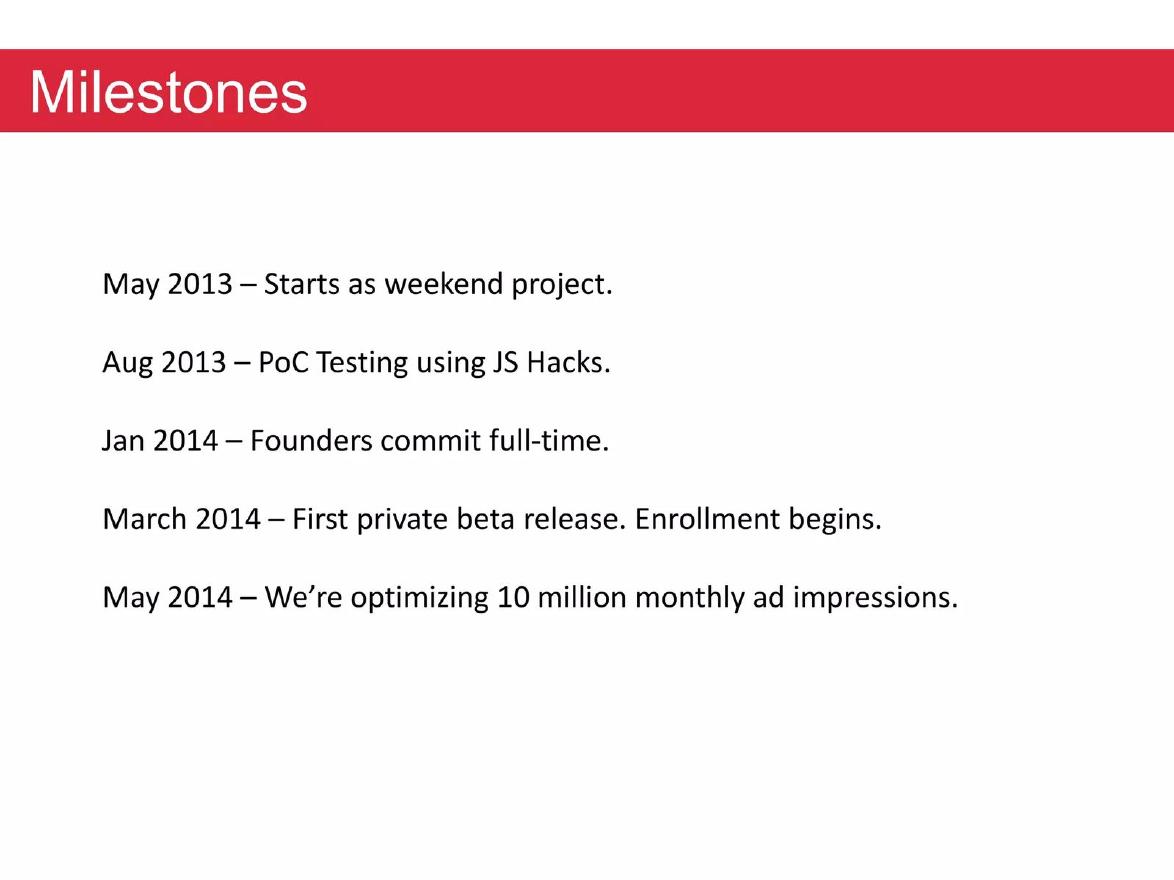
AdPushup, an advertising optimisation tool, has a slide titled "Milestones" with five dated lines: "May 2013 – Starts as weekend project.", "Aug 2013 – PoC Testing using JS Hacks.", "Jan 2014 – Founders commit full-time.", "March 2014 – First private beta release. Enrollment begins." and "May 2014 – We're optimizing 10 million monthly ad impressions."
Placing the commitment on the timeline does two things. It is honest about the start, a weekend project, and it shows what happened after the founders went full time: a beta two months later and a usage figure four months later. That turns a status into evidence: the reader can see the pace of work once the founders were fully on it.
Tracer, an advertising analytics company that grew out of the agency VaynerMedia, uses its "How we got here" timeline the same way. Among "The Idea | May 2015", "LLC Formed | Jun 2018", "Client Team Built | Apr 2019" and "Billion $ Tracked | Jun 2019" sits "Full Time CEO | Jan 2020": "Co-Founder Jeff Nicholson leaves Global Chief Media Officer post at VaynerMedia to focus as CEO of Tracer."
Tracer's entry is useful because it names what the founder gave up, a senior role at the parent company, which signals conviction. It also answers a question an investor would otherwise ask about a spin-out: whether the leader still works for the parent. One thing the slide leaves open is the period before January 2020, when the company signed partnerships and tracked over $1 billion in spend without a full-time CEO; a line on who ran it then would complete the picture.
Keep staff, board and advisors apart
A common problem on early team slides is mixing the people who work in the business with board members and advisors. If board members and advisors have no full-time or part-time label and sit in larger type above the operating team, a reader can take the slide for a bigger committed team than the company has. (General guidance; none of the five slides below shows this layout.)
The fix is to separate the groups: full-time team first, part-time contributors next, board and advisors last, each with a clear heading. The advisors guide in this library covers how to present advisors well; here the point is only that they should not blur who is doing the work.
A headcount is not a commitment statement
Roam & Wander, a children's content company, opens its team slide with "11 full time, 8 part time", then lists "Key people": the founder ("3rd startup as founder", formerly "Cloud & Content division leader reporting to CEO at HTC") and five others with employers such as Apple, Pixar-THQ, Disney and Hasbro, plus a co-founder of the Learning Station.
Stating the total split is better than saying nothing, and the employers are relevant to the product. But the two halves of the slide don't connect. With 8 of 19 people part time, an investor will want to know whether the key people are among the 11 or the 8, especially the experienced names from large companies, who are the most likely to be contributing alongside other work. One label per key person would answer it.
When the team's main job is elsewhere
AssistMe, an AI sales assistant, headlines its team slide: "The team consists of 5 MBA candidates, with complementary backgrounds from IT, Financial services, Innovation, Sales and Marketing". Each of the five profiles begins "Full-time MBA Student at ESADE Business School; Class of 2018", followed by a previous employer. Titles are CEO, Head of Technology and, for three people, "Advisor".
The slide is candid, which is to its credit, but it answers the commitment question in the wrong direction: the one thing every member does full time is study. It also gives three of the five people the title "Advisor", which leaves only two in operating roles. For an investor, the open questions are what happens after graduation, and who will work on the company and when.
A team in this position can still pitch well. The slide would be stronger if it said who will be full time and from what date (for example after graduation or on funding), what the team has built in the hours it has, and whether the advisors are expected to stay involved.
How to present commitment honestly
Across the five slides, the useful patterns are clear. Put a full-time or part-time label beside every person on the operating team. If someone moved to full time, give the month, and if they left a role to do it, name the role. If someone will move on funding, say so and say what amount or milestone triggers it. Keep board members and advisors in their own section. And if you give a headcount, connect it to the named people.
If a founder will only move to full time when the round closes, write the condition on the slide and be ready to show it in writing: the date they will resign from their current job, whether that depends on the full amount being raised, and what happens to their equity if they do not join. Investors often ask for founder vesting that starts again or continues from the round, and a clear answer on the slide shortens that conversation. A part-time founder is not a reason to avoid a meeting, but an unclear one is a reason to ask many questions about commitment before any terms are discussed. (General guidance, not drawn from the slides below.)
A part-time founder is common at the earliest stage, and stating it plainly is far better than leaving the investor to discover it. What matters is a credible plan: who goes full time, when, and what the company has achieved with the time already put in.
Common mistakes
No commitment stated. Investors will ask; answer on the slide.
Headcount without names. Say which key people are full time.
Advisors mixed with staff. Give them their own section.
Part-time founder hidden. State it with a date or trigger.
Undated full-time move. Give the month and what was left behind.
Diagnostic checklist
Full-time or part-time label per person.
Month each founder went full time.
Trigger for any part-time founder.
Board and advisors separated.
Progress since going full time.
Frequently asked questions
Should I say a co-founder is part time?
Yes. It will come out in diligence. State it with the date or funding trigger that makes them full time, as plainly as Bretzel & Co labels its part-time designer.
Where should commitment go in the deck?
Beside each name on the team slide. If the move to full time was a turning point, add it to your milestones too, as AdPushup and Tracer do.
Can student founders raise money?
Some do, but investors will ask when the team will work full time. Say who, from when, and what you have built so far.
How we chose these examples
Corpus: published pitch deck teardowns on StartupFundraising.com. Founder-uploaded private decks are excluded.
Selection (2026-10-01): we searched extracted slide text for full-time and part-time phrases near founder and team words, excluded public companies, mining and resource companies, listed-company presentations, non-profits, templates and unrelated uses, and kept six slides from six startup decks that each show a distinct approach. v2 (2026-10-05) removed Hero Homes because a page of its deck carries a restriction notice, leaving five.
Review: all five slides were rendered from the source decks at full size on 2026-10-01 and read in full against company, deck and page number; the Tracer timeline was enlarged further (editorial model review, with AI assistance in drafting). No person has yet completed an editorial review of this page. We did not verify anyone's employment status against outside sources.