Advisory Board Slide Examples: How Pitch Decks Present
When advisors deserve their own pitch deck slide, and how to show what each one does for the company. Eight real advisor slides compared.
Advisory Board Slide Examples: How Pitch Decks Present Advisors
Eight advisor slides from real pitch decks, shown in full, compare whether each slide says what its advisors do for the company or only who they are.
TL;DR
An advisor slide earns its place when each advisor covers a specific gap the founders can't, and the slide says which one. BioSculpture does this most directly: a table gives each advisor a title (Engineering Consultant, Medical Advisor, Patent Prosecution) and a background that supports it. Handspring labels two advisors "Clinical Advisor" and one "Advisor", with past roles in behavioral health and healthcare. Islet names a chair for its scientific advisory board and lists four medical professors. LX Ventures lists four well-known names under "World Class Advisory Board" with one line each and no stated role for the company. The Open Fund, an investor rather than a startup, groups nine advisors under "Startup advisors" and "Technology advisors".
Three newer examples add involvement and relevance. Kaikaku states how often its advisors meet the company ("Monthly meetings") and gives each a track record in restaurant chains or food companies. Pickle names an advisor who "Grew similar app \"Thumb\" to 1.5 MM users" and discloses that another is an investor in the company. Alloy labels its board "in formation", which is honest but tells an investor the board is not yet in place.
Advisor slides from real pitch decks
Each example shows the exact stored slide above its analysis and links to the full teardown. Backgrounds are as stated on the slide at the time; we have not checked them independently. Stage and year are given only where the deck states them.
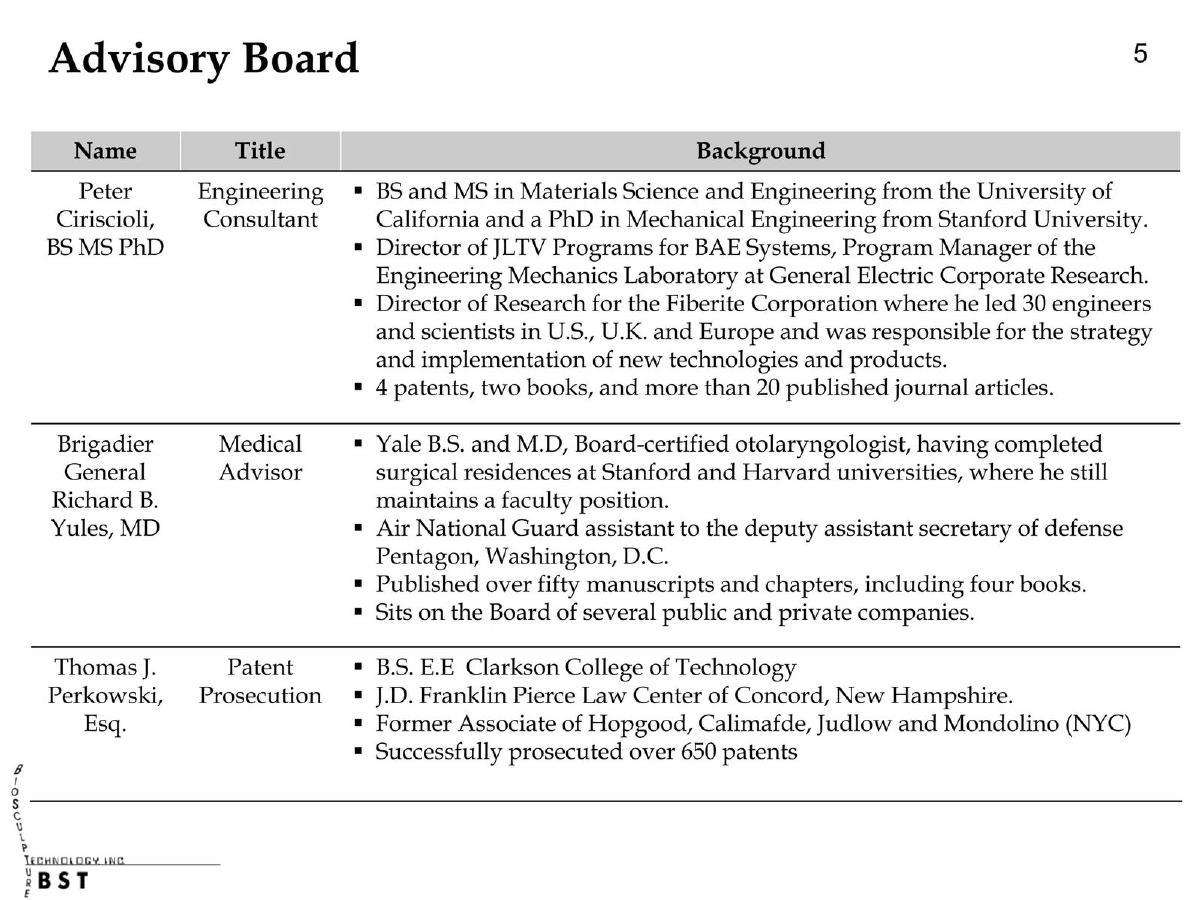
BioSculpture Technology team slide — slide 6
Medical technology. Investor presentation highlights dated August 1, 2017, referring to a Regulation A+ offering. The slide itself is printed as page 5. The regulatory slide guide uses a different slide from this deck.
BioSculpture deck, slide 6. Exact stored slide matched to this analysis.
Our analysis: Each advisor has a title that names a job, and the background under it supports that job. An investor can see which three areas (engineering, medicine, patents) the company has covered outside the core team.
Evidence and limitation: Three bullets per person is dense for a slide. The table also doesn't say how much time each advisor gives or whether they hold equity; one line on involvement would help.
What a founder can adapt: Use a title column that says what each advisor helps with, and keep each background to facts that support that title.
Supporting analysis
What the deck claims: "Advisory Board", in a Name / Title / Background table. Peter Ciriscioli, Engineering Consultant: materials science and mechanical engineering degrees (UC, Stanford PhD), roles at BAE Systems, GE Corporate Research and Fiberite, "4 patents, two books, and more than 20 published journal articles." Brigadier General Richard B. Yules, MD, Medical Advisor: board-certified otolaryngologist, Stanford and Harvard residencies, Pentagon role. Thomas J. Perkowski, Esq., Patent Prosecution: "Successfully prosecuted over 650 patents".
Presentation choice: Each advisor has a title that names a job, and the background under it supports that job. An investor can see which three areas (engineering, medicine, patents) the company has covered outside the core team.
When it does not fit: Three bullets per person is dense for a slide. The table also doesn't say how much time each advisor gives or whether they hold equity; one line on involvement would help.
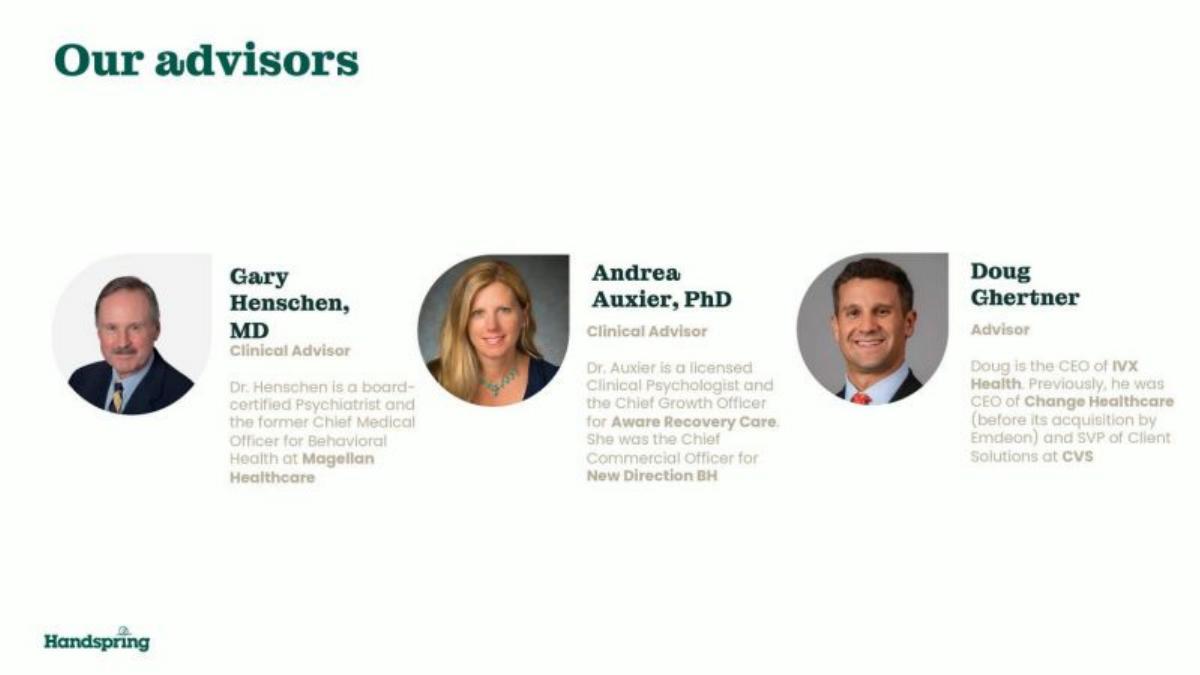
Behavioral health care for children. Stage and year not stated. The advisor slide follows the founders slide.
Handspring Health deck, slide 5. Exact stored slide matched to this analysis.
Our analysis: Three advisors, each with a short, relevant background. The "Clinical Advisor" label tells investors the company has clinical oversight, which matters for a mental health service for children.
Evidence and limitation: Ghertner is labelled only "Advisor". His background suggests commercial or operating help; saying so would make his role as clear as the other two.
What a founder can adapt: Keep to a few advisors and put the label that matters most to your investors, such as clinical, first.
Supporting analysis
What the deck claims: "Our advisors". Gary Henschen, MD, Clinical Advisor: board-certified psychiatrist, former Chief Medical Officer for Behavioral Health at Magellan Healthcare. Andrea Auxier, PhD, Clinical Advisor: licensed clinical psychologist, Chief Growth Officer for Aware Recovery Care, former Chief Commercial Officer for New Direction BH. Doug Ghertner, Advisor: CEO of IVX Health, former CEO of Change Healthcare (before its acquisition by Emdeon) and SVP of Client Solutions at CVS.
Presentation choice: Three advisors, each with a short, relevant background. The "Clinical Advisor" label tells investors the company has clinical oversight, which matters for a mental health service for children.
When it does not fit: Ghertner is labelled only "Advisor". His background suggests commercial or operating help; saying so would make his role as clear as the other two.
Diabetes therapeutics and diagnostics. Investor presentation dated May 2016.
Islet Sciences deck, slide 6. Exact stored slide matched to this analysis.
Our analysis: For a drug developer, a scientific advisory board in the relevant field is itself evidence. Diabetes centres and an islet transplant programme match the company's focus, and naming a chair shows the board has a structure.
Evidence and limitation: Only the chair has a detailed background, and no advisor has a stated role in the company's programmes. Cut the chair's degree details and add what the board reviews or decides.
What a founder can adapt: If science is the risk, show advisors from the exact field and name who leads the board.
Supporting analysis
What the deck claims: "Renowned Scientific Advisory Board". Thomas J. Kindt, PhD, Chair: former Chief Scientific Officer of Diomics and InNexus Biotechnology; from 1995 to 2005 Director, Division of Intramural Research, NIAID, NIH, "responsible for the management of the Division including 1,300 staff members, overseeing an annual budget of $340 Million". Also listed: Kevan Herold, M.D. (Professor of Immunology and Medicine, Yale), Jerry Nadler, M.D. (Director of the Strelitz Diabetes Center, Eastern Virginia Medical School), Steven Paraskevas, M.D. Ph.D. (Director of the Pancreas and Islet Transplant Program, McGill) and Christian Mende, M.D. (Clinical Professor of Medicine, UC San Diego).
Presentation choice: For a drug developer, a scientific advisory board in the relevant field is itself evidence. Diabetes centres and an islet transplant programme match the company's focus, and naming a chair shows the board has a structure.
When it does not fit: Only the chair has a detailed background, and no advisor has a stated role in the company's programmes. Cut the chair's degree details and add what the board reviews or decides.
Acquires and integrates SaaS technology companies. Deck dated November 2013.
LX Ventures deck, slide 6. Exact stored slide matched to this analysis.
Our analysis: Recognisable names and one exit figure make an immediate impression, and the layout is easy to read.
Evidence and limitation: No advisor has a role in the company, and "World Class" is a claim the slide doesn't support. For a company that buys other companies, an investor would want to know who helps find, price or integrate them.
What a founder can adapt: If you keep one-line bios, make each line say what that person will help with, such as acquisitions or selling to enterprises.
Supporting analysis
What the deck claims: "World Class Advisory Board". Four advisors, each labelled "Advisor" with one line: Alison Lawton, "Social Venture Philanthropist"; David Baxby, "Co-CEO of Virgin Group"; Reza Kazemipour, "Silicon Valley and Canadian start-up Board advisor"; Lance Tracey, "Co-founder of PEER 1. Sold for $526MM."
Presentation choice: Recognisable names and one exit figure make an immediate impression, and the layout is easy to read.
When it does not fit: No advisor has a role in the company, and "World Class" is a claim the slide doesn't support. For a company that buys other companies, an investor would want to know who helps find, price or integrate them.
A microfund investing in emerging tech and web startups in Greece and Southeastern Europe. This is an investor's deck, not a startup's: the advisors support the companies the fund backs. Stage and year not stated.
The Open Fund deck, slide 6. Exact stored slide matched to this analysis.
Our analysis: Grouping advisors by what they help with (building a company, technology) tells the reader what kind of help is on offer without a label on each name. "(so far)" is an honest signal that the list is still growing.
Evidence and limitation: Nine names is a lot for one slide, and only some have a result attached. Keep the advisors whose line shows a relevant result, and say how the funded companies get access to them.
What a founder can adapt: If you have more than four or five advisors, group them under headings that name the kind of help.
Supporting analysis
What the deck claims: "Advisors (so far)". "A strong network of advisors has been formed (and growing) to help the funded companies." Two groups: "Startup advisors" (founders and executives of Aster Data Systems, e-shop.gr, trustedplaces.com, Huddle.com and Pattern Insight, with lines such as "Raised more than $25 million of funding in 3 years" and "Grew e-shop.gr to more than 120 millions of revenue") and "Technology advisors" (a Google File System engineer, an NYU Stern computer science professor, an entrepreneur who organises Thessaloniki Open Coffee, and the CTO of Microsoft Hellas, noting "MS is also a sponsor").
Presentation choice: Grouping advisors by what they help with (building a company, technology) tells the reader what kind of help is on offer without a label on each name. "(so far)" is an honest signal that the list is still growing.
When it does not fit: Nine names is a lot for one slide, and only some have a result attached. Keep the advisors whose line shows a relevant result, and say how the funded companies get access to them.
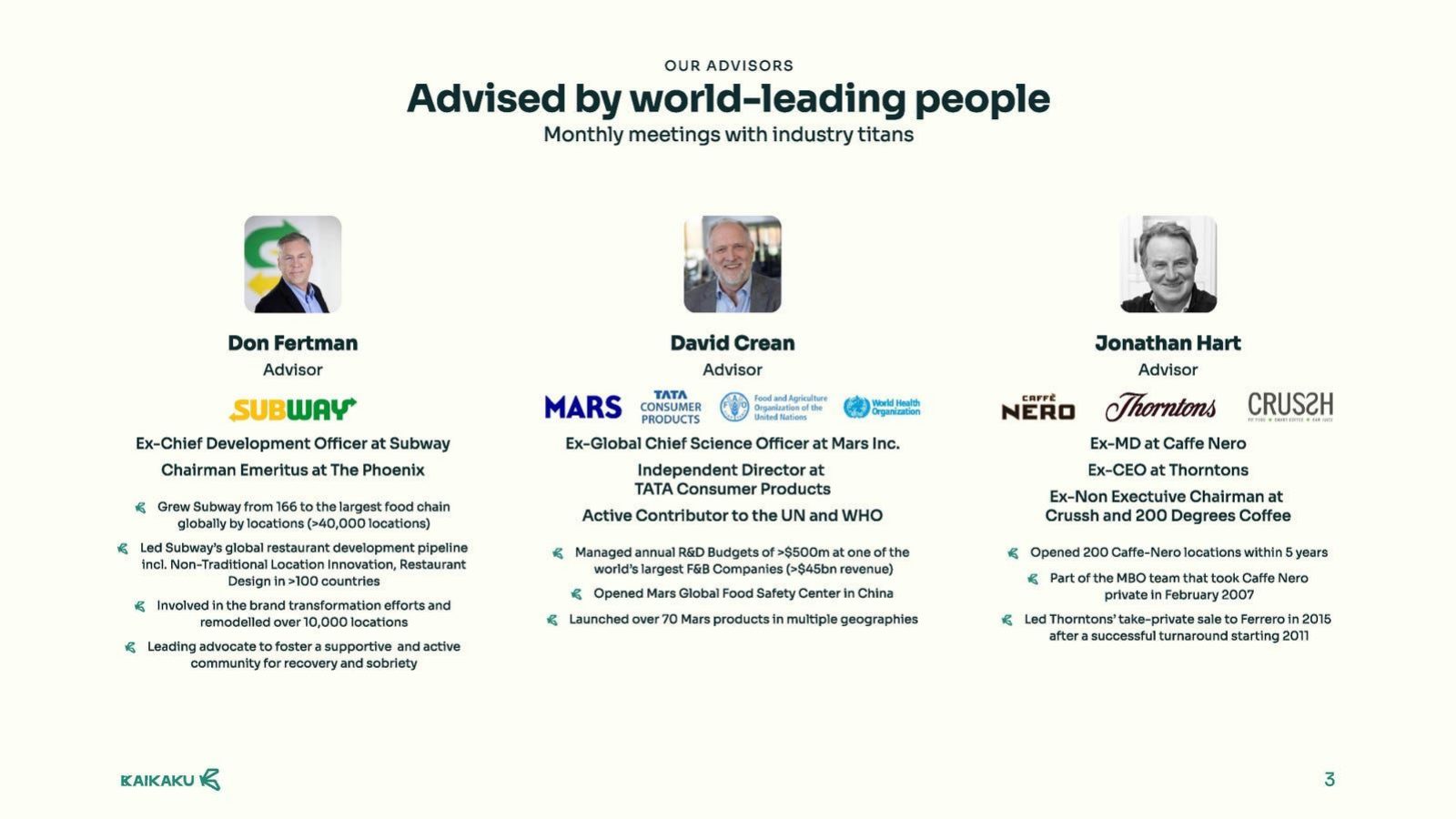
Restaurant robotics. The slide is printed as page 3. Other guides use different slides from this deck.
Kaikaku deck, slide 4. Exact stored slide matched to this analysis.
Our analysis: It is the only slide in this guide that states involvement (monthly meetings), and each advisor's record is in restaurants or food, the market Kaikaku sells into. Brand logos make the backgrounds quick to read.
Evidence and limitation: Every advisor is labelled only "Advisor", so the slide doesn't say what each one helps with. "World-leading" and "industry titans" add nothing the bios don't already show.
What a founder can adapt: State how often advisors work with you, and pick the one result per advisor that relates to your market.
Supporting analysis
What the deck claims: "Our Advisors", headed "Advised by world-leading people" with the subtitle "Monthly meetings with industry titans". Don Fertman, "Ex-Chief Development Officer at Subway": "Grew Subway from 166 to the largest food chain globally by locations (+40,000 locations)". David Crean, "Ex-Global Chief Science Officer at Mars Inc.": "Managed annual R&D Budgets of ~$500m". Jonathan Hart, "Ex-MD at Caffe Nero" and "Ex-CEO at Thorntons": "Opened 200 Caffe-Nero locations within 5 years". All are the company's claims.
Presentation choice: It is the only slide in this guide that states involvement (monthly meetings), and each advisor's record is in restaurants or food, the market Kaikaku sells into. Brand logos make the backgrounds quick to read.
When it does not fit: Every advisor is labelled only "Advisor", so the slide doesn't say what each one helps with. "World-leading" and "industry titans" add nothing the bios don't already show.
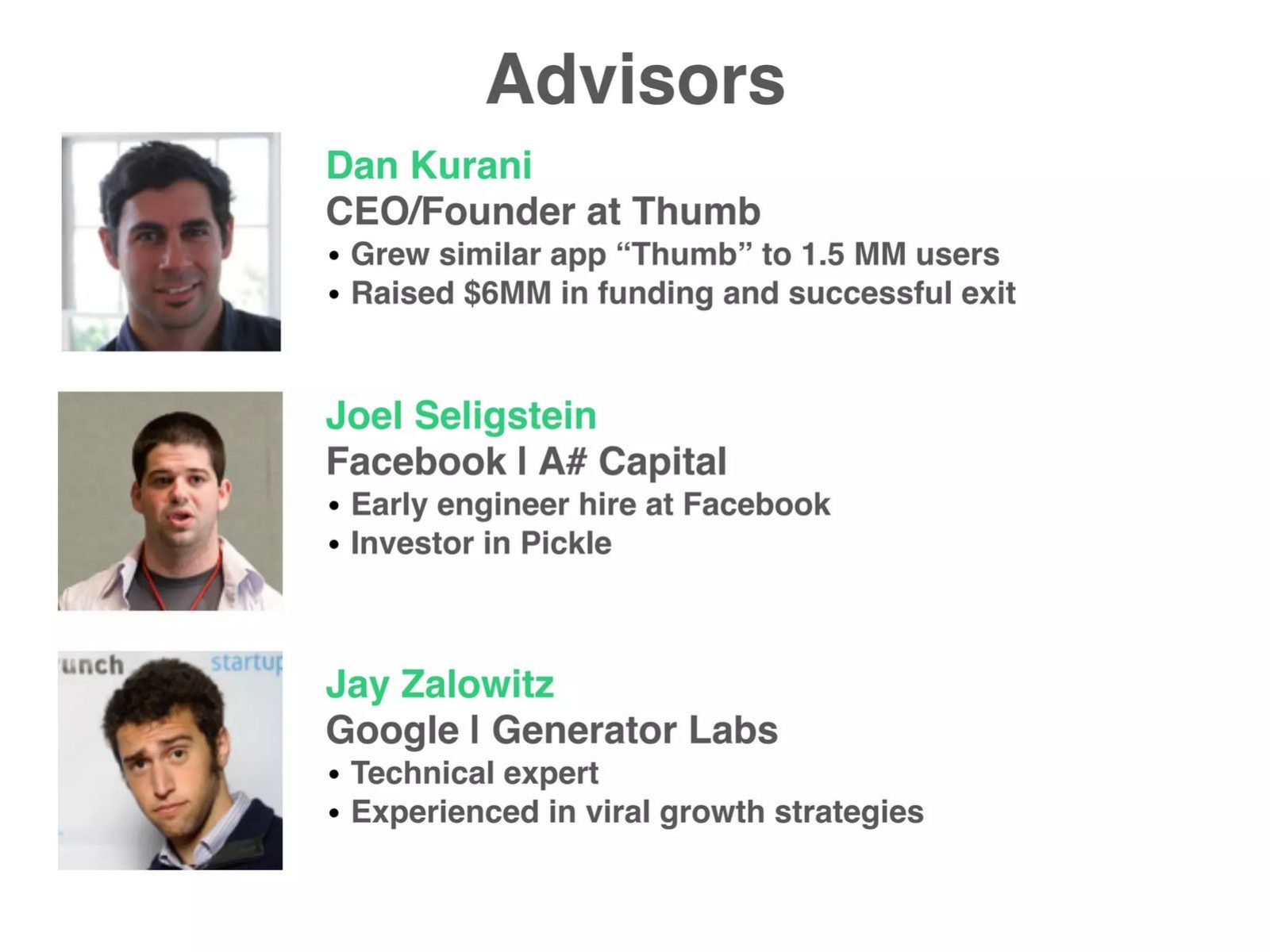
Consumer app for competitive selfies. Other guides use different slides from this deck.
Pickle deck, slide 8. Exact stored slide matched to this analysis.
Our analysis: The first advisor has grown a similar app, which speaks to Pickle's biggest risk: getting users. The slide also discloses that one advisor is an investor, which an investor would want to know.
Evidence and limitation: "Technical expert" and "Experienced in viral growth strategies" are general. A specific result, like the one given for Thumb, would be stronger. There is no role label or involvement.
What a founder can adapt: Lead with the advisor whose record matches your biggest risk, and disclose any advisor who has invested.
Supporting analysis
What the deck claims: "Advisors". Dan Kurani, "CEO/Founder at Thumb": "Grew similar app \"Thumb\" to 1.5 MM users" and "Raised $6MM in funding and successful exit". Joel Seligstein, "Facebook | A# Capital": "Early engineer hire at Facebook" and "Investor in Pickle". Jay Zalowitz, "Google | Generator Labs": "Technical expert" and "Experienced in viral growth strategies". These are the company's claims.
Presentation choice: The first advisor has grown a similar app, which speaks to Pickle's biggest risk: getting users. The slide also discloses that one advisor is an investor, which an investor would want to know.
When it does not fit: "Technical expert" and "Experienced in viral growth strategies" are general. A specific result, like the one given for Thumb, would be stronger. There is no role label or involvement.
Women's health. Other guides use different slides from this deck.
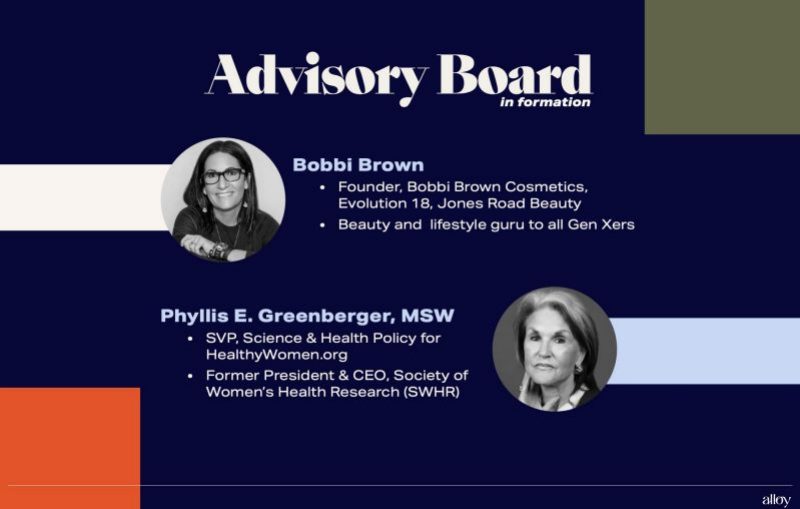
Alloy deck, slide 19. Exact stored slide matched to this analysis.
Our analysis: The "in formation" label is honest about status, and the two advisors cover two different needs: consumer brand building and women's health policy.
Evidence and limitation: The slide doesn't say whether either advisor has committed or what each will do. "Guru to all Gen Xers" is a claim, not a result.
What a founder can adapt: If your board is still forming, say so, and say which advisors have agreed.
Supporting analysis
What the deck claims: "Advisory Board in formation". Bobbi Brown: "Founder, Bobbi Brown Cosmetics, Evolution 18, Jones Road Beauty" and "Beauty and lifestyle guru to all Gen Xers". Phyllis E. Greenberger, MSW: "SVP, Science & Health Policy for HealthyWomen.org" and "Former President & CEO, Society of Women's Health Research (SWHR)".
Presentation choice: The "in formation" label is honest about status, and the two advisors cover two different needs: consumer brand building and women's health policy.
When it does not fit: The slide doesn't say whether either advisor has committed or what each will do. "Guru to all Gen Xers" is a claim, not a result.
A role label and a relevant background together show which gap each advisor covers.
Example
Advisors shown
Role label per advisor
Background matches role
Involvement stated
BioSculpture
3
Yes (engineering, medical, patents)
Yes
No
Handspring Health
3
Partly (2 of 3 clinical)
Yes
No
Islet Sciences
5
Chair only
Yes (diabetes, transplant)
No
LX Ventures
4
No (all "Advisor")
Not linked to a role
No
The Open Fund
9
By group (startup, technology)
Partly
No
Kaikaku
3
No (all "Advisor")
Yes (restaurants, food)
Yes (monthly meetings)
Pickle
3
No
Yes for 1 of 3 (similar app)
No (one disclosed as investor)
Alloy
2
No (board "in formation")
Yes (beauty, women's health)
No
Key Takeaways
Give each advisor a role label that names what they help with, not just "Advisor".
Match each advisor to a gap in the founding team: clinical, scientific, technical, legal or commercial.
Keep backgrounds relevant to that role. BioSculpture's patent advisor lists patents prosecuted, not unrelated honours.
A famous name without a stated role invites the question of how involved that person really is.
If advisors are a supporting point, a line on the team slide may be enough. Give them a slide only when they change the picture.
Build your advisor slide
Fill in each line before deciding whether advisors need their own slide.
Gap. Which skill or credibility does the founding team lack that an investor will ask about?
Advisor. Who covers that gap, and what is their most relevant past role?
Role label. What title describes what they help with (clinical, regulatory, patents, sales)?
Involvement. How often do they work with you, and do they hold equity or have a formal agreement?
Own slide?. Would one line on the team slide say enough? If so, leave out the separate slide.
Copyable framework: [Name], [role label]: [most relevant past role]. Helps us with [specific area]; [involvement, e.g. monthly reviews].
Illustrative example 1 — written by us
Before: David Baxby, Advisor. Co-CEO of Virgin Group.
After: David Baxby, [role label]: Co-CEO of Virgin Group. Helps us with [specific area]; [involvement].
What improved: Our illustrative rewrite, not LX Ventures' text. Bracketed parts are placeholders, not company facts. It adds a role and involvement to a name-only line.
What this guide adds to the team slide guides
The main team slide guide covers advisors in one line: include them only when they change the picture, and avoid long lists with no visible commitment. The industry team guides focus on founders. This guide is about the separate advisor slide: when a deck should spend a whole slide on advisors, and how that slide can show what each advisor contributes.
Stating involvement: the gap most advisor slides leave open
Of the eight slides in this guide, only Kaikaku says how often its advisors work with the company, in a subtitle that reads "Monthly meetings with industry titans". That one line answers the first question many investors have about an advisory board: is this a real working relationship, or a list of people who agreed to lend their names? The other seven slides leave the question open. None of the eight says whether advisors hold equity or have signed advisor agreements.
Involvement does not need a long explanation. A cadence (monthly, quarterly), a specific responsibility (reviews clinical protocols, introduces retail buyers) or a commitment (holds options vesting over two years) is enough. If you can't truthfully state any of these, that is useful information for you too: an investor may treat the advisor as a reference rather than as part of the team, and you may be better off moving the name to a single line on the team slide.
Relevance: tying an advisor's record to your plan
The strongest advisor bios connect a past result to something the company still has to do. Kaikaku builds restaurant robotics, and its first advisor is the former Chief Development Officer of Subway, with the slide stating he "Grew Subway from 166 to the largest food chain globally by locations (+40,000 locations)". A restaurant-chain expansion record is directly relevant to a company that needs to sell into restaurant chains. Pickle, a competitive selfie app, lists an advisor who "Grew similar app \"Thumb\" to 1.5 MM users" and "Raised $6MM in funding and successful exit". These are the advisors' own records as stated on the slides; we have not checked them.
Compare that with a bio that lists a senior title in an unrelated field. A title tells an investor the person is accomplished; a relevant result tells them why this person, for this company, at this stage. When you write each bio, ask which single line an investor would remember, and whether it connects to a risk in your plan.
Disclosing conflicts and status honestly
Two of the new examples show disclosures that some founders leave out. Pickle's slide says Joel Seligstein is an "Investor in Pickle". That is useful: an advisor who has invested has a financial interest in the company, which can signal commitment but also means the advice is not independent. Stating it on the slide avoids an investor discovering it later in due diligence.
Alloy titles its slide "Advisory Board in formation" and shows two people, Bobbi Brown and Phyllis E. Greenberger. The label is honest, and it is better than implying a finished board. It also tells an investor that these names may not yet be committed. If your board is still forming, say which advisors have agreed and which are in discussion, and avoid presenting a name prominently unless the person has agreed to be shown.
Questions investors ask about advisors
Expect questions such as: How did you meet each advisor? What has each one done for you in the last three months? Do they hold equity, and on what vesting terms? Would they take a reference call? Have any of them invested? An advisor slide that already answers one or two of these, as Kaikaku does with meeting frequency and Pickle does with the investor disclosure, makes the conversation shorter and more credible.
Be ready for a reference call with any advisor you show. If an advisor would struggle to describe what they have done with the company, leave them off the slide.
Common mistakes
Name without a role. Label what each advisor helps with.
Irrelevant credentials. Keep only the background that supports the role.
Unsupported adjectives. "World class" or "renowned" add nothing the bios don't show.
Too many advisors. Show the few who cover real gaps; put the rest in the appendix.
No sign of involvement. Say how each advisor works with you, if you can.
Diagnostic checklist
Each advisor covers a gap in the founding team.
Each advisor has a role label.
Backgrounds support the stated role.
Involvement is stated where possible.
A separate slide is justified; otherwise advisors sit on the team slide.
Frequently asked questions
How we chose these examples
Corpus: published pitch deck teardowns on StartupFundraising.com. Founder-uploaded private decks are excluded.
Selection (2026-09-28): we searched extracted slide text for slides whose opening words include "advisor" or "advisory" and that have a stored slide image. Excluded: slides where "advisor" refers to a customer or product (for example financial advisors as a market), combined team-and-advisor slides, and advisor slides already used by other guides (Coursmos in the edtech team guide, mHealthPharma in the biotech team guide).
Overlap check: the main team slide guide treats advisors as one consideration among founders' fit and gaps; the industry team guides focus on founders. The regulatory slide guide uses BioSculpture slide 15, not this advisory board slide.
Update (2026-10-01): we added Kaikaku slide 4, Pickle slide 8 and Alloy slide 19, read from images made from the original deck files. Brag House slide 22 was not used (listed-company exclusion, see the gaming guide note). Day One Ventures slide 9 was not used because the deck is an investment fund, and we already include one fund (The Open Fund).
Review: all eight slide images were inspected (the first five on 2026-09-28, the three new ones on 2026-10-01) and matched to company, deck and slide number (AI editorial model review). No person has yet completed an editorial review of this page.
Advisor backgrounds are quoted as stated on the slides and were not verified independently. We make no claim that any slide caused a fundraising outcome.