Kaikaku is a London-based startup aiming to modernize the Quick-Service Restaurant (QSR) model through AI and robotics. Their Seed deck, which facilitated a $1.8M raise in 2024, centers on a 'World's fastest Bowl Assembler' capable of creating custom meals in under 10 seconds. The company differentiates itself by pursuing a dual-track Go-To-Market strategy: building and operating their own D2C restaurant franchises to serve as live showrooms for their B2B hardware solutions. The deck emphasizes technical pedigree, citing experience from Ocado, Rolls-Royce, and Michelin-starred kitchens. While…
Key takeaways
- Kaikaku's core hardware is a 'Food Cartridge System' that assembles custom bowls in under 10 seconds (Slide 8).
- The team boasts high-level technical experience from Ocado Technology, Rolls-Royce, and Imperial College London (Slide 2).
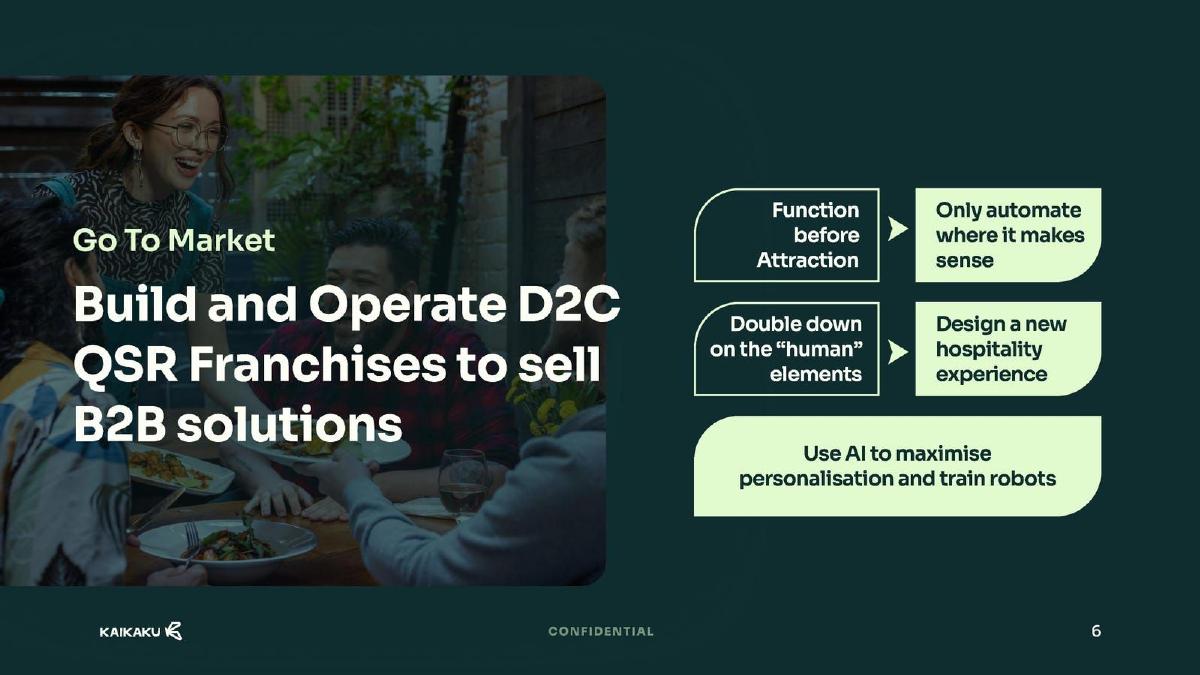
- The Go-To-Market strategy involves building D2C franchises to validate and then sell B2B solutions (Slide 6).
- The company claims a low-cost prototyping advantage, serving 100+ bowls with an $800 prototype (Slide 8).
- Kaikaku positions itself as a 'Visionary' in a Magic Quadrant, aiming to move from proof of concept to 10-20 locations (Slide 12).
- The problem slide identifies a lack of innovation in the QSR space, comparing competitors to 'mechanical horses' rather than 'engines' (Slide 4).
- The deck uses recent news coverage of Chipotle, Panera, and Starbucks to establish market timing (Slide 10).
- There is a notable absence of a specific 'Ask' slide or financial breakdown in the provided materials.
Kaikaku Pitch Deck Teardown
Kaikaku, a London-based startup, successfully raised $1.8M in 2024 to tackle one of the most difficult sectors for automation: the Quick-Service Restaurant (QSR). Their deck is a masterclass in positioning a hardware-heavy company as a scalable, AI-driven platform. By focusing on the 'why now' and the 'who,' they managed to overcome the traditional investor skepticism surrounding capital-intensive food robotics.
Slide 1: Title Slide
The deck opens with a minimalist title slide. It clearly states the company's mission: 'Reinventing the Quick-Service-Restaurant Business Model using Robotics and AI.' The branding is clean, utilizing a dark forest green palette that suggests a premium, modern tech aesthetic rather than a traditional 'fast food' look. The inclusion of a contact email (hello@kaikaku.ai) at the bottom is a standard but necessary professional touch.
Slide 2: The Team - 'Ruthless Innovators'
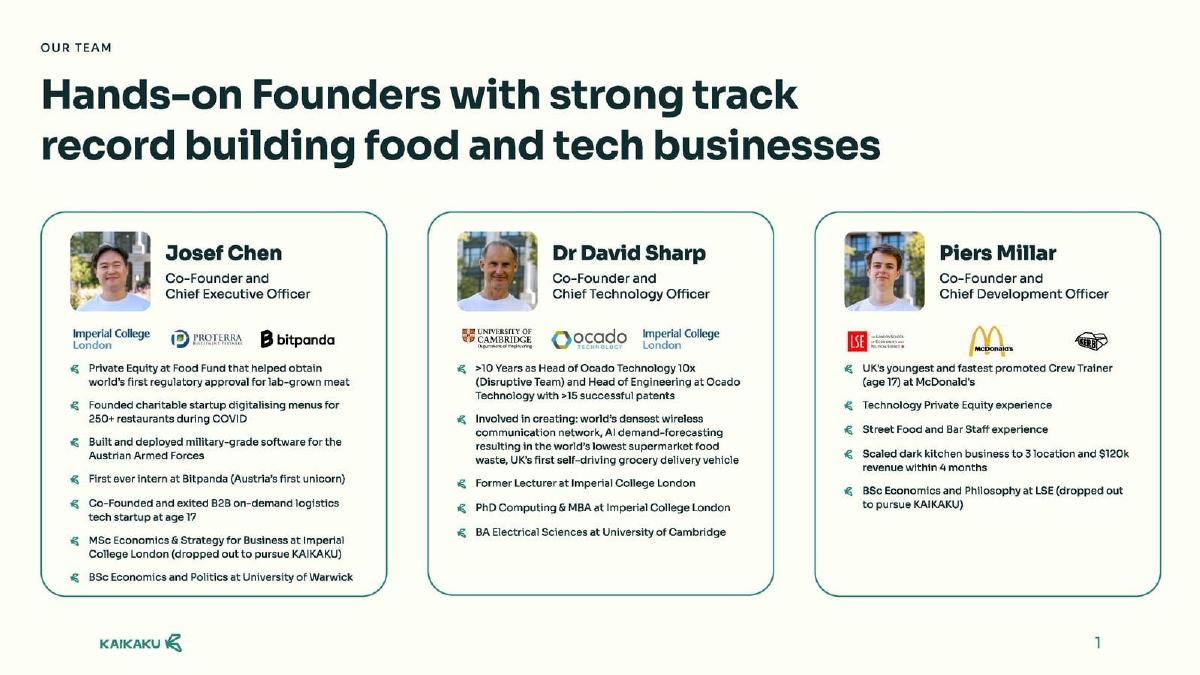
Kaikaku places their team slide early, which is a common strategy for Seed-stage companies where the pedigree of the founders is the primary asset. The slide is titled 'Ruthless Innovators' and features six key members. Ivan Tregear (Founding Engineer) brings haptics and dexterity experience from Ocado Technology , a leader in warehouse robotics. Dr. Jakub Radzikowksi (Lead Culinary Technologist) is perhaps the most unique hire, combining a PhD in Molecular Biology with experience in Michelin-starred restaurants. This blend of 'hard engineering' and 'culinary science' addresses the two biggest risks in food tech: mechanical failure and poor food quality. Other team members bring experience from Rolls-Royce , BCG , and Citi , covering the bases for hardware design, strategy, and finance.
Slide 4: The Problem - Foundational Challenges
Slide 4 identifies the target market: QSR chains like McDonald's, Subway, and Starbucks. It highlights three 'foundational challenges': low staff satisfaction due to mundane work, a lack of fundamental innovation ('mechanical horses'), and the difficulty of maintaining consistency at scale. The 'mechanical horse' analogy is particularly effective; it suggests that while others are trying to make a robot that mimics a human arm, Kaikaku is building an 'engine'—a new system entirely. This slide sets the stage for a disruptive solution rather than an incremental one.
Slide 6: Go-To-Market Strategy
This is a critical slide for any hardware startup. Investors often fear the long sales cycles of B2B enterprise hardware. Kaikaku's answer is to 'Build and Operate D2C QSR Franchises to sell B2B solutions.' By acting as their own first customer, they can iterate faster, prove the unit economics, and create a 'showroom' for future B2B clients. The slide also notes they will 'Only automate where it makes sense' and 'Double down on the human elements,' which addresses the common concern that fully robotic restaurants feel cold or uninviting.
Slide 8: In-House Hardware Development
Slide 8 provides the 'proof' of their engineering capabilities. It features photos of a prototype and claims the title of 'World’s fastest Bowl Assembler.' Key metrics cited include: 'Creates a fully custom bowl under 10 secs,' 'Ingredients swappable within 5 seconds,' and '100+ bowls served with $800 prototype at first demo.' The mention of 'Patents Filed' at the bottom of the slide provides the necessary 'moat' narrative that Seed investors look for in hardware companies.
Slide 10: Timing - 'It’s when? not if?'
Timing is everything in venture capital. Slide 10 uses a collage of news articles from the last 12 months (relative to the deck's creation) featuring Sweetgreen, Chipotle, Panera, and Wingstop. All these articles discuss the adoption of robotics and AI in fast food. This slide effectively argues that the market is already moving in this direction, and Kaikaku is the vehicle to capture that momentum. It shifts the conversation from 'Is this possible?' to 'Who will win this race?'
Slide 12: Market Overview - Magic Quadrant
Kaikaku uses a Gartner-style Magic Quadrant to map the competitive landscape. They place themselves in the 'Visionaries' quadrant, with an arrow pointing toward 'Leaders.' They categorize competitors like Sweetgreen (sg) and Chowbotics as 'Challengers' or 'Niche Players.' Interestingly, they include Zume Pizza (a high-profile failure in the space) in the 'Visionaries' section, perhaps as a nod to the ambition required, while positioning themselves as the ones who will achieve 'Proven Scalability' where others failed. The slide explicitly marks their goal to move from 'Proof of Concept' to '10-20 Locations.'
What Kaikaku Does Well
Kaikaku excels at Technical Credibility . By listing specific engineering backgrounds from Ocado and Rolls-Royce alongside a Michelin-star chef, they mitigate the risk that the machine won't work or the food will taste bad. The deck also handles the Hardware vs. Software debate well by framing the AI as a tool to 'maximise personalisation and train robots,' rather than just a buzzword.
The D2C-to-B2B pivot is another strong point. It shows a realistic understanding of how hard it is to sell unproven hardware to massive chains like McDonald's. By starting with their own stores, they control the narrative and the data, which makes the eventual B2B pitch much more compelling.
What is Missing from the Deck
The most glaring omission in the provided slides is Unit Economics . While they mention an '$800 prototype,' there is no information on the projected cost of a commercial unit, the expected labor savings per store, or the payback period for a franchisee. For a 'business model reinvention,' the numbers are surprisingly absent.
There is also no Financial Ask or Use of Funds slide in this selection. While we know from publisher reports that they raised $1.8M, a standard pitch deck should clearly state how much they are raising and what milestones that capital will unlock (e.g., 'Build 3 flagship D2C locations' or 'Finalize Gen 2 hardware').
Finally, the Software/AI component is mentioned but not detailed. We see 'AI to maximise personalisation,' but we don't see the interface, the data flow, or how the machine learning actually improves the operation over time. In a 'Seed' deck, a bit more detail on the proprietary software stack would have been beneficial.
Founder's Guide: What to Copy
1. The 'Engine vs. Horse' Analogy: If you are entering a crowded space, find a way to frame your competitors as 'incremental' and yourself as 'fundamental.' Kaikaku’s use of the mechanical horse vs. engine is a perfect example of this.
2. The Hybrid GTM: If you have a product that requires a high degree of trust (like food or medical hardware), consider the 'Be Your Own Customer' model. It proves you believe in the product enough to run a business on it and gives you immediate access to user data.
3. Pedigree Mapping: Notice how Slide 2 doesn't just list names; it lists specific skills relevant to the problem (e.g., 'Haptics & Dexterity'). When building your team slide, don't just list logos; explain why those logos make you the right person to solve this specific problem.
4. Visual Proof: Slide 8 shows the machine in action. Even if it's a messy prototype with exposed wires, showing that the hardware exists and has actually served customers is infinitely better than a 3D render. It proves execution capability.
Frequently asked questions
- What is Kaikaku's primary product?
- Kaikaku's primary product is an automated food assembly platform. According to slide 8, their 'Bowl Assembler' uses a patented 'Food Cartridge System' to create fully custom meals in under 10 seconds. The system features swappable ingredients and modules for dispensing, processing, cooling, and heating food safely.
- How does Kaikaku plan to enter the market?
- Kaikaku employs a hybrid Go-To-Market strategy. As stated on slide 6, they plan to 'Build and Operate D2C QSR Franchises' first. These owned locations serve as a proof of concept and a live testing environment to eventually sell their B2B robotics and AI solutions to other restaurant chains.
- What makes the Kaikaku team qualified for food robotics?
- The team combines robotics engineering with culinary expertise. Slide 2 lists a Founding Engineer with haptics experience at Ocado Technology, a Design Engineer from Rolls-Royce, and a Lead Culinary Technologist who is both a trained Michelin-star chef and a PhD in Molecular Biology.
- Who are Kaikaku's competitors?
- Slide 12 provides a 'Magic Quadrant' of competitors including Sweetgreen (sg), Zume Pizza, Chowbotics, Cafe X, and Artly. Kaikaku positions itself in the 'Visionaries' category, contrasting its approach against 'Niche Players' and 'Challengers' in the food automation space.
- What is the 'mechanical horse' analogy in the deck?
- On slide 4, Kaikaku criticizes the current state of restaurant automation. They claim competitors build 'mechanical horses to replace horses instead of engines.' This suggests that existing solutions merely automate manual tasks rather than fundamentally redesigning the restaurant business model from the ground up.