Kangarooo presents a localized solution to the friction-heavy process of booking Australian travel activities. By focusing exclusively on the Australian continent, the company aims to undercut global competitors like Viator with a 25% commission rate and a promise of free cancellations. The deck reports $25,920 in gross revenue within six months of its beta launch, with a customer acquisition cost of $25. The founders, Forest Ray and Luke McDaniel, bring relevant experience from Viator and Google. The $500,000 ask is clearly allocated toward hiring and marketing to scale from 1,200 unique boo…
Key takeaways
- The average traveler spends up to 10 hours on research for a 7-day trip, identifying a significant time-cost problem (Slide 2).
- Kangarooo undercuts competitors with a 25% platform commission, compared to 30% for Viator and 35% for local rivals (Slide 6).
- The company achieved $25,920 in gross revenue within six months of beta launch, selling 90 unique tours (Slide 8).
- Current unit economics show a $288 average transaction value against a $25 customer acquisition cost (Slide 8).
- Revenue streams are diversified into partner commissions (current), business retreats (future), and in-house Kangarooo tours (future) (Slide 7).
- The team has direct industry experience, with the CEO being a former Lead Designer at Viator (Slide 11).
- Financial projections target an EBIT of $2,960,000 by 2021, driven by a 40x increase in booking volume (Slide 10).
- The $500,000 ask is specifically allocated: $120k for founders, $270k for staff, $80k for marketing, and $30k for overhead (Slide 13).
Executive Summary: The Localized Marketplace Play
Kangarooo is positioning itself as the definitive mobile marketplace for Australian tourism. The deck, labeled as an 'improved version,' follows a classic venture capital structure: identifying a clear pain point in a massive market, demonstrating early traction, and outlining a roadmap to profitability. The core thesis is that global platforms are too broad and expensive, leaving room for a specialized local player to win on price and user experience.
Slide 1: Title Slide
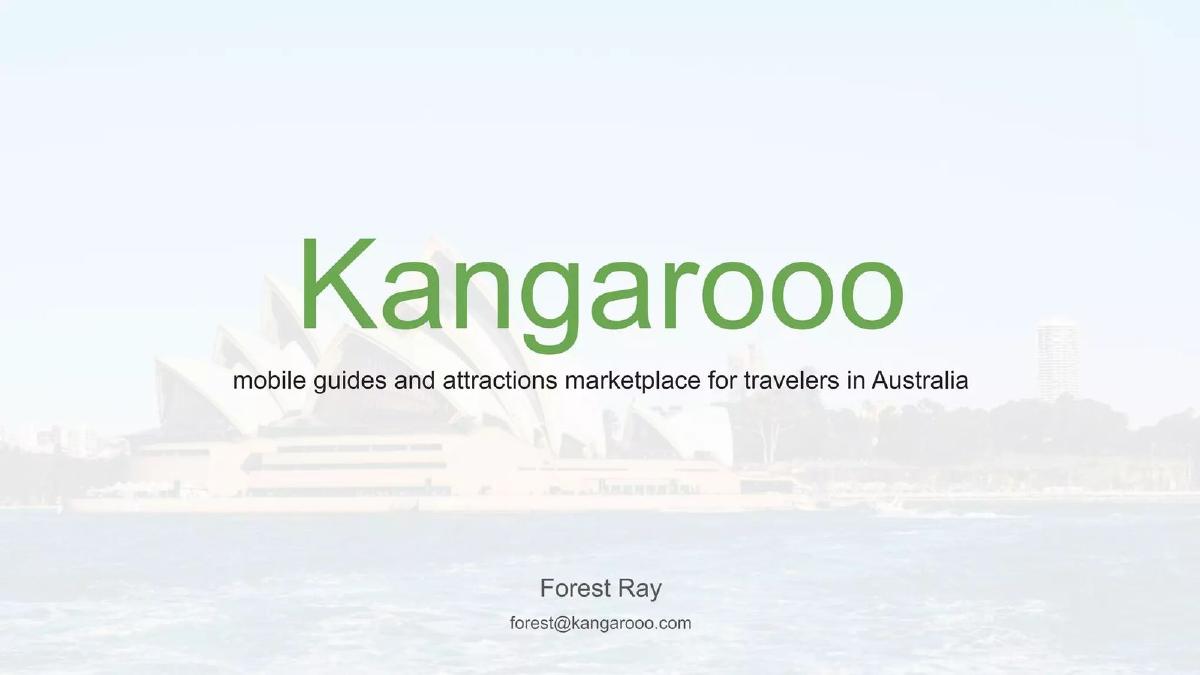
The deck opens with a clean, high-resolution image of the Sydney Opera House, immediately establishing the geographic focus. The subtitle, "mobile guides and attractions marketplace for travelers in Australia," is a concise value proposition. It identifies the product (marketplace), the platform (mobile), and the target audience (travelers in Australia).
Slide 2: The Problem
The problem slide focuses on three friction points: time, availability, and refunds. It claims the average person spends "up to 10 hours on internet research to plan a 7 day trip." It also highlights that walk-up purchasing wastes vacation time and that getting refunds from online agents is difficult. By framing the current process as "boring, long and distressing," Kangarooo sets the stage for a convenience-led solution.
Slide 3: The Solution
The solution is presented as a three-pillar marketplace: Wide Selection, Instant Booking, and Security. The slide promises "full refunds in under five days," directly addressing the refund pain point mentioned in the previous slide. The mention of major payment cards and PayPal suggests a focus on reducing friction at the point of sale.
Slide 4: The Product
This slide uses a series of iPhone mockups to demonstrate the user journey. The claim is that the interface helps users find a tour in "less than 5 minutes." The steps—Browse, Compare, Select/Book, and Have Fun—emphasize a streamlined UI. The final screen shows a digital ticket with a barcode, confirming the end-to-end mobile fulfillment strategy.
Slide 5: The Market
Kangarooo uses data from Tourism Research Australia to validate the opportunity. The chart shows Total Visitor Expenditure growing from $117B in 2015-16 to a projected $167B in 2024-25. The slide lists three growth drivers: a depreciating AUD attracting foreign buyers, increased aviation capacity, and the rising Asia-Pacific middle class. This macro-economic context justifies why now is the time to build in this sector.
Slide 6: Competition
The competitive matrix compares Kangarooo against Viator, Discover Australia, and Tourstogo.com. The standout metric here is the "Platform Commission" of 25%, which is lower than all three competitors (30-35%). Kangarooo also claims to be the only one offering both a mobile-optimized experience and a focus on corporate retreats, carving out a specific niche.
Slide 7: Business Model
The revenue model is split into three phases. The primary current source is the 25% Partner Commission. Future revenue streams include "Business Retreats" (exclusive activities for companies) and "Kangarooo Tours" (guided activities designed by the internal team). This shows a progression from a pure marketplace to a hybrid model with higher-margin proprietary products.
Slide 8: Traction
This is a critical slide for a seed deck. Kangarooo reports $25,920 gross revenue within 6 months of beta launch. A bar chart shows monthly revenue growth from $860 in October to $8,600 in March. Key metrics include a $288 average transaction value, 20% repeat customers, and a $25 customer acquisition cost (CAC). The LTV/CAC ratio appears healthy at this early stage.
Slide 9: Customer Acquisition
The acquisition strategy is transparent about current costs. The $25/user CAC is currently achieved through Facebook and Google Ads. The plan to hire a PPC agency to optimize this, followed by social media, partnerships, and SEO (travel guides), demonstrates a logical scaling path from paid to organic channels.
Slide 10: Financials
The five-year financial table is ambitious. It projects Gross Revenue growing from $695,600 in 2017 to over $26M by 2021. The model shows the company reaching break-even in 2020 with an EBIT of $590,000. Notably, marketing spend is projected to flatline at $1M per year from 2019 onwards, suggesting a heavy reliance on organic growth and repeat customers in the later years.
Slide 11: Team
The team slide is a strong point. CEO Forest Ray is a former Lead Designer at Viator with 12 years of experience, providing deep domain knowledge. CTO Luke McDaniel is a former Senior Developer at Google and a tour creator himself. This combination of design, engineering, and industry-specific operational experience reduces execution risk in the eyes of investors.
Slide 12: Milestones
The timeline spans from the September 2016 beta launch to a May 2018 goal of 3,000 unique bookings and $100,000 in gross sales. The milestones are specific and measurable, including hiring key staff, launching ad campaigns, and releasing travel guides. This gives investors a clear checklist to measure progress against the requested funding.
Slide 13: The Ask
The final slide requests $500,000 in funds to sustain the company for 12 months. The breakdown is clear: $120k for founder compensation, $270k for hiring (including an Android developer and tour guides), $80k for marketing, and $30k for office expenses. This level of detail in the use of proceeds is often missing in early-stage decks and is a welcome inclusion here.
What Works in This Deck
Unit Economics: Slide 8 provides a clear snapshot of the business's health (CAC vs. Transaction Value) that allows investors to model potential returns. · Founder-Market Fit: The CEO's background at Viator is the strongest possible signal for a startup trying to disrupt the tour and activity space. · Localized Strategy: By focusing only on Australia, they make a credible case for why they can offer better service and lower commissions than global giants. · Clarity of the Ask: The specific headcount and budget breakdown on Slide 13 shows a disciplined approach to capital allocation.
What is Missing
Retention Data: While they mention 20% repeat customers, more detail on the cohort behavior of these users would strengthen the traction slide. · Technology Deep Dive: For a mobile-first company, there is little mention of the underlying tech stack or proprietary features beyond a "pleasant UI." · Supply Side Acquisition: The deck focuses heavily on acquiring travelers but says very little about how they will convince tour operators to leave established platforms for a new marketplace. · Legal/Regulatory Context: Tourism in Australia involves various permits and insurance requirements; a brief mention of compliance would add professional weight.
Founder Takeaways
Lead with Traction: If you have revenue, even if it is small (like the $860 in month one on Slide 8), show the growth trend. It proves the market wants what you are building. · Benchmark Against Giants: The competitive table on Slide 6 is effective because it picks one or two metrics (commission and mobile optimization) where the startup can realistically win. · Be Specific with the Money: Don't just ask for $500k "for growth." Break it down into salaries and specific roles as Kangarooo did on Slide 13. It shows you have a hiring plan ready to execute. · Macro Trends Matter: Connecting your startup to larger economic shifts (like the Asia-Pacific middle-class growth on Slide 5) helps investors see the "why now" beyond just your product features.
Frequently asked questions
- What is Kangarooo's primary competitive advantage?
- Kangarooo's advantage lies in its hyper-local focus on Australia and its pricing structure. According to Slide 6, it offers a 25% commission rate, which is 5-10% lower than major competitors like Viator, Discover Australia, and Tourstogo.com. Additionally, it emphasizes 'hustle free' cancellations and a mobile-optimized interface to attract modern travelers who find traditional booking processes 'distressing'.
- How does the company plan to acquire customers?
- The strategy is phased. Currently, they rely on paid ads via Facebook and Google with a reported CAC of $25 (Slide 9). Future plans include hiring a Social Media Marketing (SMM) manager for brand building, establishing direct partnerships with major Australian tour brands, and investing in SEO through high-quality travel guides to drive organic traffic.
- Are the financial projections realistic?
- The projections are aggressive, moving from 1,200 bookings in 2017 to 48,000 in 2021 (Slide 10). This represents a 4,000% increase in volume over four years. While the gross profit margin is fixed at 25%, the model assumes the company can maintain a steady increase in average transaction value and control OPEX to reach profitability (EBIT of $590,000) by 2020.
- What is the background of the founding team?
- The team possesses strong technical and domain expertise. CEO Forest Ray was a Lead Designer at Viator with 12 years of UI/UX experience. CTO Luke McDaniel is a former Senior Developer at Google with 9 years of IT experience and personal experience creating a top-rated day tour in Melbourne (Slide 11). This combination of design, engineering, and operator experience is a highlight of the deck.
- What are the specific milestones for the seed funding?
- The funding is intended to bridge the gap between their June 2017 seed round and a May 2018 goal of 3,000 unique bookings and $100,000 in gross sales (Slide 12). Key intermediate steps include launching a paid ad campaign in July 2017, releasing travel guides and business retreat offers in September 2017, and launching proprietary Kangarooo tours by November 2017.