K&R Bash is a digital greeting platform that incentivizes users through a points-based reward system. The deck identifies a decline in the $5 billion paper greeting market and a corresponding 86% growth in digital gift cards as of 2015. The company’s value proposition centers on personalized e-greetings that come with points, which users can redeem for their choice of e-gift cards. While the deck provides clear market statistics and identifies major competitors like Shutterfly and JibJab, it lacks specific traction data, a detailed team slide, or a breakdown of unit economics. The founder, Ro…
Key takeaways
- The company is seeking a $500,000 convertible note to provide 18 months of runway (Slide 8).
- K&R Bash identifies a massive market opportunity in the $5 billion paper greeting card industry, which it claims is shrinking due to rising costs (Slide 5).
- The core product differentiator is that all e-greetings come with points redeemable for e-gift cards (Slide 4).
- Market data cited indicates that 73% of people like greetings, specifically those that are personal and include unexpected gift cards (Slide 3).
- Digital gift card sales grew by 86% in 2015, highlighting a shift in consumer behavior toward digital-first sentiments (Slide 5).
- The deck identifies four primary competitors: American Greetings (2nd largest), Shutterfly, Hallmark (brand recognition), and JibJab (Slide 7).
- The funding will be used for five specific areas: product-market fit, customer development, marketing, profitability, and app development (Slide 8).
- The deck lacks a team slide, financial projections, or evidence of current user traction.
Executive Summary: The Digital Pivot of Sentiments
K&R Bash enters a market that is historically dominated by legacy giants like Hallmark and American Greetings. The pitch deck focuses on the 'digitization of sentiment,' arguing that while paper cards are declining due to cost and the rise of social media, the desire for personalized greetings remains high. The unique angle presented is the gamification or reward-linking of e-greetings, where every sent card carries value in the form of redeemable points. This teardown examines the 8 slides provided to evaluate the clarity of the problem, the market timing, and the specific ask of the founder.
Slide 1: Title and Contact
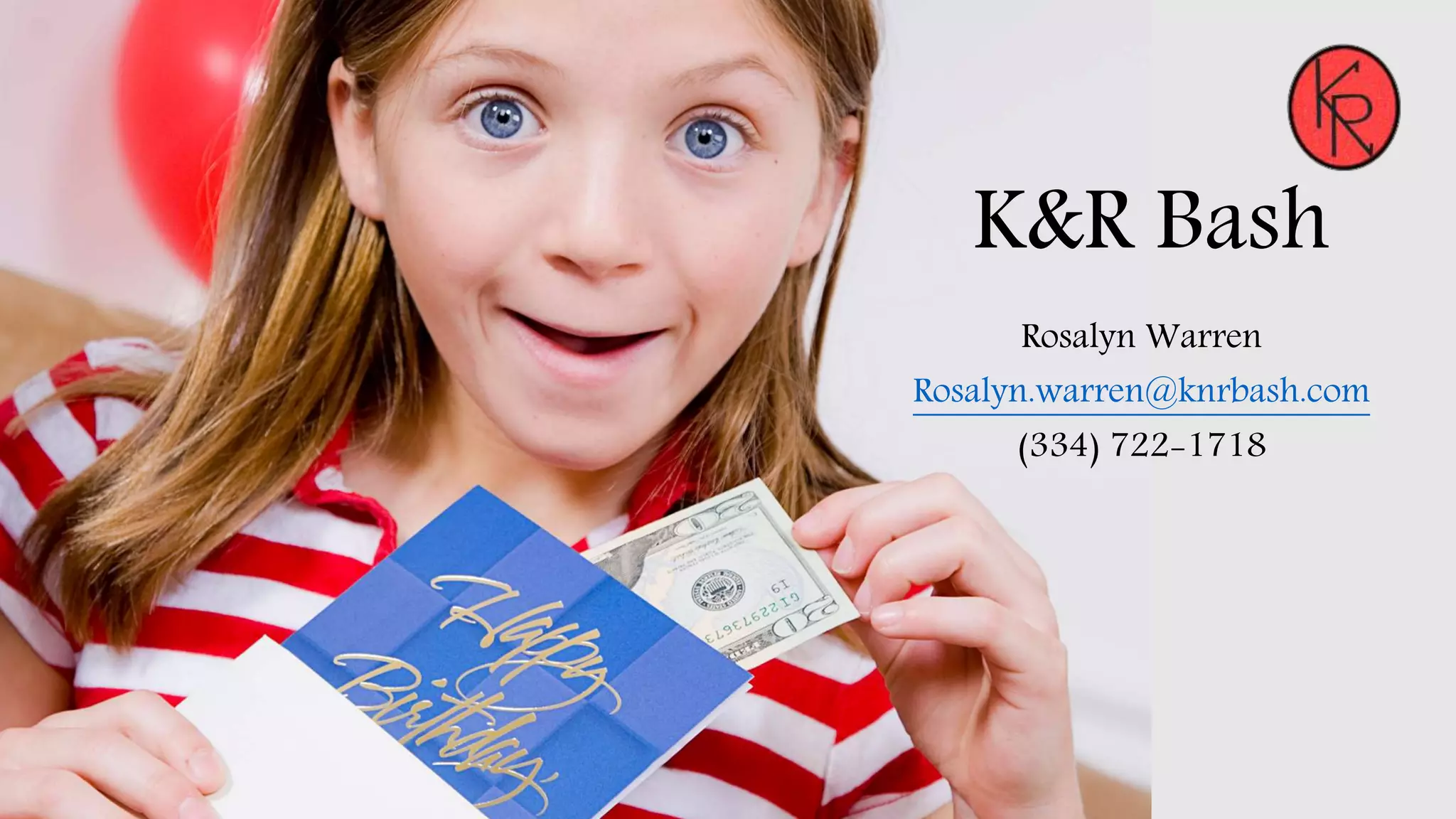
The cover slide features the company name, K&R Bash , and the name of the founder, Rosalyn Warren . The visual choice is a young girl holding a 'Happy Birthday' card with a twenty-dollar bill tucked inside. This immediately establishes the theme: the intersection of traditional greetings and monetary gifts. Contact information including an email and phone number is clearly displayed, which is standard for early-stage decks.
Slide 2: The Problem
The problem slide identifies two main pain points. First, it notes the difficulty in finding a gift that will be 'appreciated and used.' Second, it critiques the current digital alternative: social media sentiments. The deck describes social media well-wishes as 'cliché, impersonal, and easily lost in post and updates.' This sets the stage for a solution that is more permanent and valuable than a Facebook wall post but more convenient than a physical card.
Slide 3: Consumer Preferences
Citing a 'Holiday Greeting Card Cheat Sheet' from 2014, this slide claims that 73% of people like greetings . It further breaks down preferences, stating that consumers want greetings that are personal, include photos, and include an 'unexpected gift card.' This slide serves as the bridge between the problem (impersonal social posts) and the solution (personalized digital cards with monetary value).
Slide 4: Value Proposition
The value proposition is centered around a lightbulb graphic with four key pillars: Convenient and easy to navigate , Personalized e-greetings , All e-greetings come with points , and Redeem points for choice of e-gift card . This is the most important slide in the deck as it defines the business model. It suggests a platform where the 'gift' isn't just the card, but a currency that the recipient can aggregate and spend at their discretion.
Slide 5: Market Analysis
This slide provides the macro-economic justification for the business. It values the US Greeting Cards annual revenue at $5 billion for paper cards, contrasted against a much smaller $290 million for online greetings. However, it notes that the paper market is shrinking due to rising costs, while the digital gift card market grew by 86% in 2015 . The use of a pie chart visually emphasizes how much of the market is still 'up for grabs' if consumers continue to shift from physical to digital formats.
Slide 6: Gift Card Statistics
Further validating the digital gift card angle, Slide 6 states that 78% of consumers have received a digital gift card . It also claims that 69% of customers are more interested in purchasing digital gift cards now than they were 2-3 years ago. A crucial insight mentioned at the bottom of the slide is that sales for digital gift cards 'increase as the date of an event' approaches, suggesting that K&R Bash is a solution for last-minute gift-givers.
Slide 7: Competition
The competition slide uses a quadrant-style layout featuring the logos of American Greetings , Shutterfly , Hallmark , and JibJab . It acknowledges their strengths: American Greetings' size, Shutterfly's personalization, Hallmark's brand recognition, and JibJab's digital personalization. The deck does not explicitly state K&R Bash's 'unfair advantage' on this slide, though the previous 'Value Proposition' slide implies that the points system is the differentiator.
Slide 8: The Ask (What We Need)
The final slide in this set outlines the funding requirements. K&R Bash is seeking a $500,000 convertible note . The stated goal for this capital is to provide 18 months of runway to work on five specific areas: Product-market fit , Customer development , Marketing , Profitability , and App development . The slide also notes a plan for a subsequent round in 12-18 months specifically for marketing, indicating a staged approach to scaling.
What K&R Bash Does Well
The deck is highly focused on a single, understandable hook: adding a rewards layer to digital greeting cards. By citing specific growth figures for digital gift cards (86% growth in 2015), the founder successfully aligns the company with a clear market trend. The 'Problem' slide is relatable, as most users recognize the 'cliché' nature of social media birthday wishes. Furthermore, the 'Ask' slide is specific about the instrument (convertible note) and the duration of the runway (18 months), which helps investors understand the timeline for a potential return or next milestone.
What is Missing from the Deck
The most glaring omission is the Team Slide . In early-stage fundraising, the 'who' is often more important than the 'what.' Without bios for Rosalyn Warren or any co-founders/advisors, investors cannot assess the team's ability to execute against giants like Hallmark. Additionally, there is no Traction Slide . Even if the product is in beta, showing user sign-ups, card send rates, or partnerships with gift card providers would significantly strengthen the pitch. Finally, the Business Model is vague. While we know users get points, it is unclear how K&R Bash makes money. Do they take a percentage of the gift card sale? Is there a subscription fee? Is there a fee to send a card? Without unit economics, the path to the 'Profitability' mentioned on Slide 8 is invisible.
Founder's Guide: What to Copy and What to Avoid
Copy the Market Context: Slide 5 is a strong example of how to use industry data to show a 'changing of the guard.' By showing the massive $5 billion paper market next to the growing digital segment, the founder makes the opportunity feel large and inevitable. This 'incumbent vs. innovator' framing is a classic, effective pitch deck technique.
Avoid the 'Lightbulb' Value Prop: While Slide 4 explains the product, the 'lightbulb' graphic is a generic design choice that takes up too much visual real estate without adding information. Founders should use this space for screenshots of the actual app or a flow chart showing how a user goes from 'Sending a Card' to 'Redeeming Points.' Visualizing the user journey is always more effective than abstract icons.
Address the 'Why Now': The deck mentions 2014 and 2015 data. In a modern pitch, founders must ensure their data is current. If the market grew 86% in 2015, an investor today will want to know what happened in 2022 and 2023. Stale data can suggest a project that has been stagnant or a founder who isn't tracking current market shifts.
Final Analyst Thoughts
K&R Bash is a classic 'feature-as-a-product' play. The idea of a loyalty program for greeting cards is an interesting way to increase retention in a seasonal industry. However, the $500,000 ask feels speculative without a team slide or evidence of a working prototype. To move from a 'concept' to a 'company,' the next iteration of this deck needs to prove that the founder has the technical capability to build the app and the business development skills to sign the gift card partnerships required to make the 'points' valuable.
Frequently asked questions
- What is the specific product K&R Bash is offering?
- K&R Bash offers a digital platform for personalized e-greetings. Unlike standard e-cards, their 'Value Proposition' (Slide 4) states that all greetings include points. These points are accumulated by the recipient and can be redeemed for a choice of various e-gift cards, creating a loyalty-style ecosystem within the greeting card space.
- How much capital is the company raising and under what terms?
- According to Slide 8, the company is seeking $500,000. The investment instrument is specified as a convertible note. The founders intend for this capital to cover 18 months of operations, with a plan to raise a subsequent round specifically for marketing in another 12 to 18 months.
- What market trends does the deck use to justify the business?
- The deck relies on the transition from physical to digital. Slide 5 notes that the paper greeting market is $5 billion but shrinking due to paper costs and social media. Conversely, it highlights that 78% of consumers have received a digital gift card and 69% are more interested in them than they were three years prior (Slide 6).
- Who are the main competitors identified by K&R Bash?
- Slide 7 identifies four major players: American Greetings (represented by a rose logo), Shutterfly (personalized cards), Hallmark (represented by a crown logo), and JibJab (personalized digital cards). The deck positions K&R Bash against these incumbents by adding the 'points' reward layer.
- What are the biggest omissions in this pitch deck?
- The most significant omissions are a Team slide, a Traction slide, and a Business Model slide. There is no information regarding the founders' backgrounds, current user numbers, or the specific revenue split/commission structure the company takes on gift card redemptions or card sales.