Karavan was a refugee work exchange app pitched in February 2017 by founder Soraya Beheshti, built around a points system that lets refugees and citizens trade skills and services without money. The 16-slide deck is emotionally excellent and commercially empty: it spends five slides on the refugee crisis, one on the product, one on real Facebook-group demand, and never states an ask, a budget, a team beyond the founder, or the legal question at the centre of the whole idea. It is the clearest example of a mission deck being mistaken for a fundraising deck.
Key takeaways
- Karavan''s February 2017 deck is 16 slides long and never states how much money it is raising, what the money buys, or by when — the only funding reference is a crowdfunding URL on slide 15.
- The deck spends slides 2 through 7 — nearly 40% of its length — establishing that the refugee crisis exists, and a single slide, slide 8, explaining the product.
- Its strongest evidence is real and understated: a Facebook group that reached 4,000 members from 15 countries within roughly two weeks of launch, with screenshots of actual exchange requests on slide 13.
- The deck presents two incompatible camp statistics: slide 5 counts 21 million refugees under UNHCR mandate in camps out of 65 million displaced, while slide 6 states 61% of refugees live in urban settings alongside an image claiming one in three lives in a camp.
- Slide 3 says more than 60 million displaced; slide 5 says 65 million. Neither number carries a source, a date or a citation anywhere in the deck.
- The central legal risk — that refugees are, in the deck''s own words on slide 6, prohibited from earning money in many countries — is stated as a problem and never revisited as a compliance question for a points-based exchange.
- The team is one person: slide 15 profiles the founder, an undergraduate and masters student at Columbia, and no engineer, safeguarding lead or operations hire appears anywhere in the 16 slides.
- Slide 11 dates articles of incorporation as a non-profit to February 2017 with app development underway, which reframes the entire deck: it is a donor and volunteer deck, not an equity pitch.
What this deck actually is
The file calls itself a pitch deck. It is not one, and pretending otherwise makes it impossible to review fairly.
Karavan is a refugee work exchange: a mobile app that lets refugees and citizens trade skills and services with each other using points instead of money. The deck is 16 slides, dated 17 February 2017, presented by founder Soraya Beheshti under the banner Refugee Work Exchange. Slide 11 tells you what the entity is — articles of incorporation as a non-profit, signed that same month. Slide 15 tells you how it is funded — a LaunchGood crowdfunding campaign. There is no equity, no valuation, no cap table and no investor on the other side of this document.
So the correct frame is: this is a mission and crowdfunding deck wearing the label of a pitch deck. Judged as a piece of advocacy, it is genuinely good. Judged as a fundraising instrument of any kind — donor, grant or equity — it is missing the one thing every fundraising document must contain, which is a specific request.
That gap is worth an entire teardown, because it is the single most common failure in founder decks that are built out of conviction. The founder knows exactly what she wants. The deck never says it out loud.
Slide-by-slide walkthrough
Slide 1 — Cover
"Refugee Work Exchange / Pitch Deck", with the Karavan wordmark, the founder''s name and the title Founder. The company name is present, the category is present, and the presenter is identified. What is absent is any sentence describing what Karavan does. A reader who sees only this slide knows the topic and not the product. The fix is one line under the logo: a skills exchange app connecting refugees and citizens through a points system.
Slide 2 — "At KARAVAN we don''t believe kindness stops at a border"
A single sentence on a full slide. As a values statement it lands. As slide 2 of 16 in a document that has not yet said what the product is, it spends a scarce early slide on tone rather than information. Position statements like this work best after the reader knows what they are being asked to evaluate, not before.
Slide 3 — The scale of displacement
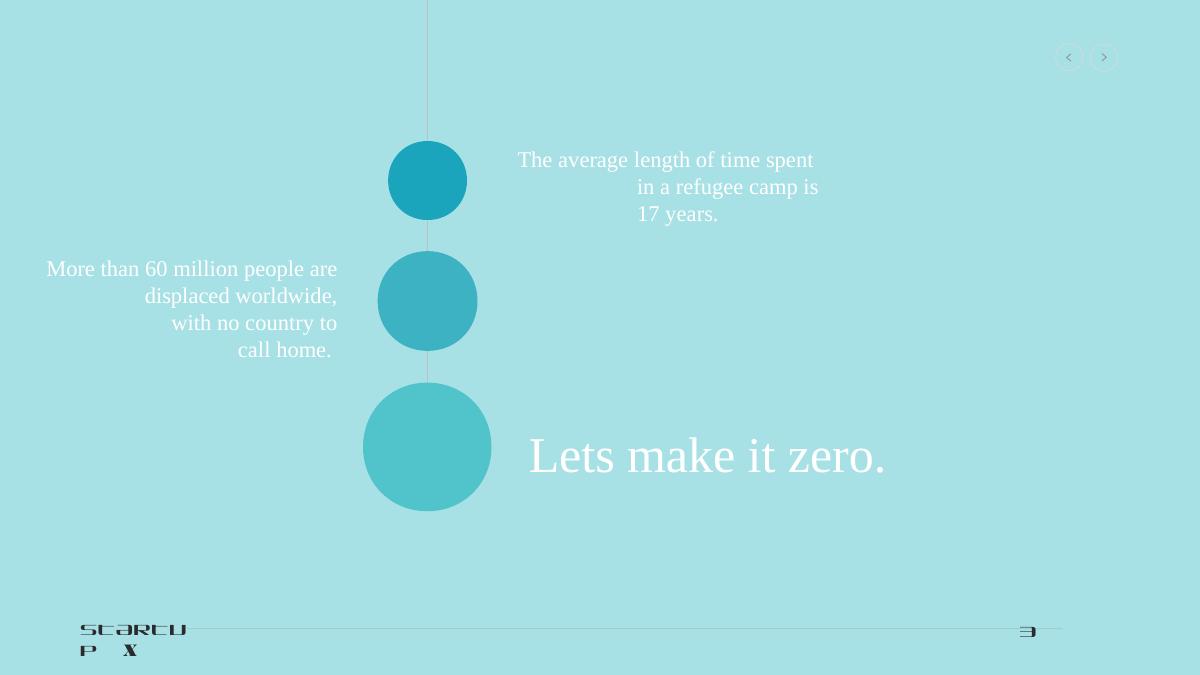
Three claims: more than 60 million people are displaced worldwide with no country to call home, the average length of time spent in a refugee camp is 17 years, and the closing line "Lets make it zero" — missing apostrophe included.
Two problems. First, no source is attached to either figure, here or anywhere in the deck. The 17-year camp figure in particular is one of the most frequently repeated and most frequently contested statistics in the sector, and a deck that leans on it without a citation invites the one question the founder does not want to spend her meeting answering. Second, "let''s make it zero" reads as a promise to end global displacement, which is not what a points-based skills app does. Overclaiming on slide 3 makes the reader discount the achievable claims on slide 8.
Slide 4 — Xenophobic nationalism
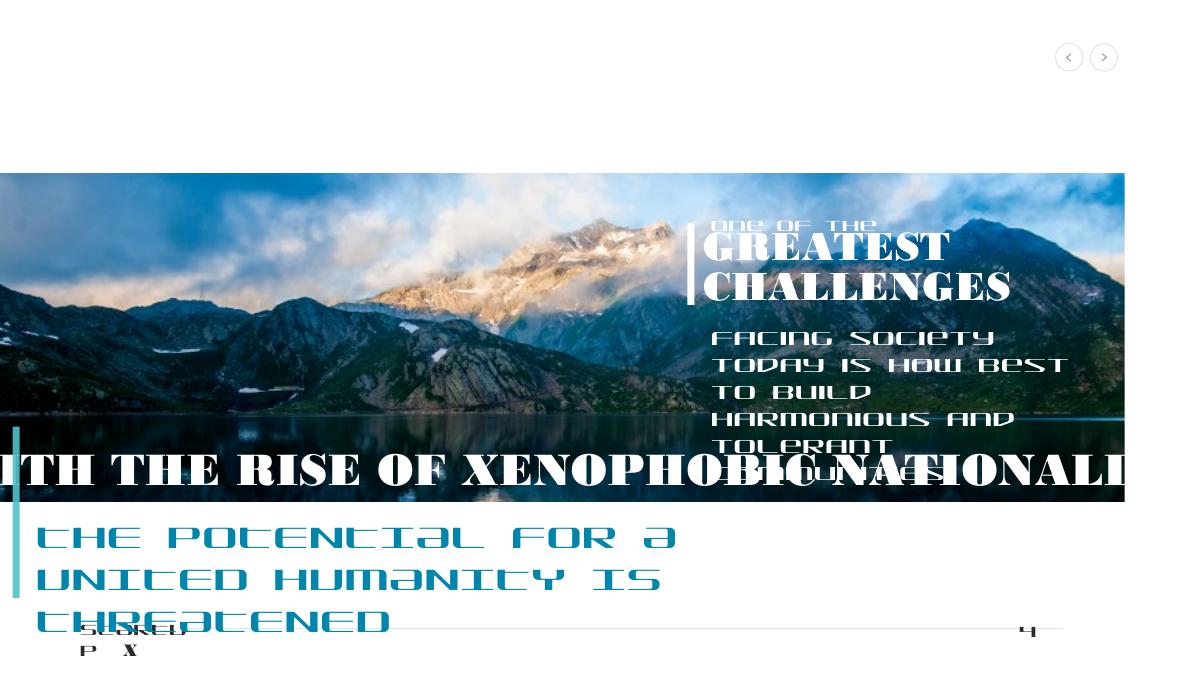
A layout casualty. Text describing "one of the greatest challenges facing society today" — building harmonious and tolerant communities — collides with a second block about the rise of xenophobic nationalism threatening "the potential for a united humanity". The two thoughts overlap physically on the slide, and neither carries evidence. This is the least useful slide in the deck and the easiest to delete.
Slide 5 — "Currently"
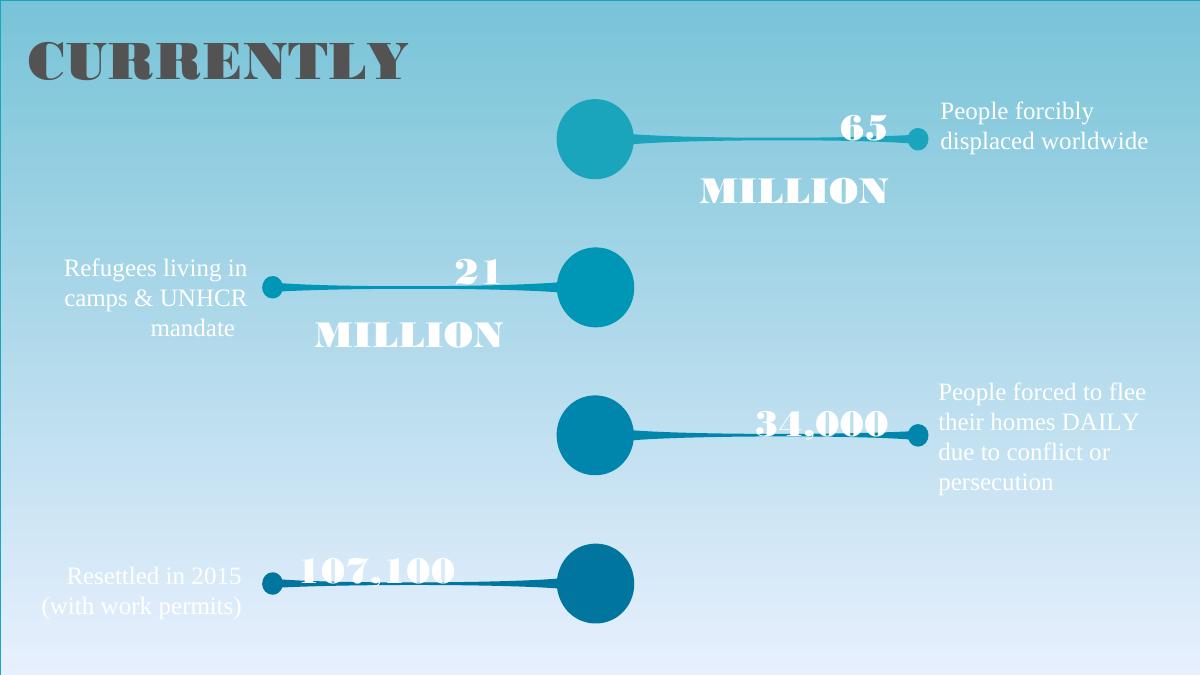
The numbers slide: 65 million people forcibly displaced worldwide, 21 million refugees living in camps and under UNHCR mandate, 34,000 people forced to flee their homes daily due to conflict or persecution, and 107,100 resettled in 2015 with work permits.
The 107,100 figure is the most valuable number in the deck and the deck does nothing with it. It quantifies the exact gap Karavan addresses: of tens of millions displaced, a five-figure number get formal permission to work each year. That is the case for a non-monetary exchange in one statistic. Instead it sits fourth in a list of four, undifferentiated.
Note also that slide 3 said "more than 60 million" and slide 5 says 65 million. Both may be defensible against different UNHCR reporting years, but with no dates and no sources attached, a reader simply sees two different numbers for the same fact two slides apart.
Slide 6 — Urban refugees and the earning ban
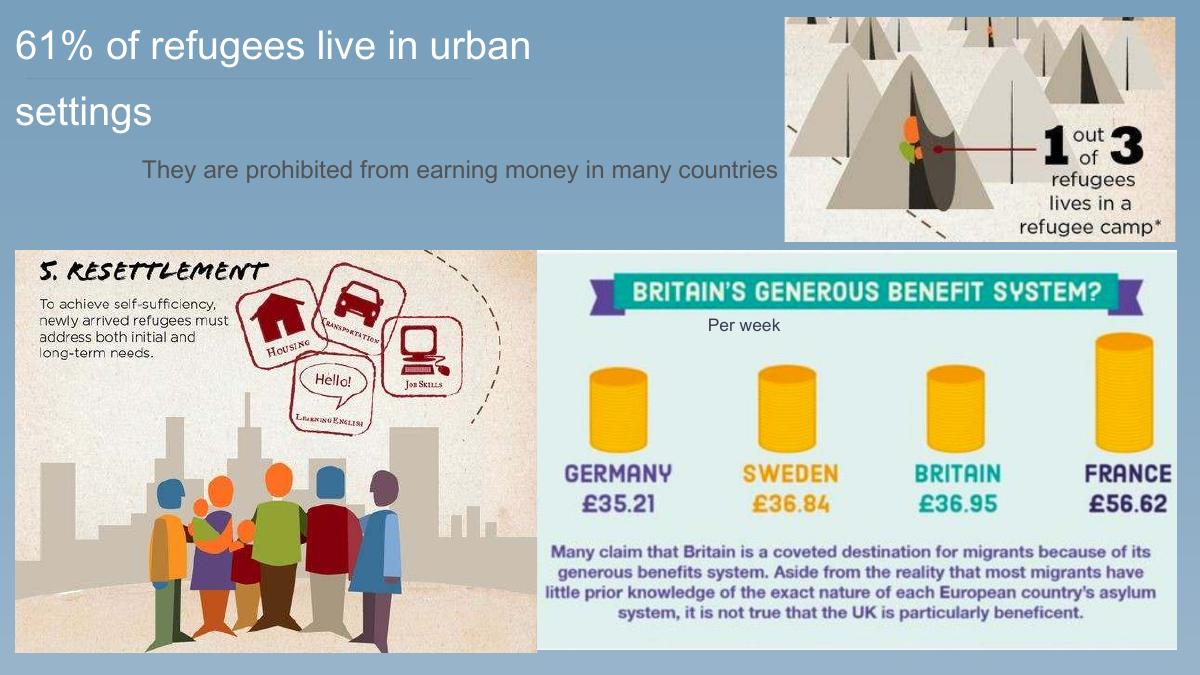
"61% of refugees live in urban settings. They are prohibited from earning money in many countries." Alongside it, a resettlement infographic and a chart comparing weekly asylum support across Germany at £35.21, Sweden at £36.84, Britain at £36.95 and France at £56.62, under the heading "Britain''s generous benefit system?". A third image asserts that one out of three refugees lives in a refugee camp.
This is the most important slide in the deck and also the most confused. Three issues:
Internal conflict. Slide 5 counts 21 million of 65 million in camps and under mandate; slide 6 says 61% live in urban settings and simultaneously displays an image claiming one in three is in a camp. Different denominators, no explanation, three numbers competing. · Borrowed assets. The infographics are visibly lifted from third-party campaign material, with different fonts, palettes and framing. They read as evidence someone else assembled for a different argument. · The unanswered question. "Prohibited from earning money in many countries" is not just a problem statement — it is the compliance question at the heart of Karavan. If a refugee earns points for four hours of Arabic tutoring and spends those points on web design, has value been exchanged? In which jurisdictions does that count as work? The deck raises the issue and never returns to it. That is the first question any serious funder, partner NGO or government stakeholder will ask, and slide 6 hands it to them.
Slide 7 — "Studies show"
The claim that the most effective way of rehabilitating refugee populations is by integrating them into social, economic and cultural spheres, split into economic benefits and social benefits. Directionally uncontroversial and, again, unsourced — the phrase "studies show" is doing the work that a named study should be doing. One footnote with one institution and one year would convert this from assertion to evidence at zero cost in space.
Slide 8 — The product
Finally, on slide 8 of 16, Karavan appears: a mobile app facilitating skill and service exchanges between refugees and citizens, on a points system, with the aim of enabling both groups to interact as "equally empowered participants". Two phone mockups sit alongside — a profile with services offered and requested, languages and common connections, and a category grid covering sports, music, cooking, business and technology, services, visual art, languages, academic, craft and skill, home and DIY, spiritual and psychological, and miscellaneous.
The mockups are the second-best asset in the deck. They are specific, they show real category taxonomy, and they make the abstract idea concrete in a way five slides of statistics did not. The design is unpolished — the wordmark overflows the slide edge — but the substance is there. This slide belongs at position two or three, not eight.
Slide 9 — How it works
The best-constructed slide in the deck. Four sequential steps: users create profiles detailing skills and services offered, a GPS system connects users in geographical proximity who offer the requested service, users arrange logistics in-app and log start and end hours to earn points per hour of service, and after each transaction both sides rate and review. The header names the trust mechanism — built-in identity verification measures — and the constraint: no money involved.
What is missing is depth on that verification. "Built-in identity-verification measures" is a phrase, not a system. For a product whose users include people without stable documentation, and whose interactions involve strangers meeting in person, verification and safeguarding are the product, not a feature of it. A funder will want to know the method, the escalation path and who is accountable when something goes wrong.
The points model also has an unexamined design flaw: one point per hour of service makes an hour of medical advice worth exactly one hour of dog walking. That may well be the intended philosophy of equal dignity, but the deck never says so, and a reader is left unsure whether it is a principle or an oversight.
Slide 10 — Why we exist
Three belief statements: human rights should not stop at a border, every individual should be treated with respect, dignity and value, and a belief in a united humanity. This is slide 2 again, expanded. The deck has now spent three separate slides on values and one on the product.
Slide 11 — Timeline
The credibility slide. May to August 2016: the founder conducts research and visits camps in Jordan, France and the UK. Two weeks later: she starts a Facebook group to determine the level of interest in refugee–citizen skill exchanges, and 4,000 members from 15 different countries join. February 2017: articles of incorporation as a non-profit are signed, a crowdfunding campaign is launched, app development is underway. The idea, the deck notes, was born in the "Jungle", northern France''s notorious camp.
Four thousand members in roughly two weeks, unpaid, from a standing start, is a real demand signal — arguably the strongest single fact in the document. It is rendered in small type inside a timeline graphic, given no headline, no growth curve and no follow-through. It should have been its own slide with the number at 200 point type.
Slide 12 — Map of active users
A world map with roughly thirty countries labelled: the UK, Sweden, Netherlands, Belgium, Ireland, France, Italy, Austria, Switzerland, Greece, Turkey, Russia, Spain, Portugal, Syria, Egypt, Lebanon, Jordan, Sudan, Oman, UAE, India, China, Japan, Afghanistan, Malaysia, Vietnam, Philippines, Indonesia, Morocco, Tunisia, Mexico, USA, New Zealand.
Geographic reach is impressive and, for this product, partly a warning. A skills exchange matched by GPS proximity needs density, not spread: 4,000 members scattered across 34 countries may mean no single city has enough supply and demand to make a first match work. The deck presents breadth as unambiguous strength without addressing the density problem underneath it.
Slide 13 — Facebook screenshots
Unedited screenshots from the group: someone offering Pashto, Dari and Urdu; a post about empowering refugee women in the UK through bread-baking training at a London bakery; a Syrian refugee in Norway asking for help booking an embassy appointment; a request for a volunteer graphic designer; an English teacher recently returned to the UK offering lessons in exchange for cooking, art or music lessons; and a thank-you post from a family in Winston-Salem, North Carolina who hosted four newly arrived Syrian families for a meal.
This is qualitative evidence at its best — real users, in their own words, asking for precisely the transaction the app is designed to broker, before the app exists. Most pre-product decks have nothing like it. The slide has no headline, no annotation and no synthesis, so its weight depends entirely on the reader zooming in and doing the work. One sentence of interpretation above it — "every request below is a transaction Karavan would have matched" — would have doubled its impact.
Slide 14 — The points economy
Three panels: accumulate points, with a wallet showing current balance and an all-time points-earned score; use points for a wide range of services online or in person, from cooking and language lessons to web design, medical advice and help around the home; and make connections, "blazing trails of community where there were none". The middle panel contains a visible typo — "help around the help".
Structurally this repeats slide 9 without adding a mechanism. It is also where the unanswered questions stack up: is there an initial points grant for new users, what stops the system running dry when one side only receives, and does medical advice offered for points create liability? None of that is addressed.
Slide 15 — Meet our founder
A full-slide biography. Soraya Beheshti is described as a BA/MA student at Columbia University, double-majoring in Film and Middle Eastern studies, specialising in post-colonial marginalisation, displacement and migration, who advocates on veganism, environmentalism and exploitation through her website, online store and creative projects, studies several languages and makes documentary films and music. Her Columbia email address is on the slide. The narrative panel describes field time in Jordan and Europe including the Jungle, and the ambition to build a scalable tech solution — spelled "scaleability" — that supersedes typical humanitarian responses.
The field credibility is real and relevant. The problem is what surrounds it: veganism, film-making and music are not qualifications for building a two-sided marketplace with an identity verification stack, and their inclusion dilutes the parts of the biography that matter. More importantly, this is the only person in the deck. There is no engineer for an app that is "under development", no safeguarding or operations lead, no board or advisory names for a newly incorporated non-profit. A one-person team is acceptable at this stage; an unacknowledged one-person team is not.
Slide 16 — Crowdfunding and contacts
A LaunchGood campaign URL, a thank you, "Questions?", the Facebook group link, a Twitter handle, the karavanapp.co.uk domain and the founder''s email address. The contact block is complete, which is more than many decks manage. What is not here is a target, an amount raised, a deadline, or any statement of what the money would buy. The reader who has been moved by fifteen slides arrives at the end with nothing specific to fund.
What this deck does better than most startup pitch decks
It proves demand before building. A Facebook group tested the core hypothesis — will refugees and citizens actually ask each other for skill exchanges — and returned 4,000 members from 15 countries in about two weeks. Most pre-product decks assert demand; this one has receipts. · It shows real user language. Slide 13''s screenshots are unpolished and unfaked, and they are worth more than any survey chart would have been. · The mechanic is explained in four steps. Slide 9 walks profile, match, logistics and rating in order, and any reader can repeat it back after one pass. · The founder''s field time is specific. Named camps in named countries across named months, not "years of experience in the sector". · The dated timeline is verifiable. Slide 11 lets a reader trace research to group to incorporation with dates attached, which is rare and disarming. · It is 16 slides. No filler appendix, no forty-slide overreach.
Where this deck would fail in an investor meeting
There is no ask. Not a soft one, not a range. Sixteen slides and no amount, no purpose, no deadline. Every funding conversation this deck starts must be rescued verbally. · There is no budget or model. No cost of building the app, no cost of running the exchange, no sustainability plan for a non-profit beyond one crowdfunding campaign. · Six slides of problem, one slide of product. Slides 2 through 7 argue that displacement is a crisis, a point no reader disputes. The product gets slide 8. · Statistics without sources. Every figure in the deck — 60 million, 65 million, 34,000 daily, 107,100 resettled, 61% urban, 17 years, one in three — appears without a citation or a date. · Numbers that disagree. 60 million versus 65 million; 21 million in camps versus 61% urban versus one in three in camps. · The legal question is raised and abandoned. The deck states refugees are prohibited from earning in many countries, then proposes an hours-for-points exchange without addressing whether that constitutes work in any of them. · Trust and safety is one phrase. "Built-in identity-verification measures" is the entire treatment of the risk surface for strangers meeting in person, including vulnerable users and minors. · The team is one person and the deck does not say so. No engineer is named for an app described as under development. · No competitive or partnership landscape. Timebanking, LETS schemes, Refugees Welcome, NGO placement programmes — none appear, so the reader cannot tell whether this is novel or a rebuild. · Polish errors compound. Overlapping text on slide 4, the wordmark bleeding off slide 8, "Lets make it zero", "help around the help", "scaleability". Individually trivial, collectively a signal about operational care.
Mission deck versus fundraising deck
Element What Karavan''s deck does What a fundraising deck must do
Ask Absent; a crowdfunding URL on slide 15 Amount, timeline and what it unlocks, on a dedicated slide
Use of funds Not present Categories summing to 100% of the raise
Problem Six slides, unsourced One or two slides, sourced and dated
Product One slide, on slide 8 Early, with the mechanic visible
Traction Real, buried in a timeline graphic Headlined, with a growth curve
Team Founder only, gap unacknowledged Named roles, plus the hires the money funds
Risk Legal exposure raised then dropped Named risk with a stated mitigation
Sustainability One crowdfunding campaign How the organisation funds year two
How you would rebuild this deck in 12 slides
Cover with a one-line definition. "Karavan — a skills exchange app connecting refugees and citizens through points, not money." · One problem slide, sourced. Keep 107,100 resettled with work permits against 65 million displaced. Cite the source and the year. Delete the other five problem slides. · Product on slide 3. The phone mockups from slide 8, with the category grid visible. · How it works. Slide 9 unchanged; it already works. · Trust and safety as its own slide. Verification method, safeguarding policy, reporting path, who is accountable. This is not an appendix item for this product. · The legal position. One slide: in which jurisdictions a non-monetary exchange sits outside right-to-work restrictions, which counsel or NGO confirmed it, and where the pilot will run because of that. · Demand, headlined. "4,000 members in 14 days, 15 countries, zero marketing spend", with the growth curve. · Proof in user words. Slide 13''s screenshots with a one-line synthesis on top. · Pilot city, not world map. Pick the densest city in the group, state the member count there, and show the first hundred matches as the goal. Save the map for a growth slide later. · Team and gaps. The founder as she is, plus "hiring: one mobile engineer, one safeguarding lead" — funded by the raise. · The ask. A number, a period of runway, and four or five spending categories summing to the total. · Sustainability and contact. How the organisation funds itself after the campaign, then the contact block from slide 16.
The transferable lesson
Karavan''s deck fails in the most sympathetic way a deck can fail. The founder had done the fieldwork, tested the idea for free, gathered 4,000 people who wanted it, incorporated the entity and designed a coherent mechanic. Every hard part was already done. What she did not do was tell the reader what to do next.
That is the pattern to check for in your own deck. Read it as a stranger and ask: at the end of this, what exactly am I being asked for, how much, by when, and what does it buy? If the answer is anywhere other than a slide with a number on it, your deck is a speech. Then check the second thing Karavan missed: the strongest fact in the whole document — 4,000 people in two weeks — was set in eight-point type inside a timeline. Founders routinely bury their best evidence because they are too close to it to see that it is remarkable.
Find your 4,000. Put it in the largest type on the page. Then say what you want.
Frequently asked questions
- What is Karavan?
- Karavan was a mobile app concept, pitched in February 2017 by founder Soraya Beheshti, that facilitated skill and service exchanges between refugees and citizens using a points system rather than money. Users would list skills they could offer, be matched by GPS proximity, log start and end hours, earn points per hour of service and rate each other afterwards. It was incorporated as a non-profit and ran under the name Refugee Work Exchange.
- Is the Karavan deck a real investor pitch deck?
- Only in name. The file is titled Pitch Deck and follows a pitch structure for its first ten slides, but it contains no ask, no valuation, no use of funds, no financial model and no equity language. Slide 11 states the entity was incorporated as a non-profit and slide 15 points to a LaunchGood crowdfunding campaign, which makes it a donor, volunteer and partner deck rather than an equity fundraising document.
- How much was Karavan raising?
- The deck never says. There is no ask slide, no target amount, no runway figure and no breakdown of what money would be spent on. The only funding signal in all 16 slides is the URL of a LaunchGood crowdfunding campaign on the penultimate slide, with no goal, no amount raised to date and no deadline attached to it.
- What traction did the Karavan deck show?
- Its real evidence is a Facebook group. Slide 11 states that a group created to test demand reached 4,000 members from 15 different countries within roughly two weeks, and slide 12 maps active users across around 30 countries. Slide 13 shows screenshots of genuine posts: a Syrian refugee asking for help booking an embassy appointment, a bread-baking training offer, a volunteer graphic designer request. The app itself did not exist yet.
- Which slides from the Karavan deck should founders copy?
- Three. Slide 9, which explains the mechanic in four sequential steps with the trust measures named inline. Slide 13, which proves demand with unedited screenshots of real users asking for exactly the thing the product does. And slide 11, a plain dated timeline from first field research to incorporation that lets a reader verify momentum without taking any claim on faith.
- What is the main lesson from the Karavan pitch deck teardown?
- Conviction is not a plan. Karavan spends six slides proving the problem is real and enormous, which no reader disputed, and zero slides on the ask, the budget, the team or the legal position of the exchange it proposes. If your deck moves someone emotionally and leaves them with nothing to say yes to, it has not made a request — it has made a speech.