The Katalyst MoneyTrees deck from 2016 pitches a network of leasable, fully customizable hardware kiosks designed to drive impulse sales in physical retail environments. The core value proposition, as stated on Slide 1, is a 'leasable network' that generates revenue 24/7 without requiring users to download an app. The company targets millennials by integrating digital shared experiences into physical retail (Slide 4). While the deck outlines a clear marketing strategy focused on high-traffic areas like malls and airports (Slide 6), it lacks critical financial data, unit economics, and a speci…
Key takeaways
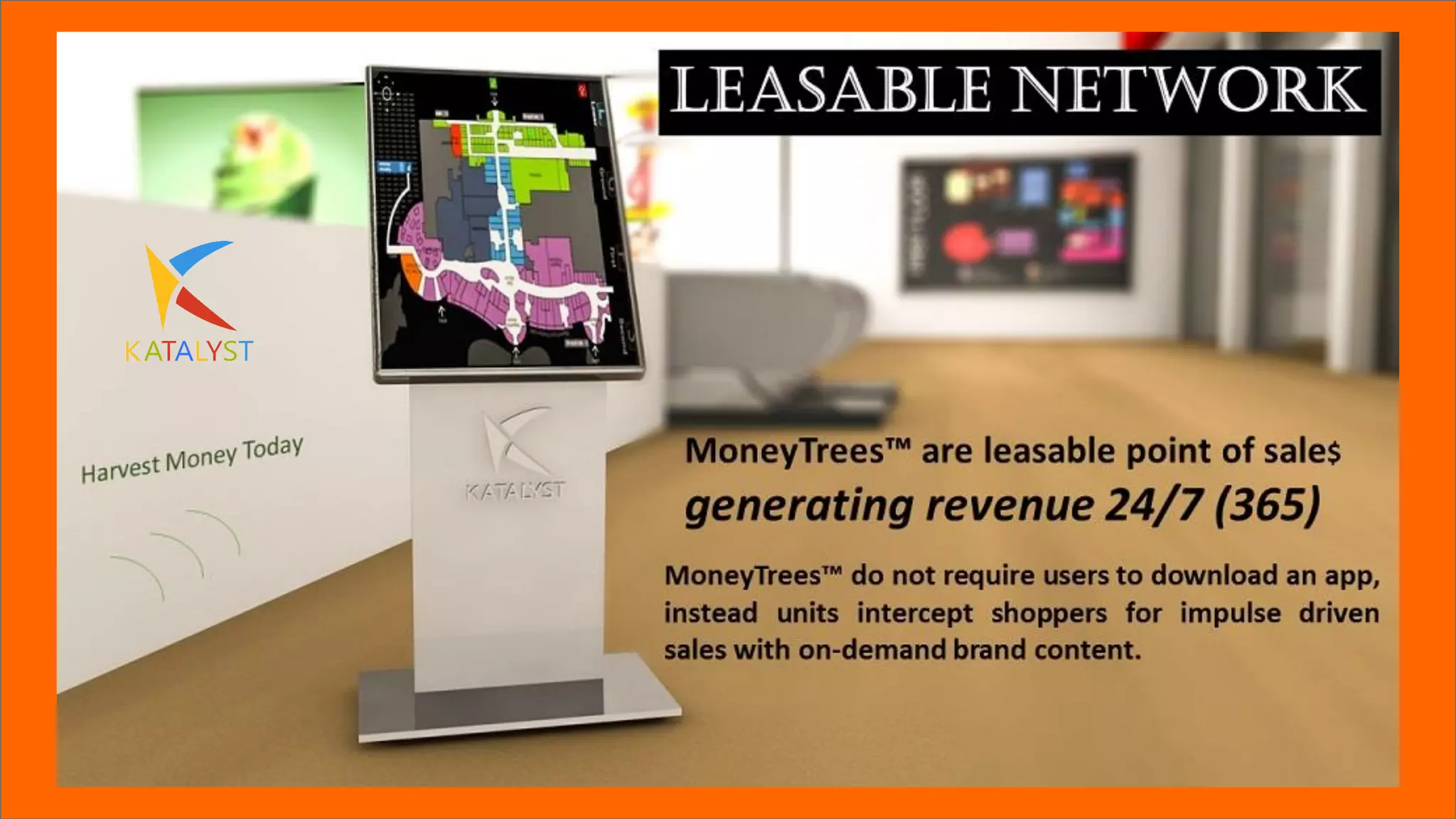
- The product consists of 'MoneyTrees,' which are leasable point-of-sale units designed to generate revenue 24/7 (Slide 1).
- The strategy explicitly avoids app downloads, instead using on-demand brand content to 'intercept' shoppers for impulse sales (Slide 1).
- Market opportunity is framed by ICSC data suggesting consumers prefer self-service and view apps as 'data burdens' (Slide 2).
- Hardware is fully customizable and allows brands to embed existing websites or e-commerce platforms without new software development (Slide 3).
- The target market is broadly defined as 'EVERYBODY,' with a specific core focus on millennials who seek physical-digital integration (Slide 4).
- Marketing efforts involve geo-fencing to target cellphones within a specific geographic zone near the kiosks (Slide 5).
- The business model is described as a 'scalable model prime for rapid growth and high dividends' (Slide 6).
- The deck lists potential locations as malls, airports, hospitals, office lobbies, and university campuses (Slide 6).
Executive Summary: The Kiosk as a Revenue Engine
The Katalyst MoneyTrees pitch deck presents a vision for the future of retail that centers on physical hardware rather than mobile software. By positioning their 'MoneyTrees' as leasable revenue generators, the company attempts to solve the friction of app-based shopping in physical environments. The deck focuses heavily on the 'impulse' nature of retail, suggesting that large-format, interactive screens can 'intercept' shoppers more effectively than their own smartphones.
Slide 1: The Value Proposition
The opening slide introduces the 'MoneyTrees' as a 'Leasable Network.' The core claim is that these units are point-of-sale systems generating revenue 24/7, 365 days a year. A key differentiator highlighted here is that the units 'do not require users to download an app.' This is a direct response to the perceived fatigue of the app economy. The visual shows a sleek, white kiosk with a large touchscreen displaying a mall directory or map, suggesting the hardware is intended to be both a utility and a sales tool.
Slide 2: The Market Opportunity
Katalyst cites the ICSC (International Council of Shopping Centers) to validate their business model. The slide lists four key findings: consumers are channel-agnostic, self-service is the preferred checkout method, apps are viewed as 'data burdens,' and digital sales strategies (like geo-driven and time-sensitive sales) drive growth. By citing an external retail merchant association, the deck attempts to ground its hardware-first approach in broader industry trends. The mention of 'Assurance Deals' and 'Bundles from Multiple Brands' suggests the kiosks are intended to be multi-tenant platforms.
Slide 3: Hardware Customization and Content Integration
This slide emphasizes that the hardware is 'fully customizable.' It showcases various use cases through a collage of images: a girl using a stylus on a screen, a Mazda advertisement, a bank kiosk, and a mall directory. A critical technical claim is made here: brands can 'embed your current website, e-commerce platform and back-end services directly to the network.' The slide explicitly states there is 'no need for middleware or costly software development,' which is a pitch for low-friction onboarding for retail partners.
Slide 4: Target Market - The Millennial Focus
Slide 4 uses a large, red 'EVERYBODY' stamp to define the target market, but quickly narrows the focus to millennials. The rationale provided is that millennials seek 'physical retail integration with digital shared experiences' and 'fear missing out on experiences happening around them.' The deck frames the kiosks as 'fun units' that are voice and touch-activated, aiming to capitalize on the interactive habits of younger consumers. It cites data from 'millennialbranding.com' to support these psychological profiles.
Slide 5: Marketing Strategy and Customer Acquisition
The marketing strategy is split into two parts: how they promote brands and how they acquire users. Katalyst states they focus on promoting participating brands in a 'shoppers guide' style, with 'NO Katalyst SKU's' being sold directly. This confirms they are a platform/service provider, not a retailer. Customer acquisition is purely location-based, targeting 'High traffic areas or Captive Audiences.' Interestingly, they mention 'Mobile-heavy presence' as a marketing effort, specifically targeting cellphones within a geographic zone to drive traffic to the physical kiosks.
Slide 6: The 'Why Katalyst' Pitch
This slide serves as the summary of the investment thesis. It describes the company as a 'lean and agile startup' with an 'experienced executive team' (though no names or bios are provided in the available slides). It claims the model is prime for 'high dividends' and 'lucrative exit opportunities,' specifically mentioning an 'eventual I.P.O.' The slide also lists potential locations: Malls, Airports, Hospitals, Office Lobbies, and University campuses. The mention of 'Multiple Forms Risk Mitigation and Financial collaterals' suggests a complex underlying lease or financing structure, though no details are given.
Slide 7: Contact and Legal Disclaimer
The final slide provides the company's contact information: Katalyst of America CORP, located in Sunny Isles Beach, Florida. It includes the URL 'MyMoneyTreeKiosk.com.' A small-print legal disclaimer at the bottom notes that 'no offering for sale is made herein' and that the content is confidential and protected by Florida law. The visual repeats the kiosk rendering from the first slide, reinforcing the product's physical design.
What Katalyst MoneyTrees Does Well
The deck is very clear about what the product is: a physical kiosk. In an era where many startups struggle to explain their 'black box' software, Katalyst is refreshingly literal. The 'no-app' messaging is a strong, counter-intuitive hook that addresses a real pain point for both retailers (who struggle with app adoption) and consumers (who have limited phone storage and patience).
The emphasis on 'no middleware' (Slide 3) is also a strong selling point for B2B sales. By promising that a brand can simply 'embed' their existing website, they lower the barrier to entry for potential retail partners who might otherwise be intimidated by the cost of developing custom kiosk software.
Omissions and Weaknesses
The most glaring omission is the lack of a Team slide. While Slide 6 mentions an 'experienced executive team,' it provides no names, photos, or track records. For a hardware startup, which involves significant supply chain and logistics complexity, the 'who' is just as important as the 'what.'
Furthermore, the deck is entirely devoid of unit economics. There is no mention of how much a 'MoneyTree' costs to manufacture, what the lease terms are for retailers, or what the projected revenue per unit looks like. Without these figures, the claim of a 'scalable model prime for rapid growth' (Slide 6) is purely speculative. The 'EVERYBODY' target market on Slide 4 is also a red flag for investors, as it suggests a lack of disciplined focus, even if it is immediately qualified by the mention of millennials.
Founder Takeaways: Hardware vs. Software Friction
Address the 'App Fatigue': If your solution avoids the need for a download, make that a headline. Katalyst correctly identified that the app store is a barrier to impulse purchases. · Leverage Existing Assets: The promise to use a brand's existing e-commerce site (Slide 3) is a great way to reduce the 'cost of change' for your customers. · Be Specific About Locations: Listing Malls, Airports, and Hospitals (Slide 6) helps investors visualize the 'where' and 'how' of your business model. · Avoid Generic Market Sizes: Stamping 'EVERYBODY' on a slide (Slide 4) rarely impresses investors; they want to see a calculated Total Addressable Market (TAM) based on real numbers, not a broad demographic. · Include the 'Ask': A pitch deck should clearly state what the company needs—whether it's $500k for a pilot or $5M for manufacturing—and what that money will achieve.
Frequently asked questions
- What is the primary product offered by Katalyst?
- The primary product is the 'MoneyTree,' a leasable, voice and touch-activated kiosk. According to Slide 1 and Slide 3, these units are fully customizable hardware pieces designed to act as point-of-sale terminals. They allow brands to display digital content and e-commerce platforms directly to shoppers in physical locations, facilitating impulse purchases without the need for a dedicated mobile application.
- How does Katalyst plan to acquire customers?
- Katalyst's customer acquisition strategy, detailed on Slide 5, relies on installing units in high-traffic areas with 'preexisting flow of shopping pedestrians.' They also mention 'Captive Audiences' in locations like airports and hospitals. Their marketing efforts include digital signage on the screens and a 'mobile-heavy presence' that uses geo-fencing to target the cellphones of people near the kiosks.
- What is the company's stance on mobile apps?
- Katalyst takes a contrarian view of mobile apps. Slide 2 states that 'apps have lost their novelty and are viewed as data burdens on mobiles.' Consequently, Slide 1 emphasizes that MoneyTrees do not require users to download an app, aiming to remove friction from the impulse buying process by using the kiosk as the primary interface.
- Who is the intended audience for these kiosks?
- While Slide 4 features a large 'EVERYBODY' stamp, it specifies that millennials are the core focus. The company believes millennials perceive digital sales strategies as enhancers and have a 'fear of missing out' (FOMO) on experiences, making them more likely to engage with touch-activated units that integrate physical retail with digital content.
- What financial information is included in the deck?
- The provided slides contain no specific financial information. There are no revenue figures, projections, unit costs, or lease pricing details. Slide 6 mentions a 'scalable model prime for rapid growth and high dividends,' but these are qualitative claims rather than quantitative data points. The deck also lacks a specific funding 'ask' or valuation.