Viso’s Series A deck, which facilitated a $9.2M raise in 2023, positions the company as the 'only' end-to-end infrastructure for computer vision. By covering the entire lifecycle—from collection and annotation to delivery and maintenance—Viso addresses the high failure rate of AI projects. The deck highlights significant ROI metrics, including a 695% return over three years and a 10x faster release cycle. While the provided slides focus heavily on the platform's architecture and value proposition, the inclusion of a 'Demo' slide suggests a product-led sales motion. The teardown explores how V…
Key takeaways
- Viso positions itself as the only end-to-end no-code computer vision platform, covering 10 distinct stages of the application lifecycle (Slide 2).
- The platform claims to achieve a 695% ROI in 3 years with a 3-month payback period for enterprise customers (Slide 2).
- Viso addresses the speed-to-market barrier by offering a 10x faster release cycle compared to traditional coding methods (Slide 2).
- The infrastructure supports 1-click scaling from single devices to hundreds of cameras, solving a major deployment pain point (Slide 2).
- A dedicated 'Demo' slide indicates that the product's visual interface is a core selling point for the Series A round (Slide 11).
- The company reported a >95% success rate for applications built using their 'app blueprints' (Slide 2).
- Viso raised $9.2M in 2023 to expand its Swiss-based AI operations, as reported by Business Insider.
- The deck emphasizes cost savings, specifically citing the ability to save the costs of 4 FTEs per application (Slide 2).
The Vision for No-Code Computer Vision
Viso entered the market at a time when 'AI' was a buzzword, but 'deployed AI' was a rarity. Most computer vision projects fail because the gap between a trained model and a functioning, secured, and monitored enterprise application is massive. Viso’s $9.2M Series A deck is a study in positioning a startup not just as a tool, but as the essential infrastructure for an entire industry. By focusing on the 'No-Code' aspect, they target the bottleneck of specialized talent, promising that existing teams can deploy complex vision systems 10x faster.
Slide 1: The Hook
The title slide is minimalist, featuring the logo and a bold claim: "The Only No-Code Computer Vision Platform." The background uses a montage of computer vision use cases—safety gear detection, logistics tracking, and retail monitoring—subtly signaling the breadth of their market applicability. It establishes the brand identity immediately: clean, professional, and focused on a single, powerful category-defining statement.
Slide 2: The Value Proposition and ROI
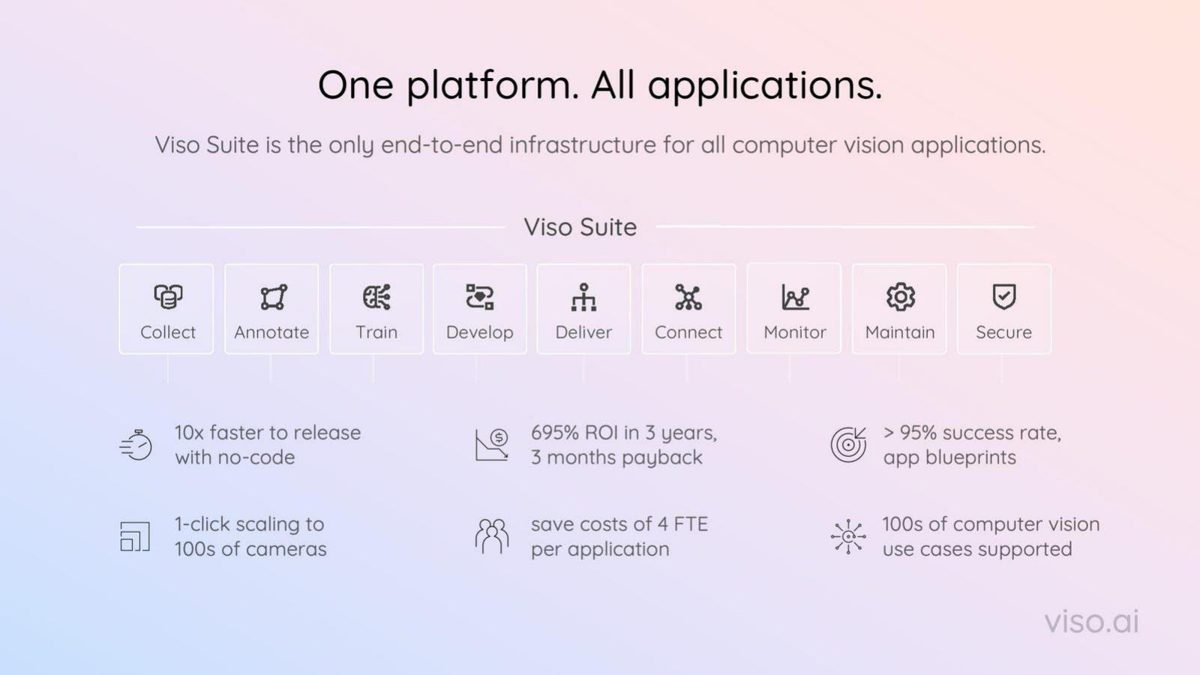
This is arguably the most important slide in the deck. It breaks down the Viso Suite into ten functional blocks: Collect, Annotate, Train, Develop, Deliver, Connect, Monitor, Maintain, and Secure. This comprehensive list is a direct attack on 'point solutions' that only handle one part of the workflow. Below the architecture, Viso lists six hard-hitting metrics:
10x faster to release with no-code. · 695% ROI in 3 years , with a 3-month payback. · > 95% success rate using app blueprints. · 1-click scaling to 100s of cameras. · Save costs of 4 FTE per application. · 100s of computer vision use cases supported.
By quantifying the value (FTE savings and ROI) alongside the technical ease (1-click scaling), Viso speaks to both the CTO and the CFO. The mention of 'app blueprints' is a clever way to de-risk the investment for the customer, suggesting that they aren't starting from scratch.
Slide 11: The Product Demo
Slide 11 features a Demo screen showing the Viso Suite interface. The visual highlights a node-based 'Flow Builder,' where users can drag and drop modules. Specifically, the screen shows a flow connecting a 'Camera' to a 'People Detect' node, leading to a 'Left Video View.' This visual proof is critical for a 'no-code' claim. It shows a 'Welcome Matt' dashboard, suggesting a multi-tenant or multi-user enterprise environment. The presence of a sidebar with 'Data Collection,' 'Image Annotation,' and 'Model Training' reinforces the end-to-end nature of the platform described in Slide 2.
Analysis of Supplemental Slides (Weav.ai, Dashtoon, Frenetic)
The provided materials include slides from other companies (Weav.ai, Dashtoon, Frenetic) which serve as a comparative context for modern AI and deep-tech decks. For example, the Weav.ai Customer Pipeline (Slide 13) shows how a Series A company should track leads across industries like EdTech, Retail, and Healthcare, using 'Booked ARR' and 'Potential' as key metrics. The Weav.ai Gen AI Architecture (Slide 14) introduces the concept of 'FOMO' (Foundation Model Orchestration), illustrating how startups are now positioning themselves as the glue between enterprise content and models like ChatGPT or LLaMA.
The Dashtoon Problem Slide (Slide 24) uses a narrative approach to explain a 'White space market' in the creator economy, contrasting the US/Europe markets with the established ecosystems in Japan and Korea. This is a classic 'market gap' argument. Finally, the Frenetic Team Slide (Slide 41) uses illustrated avatars and clear geographic markers (Madrid, San Francisco, Zurich) to showcase a global, 55-employee operation. These slides highlight that while Viso focuses on infrastructure, the broader trend in 2023 fundraising was about demonstrating 'synergy,' 'orchestration,' and 'global scale.'
What Works in the Viso Deck
Comprehensive Lifecycle Coverage: Most AI decks focus on the 'magic' of the model. Viso focuses on the 'misery' of the maintenance. By including 'Secure' and 'Maintain' in their core platform slide (Slide 2), they show they understand the long-term pain points of enterprise IT departments. This is a high-maturity approach that appeals to Series A investors looking for 'boring' but essential infrastructure.
Aggressive Quantification: The ROI metrics on Slide 2 are exceptionally specific. Claiming a 695% ROI and a 3-month payback period is a bold move that requires significant case study data to back up during due diligence. However, in a pitch deck, these numbers act as a powerful anchor for the company's value.
Visual Simplicity: Despite the complexity of computer vision, the deck remains uncluttered. The use of icons for the ten stages of the Viso Suite makes a complex technical stack feel manageable and modular.
What is Missing
The 'Ask' and Use of Funds: In the provided 9-slide subset, there is no mention of the specific amount being raised or how the $9.2M will be allocated. Typically, a Series A deck should detail the split between R&D, Sales/Marketing, and Operations.
Competitive Landscape: While Viso claims to be the 'only' no-code platform, the deck (in this subset) does not address how they compare to giants like AWS Panorama or specialized startups in the MLOps space. Investors at the Series A stage usually want to see a 'Magic Quadrant' style comparison or a feature-parity matrix.
Case Studies: Slide 2 mentions '100s of use cases,' but the deck would be strengthened by a deep dive into one specific customer success story. Showing exactly how a retail chain or a factory saved those '4 FTEs' would move the claims from theoretical to proven.
Founder's Playbook: What to Copy
The 'End-to-End' Visual: If you are building a platform, do not just list features. Create a linear workflow like Viso did on Slide 2. It helps investors visualize where your product starts and ends in the customer's existing stack.
The 'Demo' Placeholder: Including a dedicated slide for a demo (Slide 11) with a high-quality screenshot of the actual UI is better than trying to explain the UI with text. It proves the product is real and 'shipping.'
Focus on 'No-Code' as a Multiplier: Viso doesn't just say they have AI; they say they have AI that anyone can use. If your technology is complex, your pitch should focus on how you've simplified the interface, not just the underlying math. The '10x faster' metric is a perfect example of translating a technical feature into a business benefit.
Final Thoughts
Viso’s deck is a textbook example of 'Infrastructure-as-a-Service' positioning. By moving the conversation away from model accuracy and toward deployment speed and ROI, they successfully navigated the 2023 funding environment. The $9.2M raise is a testament to the market's appetite for tools that make AI operational rather than just experimental. Founders in the AI space should take note: the 'how' (no-code, 1-click scaling) is often more investable than the 'what' (the specific AI model).
Frequently asked questions
- What is Viso's primary value proposition?
- Viso provides a no-code infrastructure that manages the entire computer vision lifecycle. Unlike tools that only handle training or annotation, Viso covers ten stages: Collect, Annotate, Train, Develop, Deliver, Connect, Monitor, Maintain, and Secure. This end-to-end approach is designed to reduce the high failure rate of AI projects and accelerate time-to-market by 10x.
- How does Viso justify its ROI to enterprise investors?
- The deck presents specific financial metrics, including a 695% ROI over three years and a rapid 3-month payback period. It also highlights operational efficiency by claiming the platform saves the cost of four full-time employees (FTEs) per application, making it a compelling case for large-scale industrial or retail deployments.
- What technical capabilities does the Viso Suite offer?
- The platform is built for scale, offering 1-click deployment to hundreds of cameras. It utilizes 'app blueprints' to ensure a success rate of over 95%. The visual interface, shown in the demo slide, uses a node-based 'Flow' builder to connect different AI modules like 'People Detect' to video inputs without writing code.
- What was the outcome of this fundraising round?
- As reported by Business Insider, Viso raised $9.2 million in a Series A round in 2023. The company is headquartered in Europe (Switzerland) and operates within the AI and computer vision sector, targeting the growing demand for accessible enterprise AI tools.
- Does the deck include a team or financial slide?
- While the full deck consists of 42 slides, the specific images provided focus on the value proposition, platform architecture, and product demo. The publisher-reported facts confirm the team is Swiss-based, but specific founder biographies or detailed historical financial tables were not included in the provided slide subset.