Visabot’s 2016 seed deck is a study in brevity, utilizing only nine slides to communicate a high-growth narrative in the legal-tech space. By focusing on a specific pain point—the administrative overload of immigration lawyers—and presenting a solution that claims a 10x speed improvement, the founders successfully navigated the seed stage. The deck is notable for its 'Traction' slide, which boasts 60,000 users and 35% month-over-month growth just months after launch. While it lacks traditional sections like a detailed financial forecast, business model, or a specific 'Ask' slide, it compensat…
Key takeaways
- The deck leads with a provocative mission statement that mirrors the 2016 political climate to ensure immediate engagement (Slide 1).
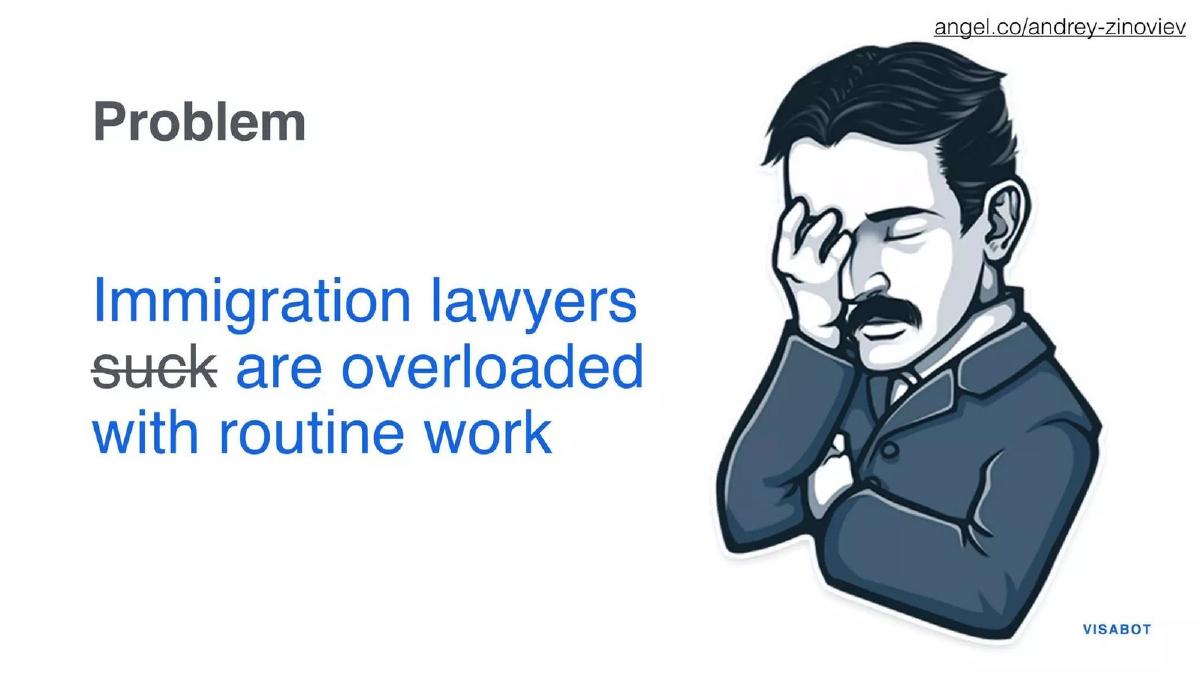
- The problem is framed as a workflow issue, stating lawyers are 'overloaded with routine work' rather than being incompetent (Slide 2).
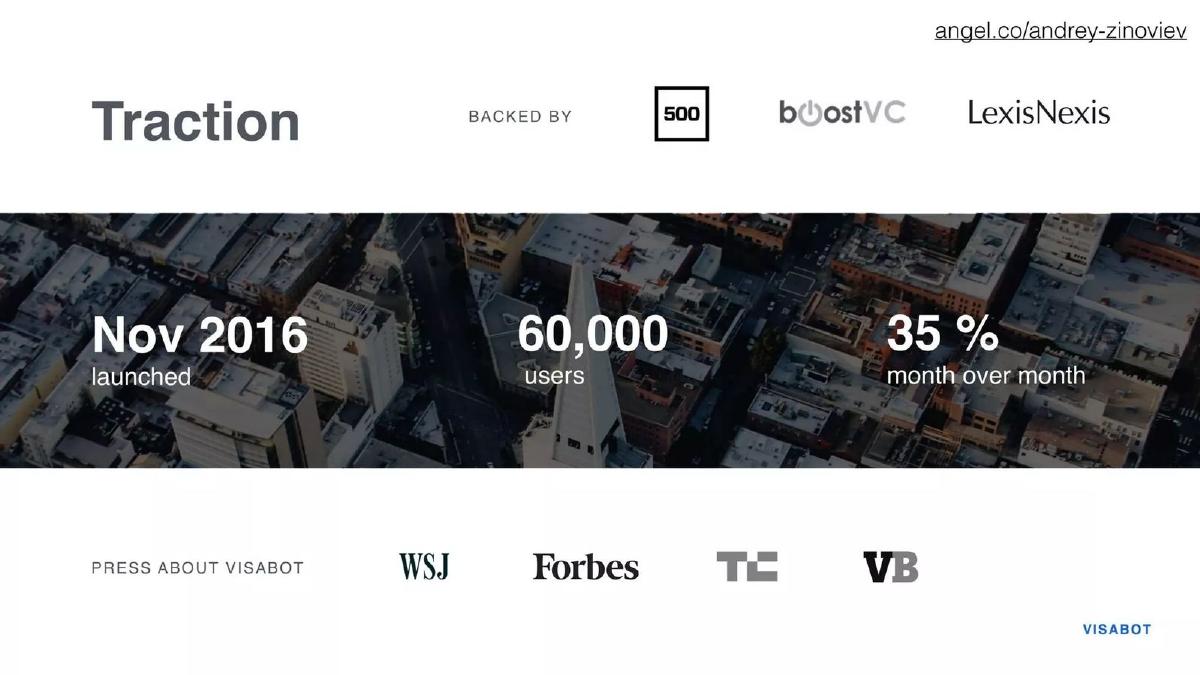
- Traction is the strongest slide, showing 60,000 users and 35% month-over-month growth since a November 2016 launch (Slide 3).
- The company highlights institutional backing from 500 Startups, Boost VC, and LexisNexis to establish early credibility (Slide 3).
- The product value proposition is quantified as a 10x speed increase, reducing a 10-hour case to a streamlined automated process (Slides 5-6).
- Market size is presented as a simple pie chart with figures of $8 billion and $20 billion, though specific segments are not labeled (Slide 7).
- The team slide prioritizes high-profile advisors from LawLogix and Stanford Law School over detailed founder biographies (Slide 8).
- The deck completely omits a business model slide, unit economics, or a specific fundraising 'Ask' amount (Slides 1-9).
The 9-Slide Seed Strategy
Visabot’s pitch deck is an example of the 'Traction-First' philosophy. In 2016, the bot ecosystem was peaking, and the political climate in the United States was highly focused on immigration. Visabot capitalized on both trends. The deck does not waste time on long-winded explanations of AI or legal theory; instead, it uses large typography and simple graphics to move the reader through a narrative of rapid growth and obvious utility. With only nine slides, it is designed to be read in under two minutes, serving more as a visual aid for a conversation than a standalone business plan.
Slides 1-2: The Hook and the Pivot
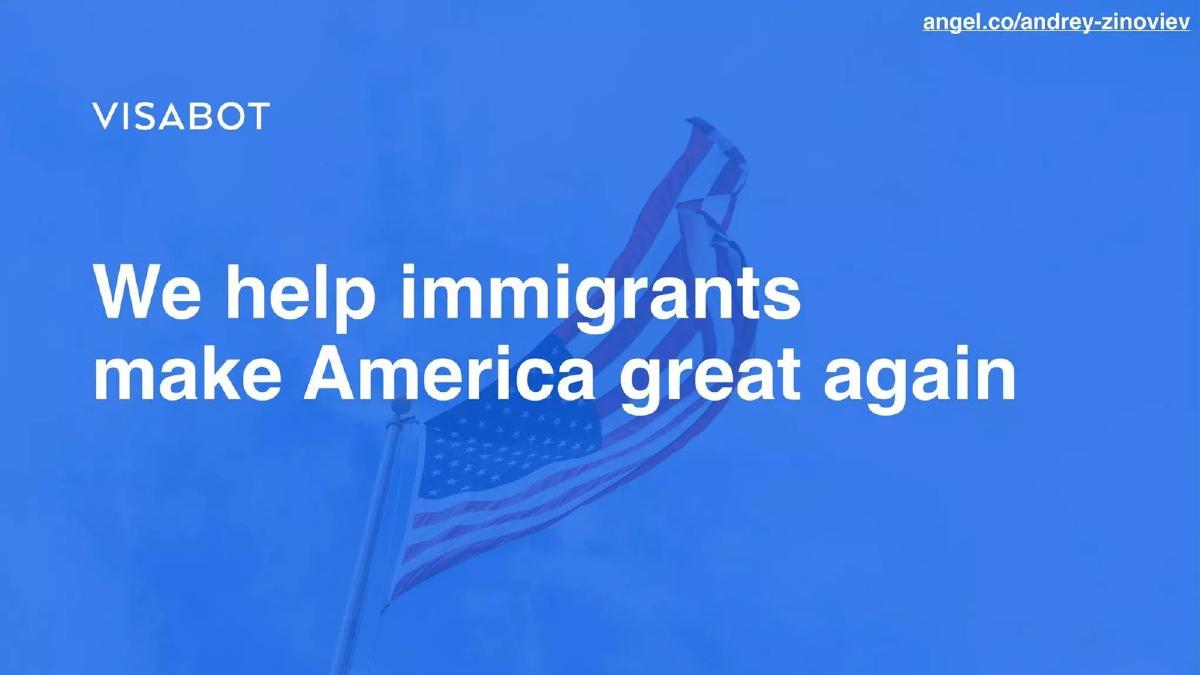
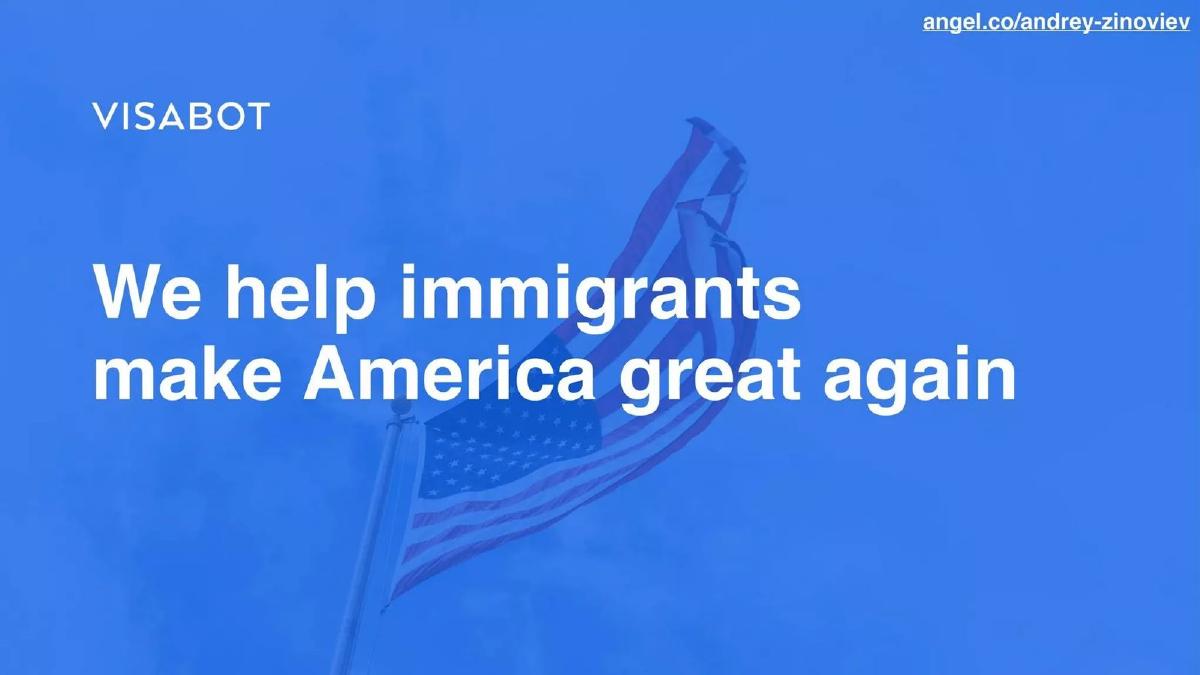
Slide 1: Title The cover slide features the company name, 'VISABOT,' and the slogan 'We help immigrants make America great again' set against a blue-tinted image of the American flag. This is a direct play on the 2016 Donald Trump campaign slogan. By adopting this language, the founders created an immediate talking point, regardless of the investor's political leanings. It signals that the company is operating in a high-stakes, highly relevant sector.
Slide 2: Problem The problem slide is minimalist. It features a cartoon of a man (resembling Nikola Tesla) in a 'facepalm' pose. The text reads 'Immigration lawyers suck are overloaded with routine work.' This is a strategic framing. By crossing out 'suck,' they acknowledge the frustration users feel with the current system while immediately pivoting to a professional B2B value proposition: the problem isn't the lawyers themselves, but the 'routine work' that prevents them from being efficient. This sets the stage for a tool that assists rather than replaces the professional.
Slides 3-4: The Traction Proof
Slide 3: Traction This is the most important slide in the deck. It establishes three pillars of credibility. First, it lists institutional backers: 500 Startups, Boost VC, and LexisNexis. Second, it provides raw numbers: 'Nov 2016 launched,' '60,000 users,' and '35% month over month.' Third, it displays press logos from the Wall Street Journal, Forbes, TechCrunch, and VentureBeat. For a seed-stage company, having 60,000 users within months of launch is a powerful signal of product-market fit.
Slide 4: Private Beta Following the massive user numbers on the previous slide, Slide 4 adds a B2B dimension: '3 paying law firms in our private beta.' This addresses the 'how do you make money?' question without needing a full business model slide. It proves that professional entities are willing to pay for the service, validating the B2B2C or SaaS potential of the bot.
Slides 5-6: The Product and Efficiency Gain
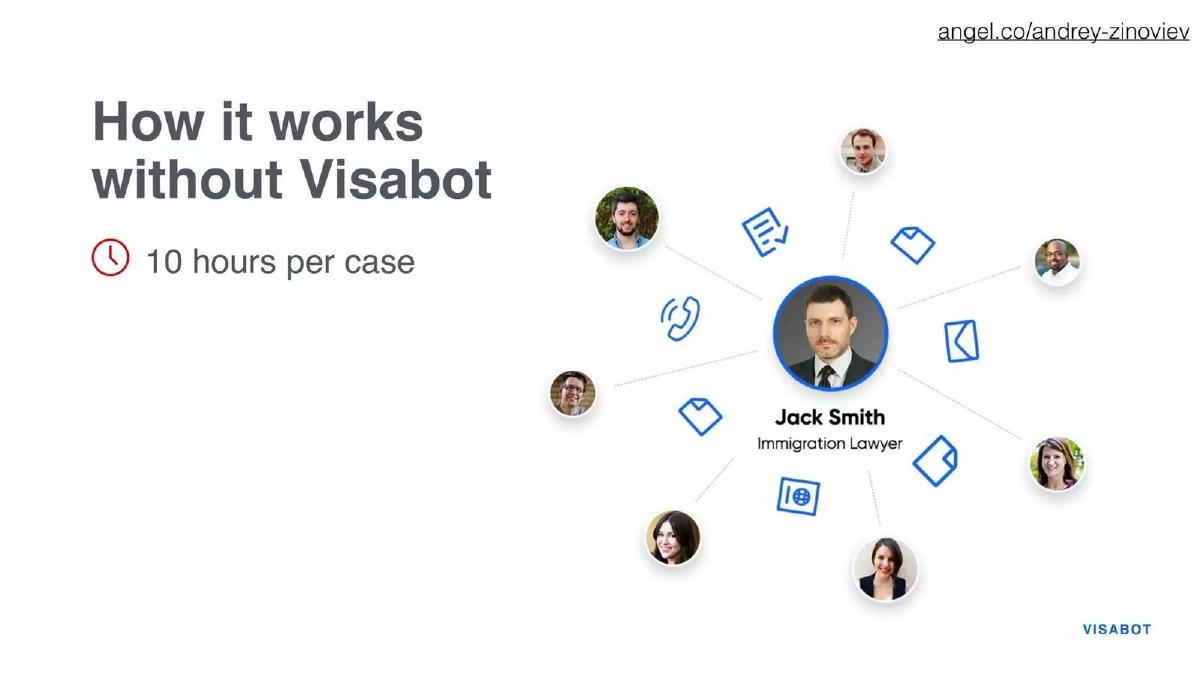
Slide 5: How it works without Visabot This slide visualizes the 'before' state. It shows a central lawyer, 'Jack Smith,' surrounded by a chaotic web of clients and icons representing calls, emails, and documents. The key metric here is '10 hours per case.' It defines the baseline of inefficiency that the startup intends to disrupt.
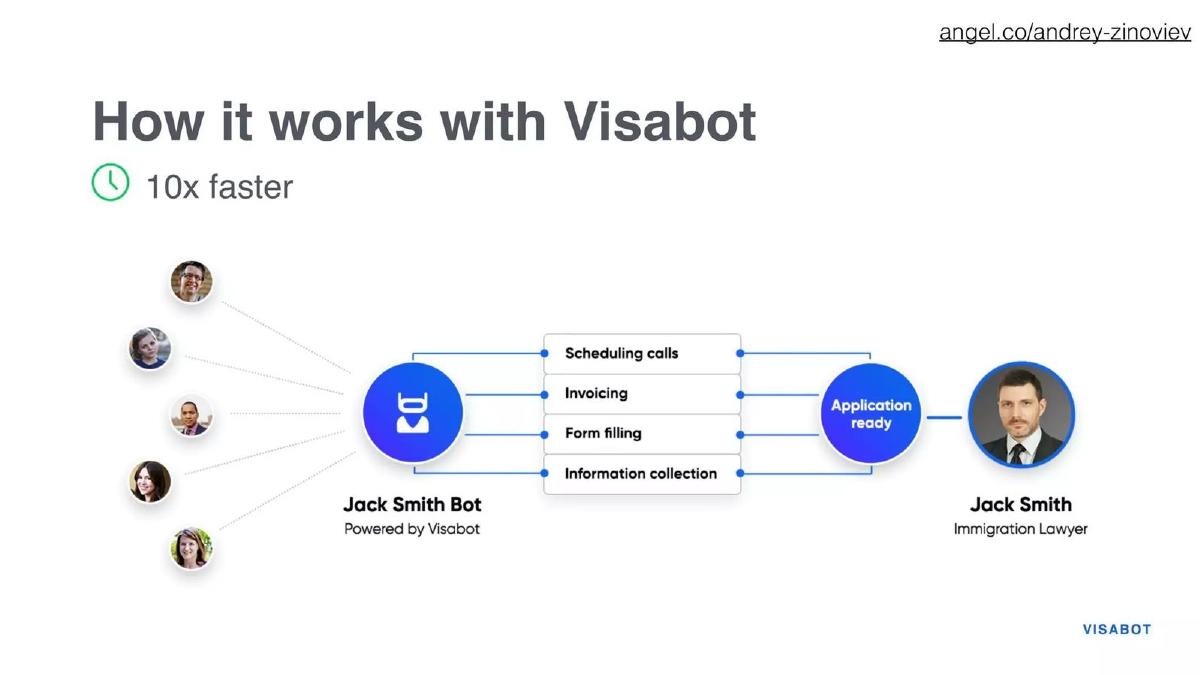
Slide 6: How it works with Visabot The 'after' state shows a linear, organized process. Clients interact with 'Jack Smith Bot (Powered by Visabot),' which handles four specific tasks: scheduling calls, invoicing, form filling, and information collection. The output is an 'Application ready' status delivered to the lawyer. The headline metric is '10x faster.' By breaking down the specific tasks the bot handles, the founders show they understand the granular workflow of an immigration practice.
Slides 7-9: Market, Team, and Contact
Slide 7: Market The market slide is perhaps the weakest in the deck due to its lack of detail. It shows a pie chart with two segments: '$8 BN' and '$20 BN.' While a footnote provides a URL to a State Department report from FY2015, the slide does not explicitly define what these numbers represent (e.g., Total Addressable Market vs. Serviceable Obtainable Market). However, the scale of the numbers ($28 billion total) suggests a large enough opportunity for a venture-scale return.
Slide 8: Team The team slide lists two founders, Andrey Zinoviev and Artem Goldman, but provides no biographical text for them. Instead, the slide leans heavily on its 'Advisors' section. By featuring Andrew Arruda (CEO of ROSS, a major AI legal player at the time) and Dan Siciliano (associated with LawLogix, which the slide claims is 'Used by 60% of the US immigration law firms'), Visabot borrows massive amounts of industry authority. The inclusion of Donald Trump as a 'PR' advisor with the note 'Thanks for PR' is a final callback to the opening slide's provocative tone.
Slide 9: Contact The final slide is a simple call to action, providing Andrey Zinoviev’s email address and a link to his AngelList profile. It maintains the blue-and-white color scheme used throughout the deck.
What Works in the Visabot Deck
The primary strength of this deck is its clarity of metrics . In a seed round, investors are looking for signs of life. By highlighting 60,000 users and 35% MoM growth on Slide 3, Visabot makes it difficult for an investor to ignore the momentum. The deck also excels at quantifying the value proposition . Many startups describe their product as 'better' or 'easier,' but Visabot specifically claims a '10x' improvement and a reduction from '10 hours' of work. This gives investors a concrete metric to test during due diligence.
Furthermore, the social proof is exceptionally well-handled. For a small team, having the backing of LexisNexis and advisors from the top immigration law software (LawLogix) and Stanford Law School (Roland Vogl) mitigates the risk of the founders being 'outsiders' to the complex legal industry. It signals that the industry incumbents and experts see value in the technology.
What is Missing from the Visabot Deck
The most glaring omission is a Business Model slide . While Slide 4 mentions 'paying law firms,' there is no explanation of the pricing structure. Is it a per-visa fee? A monthly SaaS subscription for lawyers? A lead-generation model? Investors generally want to see how the 60,000 users mentioned on Slide 3 translate into long-term revenue.
The deck also lacks a Competition slide . The immigration tech space is not empty, and explaining how Visabot differs from traditional form-filling software or other emerging bots would have strengthened the case. Additionally, there is no 'The Ask' slide . The deck never specifies how much money is being raised, what the valuation is, or how the funds will be allocated (e.g., hiring, marketing, R&D). While this information is often shared in a follow-up email, its absence in the deck makes the presentation feel more like a teaser than a full investment proposal.
What a Founder Should Copy
Founders should emulate the visual hierarchy of this deck. Each slide has one clear message, usually delivered in a large, bold header. There are no dense paragraphs of text or complex spreadsheets. This ensures the investor stays focused on the narrative rather than getting lost in the details.
The 'Before vs. After' visualization on Slides 5 and 6 is a best-practice technique for any workflow automation startup. By showing the specific tasks being removed from the human's plate (scheduling, invoicing, etc.), you make the 'AI' feel real and functional rather than like a buzzword. Finally, the use of timely cultural hooks (the 'Make America Great Again' play) is a bold but effective way to ensure a deck is memorable in a sea of hundreds of pitches, provided the hook is relevant to the business sector.
Company: Visabot · Sector: Legal Tech / AI · Stage: Seed · Year: 2016 · Slides: 9 · Deck Type: Seed Pitch Deck · Outcome: Raised $475,000 · HQ: San Francisco, CA (implied by 500 Startups/Boost VC backing)
Frequently asked questions
- How much did Visabot raise with this deck?
- According to the catalogue facts, Visabot raised $475,000 in a Seed round in 2016. The deck itself does not state the amount being raised or the terms of the investment, which is common for decks intended for wide circulation or early-stage interest generation.
- What is the primary value proposition for the product?
- The deck defines its value through time savings. Slide 5 shows that without Visabot, a case takes 10 hours of manual work. Slide 6 claims the process is '10x faster' with Visabot by automating scheduling, invoicing, form filling, and information collection before the lawyer receives a ready application.
- Who are the key advisors mentioned in the deck?
- Slide 8 lists several prominent advisors, including Andrew Arruda (ROSS), Dan Siciliano (LawLogix), Roland Vogl (Stanford Law School/CodeX), and Mike Melanin (Statsbot). These names provide significant industry-specific social proof in the legal and bot-technology sectors.
- What traction did the company have at the time of the pitch?
- Slide 3 reports that the company launched in November 2016 and had already reached 60,000 users. It also claims a 35% month-over-month growth rate and mentions having three paying law firms participating in a private beta (Slide 4).
- Is there a clear exit strategy or financial projection in the deck?
- No. The 9-slide deck is extremely lean and omits financial projections, revenue models, and exit strategies. It focuses almost exclusively on current traction, the efficiency of the tool, and the credibility of the team and advisors.