The VirtuOz deck from 2008 represents a transitional moment in AI, moving from basic automated scripts to the concept of a Personal Intelligent Assistant (PIA). The company leverages significant traction in the French enterprise market, citing work with eBay and SNCF, to pitch a broader consumer vision. By positioning their technology as a way to save '10 minutes a day' for hyperconnected young actives, they attempt to solve the problem of digital overwhelm. While the consumer 'PIA' vision feels ahead of its time for 2008 technology, the deck is anchored by strong B2B metrics, including a 50%…
Key takeaways
- The company defines its core product as a Personal Intelligent Assistant (PIA) designed to manage a user's connected life (Slide 2).
- VirtuOz claims its virtual salesman increases sales by 30% and its virtual assistant decreases support costs by 50% (Slide 5).
- The enterprise traction is localized but significant, featuring top-3 French websites like eBay, SNCF, and AOL (Slide 5).
- The value proposition targets 20-35 year-olds with a promise to save 10 minutes of 'stupid' online time per day (Slide 4).
- The technology stack is described as a 'Virtual Agent Platform' that integrates with ecosystems like Google Calendar, Outlook, and Amazon (Slide 3).
- User acquisition strategy relies on revenue-sharing partnerships with high-audience, low-monetization platforms like IM networks and homepages (Slide 8).
- The competitive landscape positions VirtuOz as 'Empathic' and 'Exhaustive' compared to 'Vertical' assistants like Mint or TripIt (Slide 7).
- The deck lacks a formal team slide, financial projections, or a specific investment ask in the provided 8-slide sequence.
VirtuOz 2008 Pitch Deck Analysis
The VirtuOz deck is a relic of the first major wave of conversational AI, long before the current LLM explosion. Dated March 6, 2008, this presentation attempts to bridge the gap between a proven B2B SaaS business and a speculative consumer platform. At the time, VirtuOz was a leader in the French market for automated customer service agents, but this deck reveals an ambition to become the 'brain' of the user's digital life.
Slide 1: Title and Confidentiality
The cover slide is minimalist, featuring the VirtuOz logo and the subtitle Executive Summary . Notably, the footer contains a version number (V2.0.0) and a date (2008.03.06), identifying the entity as VirtuOz SA . The aesthetic is typical of the late 2000s—glossy reflections and a dark gradient background.
Slide 2: The Problem Statement
Slide 2 uses a visual metaphor of a balance scale to illustrate the problem of time management. On one side is a fixed 'My day = 24h' block; on the other is a pile of digital tasks including Social networks, Email, Web, Buy, Manage, Voice, Plan, IM, and Communicate . The scale is tipped heavily toward the tasks. The solution is introduced at the bottom: VirtuOz will enable people to save time with a personal intelligent assistant (PIA) that manages their connected life.
Slide 3: The PIA Architecture
This slide attempts to explain the 'how.' It features a stylized human silhouette with a brain graphic labeled with three inputs: My habits, My ecosystem, and My context . This 'Intelligence' layer leads to an 'Execution' layer. The slide lists specific partners and tasks: IMing on my behalf (using a Windows Live Messenger icon), Planning (Google Calendar, Outlook), Shopping (Amazon, eBay), and Booking (Travelocity, Orbitz). This was a highly ambitious vision for 2008, essentially proposing a cross-platform API orchestrator controlled by natural language.
Slide 4: The Value Proposition
VirtuOz gets specific about the benefit here. They aim to Reduce by 50% what they call 'stupid' online time —defined as tasks where 'personal presence is unnecessary.' For their target demographic of 20~35 year-olds (hyperconnected young actives), the goal is to Save 10 minutes a day . While 10 minutes might seem small, the aggregate value across a large user base is the implied hook for investors.
Slide 5: Enterprise Traction and ROI
This is arguably the strongest slide in the deck because it moves from theory to proven results. It outlines 'Step 2' of their journey: a successful virtual agent for customer care. They claim an Excellent product and ROI , specifically:
Virtual salesman increases sales +30% · Virtual assistant decreases support costs -50%
The slide displays a 'World-class customers' logo cloud including eBay, MSN, AOL, Voyages-sncf.com, Credit Agricole (CA), and La Poste . They note that they serve the Top-3 websites in France . This provides the necessary social proof to justify their expansion into the consumer PIA space.
Slide 6: The Roadmap (Next Steps)
Slide 6 uses a Y-shaped roadmap graphic. The base of the 'Y' represents their history: the Technology Foundation and the Customer care virtual agent . The path then splits into two concurrent tracks: Repeat business (global expansion, represented by a globe icon) and the Skaaz Test (the consumer PIA vision, represented by the brain icon). This shows a dual-track strategy: using B2B revenue to fund B2C innovation.
Slide 7: Market Environment
The competitive landscape is mapped on a 2x2 grid. The Y-axis ranges from Listing display to Empathic , and the X-axis ranges from Vertical to Exhaustive (Fulfills 360° needs) . VirtuOz places itself in the top-right quadrant (Empathic/Exhaustive), claiming to be Personalized, Proactive, Easy, and Ubiquitous (mobile) . They contrast themselves against:
Vertical assistants: Mint, TripIt, Sandy, MyCyberTwin. · Social platforms: Facebook, MySpace. · Search: Google, Microsoft. · Homepages: Netvibes, iGoogle, My Yahoo.
This positioning is bold, suggesting that while Google handles search and Facebook handles social, VirtuOz handles the action across all of them.
Slide 8: User Acquisition Strategy
The final slide in this set addresses the 'Go-to-Market.' They propose Fast user acquisition owing to biz dev deals . The target partners are services with huge audience but low monetization . The model is simple: the partner proposes a PIA to their users, and VirtuOz shares the revenue. They cite two specific opportunities:
IM networks (MSN, Y!, AIM, QQ...): 300M+ active users, with ongoing talks with MSN . · Homepages (Netvibes, MyYahoo, iGoogle...): 100M+ active users, with starting talks with Netvibes .
The slide includes a screenshot of a Windows Live Messenger interface showing a 'myPIA' contact, illustrating how the product would live where the users already were.
What Works in This Deck
1. Hard ROI Metrics: The inclusion of specific percentage improvements for sales (+30%) and support costs (-50%) on Slide 5 is excellent. It transforms the 'AI' buzzword into a tangible business tool. Investors in 2008 were skeptical of chatbots; these numbers counter that skepticism with data.
2. Clear Market Positioning: The 2x2 matrix on Slide 7 is well-constructed. It doesn't just list competitors; it categorizes them by their functional limitations (e.g., 'each service in a silo'). This helps the investor understand exactly where VirtuOz fits in a crowded digital ecosystem.
3. Strategic Partnerships: The acquisition strategy on Slide 8 is pragmatic. Rather than trying to build a new destination site, VirtuOz recognized that the 'Personal Assistant' should live inside existing communication hubs like MSN Messenger. This 'piggyback' strategy is a classic way for startups to achieve scale quickly.
What Is Missing
1. The Team Slide: In the provided 8 slides, there is no mention of the founders or the technical team. For an AI company in 2008, the 'who' is just as important as the 'what,' as the technology was notoriously difficult to build and maintain.
2. Financials and Ask: The deck lacks a slide detailing how much capital is being raised and how it will be allocated. There are no projections for revenue growth or a path to profitability for the consumer 'PIA' side of the business.
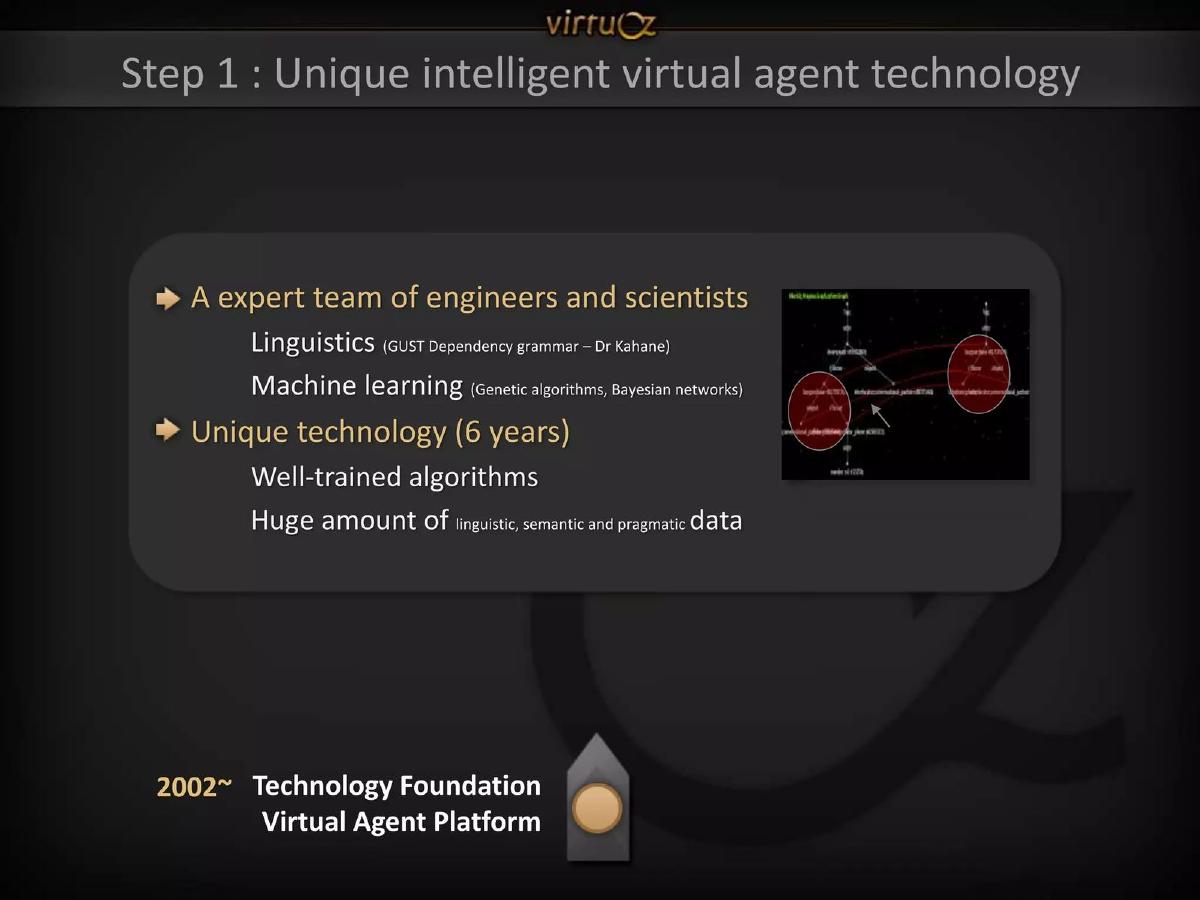
3. Technical Depth: While the deck mentions a 'Virtual Agent Platform,' it doesn't explain the underlying technology. In 2008, this was likely based on pattern matching and decision trees rather than modern machine learning. A brief explanation of their 'Intelligence' layer would have added credibility.
What a Founder Should Copy
1. The 'Step 2' Logic: VirtuOz does a great job of showing that they aren't just dreaming—they have already succeeded in a narrower vertical (Customer Care). Founders should always try to show a 'Technology Foundation' that is already generating value before pitching a massive, world-changing vision.
2. Quantifying the Problem: Instead of saying 'people are busy,' VirtuOz said 'save 10 minutes a day.' This makes the value proposition much more concrete and easier to model. If you can save a user 10 minutes a day, you can calculate the hourly value of their time and determine a potential subscription price or efficiency gain.
3. Visual Metaphors: The balance scale on Slide 2 and the Y-shaped roadmap on Slide 6 are effective ways to communicate complex strategic ideas without using too much text. They guide the viewer's eye and make the narrative easy to follow.
Frequently asked questions
- What was the primary problem VirtuOz aimed to solve?
- VirtuOz addressed the 'connected life' overwhelm, where users spent too much time on 'stupid' online tasks. They quantified this problem by stating that hyperconnected 20-35 year-olds could save 10 minutes a day by delegating tasks like booking, shopping, and planning to an intelligent agent. This was a precursor to the modern virtual assistant market.
- How did VirtuOz prove their technology worked in 2008?
- They relied on enterprise case studies. Slide 5 highlights that their virtual agents were already in use by major brands like eBay, MSN, and SNCF. They provided hard ROI figures: a 30% increase in sales for their 'virtual salesman' product and a 50% reduction in support costs for their 'virtual assistant' product, establishing technical credibility through B2B success.
- What was the 'PIA' mentioned throughout the deck?
- PIA stands for Personal Intelligent Assistant. According to Slide 3, the PIA was designed to understand a user's habits, context, and ecosystem to execute tasks on their behalf. The deck illustrates integrations with then-dominant platforms like Windows Live Messenger (MSN), Google Calendar, and eBay to show the PIA's reach across the web.
- What was the company's growth strategy for consumer adoption?
- Instead of direct-to-consumer marketing, VirtuOz planned a 'biz dev' led acquisition strategy. They targeted services with huge audiences but low monetization, such as IM networks (300M+ users) and personalized homepages (100M+ users). The plan was to embed the PIA into these platforms and share the resulting revenue with the partners.
- How did VirtuOz differentiate itself from competitors like Google or Facebook?
- On Slide 7, VirtuOz used a 2x2 matrix to position itself. They claimed to be more 'Empathic' than search engines like Google and more 'Exhaustive' (fulfilling 360-degree needs) than vertical assistants like Mint or TripIt. They positioned themselves as a proactive, mobile-ready layer that sat above the fragmented service silos of the time.