Indiez successfully raised a $500k Seed round using an 18-slide deck that emphasizes the friction in both the client and freelancer experience. By positioning themselves as a 'managed' marketplace rather than a pure platform like Upwork, Indiez addressed the quality concerns that plague traditional outsourcing. The deck is particularly strong in its presentation of traction, showing a clear upward trajectory in both community members and revenue over a four-quarter period. While the 'AI engine' claims are somewhat abstract, the unit economics slide provides a compelling argument for how they…
Key takeaways
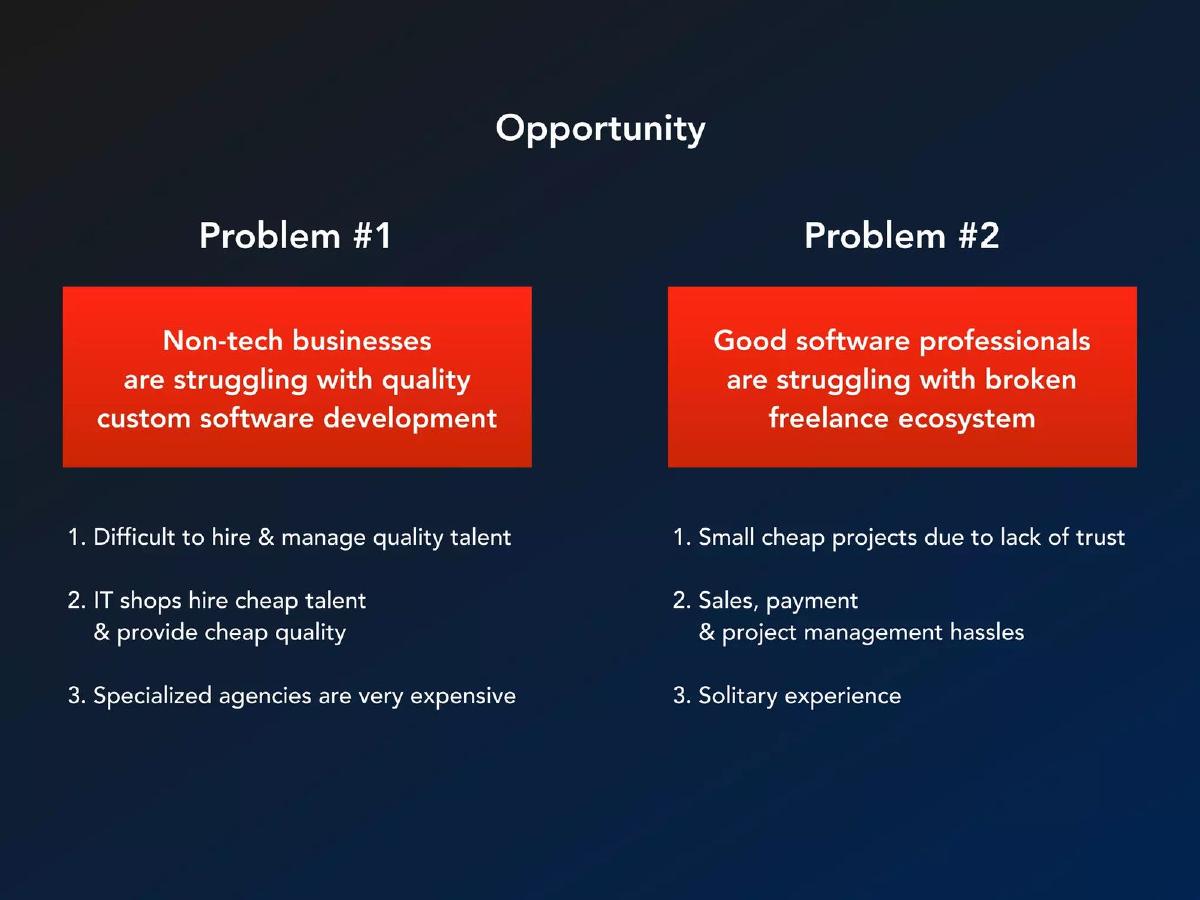
- The company identifies a dual-sided problem: non-tech businesses struggle with quality, while freelancers struggle with a broken ecosystem (Slide 3).
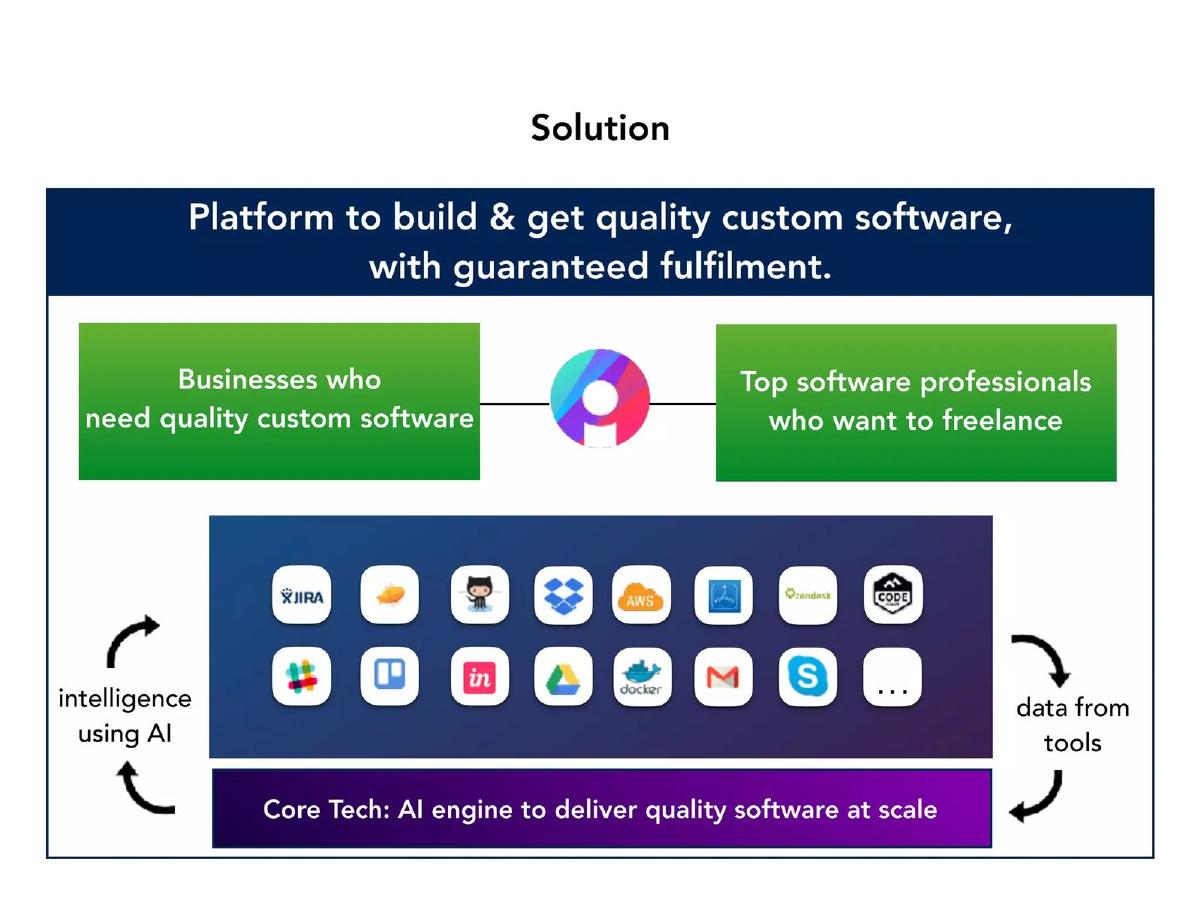
- Indiez claims to use an AI engine to deliver quality software at scale by integrating data from tools like Jira, GitHub, and Slack (Slide 4).
- The business model targets an average project size of $20k with a current margin of 20-30% (Slide 8).
- Traction is a highlight, showing growth from near zero to $50,000 in monthly revenue within one year (Slide 9).
- The global custom software outsourcing market is valued at $200 billion with a 33% CAGR (Slide 10).
- The deck features a strong endorsement from Beerud Sheth, the co-founder of Elance (Slide 11).
- Unit economics comparisons suggest Indiez has lower overheads than traditional IT services companies, allowing for higher developer payouts (Slide 12).
- The $500k capital requirement is explicitly broken down: 60% for Product, 30% for Sales, and 10% for Brand (Slide 15).
The Managed Marketplace Thesis
Indiez entered the market at a time when the 'Future of Work' was transitioning from simple job boards to managed services. This deck reflects that shift, moving away from the 'bid-to-win' model of early freelancing sites toward a curated, high-stakes software delivery model. The $500k Seed round was predicated on the idea that software development is too complex for unmanaged marketplaces.
The Problem and Opportunity (Slides 1-3)
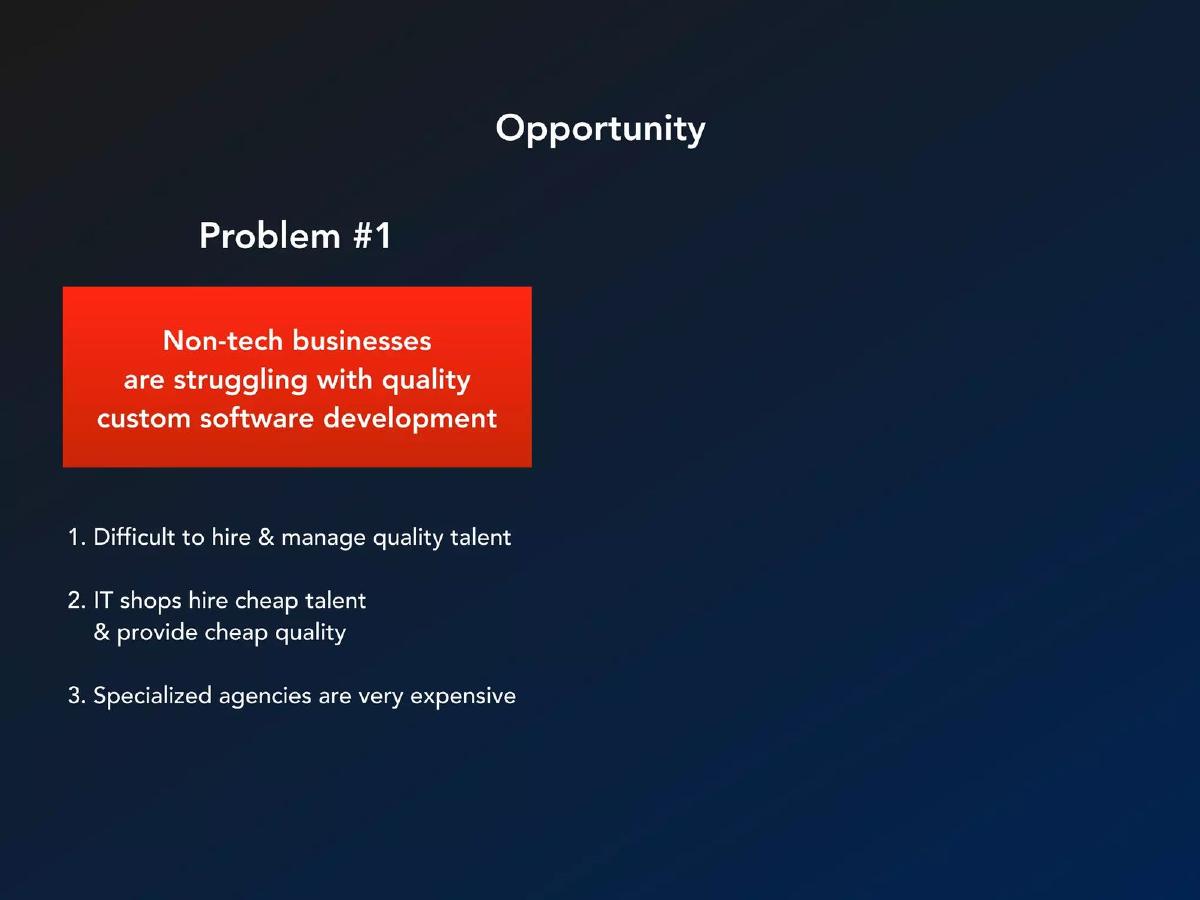
The deck opens with a standard title slide (Slide 1) branding Indiez as "The future of work." It moves quickly into the "Opportunity" section. Slide 2 focuses on "Problem #1": non-tech businesses struggling with quality custom software. It lists three pain points: difficulty in hiring/managing talent, cheap quality from IT shops, and the high expense of specialized agencies.
Slide 3 expands this to "Problem #2": the freelancer's perspective. It cites small, cheap projects due to lack of trust, administrative hassles (sales, payment, project management), and the solitary nature of the work. By presenting a dual-sided problem, Indiez sets the stage for a platform that solves for both supply and demand simultaneously.
The Solution and Product (Slides 4-7)
Slide 4 introduces the solution: a platform to build quality custom software with "guaranteed fulfilment." This slide introduces the "Core Tech," described as an AI engine that uses data from existing tools (Jira, GitHub, Slack, etc.) to deliver software at scale. This is a common pitch trope of the era—positioning a service business as a tech-heavy platform.
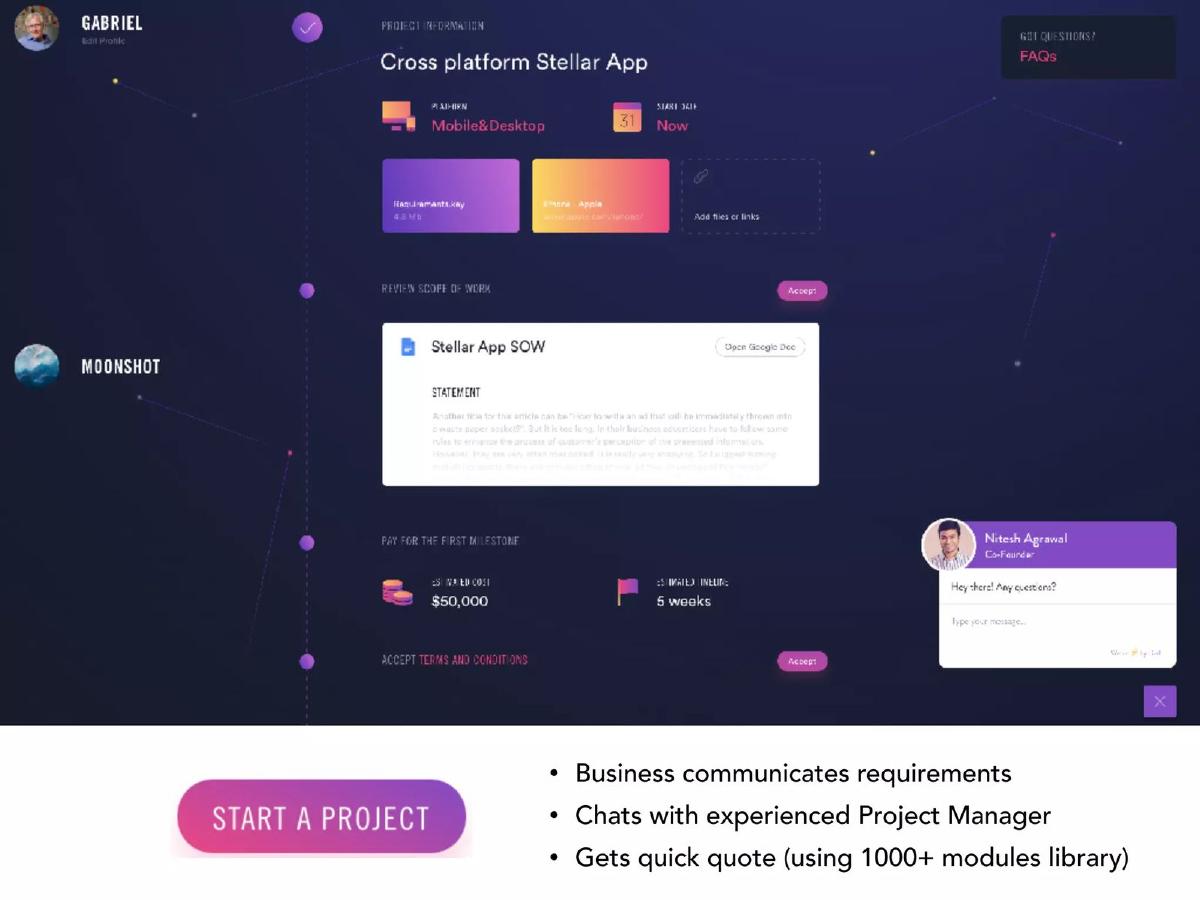
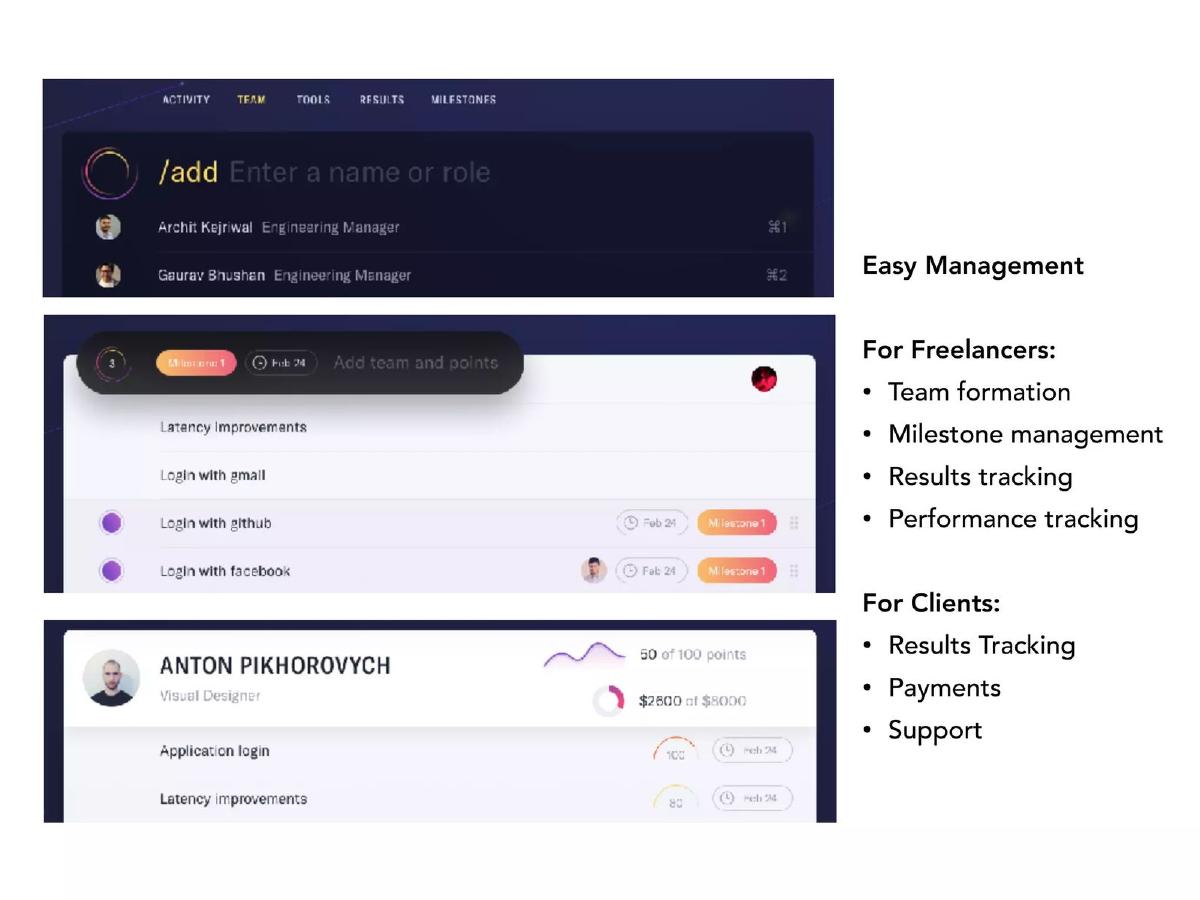
Slides 5, 6, and 7 provide a visual walkthrough of the product. Slide 5 shows the client interface for starting a project, highlighting a "1000+ modules library" for quick quoting. Slide 6 focuses on management features for both freelancers (team formation, milestone tracking) and clients (results tracking, payments). Slide 7 reiterates the integration with third-party tools, suggesting that Indiez doesn't just host the work but monitors it through data products.
Business Model and Traction (Slides 8-9)
The business model on Slide 8 is straightforward. Indiez acts as the contracting entity ("Client signs contract with Indiez Inc"). Key metrics include an average project size of $20k and a target account size of $100k to $10m per year. They disclose a current margin of 20-30% with a target of 30-40%. The mention of "Advance milestone payment collection" is a crucial detail for cash flow management in a service-heavy startup.
Slide 9 is the strongest in the deck. It shows "Pre-Product, 0$ Marketing Traction" over one year. Community members grew from approximately 40 in Q2 16 to over 225 in Q1 17. Revenue followed a similar hockey-stick curve, ending at $50,000 monthly revenue. The slide also lists impressive logos of companies where their freelancers come from (Microsoft, Uber, Google) and clients they have served (Domino's, Aditya Birla, UpGrad).
Market and Credibility (Slides 10-11)
Slide 10 quantifies the "Massive Opportunity": a $200 billion global custom software outsourcing market with a 33% CAGR. It also notes Upwork's $1 billion GMV to show the scale of the existing, albeit "broken," players.
Slide 11 is a high-impact social proof slide. It features a quote from Beerud Sheth, an advisor to Indiez and the co-founder of Elance (which merged with oDesk to become Upwork). Having the founder of the industry incumbent state that "Indiez is the next gen Elance" provides immense validation for a Seed-stage company.
Economics and Competition (Slides 12-13)
Slide 12, titled "The Math behind the Magic," uses bar charts to compare unit economics. It argues that by using AI and management tools, Indiez has lower overheads than traditional IT services companies. This allows them to give a larger share of the hourly rate to the developer (approx. 70% vs. 20%), which theoretically attracts better talent. It also claims their developers are "Smarter and faster," leading to 100% project speed compared to 50% for "cheap" developers.
Slide 13 is a standard 2x2 competitive matrix. Indiez places itself in the top-center: "Great Quality" and mid-range on the "Cheap to Expensive" axis. They position themselves as higher quality than Toptal and Gigster, and significantly better than "Freelance Marketplaces" or "Cheap Dev Shops."
Team and The Ask (Slides 14-15)
The team slide (Slide 14) shows five members with deep roots in the Indian tech scene, specifically Housing.com and Ola. Amrose Birani (CTO) is noted for 6 years of Bay Area experience and an IIT Bombay background. The collective experience covers UX, operations, sales, and product management, with a heavy emphasis on prestigious logos like Google, AMEX, and P&G.
Slide 15 outlines the "Next Milestone." It uses a checklist to show what has been achieved (Founding team, Proof of model, Traction) and what the capital will fund (Platform product, US/EU expansion). The "Capital Requirement" is stated as $500k. They also set ambitious 1-year targets, including $500k monthly revenue and 100 recurring accounts.
Closing and FAQs (Slides 16-18)
Slide 16 is a rare but effective FAQ slide. It addresses the "Moat" (enterprise lock-in, data network effects) and the "Why now?" (global rise of freelancing and open APIs). It also clarifies that they are "significantly (>100%) more affordable than any traditional alternatives."
Slide 17 provides testimonials from both clients (Domino's) and developers, reinforcing the dual-sided value proposition. The deck concludes on Slide 18 with contact information for Ishan Shrivastava and Nitesh Agrawal over a lifestyle image of a laptop on a beach, leaning into the "future of work" aesthetic.
What Works in This Deck
The Traction Slide: Showing $50k MRR with zero marketing spend is the most compelling argument for a Seed round. It proves organic demand. · Advisor Validation: The quote from the Elance co-founder is a masterclass in using social proof to neutralize concerns about market entry. · Dual-Problem Definition: By explaining why the current system fails both the buyer and the seller, they justify why a new platform (rather than just a better agency) is necessary. · Unit Economics Transparency: Slide 12 clearly explains how they can afford to pay developers more while remaining competitive on price.
What is Missing
AI Specifics: While the deck mentions an "AI engine" multiple times, it never explains what the AI actually does. Is it matching talent? Reviewing code? Predicting milestones? At the Seed stage, this often feels like a buzzword. · Retention Data: They mention "15 recurring accounts," but more detail on the churn or expansion of those accounts would have strengthened the case for enterprise "lock-in." · Legal/Compliance: In the global outsourcing space, worker classification and IP protection are major hurdles. The deck doesn't address how Indiez handles the legal complexities of hiring across 30 countries.
What a Founder Should Copy
The FAQ Slide: This is an excellent way to pre-empt the most common reasons an investor might say "no." It shows you have thought deeply about your risks. · The Milestone Checklist: Using a "Done vs. To-Do" list (Slide 15) provides a clear narrative of progress and a logical justification for the amount of money being raised. · Visualizing the Business Model: Slide 8 uses simple icons and clear bullet points to explain a complex service flow. It makes the mechanics of the business easy to digest in seconds.
Frequently asked questions
- What is the core value proposition of Indiez?
- Indiez positions itself as a managed software development platform that connects businesses with top-tier independent talent. Unlike pure marketplaces, Indiez provides 'guaranteed fulfillment' by using a project management layer and a library of over 1,000 modules to speed up development and ensure quality.
- How does Indiez differentiate itself from Upwork or Toptal?
- According to Slide 13 and Slide 16, Indiez differentiates through 'experience control.' They argue that Upwork is a 'pure marketplace' stuck in a cycle of poor talent and cheap projects. Indiez claims to be more affordable than boutique agencies while maintaining higher quality than standard freelance marketplaces through active project monitoring.
- What were the financial milestones at the time of the pitch?
- Slide 9 shows that within one year (Q2 2016 to Q1 2017), Indiez reached $50,000 in monthly revenue. They had completed 80 projects across 10 countries and established 15 recurring accounts, all while spending $0 on marketing.
- Who are the founders and what is their background?
- The team consists of five members with significant experience in the Indian tech ecosystem. Key backgrounds include roles at Housing.com, Ola, Google, and Evernote. Several team members are alumni of IIT Bombay, which is a prestigious engineering institution in India (Slide 14).
- How does the company plan to use the $500k investment?
- As stated on Slide 15, the funds are earmarked for accelerating product development (60%), sales (30%), and brand building (10%). Their one-year targets following the raise included reaching $500k in monthly revenue and growing the community to 500 members.