FAQ Slide in a Pitch Deck: How to Answer Investor Questions
Should your pitch deck have an FAQ slide? Five real slides show which questions to answer, how to write an answer that holds up.
FAQ Slide: Answer the Doubts Investors Really Have, With Evidence
Some founders end their deck with a slide of questions and answers. It is a useful idea, because most decks are read without the founder in the room, and the reader can't ask the question that stops them. A good FAQ slide answers the two or three doubts that would otherwise end the conversation. A weak one lists questions every deck answers anyway, with one-line answers that claim more than they show. This guide uses five real slides from four startup decks to show the difference.
TL;DR
Use an FAQ slide for the specific doubts your deck raises, not for general topics. Write the question the way an investor would ask it, answer it in two or three sentences, and include one fact the reader can check. Cleary does this best: "Do People and HR Teams have enough budget for such a solution?" is a doubt a buyer-minded investor really has, and the answer names the budget lines it draws from. Indiez shows the weak version: "Q. Moat? A. Enterprise accounts lock-in; Data network effects; Brand leadership" is a list of labels, not an answer.
Five question-and-answer slides, read in full
Each slide was rendered from the original deck at full size and read in full. Quotes are the slides' own words; we did not verify the companies' claims.
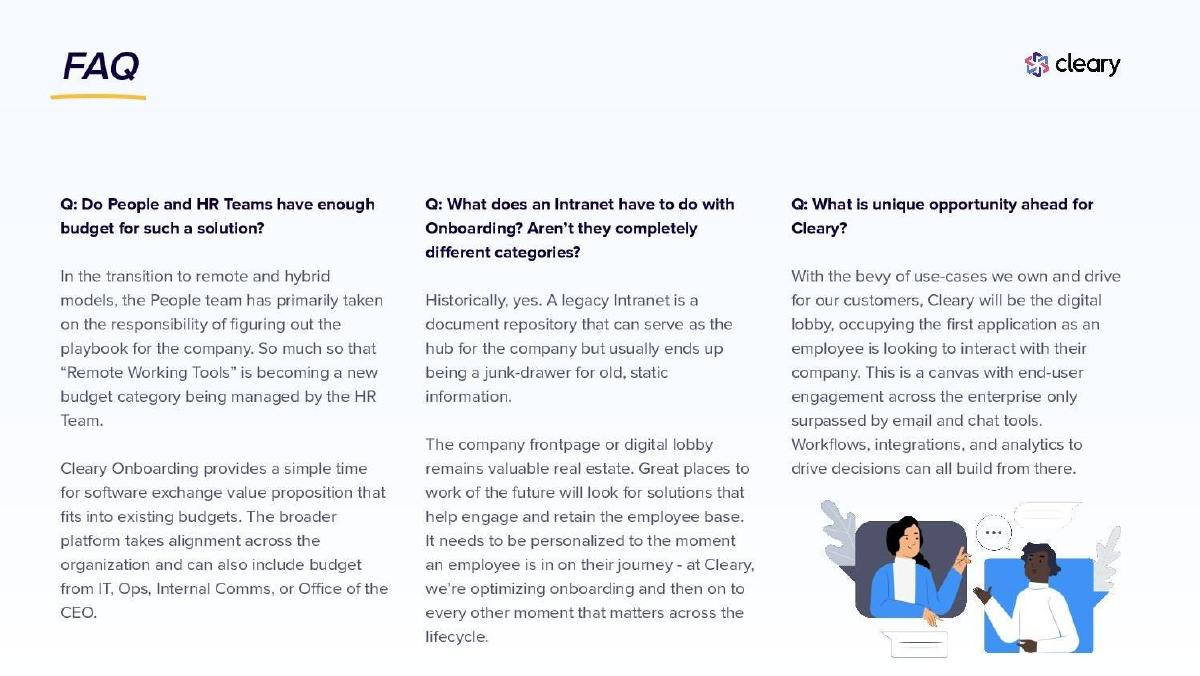
Cleary executive summary slide — slide 17
Employee onboarding and intranet platform. First of two FAQ slides near the end of the deck.
Cleary deck, slide 17. Exact stored slide matched to this analysis.
Our analysis: The questions investors would really ask about this business.
Evidence and limitation: Real buyer doubts, full answers; no figure or customer named.
What a founder can adapt: Add one customer or figure to the budget answer.
Supporting analysis
What the deck claims: "Q: Do People and HR Teams have enough budget for such a solution?"; "'Remote Working Tools' is becoming a new budget category being managed by the HR Team"; "Q: What does an Intranet have to do with Onboarding? Aren't they completely different categories?" "Historically, yes."
Presentation choice: Agreeing with the doubt before answering it builds trust.
When it does not fit: Answering a budget doubt with categories only.
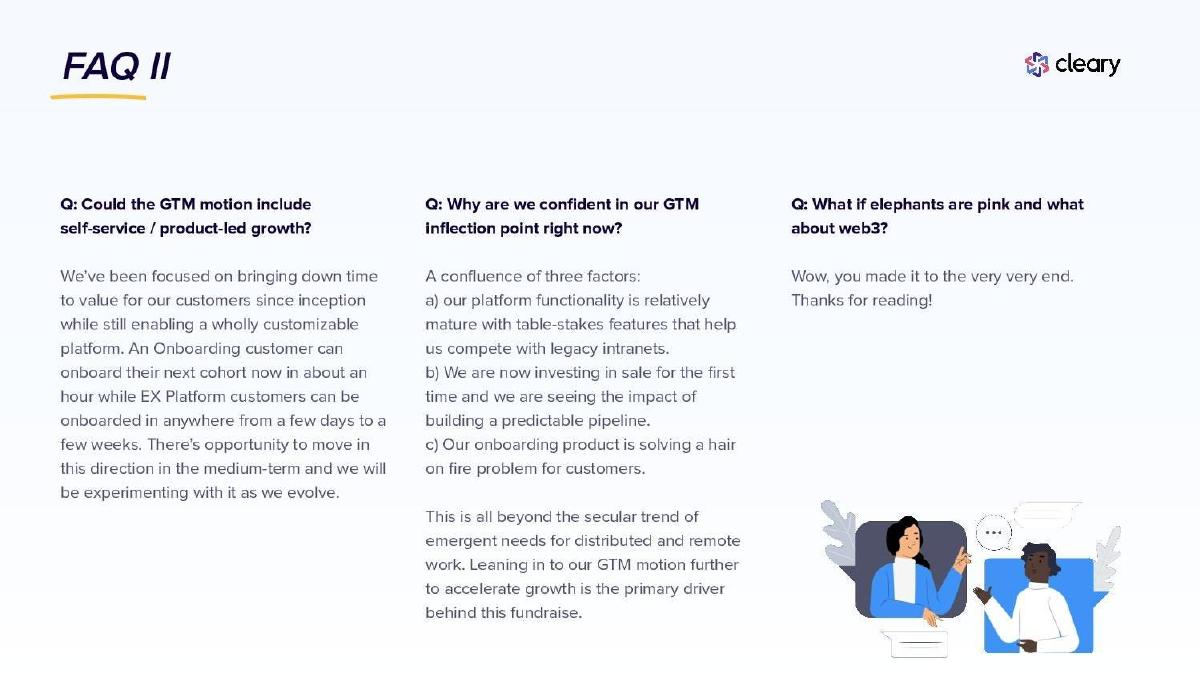
Cleary deck, slide 18. Exact stored slide matched to this analysis.
Our analysis: Connects the FAQ to why the company is raising now.
Evidence and limitation: Times stated; answer tied to the raise; one joke question.
What a founder can adapt: Use the joke slot for a real question.
Supporting analysis
What the deck claims: "onboard their next cohort now in about an hour"; "a few days to a few weeks"; "Leaning in to our GTM motion further to accelerate growth is the primary driver behind this fundraise."; "Q: What if elephants are pink and what about web3?"
Presentation choice: An answer that leads to the ask closes the deck with purpose.
When it does not fit: Spending one of six questions on a joke.
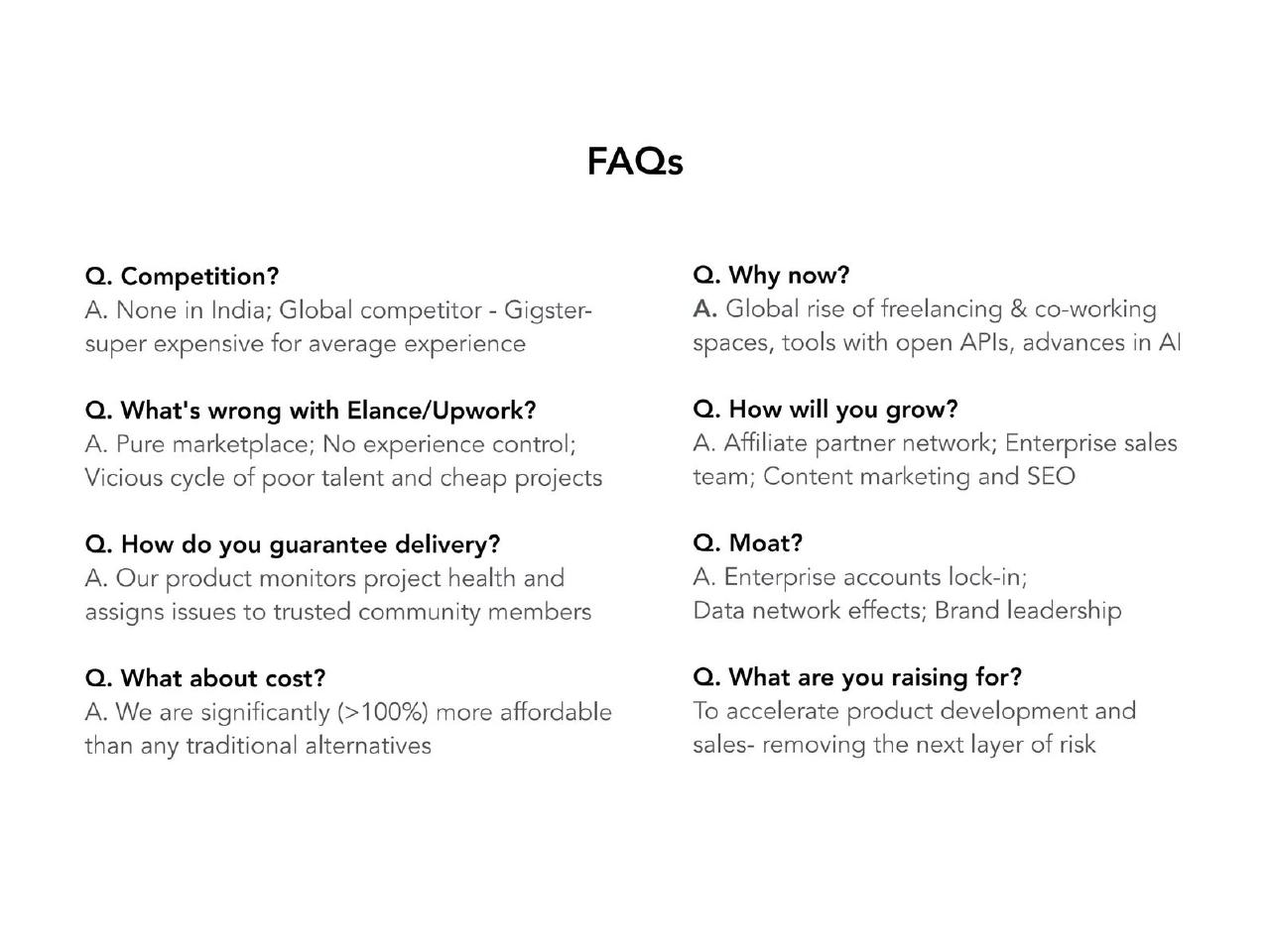
Software development marketplace. Single FAQ slide.
Indiez deck, slide 16. Exact stored slide matched to this analysis.
Our analysis: An FAQ that repeats other slides in weaker form.
Evidence and limitation: Eight generic questions; most answers are labels; one figure that doesn't add up.
What a founder can adapt: Keep three questions and answer each with a fact.
Supporting analysis
What the deck claims: "Q. Competition? A. None in India"; "Q. What about cost? A. We are significantly (>100%) more affordable than any traditional alternatives"; "Q. Moat? A. Enterprise accounts lock-in; Data network effects; Brand leadership".
Presentation choice: Shows how short answers turn into slogans.
When it does not fit: "None" for competition and percentages that can't be right.
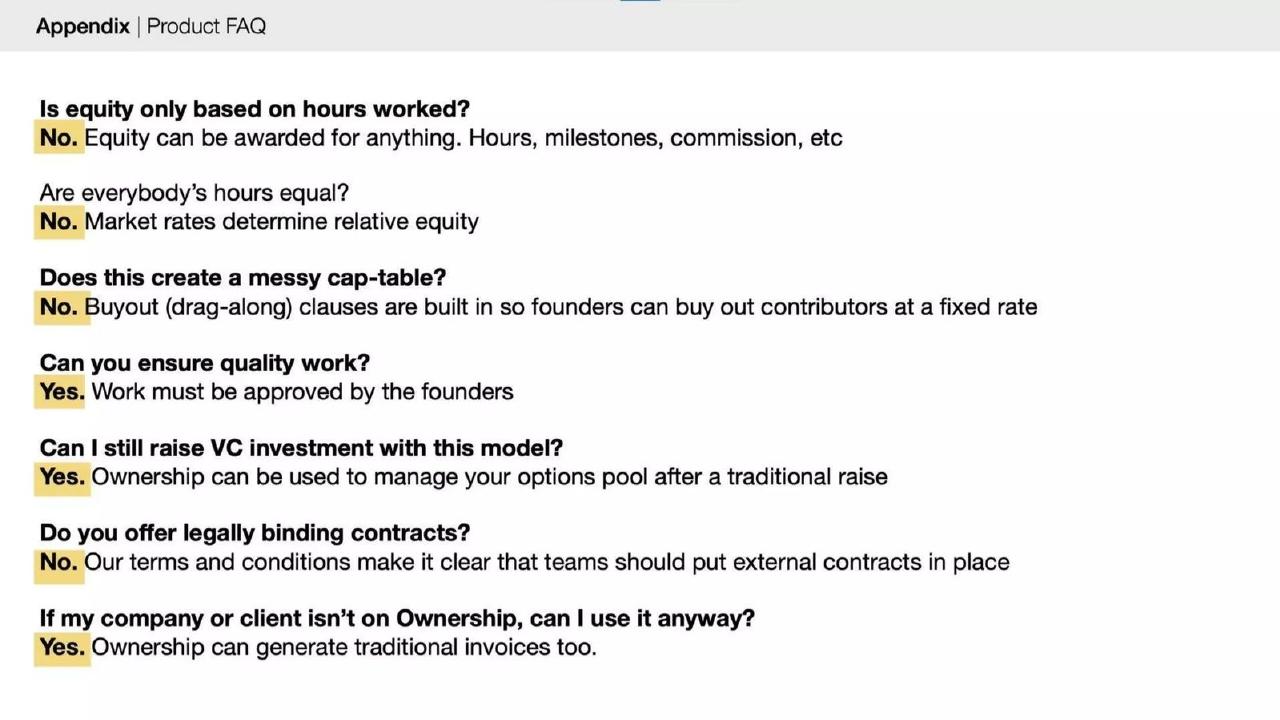
Tool for paying contributors in equity. Appendix product FAQ.
Ownership deck, slide 20. Exact stored slide matched to this analysis.
Our analysis: The right questions, placed in the appendix.
Evidence and limitation: Product-specific doubts, direct yes/no answers, one honest limit.
What a founder can adapt: Add a figure where an answer is about results, such as disputes.
Supporting analysis
What the deck claims: "Does this create a messy cap-table? No. Buyout (drag-along) clauses are built in"; "Can I still raise VC investment with this model? Yes."; "Do you offer legally binding contracts? No."
Presentation choice: A plain "No" about a limit makes the other answers more believable.
When it does not fit: Yes/no answers for questions that need evidence.
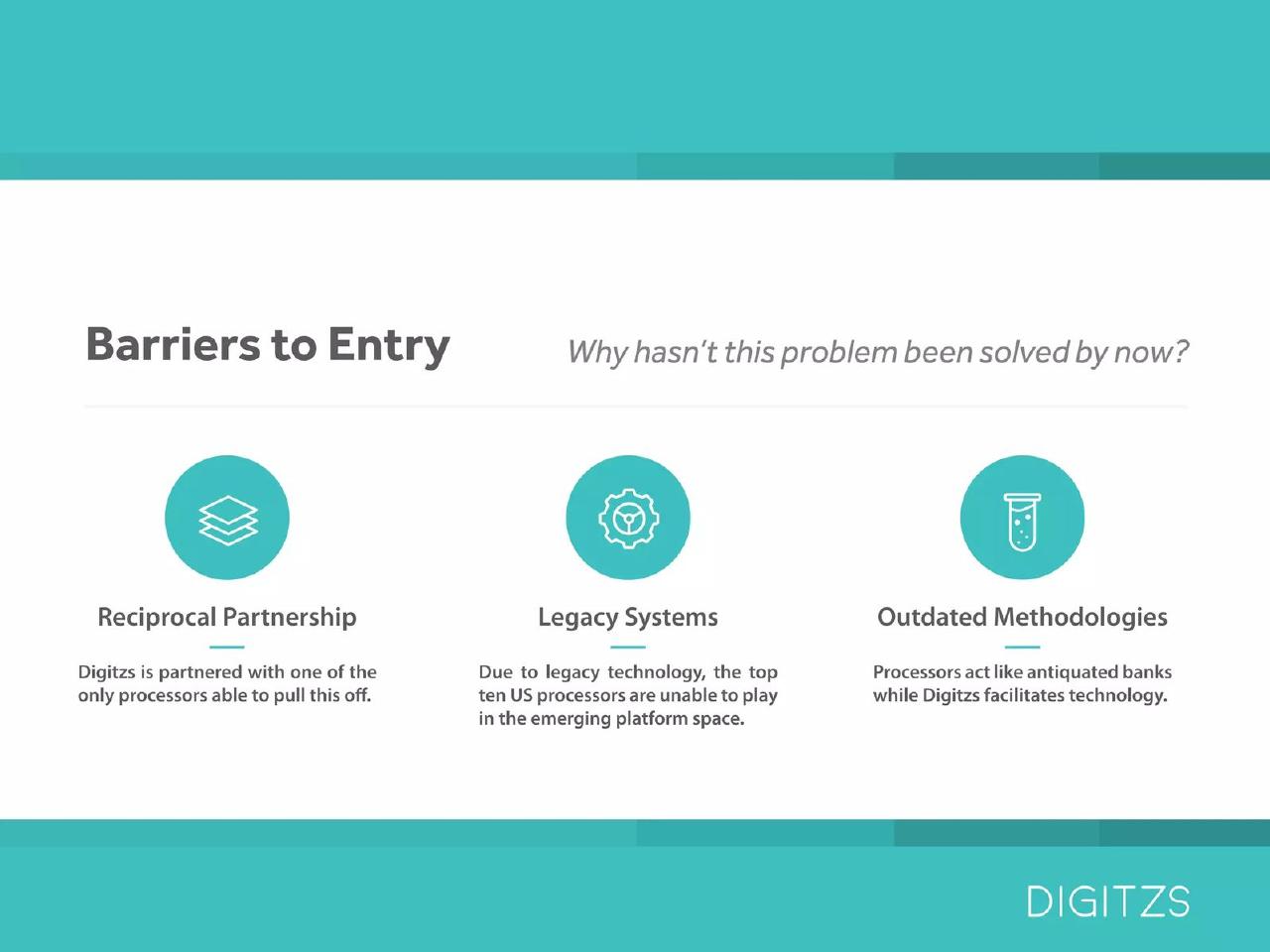
Digitzs deck, slide 10. Exact stored slide matched to this analysis.
Our analysis: A single-question slide for the doubt that matters most.
Evidence and limitation: One sharp question; partner unnamed; one point is opinion.
What a founder can adapt: Name the partner and how long the contract runs.
Supporting analysis
What the deck claims: "Why hasn't this problem been solved by now?"; "Digitzs is partnered with one of the only processors able to pull this off."; "the top ten US processors are unable to play in the emerging platform space".
Presentation choice: Investors ask this about every obvious-sounding idea.
When it does not fit: Answering with opinions about incumbents.
How many questions, whether they are specific to the business, and whether answers include something checkable.
Example
Questions
Specific to business
Checkable fact in answers
Placement
Cleary (FAQ I)
3
Yes
Few
End of deck
Cleary (FAQ II)
3 (one joke)
Yes
Times stated
Last slide
Indiez
8
Mostly generic
Rarely
Main deck
Ownership
7
Yes
Product mechanics
Appendix
Digitzs
1
Yes
Partner unnamed
Main deck
Key Takeaways
Answer the doubts your deck raises.
Write the question as an investor would ask it.
Two or three sentences, with one checkable fact.
Three to six questions, not twelve.
Put it in the appendix if the main deck already answers them.
Build your FAQ slide
Answer each prompt before adding questions to your deck.
Source. Which questions came up in more than one investor meeting?
Fit. Is the question already answered on another slide? If so, drop it.
Answer. Can you answer in two or three sentences, starting with yes, no or a direct statement?
Proof. Which figure, customer, date or contract backs the answer?
Place. Main deck or appendix?
Copyable framework: Q: [Question as an investor asked it]? A: [Direct answer]. [Reason]. [One checkable fact.]
Illustrative example 1 — written by us
Before: "Q. Moat? A. Data network effects; Brand leadership."
After: "Q: What stops a larger marketplace copying you? A: Our enterprise customers sign 12-month contracts and route all projects through us; 9 of 11 renewed last year."
What improved: Our illustrative rewrite; the figures are invented for the example. It asks the real doubt, answers directly and gives a fact the reader can check.
The question this guide answers
Founders ask whether an FAQ slide is worth adding, and what to put on it. Other guides cover the slides an FAQ often repeats: competition, moat, why now, go-to-market and the ask. The risks draft covers how to name risks and what reduces them. The appendix draft covers what to move out of the main deck. None of them covers the question-and-answer format itself: when it helps, which questions to choose and how to write the answers.
The short answer: an FAQ slide helps when your business raises a doubt that doesn't fit naturally on another slide. A buyer who may not have budget, a category investors think is crowded, a model that sounds legally messy. It doesn't help when it repeats the competition and moat slides in shorter form.
How we chose and read the examples
We searched the saved slide text of the teardown library for FAQ titles, question-and-answer formats and slides built around a single question, and left out investor-fund presentations and listed companies. Five slides from four startup decks remained: two FAQ slides from Cleary, one each from Indiez and Ownership, and Digitzs' "Why hasn't this problem been solved by now?" slide.
Each slide was rendered from the original deck at full size and read in full. Quotes are the slides' own words. We judge how clearly each answer is written and whether it gives the reader something to check; we did not verify the companies' claims. One of Cleary's FAQ slides is also used in the time-to-value guide, for a different point.
The strongest pattern: real doubts, full answers
Cleary, an employee onboarding and intranet platform, ends its deck with two FAQ slides of three questions each. The first asks: "Do People and HR Teams have enough budget for such a solution?" The answer says remote and hybrid work moved that job to the people team, that "'Remote Working Tools' is becoming a new budget category being managed by the HR Team", and that the broader platform "can also include budget from IT, Ops, Internal Comms, or Office of the CEO."
The second question, "What does an Intranet have to do with Onboarding? Aren't they completely different categories?", is a doubt an investor would really have after reading the deck, and the answer starts with "Historically, yes." Agreeing with the doubt before answering it makes the rest more believable.
On the second slide, "Could the GTM motion include self-service / product-led growth?" is answered with a time: an onboarding customer can onboard "their next cohort now in about an hour", while platform customers take "anywhere from a few days to a few weeks". "Why are we confident in our GTM inflection point right now?" gives three reasons and ties them to the raise: "Leaning in to our GTM motion further to accelerate growth is the primary driver behind this fundraise."
Two weaknesses. The budget answer says where money comes from but gives no figure or customer example. And the last question, "What if elephants are pink and what about web3?", answered "Wow, you made it to the very very end. Thanks for reading!", is a joke. It costs little at the end, but it uses one of six slots.
A grid of short answers
Indiez, a software development marketplace, has one slide titled "FAQs" with eight questions in two columns: "Competition?", "What's wrong with Elance/Upwork?", "How do you guarantee delivery?", "What about cost?", "Why now?", "How will you grow?", "Moat?" and "What are you raising for?"
The format is easy to scan, but most answers are labels. "Moat? A. Enterprise accounts lock-in; Data network effects; Brand leadership" names three kinds of moat without showing any of them. "Competition? A. None in India" is a claim investors tend to doubt on sight. "What about cost? A. We are significantly (>100%) more affordable than any traditional alternatives" gives a figure that doesn't make sense as written, since a price can't be more than 100% lower, and names no alternative.
The strongest answer is "How do you guarantee delivery? A. Our product monitors project health and assigns issues to trusted community members". It describes a mechanism. Even that would be stronger with one result, such as an on-time delivery rate.
Product questions in the appendix
Ownership, a tool for paying contributors in equity, puts a "Product FAQ" in its appendix with seven questions, each answered "Yes." or "No." in highlighted type and then one sentence: "Does this create a messy cap-table? No. Buyout (drag-along) clauses are built in so founders can buy out contributors at a fixed rate"; "Can I still raise VC investment with this model? Yes."; "Do you offer legally binding contracts? No. Our terms and conditions make it clear that teams should put external contracts in place".
This works because the questions are specific to the product and are the ones an investor would worry about: cap tables and legal risk. Putting a plain "No" in front of the contracts answer is honest about a limit. Placing it in the appendix keeps the main deck short while the answers stay available.
What it can't show is proof. "Work must be approved by the founders" answers "Can you ensure quality work?", but says nothing about how often work is disputed. For product mechanics this is acceptable; for claims about results, add a figure.
One question as a slide title
Digitzs, a payments company, titles a slide "Barriers to Entry" with the subtitle "Why hasn't this problem been solved by now?". It answers with three points: "Reciprocal Partnership" ("Digitzs is partnered with one of the only processors able to pull this off."), "Legacy Systems" ("the top ten US processors are unable to play in the emerging platform space") and "Outdated Methodologies".
Using one sharp question as the slide's subtitle is a good alternative to a full FAQ when there is one doubt that matters most. This is the question every investor asks about an obvious-sounding idea. But the answers don't name the partner, and "Processors act like antiquated banks while Digitzs facilitates technology" is an opinion, not a reason. Naming the processing partner, even as "a top-20 US processor, under contract since 2016", would turn the first point into evidence.
Which questions to choose
Pick questions from real meetings. After a few pitches, write down the questions that came up more than once, and the ones that ended conversations. Those are your FAQ. Questions every deck already answers, such as "Competition?" or "Why now?", belong on their own slides, not in a list.
Good FAQ questions are usually about something unusual in your business: a buyer whose budget is in doubt (Cleary), a model that sounds legally risky (Ownership), or an idea that seems too obvious not to exist (Digitzs). Three to six is enough. More than that, and the slide becomes a second deck in small print.
Writing the answer
Answer in two or three sentences. Start with a direct answer, "Yes", "No" or "Historically, yes", then the reason, then one fact the reader can check: a figure, a customer, a date or a contract. If you don't have the fact yet, say what you are doing to get it.
Avoid answers that are lists of labels ("network effects; brand leadership"), absolute claims ("None"), and figures that don't add up. A reader who catches one weak answer will doubt the others.
Keeping the FAQ current
An FAQ goes out of date faster than other slides, because the questions investors ask change as the company grows. A question about whether buyers have budget matters at seed; at Series A, investors care more about sales cycle length and renewals. Review the slide after every few meetings. Remove questions nobody asks any more, and add the ones that came up twice. If an answer now has a better fact behind it, such as a signed customer or a new figure, replace the old one.
Common mistakes
Generic questions. "Competition?" belongs on the competition slide.
Labels as answers. Show the moat; don't name it.
Absolute claims. "None" invites doubt.
Figures that don't add up. A price can't be more than 100% lower.
Too many questions. Three to six is enough.
Diagnostic checklist
Questions drawn from real meetings.
None repeats a main slide.
Each answer starts directly.
Each answer includes a checkable fact or an honest limit.
Three to six questions.
Frequently asked questions
Should an FAQ slide go in the main deck or the appendix?
Put it in the main deck only if the doubt it answers would stop most readers. Otherwise put it in the appendix, as Ownership does.
Is a joke question at the end a good idea?
It can show personality, but it uses a slot a real doubt could fill. If you keep one, keep it short and last.
Can an FAQ replace the competition or risk slide?
No. Short answers in a list carry less weight than a full slide with evidence.
How we chose these examples
Corpus: published pitch deck teardowns on StartupFundraising.com. Founder-uploaded private decks are excluded.
Selection (2026-10-01): we searched extracted slide text for FAQ titles, Q-and-A formats and single-question titles, excluded investor-fund presentations and listed companies, and kept five slides from four startup decks.
Review: all five slides were rendered from the source decks at full size on 2026-10-01 and read in full against company, deck and page number (editorial model review, with AI assistance in drafting). No person has yet completed a human review. Company claims were not verified.