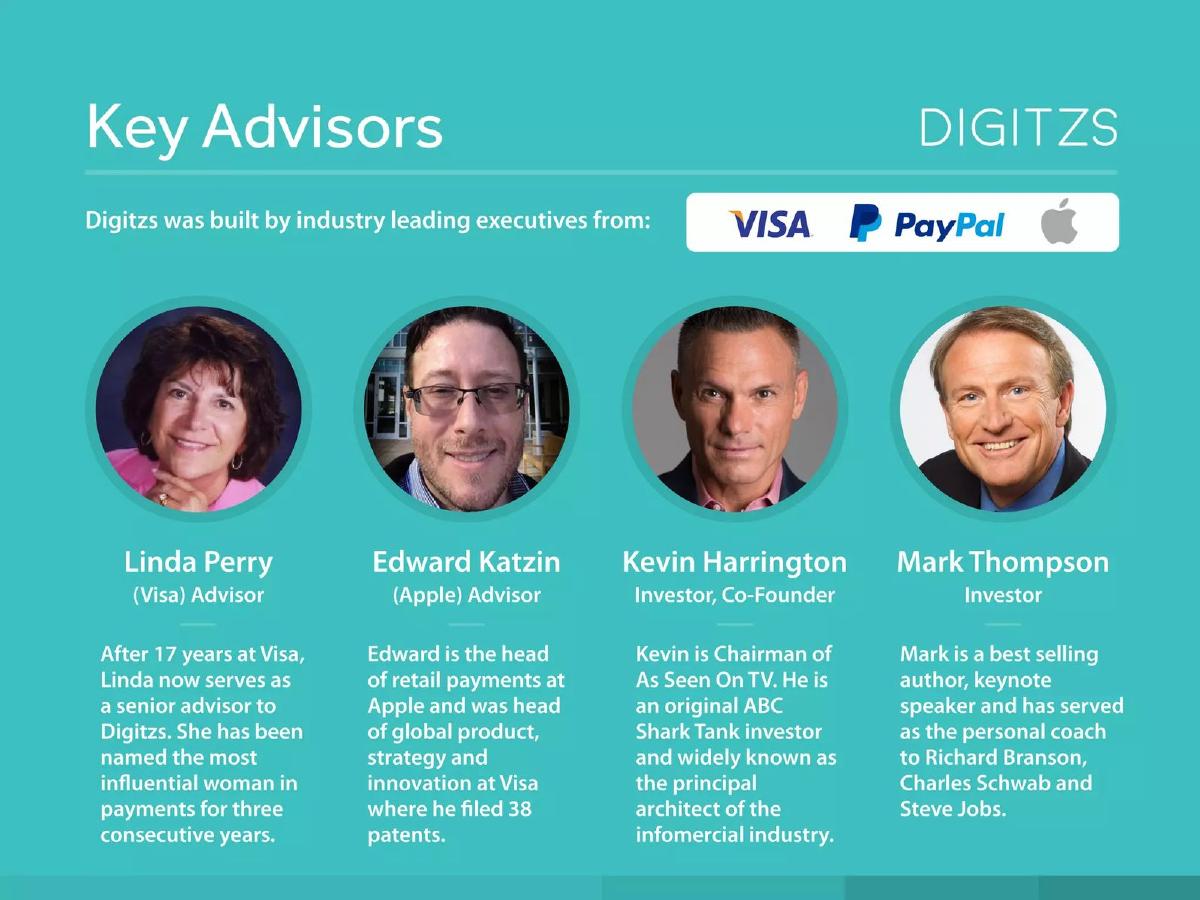
The Digitzs pitch deck, dated November 2016, targets the infrastructure layer of the payments industry, specifically focusing on white label platforms, marketplaces, and apps. The company identifies three core pain points: difficult merchant onboarding, outdated invoicing processes, and a lack of financial incentives for platforms to integrate payments. By offering a solution that allows platforms to add their own usage fees to transaction costs and receive lifetime residual commissions, Digitzs positions itself against incumbents like Stripe and Braintree. The deck leans heavily on the pedig…
Key takeaways
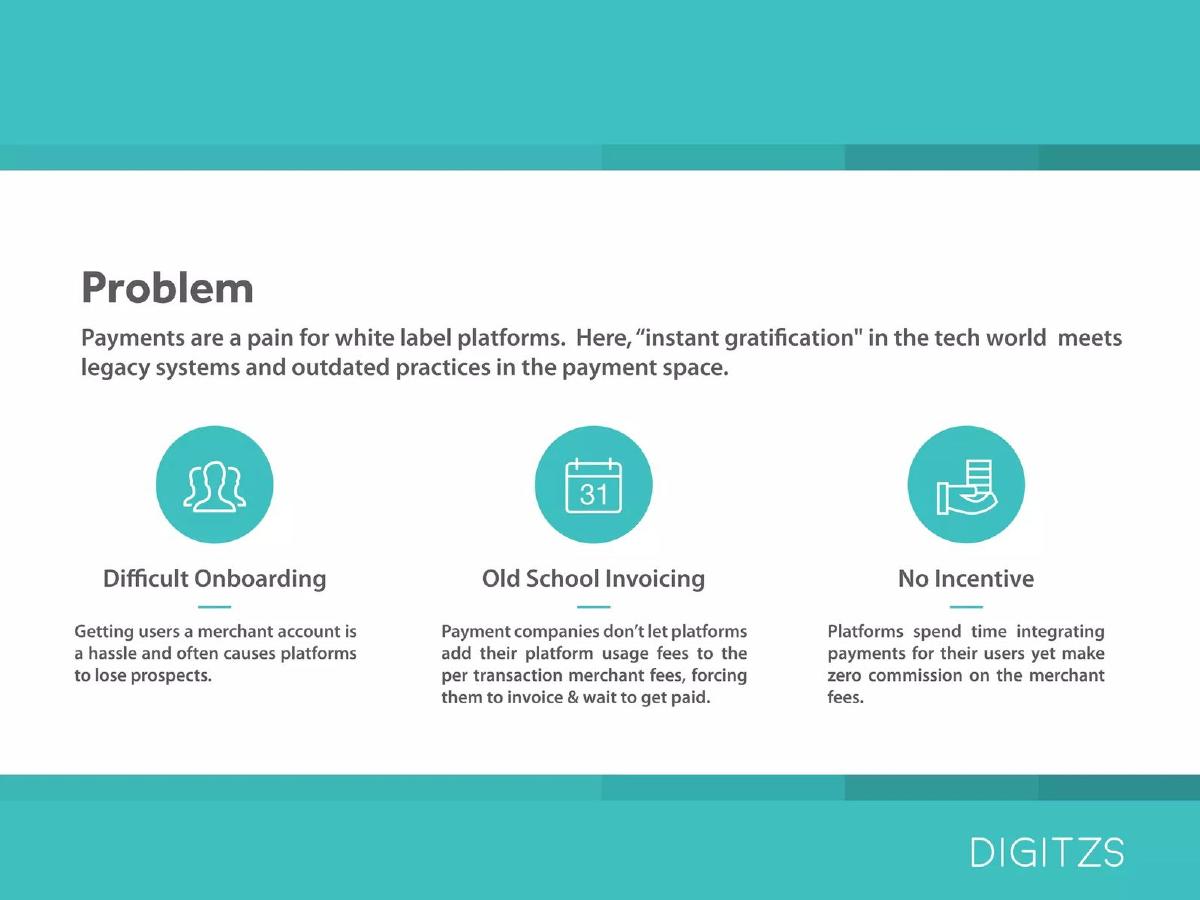
- Digitzs identifies white label platforms as their primary target market, citing a need for better merchant onboarding (Slide 2).
- The platform allows partners to add their own value-added fees to transactions and get paid within two days (Slide 5).
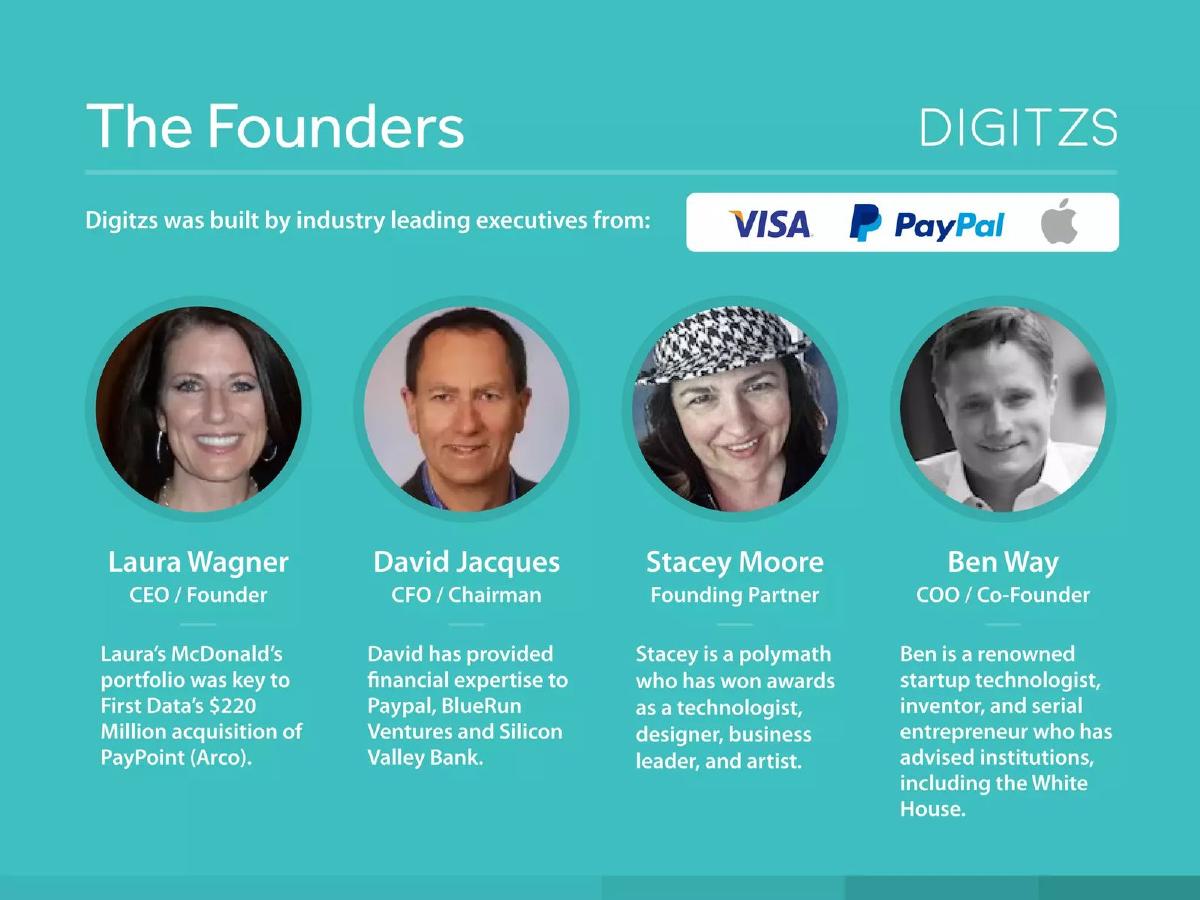
- The founding team claims deep industry experience with backgrounds at Visa, PayPal, and Apple (Slide 3).
- Digitzs reports that their average platform processes over $1 million per month in collective merchant payments (Slide 4).
- The competitive matrix claims superiority over Stripe and Braintree in areas like real-time white label boarding and reporting (Slide 5).
- The deck highlights a massive M&A environment in 2016, noting that 47% of global FinTech deals were in the payments sector (Slide 6).
- Kevin Harrington, an original 'Shark' from ABC’s Shark Tank, is featured as an investor and brand advocate (Slide 7).
- The deck focuses on three specific niche verticals: ticket payments, rent payments, and donation payments (Slide 4).
Introduction and Strategy
The Digitzs pitch deck from late 2016 is a focused look at the 'payment-facilitator-as-a-service' model before that term became ubiquitous in the fintech world. The deck is structured to move quickly from the high-level problem of legacy payment systems to a very specific solution for a very specific type of customer: the white label platform. By focusing on the infrastructure that powers other apps, Digitzs positions itself as a 'picks and shovels' play in the digital economy.
Slide 1: Title and Positioning
The cover slide features a minimalist aesthetic with a background image of a person in a hammock overlooking a lake. The tagline is clear: "Making payments painless for apps, marketplaces and platforms." This immediately defines the target audience. It isn't for individual merchants; it is for the entities that aggregate those merchants. The contact information for CEO Laura Wagner is prominently displayed, establishing a direct line of communication from the start.
Slide 2: The Three-Pronged Problem
Slide 2 identifies the friction points in the 2016 payment landscape. It categorizes the problem into three buckets: Difficult Onboarding , Old School Invoicing , and No Incentive . The most compelling point here is the 'No Incentive' argument—that platforms spend time integrating payments but make zero commission. This sets the stage for a solution that isn't just a utility, but a revenue generator.
Slide 3: The Founders and Pedigree
In the payments industry, trust and regulatory experience are paramount. Digitzs leans heavily on this by showcasing logos for Visa, PayPal, and Apple . The biographies are brief but high-impact. Laura Wagner’s connection to a $220 million acquisition and David Jacques’ history with PayPal and Silicon Valley Bank provide the necessary 'adult in the room' credibility for a fintech startup. The inclusion of Stacey Moore as a 'polymath' and Ben Way as a 'renowned startup technologist' rounds out the team with creative and technical breadth.
Slide 4: Market Verticals and Traction
Slide 4, titled "The New Normal," identifies three specific niches where white label payments are essential: Ticket Payments , Rent Payments , and Donation Payments . This is a smart move; rather than claiming to serve everyone, they highlight high-volume, recurring transaction industries. The slide also provides a key metric: "Our average platform processes over $1 million PER MONTH in collective merchant payments." This suggests that while they may have a small number of clients, those clients are significant in scale.
Slide 5: The Competitive Matrix
This slide is a standard feature-comparison table. Digitzs compares itself against Vantiv, Stripe, WePay, and Braintree . The company claims to be the only one offering a complete suite of white label boarding, lifetime residual commissions, value-added fee integration, and real-time reporting. While these matrices are always biased toward the presenter, it clearly communicates the product's intended differentiators: speed of onboarding and financial upside for the platform owner.
Slide 6: The M&A Landscape
Slide 6 serves as an 'exit strategy' slide without explicitly saying so. By highlighting that 47% of global FinTech M&A deals in the previous year were payments companies, and listing multi-billion dollar acquisitions by Tsys, PayPal, and Mastercard , the founders are telling investors that there is a clear path to liquidity. It frames the payments space as a 'frenzy,' creating a sense of urgency for the investor.
Slide 7: The Celebrity Endorsement
The final slide features Kevin Harrington , an original shark from the TV show Shark Tank . His quote, "Digitzs is the next big disruptor in the trillion dollar payments space," serves as a powerful social proof. For many investors, seeing a known commodity like Harrington already on the cap table reduces the perceived risk of the deal.
What Digitzs Does Well
The deck is exceptionally clear about its target customer. By repeatedly mentioning "white label platforms," they avoid the trap of looking like just another merchant acquirer. The focus on turning payments into a revenue stream for their partners is a powerful value proposition that directly addresses the 'No Incentive' problem mentioned early in the deck.
The team slide is another strong point. In fintech, investors are often wary of founders who don't understand the complex regulatory and technical debt of the legacy banking system. By highlighting deep ties to Visa and PayPal, Digitzs mitigates this concern immediately.
What is Missing from the Deck
The most glaring omission in the provided slides is a Financial Projections slide. While they mention the volume processed by their average platform, they do not show their own take-rate, gross margins, or path to profitability. Without these numbers, it is impossible to judge the actual health of the business.
Furthermore, there is no Technology slide. For a company claiming to offer 'true real-time' boarding and reporting, a high-level architectural diagram or a discussion of their API would have been beneficial to prove they aren't just a thin wrapper over another provider's legacy rails.
Finally, the lack of a Specific Ask (how much money they want and what they will do with it) makes this feel more like a general company overview than a focused fundraising pitch. If this was used in a live pitch, those details were likely handled verbally or in a separate document.
Founder Takeaways
Focus on the 'Why Now': Digitzs used the 2016 M&A frenzy to justify their existence. Founders should always link their startup to a broader market trend that makes their success feel inevitable. · Monetize the Pain: Don't just solve a technical problem; solve a financial one. Digitzs didn't just make payments easier; they made them profitable for their clients. · Leverage Social Proof: If you have a notable investor or advisor, don't bury them in the appendix. Digitzs put Kevin Harrington on the closing slide to leave a lasting impression of credibility. · Define Your Niche: By naming specific sectors like rent and donations, Digitzs showed they understood the specific workflows of their users, rather than pitching a generic 'one size fits all' tool.
Frequently asked questions
- What is the core value proposition of Digitzs?
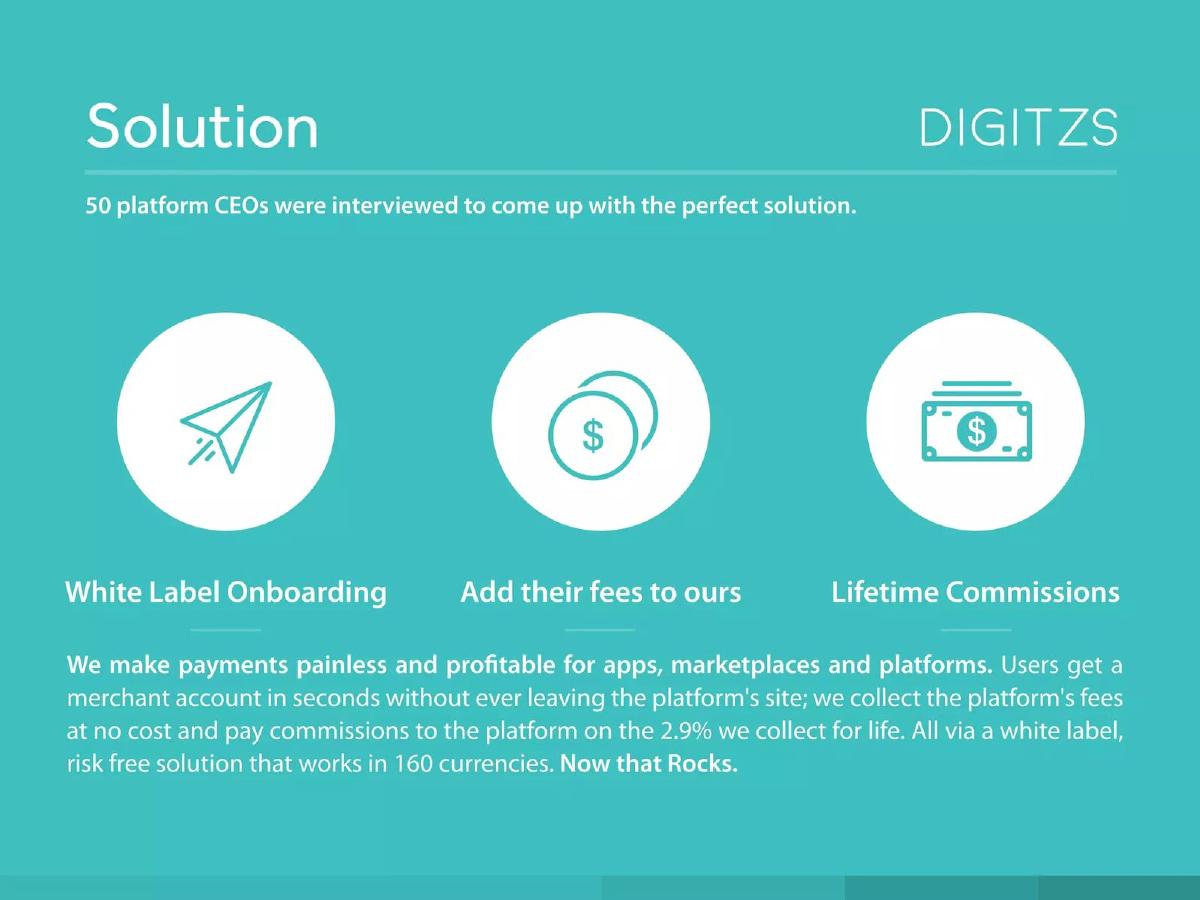
- Digitzs provides a white label payment processing solution designed for apps and marketplaces. Unlike standard processors, it allows the platform owner to easily add their own service fees on top of the merchant transaction fees and earn a residual commission. This transforms payments from a cost center into a revenue stream for the platform provider while simplifying the onboarding process for their sub-merchants.
- Who are the key competitors mentioned in the deck?
- The deck explicitly compares Digitzs to Vantiv, Stripe, WePay, and Braintree. Digitzs claims to differentiate itself by offering 'true real-time white label merchant boarding' and 'true white label real-time reporting,' features it suggests are lacking or incomplete in the offerings of its larger, more established competitors as of 2016.
- What evidence of market traction does the deck provide?
- Traction is primarily demonstrated through a single metric on Slide 4: 'Our average platform processes over $1 million PER MONTH in collective merchant payments.' While this indicates the scale of the platforms they serve, the deck does not disclose the total number of platforms currently using the service or the company's own net revenue.
- What is the professional background of the founding team?
- The team is presented as a group of 'industry leading executives.' CEO Laura Wagner is credited with a portfolio that was key to a $220 million acquisition by First Data. CFO David Jacques has experience with PayPal and Silicon Valley Bank. The team also includes Ben Way, described as a serial entrepreneur who has advised the White House.
- Does the deck include a specific funding request?
- No. The provided slides do not include a 'The Ask' slide detailing the amount of capital being raised, the valuation, or the specific use of funds. It functions more as a high-level capabilities and opportunity deck rather than a complete investment memorandum.