Digs, a Vancouver-based AI construction startup, successfully raised a $5M Seed round in 2024 by positioning itself as the connective tissue for unstructured build data. The 17-slide deck focuses heavily on product capabilities, specifically its 'DigsCanvas' and 'AskDigs' AI co-pilot, which aim to reduce cycle times and eliminate errors. Rather than leading with dense financial tables, the deck emphasizes user experience, claiming a 'consumer app' feel for a traditionally clunky industry. By highlighting a founding team with a previous exit to Lowe’s and securing a high-profile endorsement fr…
Key takeaways
- The deck highlights a 2,600% increase in data available to homeowners through their 3D digital twin handoff (Slide 11).
- Digs claims its photo-realistic sales tools lead to a 15%+ increase in sales for builders (Slide 7).
- The 'AskDigs' AI co-pilot is marketed as providing a 25% decrease in time spent searching for answers (Slide 9).
- The platform aims to eliminate 5-7 critical errors per project by centralizing collaboration on accurate data (Slide 7).
- Digs leverages significant social proof, including 11+ patents and a presence in 50 states and Canada (Slide 15).
- The founding team previously built Streem, which was acquired in 2019 after partnering with Lowe's (Slide 15).
- The deck omits a specific 'Ask' slide detailing the exact use of the $5M funds or a detailed financial projection slide.
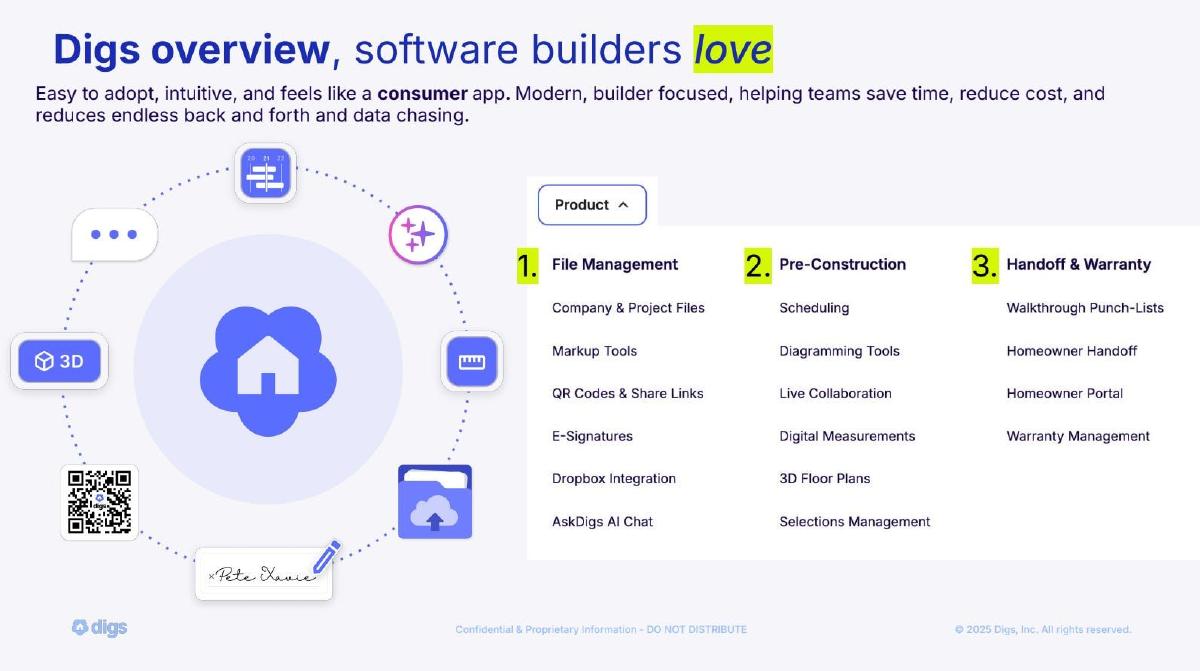
- The product is segmented into three clear pillars: File Management, Pre-Construction, and Handoff & Warranty (Slide 5).
The Hook: Unlocking Happier Homes
Slide 1: Title Slide
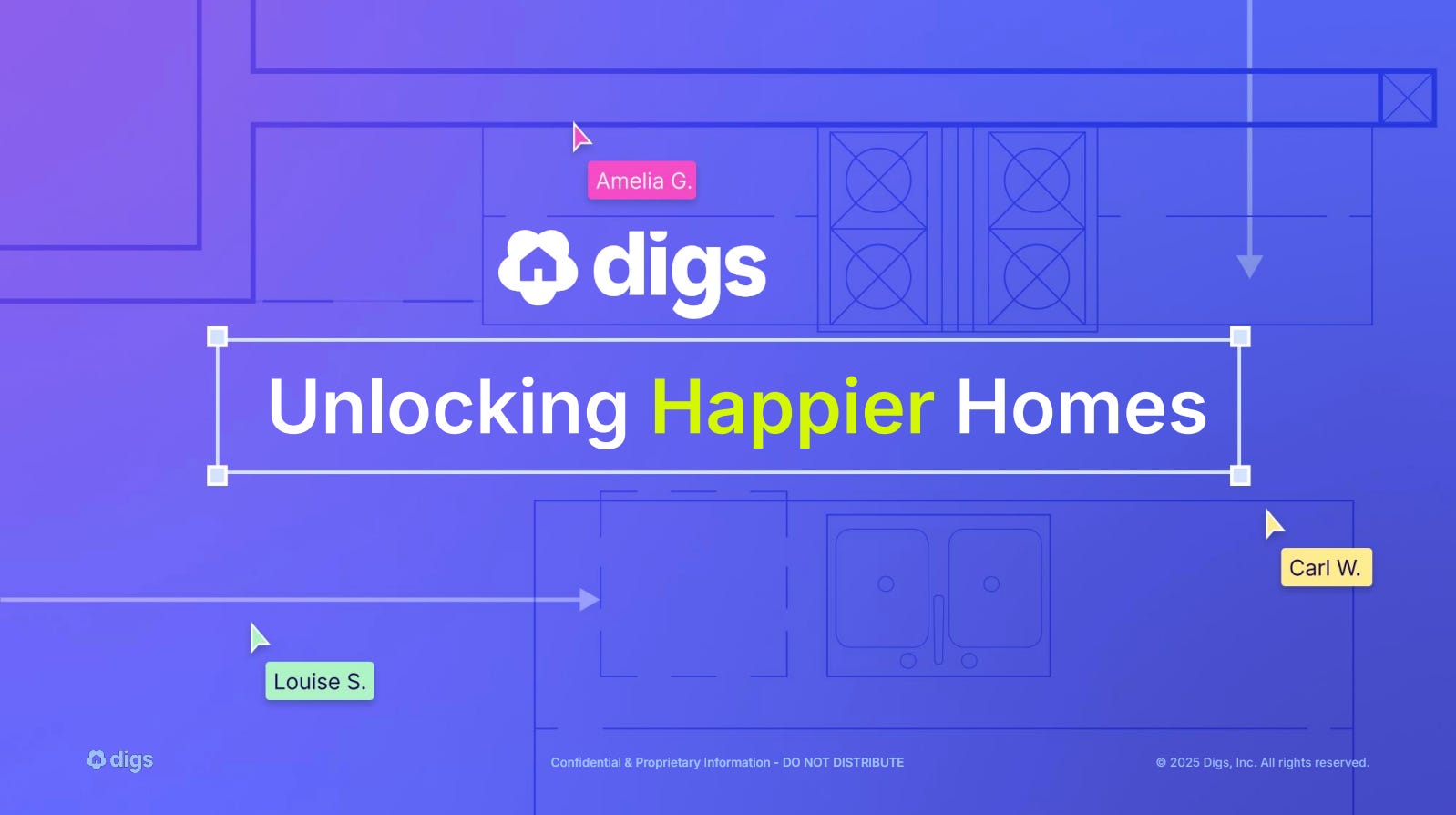
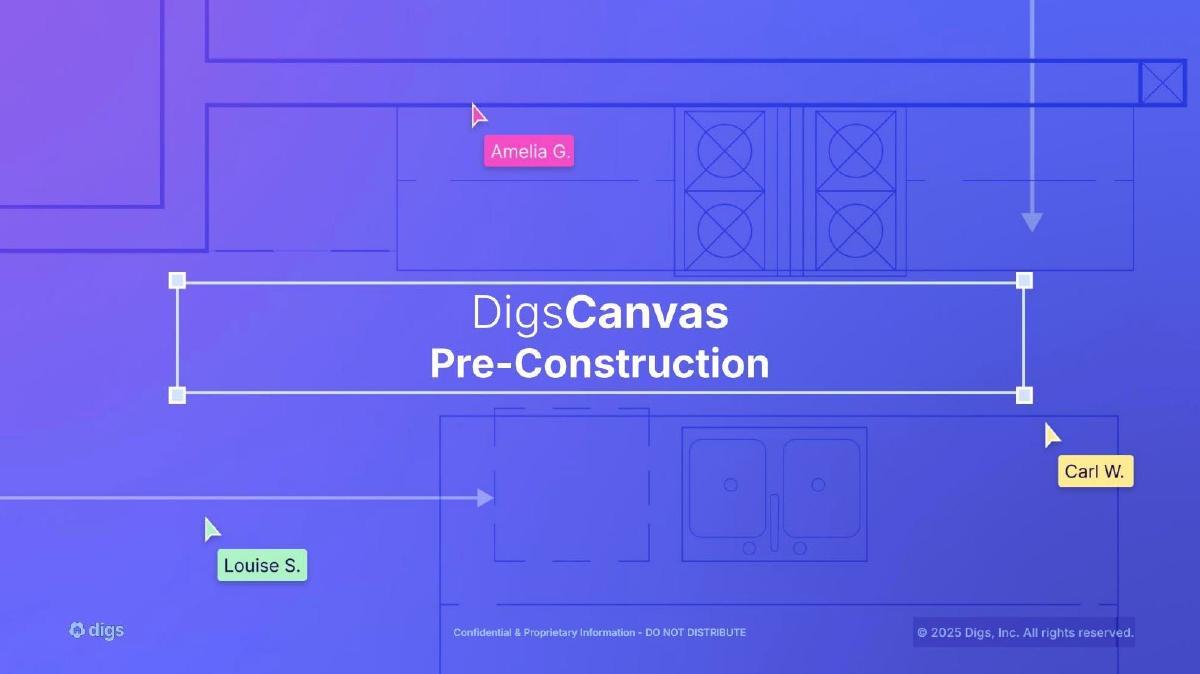
The deck opens with a clean, branded title slide featuring the tagline 'Unlocking Happier Homes.' The background uses a blueprint aesthetic with collaborative cursors (Amelia G., Louise S., Carl W.), signaling that this is a multi-user, collaborative platform. It establishes the brand identity immediately: modern, tech-forward, and focused on the residential space.
Slide 2-3: The AI Thesis
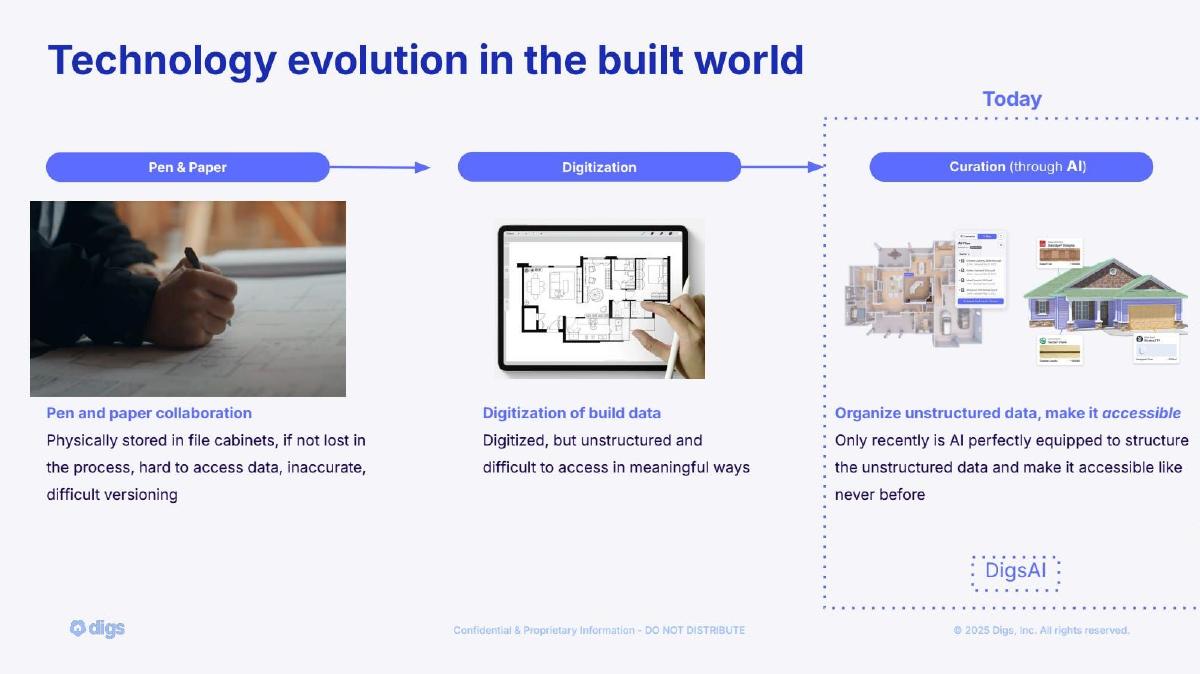
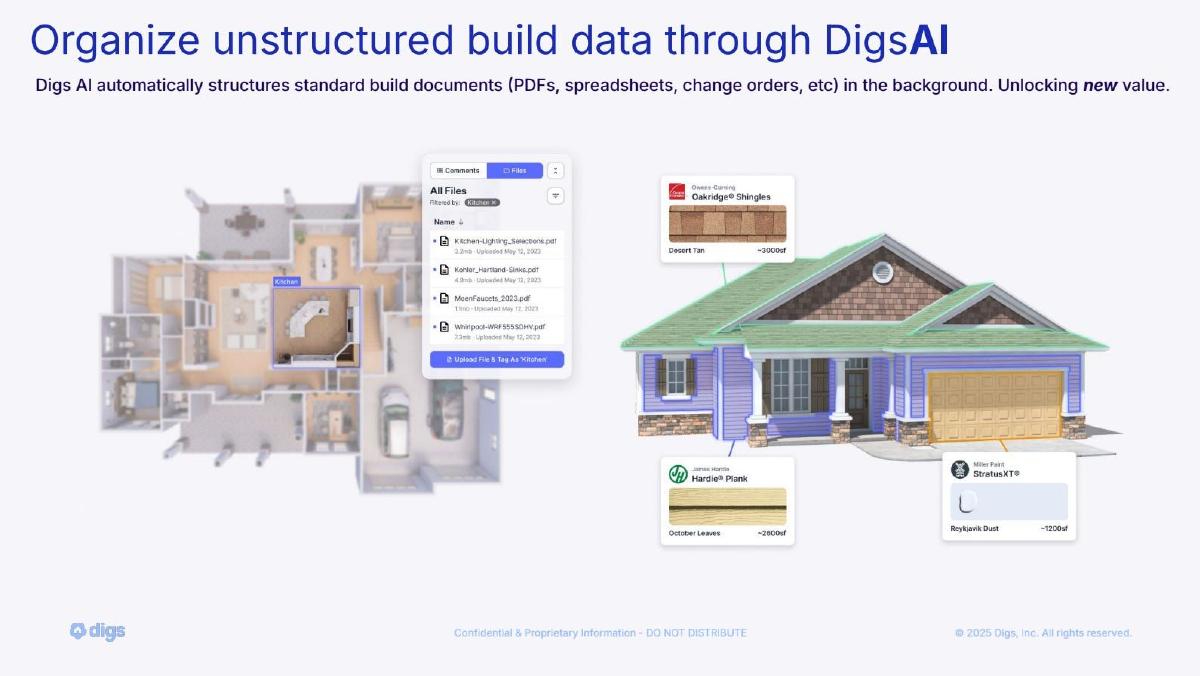
Slide 2 (not pictured in detail but noted in text) discusses the technology evolution in the 'built world.' Slide 3 gets straight to the value proposition: 'Organize unstructured build data through DigsAI.' The slide shows a 3D model of a home alongside a file management interface. It explicitly states that Digs AI 'automatically structures standard build documents (PDFs, spreadsheets, change orders, etc) in the background.' This is a classic 'show, don't just tell' approach to an AI pitch.
Slide 4-5: Focus and Product Overview
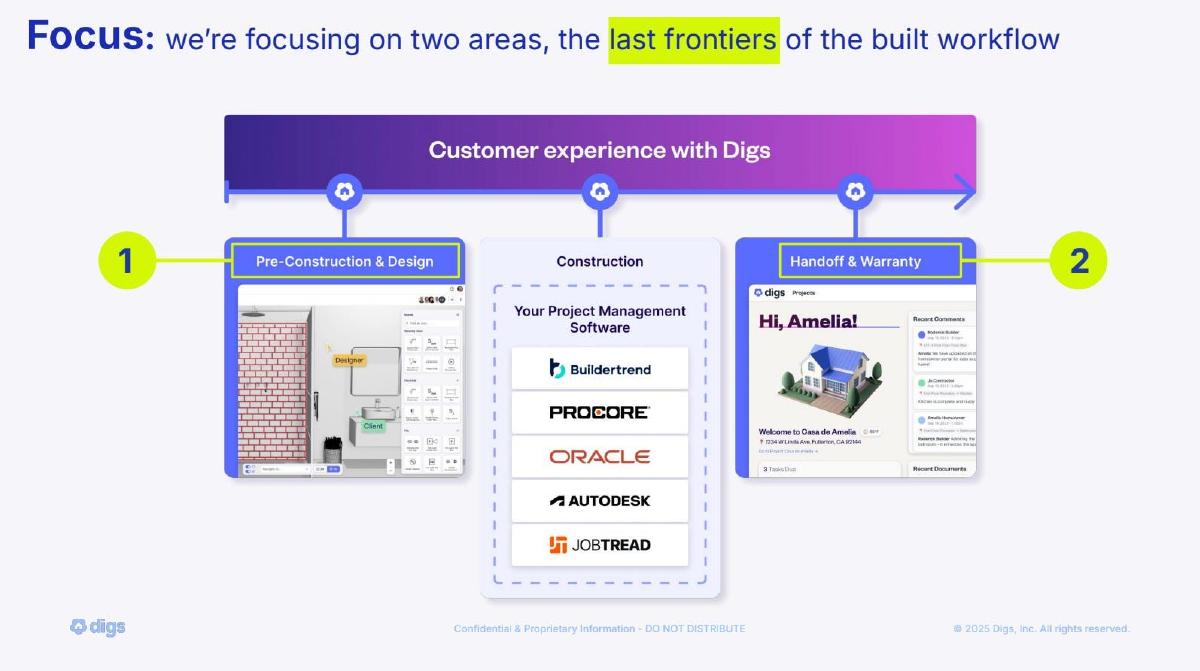
Slide 4 identifies the 'last frontiers' of the built workflow: pre-construction and aftercare. Slide 5 provides a high-level overview of the software, emphasizing a 'consumer app' feel. The product is broken down into three pillars: 1. File Management (Markup tools, QR codes, E-signatures), 2. Pre-Construction (Scheduling, 3D floor plans, digital measurements), and 3. Handoff & Warranty (Punch-lists, homeowner portal, warranty management). This slide is crucial as it maps the entire customer journey.
Slide 6-8: DigsCanvas and the 3D Vision
These slides focus on 'DigsCanvas.' Slide 7 is particularly metric-heavy, claiming that the tool can 'eliminate 5-7 critical errors per project' and lead to a '15%+ increase in sales' through photo-realistic sales tools. The slide demonstrates the transition from a 2D PDF to a 3D interactive plan 'in seconds.' By quantifying the error reduction and sales increase, Digs moves from a 'nice-to-have' visualization tool to a 'must-have' ROI generator.
Slide 9: The AI Co-pilot
Slide 9 introduces 'AskDigs,' an AI co-pilot. The slide claims a '25% decrease in time searching for answers.' It shows three specific use cases: floor plan calculations, surface selection decisions, and warranty queries. The UI screenshots show the AI answering specific questions like 'What is the square footage of the garage?' and 'What is covered in my structural warranty?' This demonstrates a practical, vertical-specific application of LLMs that goes beyond generic chat.
Slide 10-12: The Handoff and Aftercare
Slide 11 highlights the 'Handoff' process, claiming a '2,600% increase in data on the home for new homeowners.' It positions the '3D Digital Twin' as a way to mitigate risk exposure by providing a complete, agreed-upon record of the home at the time of sale. Slide 12 (noted in text) focuses on Warranty & Aftercare, closing the loop on the home's lifecycle. This is a strategic move, as it extends the lifetime value of the software beyond the construction phase.
Slide 13-15: Traction and Team
Slide 13 and 14 serve as recaps and social proof. Slide 15, 'About Digs,' is the heavy hitter for credibility. It notes that the founding team previously built Streem (acquired in 2019) and partnered with Lowe's. It also features a quote from Mike Rowe (Dirty Jobs), stating, 'I believe that company is Digs.' The slide lists traction metrics: ~10k homes, 11+ patents, and customers in 50 states and Canada. This slide effectively de-risks the investment by showing both founder pedigree and market validation.
Slide 16-17: Leadership and Closing
The deck concludes with a leadership slide and a 'Thank you' slide. The leadership slide (noted in text) likely details the specific roles of the founders mentioned in the 'About' section, reinforcing the 15+ years of experience in building AI products mentioned on Slide 15.
What Digs Does Exceptionally Well
Visualizing the Invisible: Construction software is often dry. Digs uses high-quality 3D renders and clean UI mockups to make 'data organization' look exciting. By showing the 3D digital twin, they make the abstract concept of 'unstructured data' tangible.
Quantified Value: The deck doesn't just say the tool is better; it uses specific numbers. The '15%+ increase in sales' (Slide 7), '25% decrease in time searching' (Slide 9), and '2,600% increase in data' (Slide 11) provide anchors for investors to calculate potential ROI.
Founder-Market Fit: Slide 15 is a masterclass in establishing authority. Mentioning a previous exit (Streem) and a partnership with a major industry player (Lowe's) immediately puts the founders in the top 1% of Seed-stage entrepreneurs.
What is Missing from the Digs Deck
The 'Ask' Slide: While we know from publisher reports that they raised $5M, the deck itself does not explicitly state the amount being raised or the specific milestones they intend to hit with that capital. A clear 'Use of Funds' slide is a standard expectation in Seed decks.
Business Model & Unit Economics: The deck explains what they built and who uses it, but not how they make money. Is it a per-project fee? A SaaS subscription for builders? A freemium model for homeowners? The lack of pricing strategy or CAC/LTV projections is a notable omission.
Competitive Landscape: The construction tech (ConTech) space is crowded with giants like Procore and newer AI entrants. Digs does not include a 'Competitor Matrix' or a slide explaining why their approach to digital twins is defensible against incumbents who might add similar AI features.
Founder's Guide: What to Copy from Digs
The 'Pillar' Structure: Use Slide 5 as a template for explaining a complex product. Breaking a platform down into 3-4 clear functional pillars makes it much easier for an investor to digest the scope of your solution.
Vertical AI Use Cases: If you are pitching an AI company, copy Slide 9. Don't just say you have an AI chat; show three specific, high-value questions that only your AI can answer because of your unique data access.
Social Proof Layout: Slide 15 is an excellent way to combine team history, press logos (WSJ, Forbes, TechCrunch), and customer logos into a single 'Credibility' powerhouse. It creates a 'wall of winning' that is hard for an investor to ignore.
Frequently asked questions
- What is the core problem Digs is solving?
- Digs addresses the issue of 'unstructured build data'—the mess of PDFs, spreadsheets, and change orders that typically get lost during a construction project. By using AI to organize this data into a 3D digital twin, they ensure that builders and homeowners have a permanent, searchable record of the home's components and history.
- How does Digs differentiate its AI from generic chatbots?
- According to Slide 9, the 'AskDigs' AI co-pilot is specifically trained on construction documents. It can perform floor plan calculations (e.g., calculating garage square footage) and answer specific warranty questions based on the uploaded structural documents, rather than just providing general information.
- What is the 'DigsCanvas' mentioned in the deck?
- DigsCanvas is the platform's visual engine. As shown on Slides 6 and 7, it converts 2D PDF floor plans into 3D interactive plans in seconds. It includes tools for automatic scaling, point-to-point measurements, and photo-realistic visualizations intended to help builders close more sales.
- Who is the target customer for Digs?
- The deck identifies two primary users: professional home builders and the eventual homeowners. Builders use it for pre-construction and project management, while homeowners receive a 'digital twin' portal at handoff for long-term maintenance and warranty tracking.
- Does the deck include a roadmap or financial projections?
- No. The 17-slide deck is heavily product-centric. It focuses on current capabilities and the immediate value proposition. It lacks a multi-year financial forecast, a detailed hiring plan, or a specific breakdown of how the $5M Seed round will be allocated.