Calico’s pitch deck is a study in brevity, using only six slides to secure a $2.1M Seed round in 2023. The deck excels by visualizing the chaotic reality of fashion production—listing dozens of manual tasks across disparate platforms like WeChat, Excel, and Gmail—and contrasting it with a clean, unified 'operating system.' The narrative hinges on positioning Calico as the 'missing piece' of the modern eCommerce stack, sitting alongside Shopify and Stripe. While the deck completely omits financial projections, market sizing (TAM), and a specific funding ask, it relies heavily on the deep indus…
Key takeaways
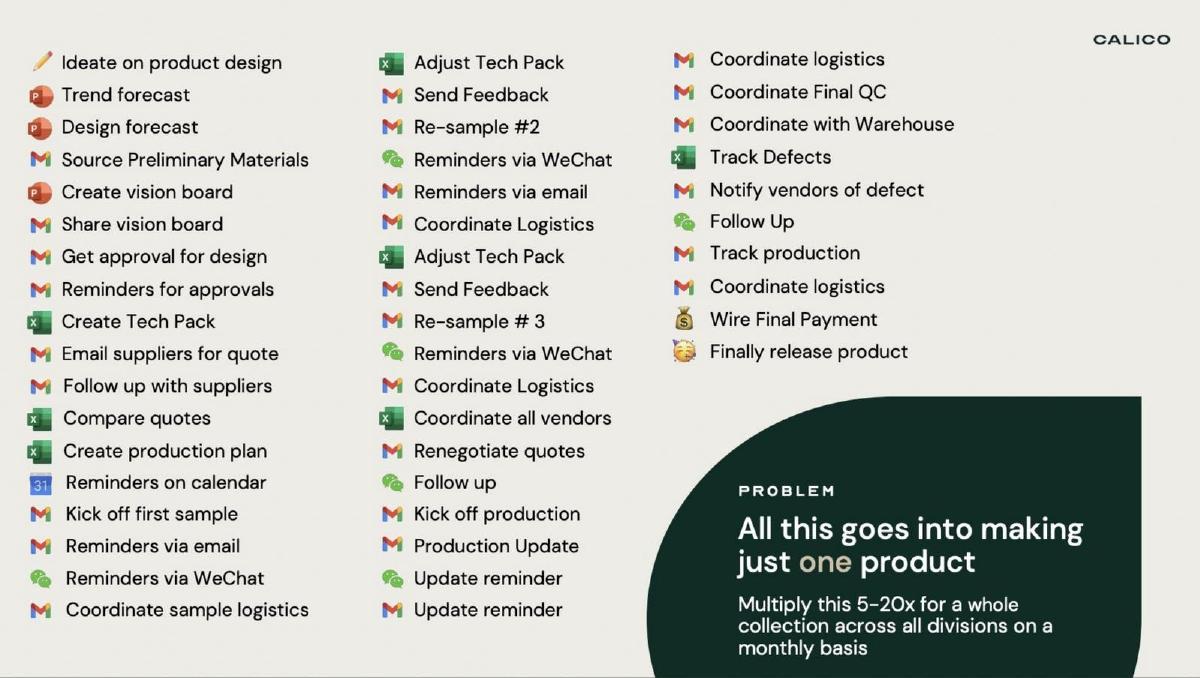
- The deck uses a high-density list on Slide 2 to visualize the friction of managing just one product, mentioning tools like WeChat, Excel, and email.
- Calico positions itself as the third pillar of eCommerce on Slide 3, placing its logo alongside Shopify and Stripe.
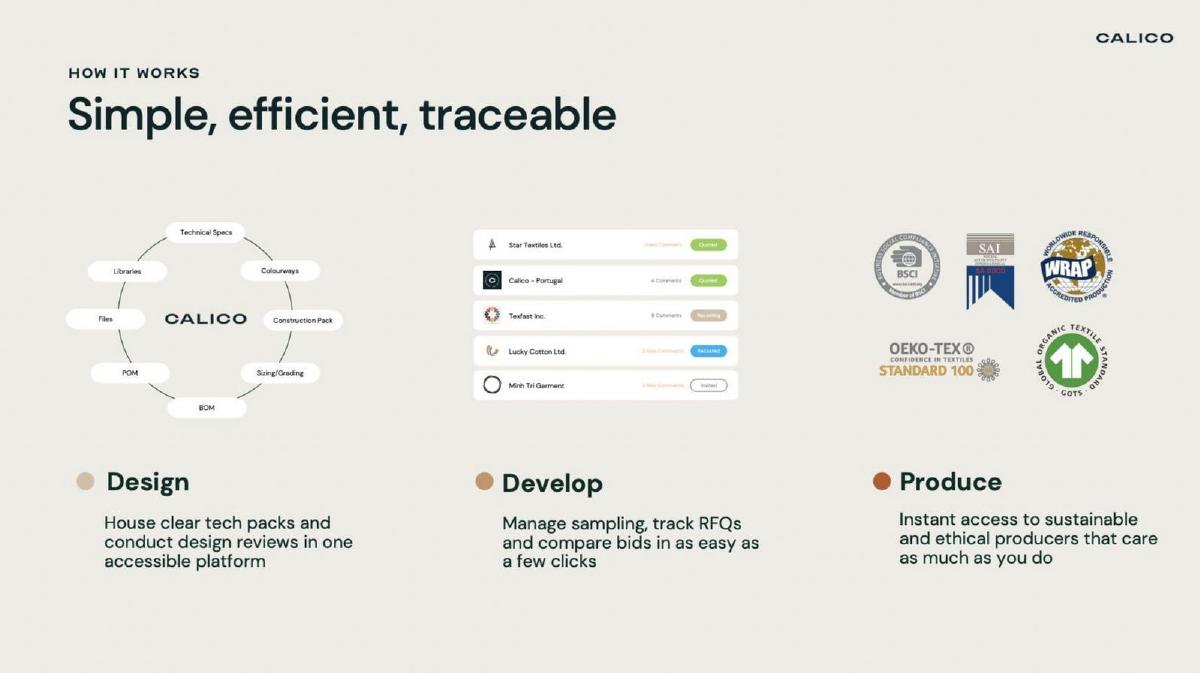
- The 'How it Works' slide (Slide 4) breaks the value proposition into three clear stages: Design, Develop, and Produce.
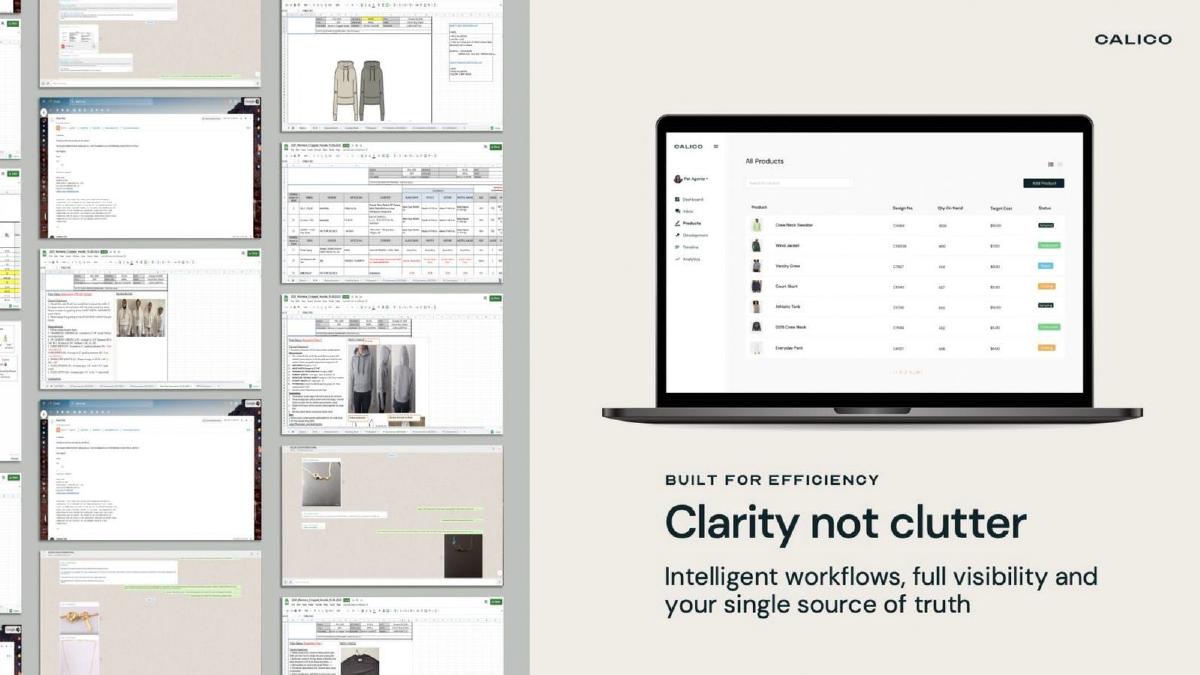
- Slide 5 uses a 'Clarity not clutter' comparison, showing a collage of messy spreadsheets versus a clean SaaS dashboard.
- The team slide (Slide 6) highlights significant domain expertise, including a founder who was a 'Professor @ 23' and a Head of Ops with 10+ years at Aldo.
- The deck contains zero financial data, omitting revenue, burn rate, and unit economics entirely.
- There is no 'Ask' slide; the amount raised ($2.1M) and the round (Seed) are known only from external reporting.
- Market size (TAM/SAM/SOM) is not mentioned, assuming the investor already understands the scale of the fashion industry.
The Power of Brevity: Calico’s 6-Slide Seed Deck
Calico, a North American supply chain software startup, raised $2.1 million in 2023 for its fashion-focused operating system. In an era where pitch decks are often bloated with 20+ slides of market data and financial modeling, Calico took the opposite approach. Their deck is a lean, 6-slide narrative that focuses almost exclusively on the workflow problem and the team’s ability to solve it.
Slide 1: The Hook
The opening slide is minimalist, featuring the company name and the tagline: "The smartest way to manage production." It includes the contact information for Kathleen Chan, the Founder and CEO. The background image of industrial thread spools immediately anchors the company in the textile and manufacturing space. There is no fluff here; it establishes the brand and the sector instantly.
Slide 2: The Visualized Chaos
Slide 2 is perhaps the most effective 'Problem' slide in recent memory. Instead of using bullet points to describe 'inefficiency,' Calico lists the actual tasks required to make a single product. The slide is packed with icons representing WeChat, Gmail, Excel, and Calendar. Tasks include "Reminders via WeChat," "Adjust Tech Pack," "Coordinate Final QC," and "Wire Final Payment." The kicker is the text in the bottom right: "All this goes into making just one product. Multiply this 5-20x for a whole collection across all divisions on a monthly basis." This slide forces the investor to feel the administrative burden of the fashion industry.
Slide 3: The Strategic Positioning
On Slide 3, Calico moves to the 'Solution.' They position themselves as "The missing piece in the eCommerce stack." The slide shows a simple equation: Calico (Product) + Shopify (Platform) + Stripe (Payments). By placing their logo alongside two of the most successful companies in the internet economy, they are making a bold claim about their eventual utility. The slide concludes with the value proposition: "Calico can stand up an entire supply chain in mere minutes."
Slide 4: The Workflow Breakdown
Slide 4, titled "How it Works," uses a three-pillar structure: Design, Develop, and Produce.
Design: Focuses on housing tech packs and design reviews. · Develop: Mentions managing sampling and tracking RFQs (Request for Quotes). · Produce: Highlights access to sustainable and ethical producers, showing logos for certifications like OEKO-TEX, GOTS, and WRAP.
This slide transitions the pitch from a high-level concept to a functional tool, showing that they handle everything from the initial sketch to the final ethical certification.
Slide 5: The 'Before and After'
Slide 5 reinforces the problem/solution dynamic through a visual comparison. On the left, a cluttered collage of spreadsheets and technical drawings represents the status quo. On the right, a clean laptop mockup shows the Calico dashboard with columns for "Design No.," "Qty On Hand," "Target Cost," and "Status." The headline "Clarity not clutter" emphasizes their role as a "single source of truth." This is a classic SaaS sales tactic applied to a venture pitch, and it works well to demonstrate product-market fit at the workflow level.
Slide 6: The Pedigree
The final slide introduces the team, which is clearly a major selling point for the $2.1M raise.
Kathleen Chan (CEO): Listed as a 3x Startup Founder and a "Professor @ 23" with leadership in DTC brands. · Khalid Khatib (Head of Eng): Formerly of Freightos, with 6+ years building supply chain platforms. · Nicholas Finlayson (Head of Ops): Brings 10+ years of experience from Aldo, having led global supply chains for retailers like Walmart, Nordstrom, and Target.
The team slide justifies the lack of other data; these are individuals who have lived the problem they are solving.
What Calico Got Right
The deck’s greatest strength is its empathy for the user . Slide 2 doesn't just say the supply chain is broken; it shows the specific, grueling tasks that a production manager has to perform every day. This level of detail suggests that the founders aren't just tech outsiders trying to disrupt an industry—they are insiders who know exactly where the friction lies.
Furthermore, the positioning strategy on Slide 3 is brilliant. By framing Calico as the "third leg" of the eCommerce stool (alongside Shopify and Stripe), they bypass the need for a complex market map. They are telling investors: "You already know why Shopify is valuable; we are that, but for the factory side."
What is Missing
While the deck was successful in raising $2.1M, it leaves several critical questions unanswered for a typical investor:
No Market Size: There is no mention of TAM (Total Addressable Market). While the fashion industry is obviously large, the deck doesn't specify how much of that market Calico can capture via its SaaS model. · No Financials: There are no mentions of current revenue, customer count, or growth rates. This suggests the round may have been raised on the strength of the MVP and the team's reputation. · No Unit Economics: The deck doesn't explain the pricing model. Is it a per-user SaaS fee, a percentage of GMV (Gross Merchandise Volume), or a transaction fee on payments? · No Competition: The deck ignores other PLM (Product Lifecycle Management) or ERP (Enterprise Resource Planning) software. It assumes the only competition is "clutter" and spreadsheets.
The Founder’s Takeaway
If you are a founder with deep domain expertise and a product that solves a highly manual, multi-platform workflow, Calico’s deck is your blueprint. You don't need 20 slides if you can prove you understand the problem better than anyone else. However, most founders will need to add at least one slide on traction and one on market size to satisfy institutional VCs who aren't already familiar with the team's track record.
Calico proves that in the Seed stage, clarity of vision and team credibility are the two most important currencies. They used six slides to say: "We know this mess, we have the team to fix it, and we fit perfectly into the existing tech ecosystem." For a $2.1M check, that was enough.
Frequently asked questions
- How did Calico raise $2.1M with only 6 slides?
- Calico focused on a high-pain, high-complexity problem (fashion supply chain) and presented a 'single source of truth' solution. By highlighting a team with deep industry experience at companies like Microsoft, Freightos, and Aldo, they built enough credibility to move to due diligence without needing a 20-slide deck.
- What is the 'eCommerce stack' strategy used in this deck?
- On Slide 3, Calico uses a 'Missing Piece' analogy. They argue that while Shopify handles the storefront and Stripe handles payments, there is no equivalent for product production. This framing makes their software seem essential rather than optional for any serious brand.
- Why did the founders omit a market size slide?
- In niche vertical SaaS, investors often already know the market is massive (e.g., global fashion). Calico chose to spend their limited slide count on the 'Problem' and 'Product' to prove they understood the specific workflows better than a generalist competitor.
- Is it normal to exclude financial metrics from a Seed deck?
- While not standard, it is common for very early-stage companies or those with high-pedigree teams. Calico relied on the strength of their product vision and team background to sell the 'future' rather than current traction numbers.
- What does 'soft goods' mean in the context of this deck?
- Soft goods refers primarily to textiles and clothing. Calico’s Slide 4 shows certifications like OEKO-TEX and GOTS, which are specific to the textile industry, signaling that their 'operating system' is purpose-built for fashion brands.