How e-commerce and online retail startups present the solution in a pitch deck: say where the product plugs into the store, what the merchant stops doing.
E-commerce Startup Solution Slide: Real Pitch Deck Examples
Eight solution slides from e-commerce and online retail startups, shown in full, compare whether each slide says where the product fits in selling online, what work it removes from the merchant or shopper, and what result it promises.
TL;DR
An e-commerce solution slide should say where the product plugs in (the checkout, the store platform, the marketplaces, the shop floor), what the merchant or shopper no longer has to do, and what that changes. DRF's Pop Shop slide answers its own two-column problem slide side by side: brands "showroom their products in a network of stores", retailers "receive new store traffic", and "smart matching" makes sure both get "their money's worth". Calico places itself in a stack investors already know — "CALICO product + shopify platform + stripe payments" — and makes one claim: it "can stand up an entire supply chain in mere minutes". Kiddo lists three intentions ("gather multi vendors", "choose among the best brands", "deliver organized orders") with no mechanism or result, which is the weaker pattern.
E-commerce solution slides from real pitch decks
Each example shows the exact stored slide above its analysis and links to the full teardown. Claims are as shown on the slides; we have not verified them.
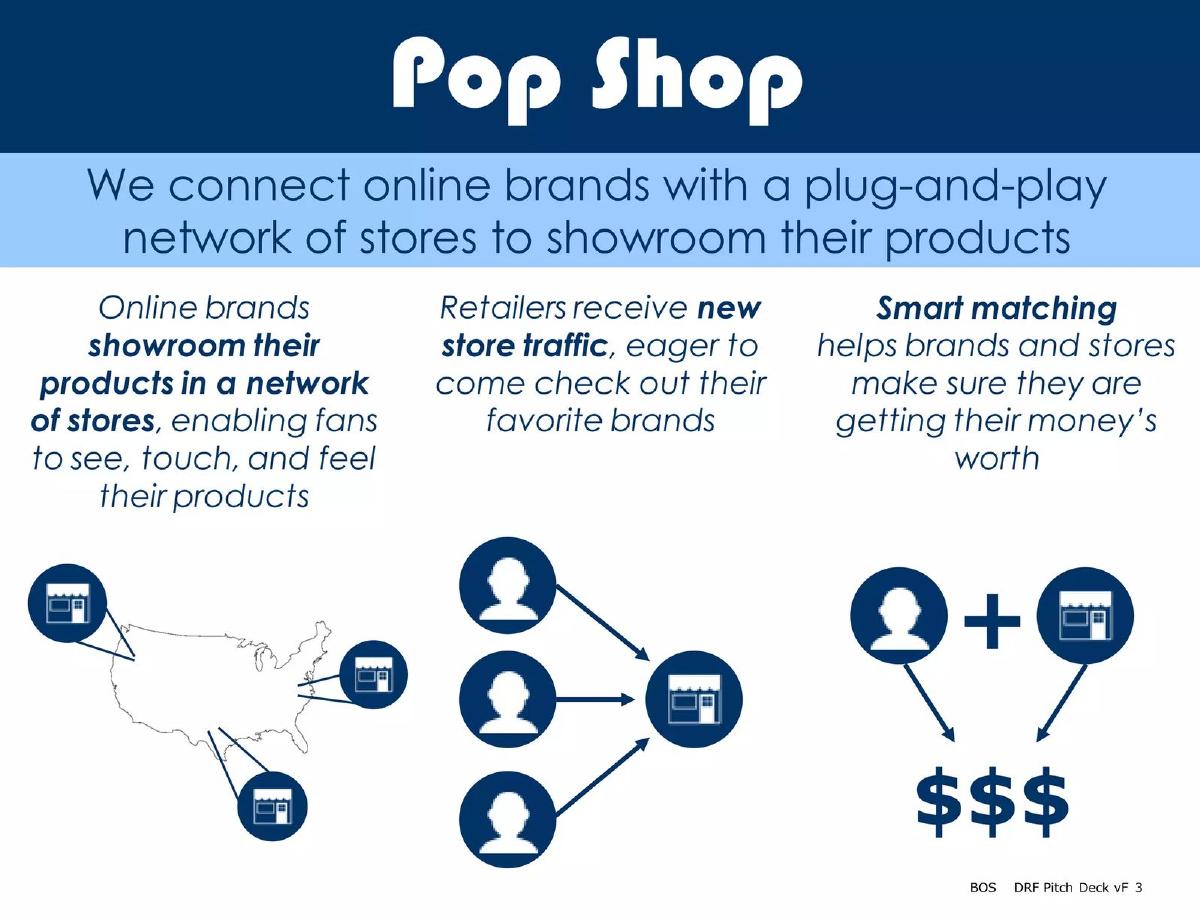
DRF (Pop Shop) solution slide — slide 3
Physical showroom network for online brands. One headline and three illustrated columns.
DRF deck, slide 3. Exact stored slide matched to this analysis.
Our analysis: The strongest here. Its problem slide gave brands and retailers a column each; this slide answers both, then adds the mechanism (matching) that makes it work for both.
Evidence and limitation: No figures.
What a founder can adapt: Re-use your problem slide's structure: one column per party, then the piece that connects them.
Supporting analysis
What the deck claims: "Pop Shop." "We connect online brands with a plug-and-play network of stores to showroom their products." "Online brands showroom their products in a network of stores, enabling fans to see, touch, and feel their products." "Retailers receive new store traffic, eager to come check out their favorite brands." "Smart matching helps brands and stores make sure they are getting their money's worth."
Presentation choice: Answering the problem slide point for point shows the solution was designed for the pain, not bolted on.
When it does not fit: "Money's worth" is vague; name what is measured (sales lift, foot traffic) — the next slide does, so move one number up.
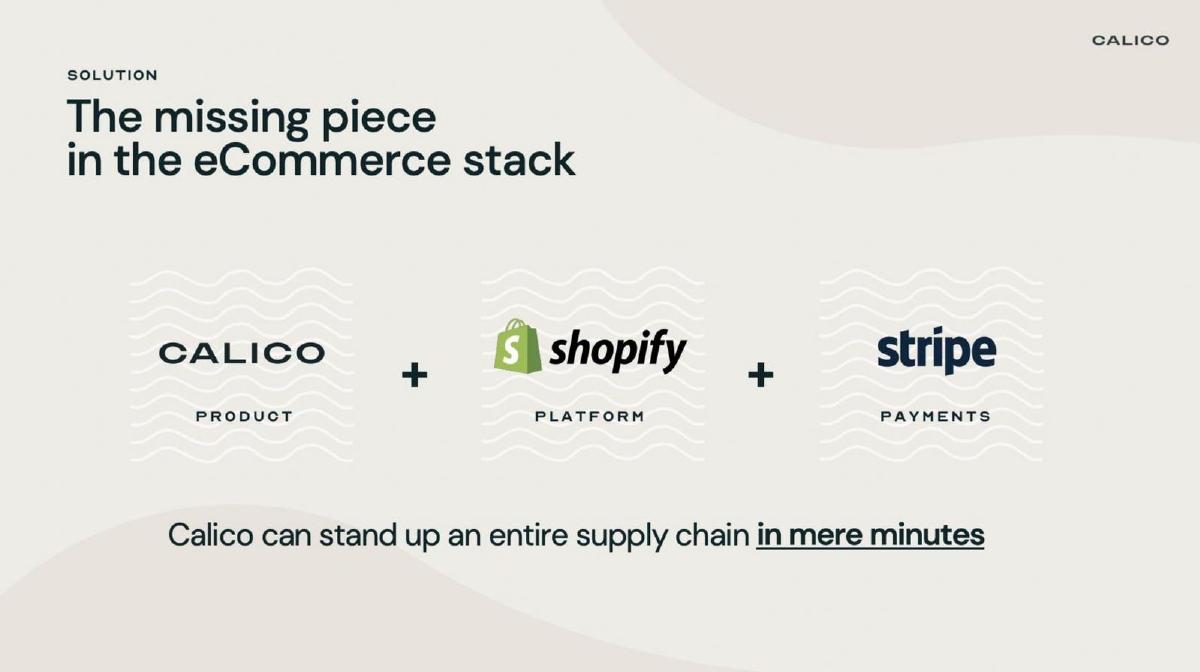
Supplier and product setup for online brands. Three logos and one sentence.
Calico deck, slide 3. Exact stored slide matched to this analysis.
Our analysis: It places the product in one line next to two tools every e-commerce investor knows, and promises one outcome.
Evidence and limitation: "In mere minutes"; no measured figure.
What a founder can adapt: If your category is new, position it beside the tools merchants already run.
Supporting analysis
What the deck claims: "Solution." "The missing piece in the eCommerce stack." "CALICO product + shopify platform + stripe payments." "Calico can stand up an entire supply chain in mere minutes."
Presentation choice: "Shopify for the store, Stripe for payments, us for product" is understood instantly and implies a large market without saying so.
When it does not fit: Say what a "supply chain" covers here (sourcing, manufacturing, fulfilment?) and measure "minutes" against today's weeks.
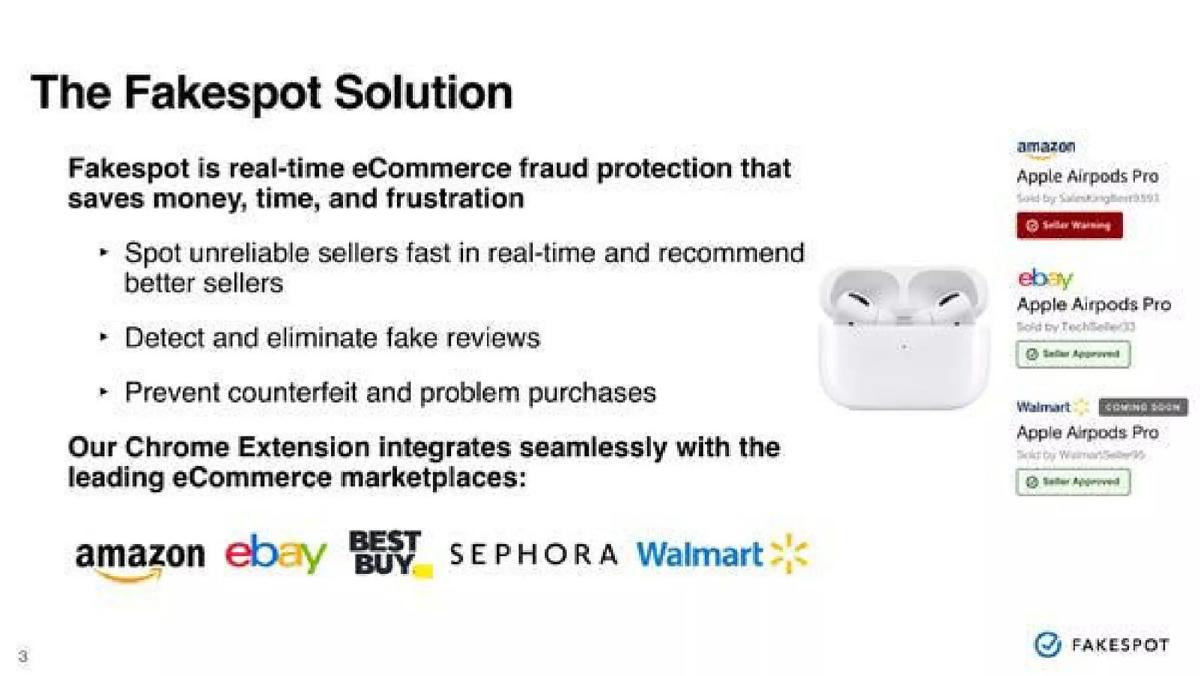
Browser extension that rates sellers and reviews. Headline, three bullets, a product mock-up and marketplace logos.
Fakespot deck, slide 3. Exact stored slide matched to this analysis.
Our analysis: It shows the product working (a warning on one listing, approval on another) and where it runs (five named marketplaces).
Evidence and limitation: No figures.
What a founder can adapt: Show your product's output on a real listing or order, not just a description.
Supporting analysis
What the deck claims: "The Fakespot Solution." "Fakespot is real-time eCommerce fraud protection that saves money, time, and frustration." "Spot unreliable sellers fast in real-time and recommend better sellers." "Detect and eliminate fake reviews." "Prevent counterfeit and problem purchases." "Our Chrome Extension integrates seamlessly with the leading eCommerce marketplaces:" Amazon, eBay, Best Buy, Sephora, Walmart. Mock-up: the same AirPods listed on three sites with "Seller Warning" or "Seller Approved".
Presentation choice: The side-by-side listings make an invisible service visible in one glance.
When it does not fit: "Money, time, and frustration" are three benefits with no measure; pick one and give a number (share of flagged sellers, refunds avoided).
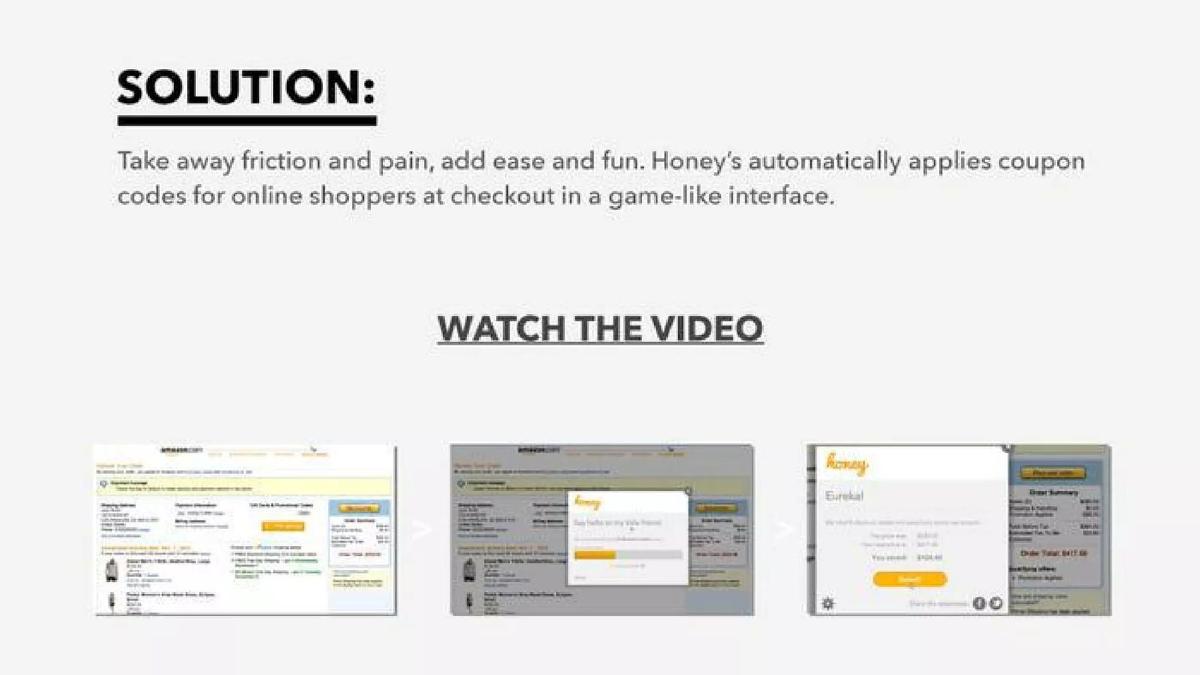
Browser extension that applies coupon codes. One sentence, a video link and three screenshots.
Honey deck, slide 3. Exact stored slide matched to this analysis.
Our analysis: It answers its problem slide exactly: the same promo-code box, now filled automatically. Three screenshots show the sequence.
Evidence and limitation: No figures.
What a founder can adapt: Show the same screen as your problem slide, after your product.
Supporting analysis
What the deck claims: "Solution:" "Take away friction and pain, add ease and fun. Honey's automatically applies coupon codes for online shoppers at checkout in a game-like interface." "Watch the video." Three screenshots of a checkout page with the Honey window opening.
Presentation choice: The problem showed one moment at checkout; the solution changes that same moment. Nothing else to explain.
When it does not fit: The screenshots are too small to read and the slide relies on a video; add one line on the result (savings per order, or the share of carts completed).
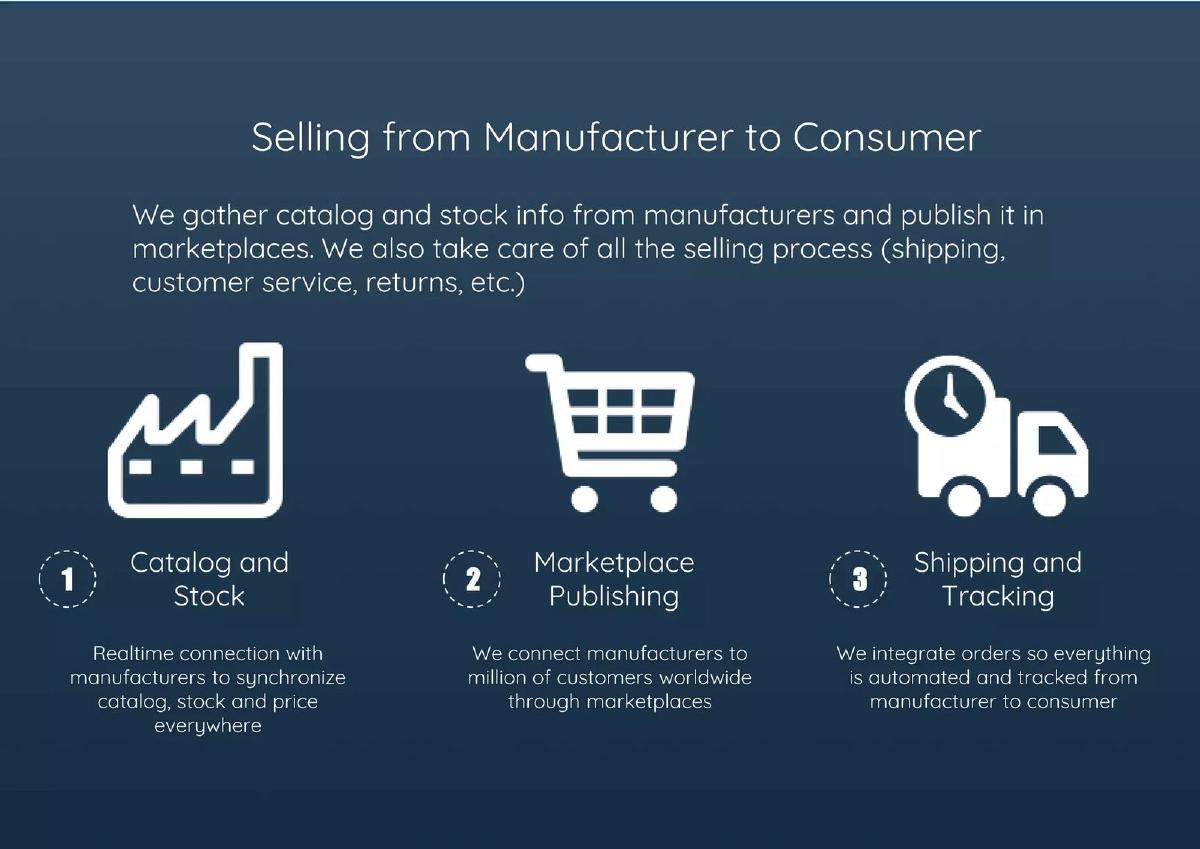
Connecting manufacturers to online marketplaces. Headline, one paragraph and three numbered steps.
QaShops deck, slide 4. Exact stored slide matched to this analysis.
Our analysis: Three steps in order show exactly what the manufacturer hands over: catalog and stock in, sales and shipping handled.
Evidence and limitation: "Million of customers"; no other figures.
What a founder can adapt: Number the steps you take off the merchant's plate, in the order they happen.
Supporting analysis
What the deck claims: "Selling from Manufacturer to Consumer." "We gather catalog and stock info from manufacturers and publish it in marketplaces. We also take care of all the selling process (shipping, customer service, returns, etc.)" "1 Catalog and Stock: Realtime connection with manufacturers to synchronize catalog, stock and price everywhere." "2 Marketplace Publishing: We connect manufacturers to million of customers worldwide through marketplaces." "3 Shipping and Tracking: We integrate orders so everything is automated and tracked from manufacturer to consumer."
Presentation choice: A numbered flow makes the scope of the service clear — this is not just a sync tool.
When it does not fit: Name the marketplaces on this slide and say what the manufacturer gains (time to list, new markets reached).
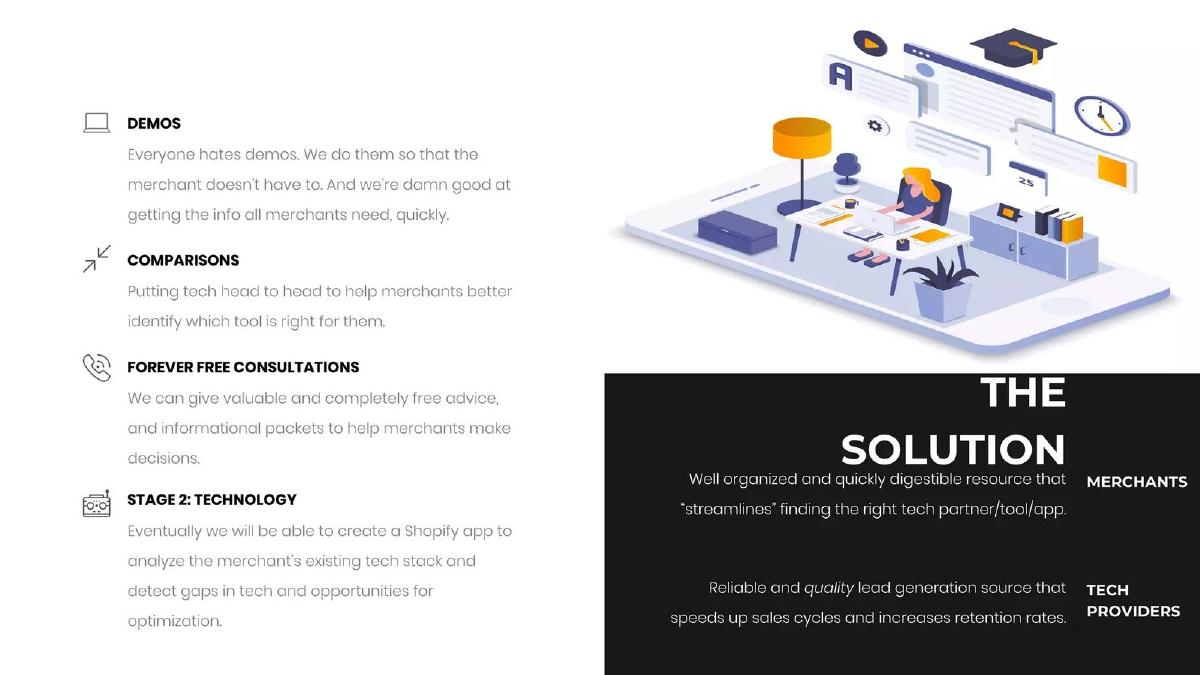
Resource matching online stores with software vendors. One line per side and four features. Partial.
Ecommerce Technology deck, slide 4. Exact stored slide matched to this analysis.
Our analysis: It answers both sides of its problem slide, but "resource" and "streamlines" don't say what the merchant does differently.
Evidence and limitation: No figures.
What a founder can adapt: Describe one merchant's path: from searching to a chosen tool, and how long it now takes.
Supporting analysis
What the deck claims: "The solution." Merchants: "Well organized and quickly digestible resource that 'streamlines' finding the right tech partner/tool/app." Tech providers: "Reliable and quality lead generation source that speeds up sales cycles and increases retention rates." Features: "Demos", "Comparisons", "Forever free consultations", "Stage 2: Technology" (a planned Shopify app).
Presentation choice: Kept as partial: the two-sided structure is right, the mechanism is thin.
When it does not fit: Small grey text; a future "Stage 2" belongs on the roadmap slide.
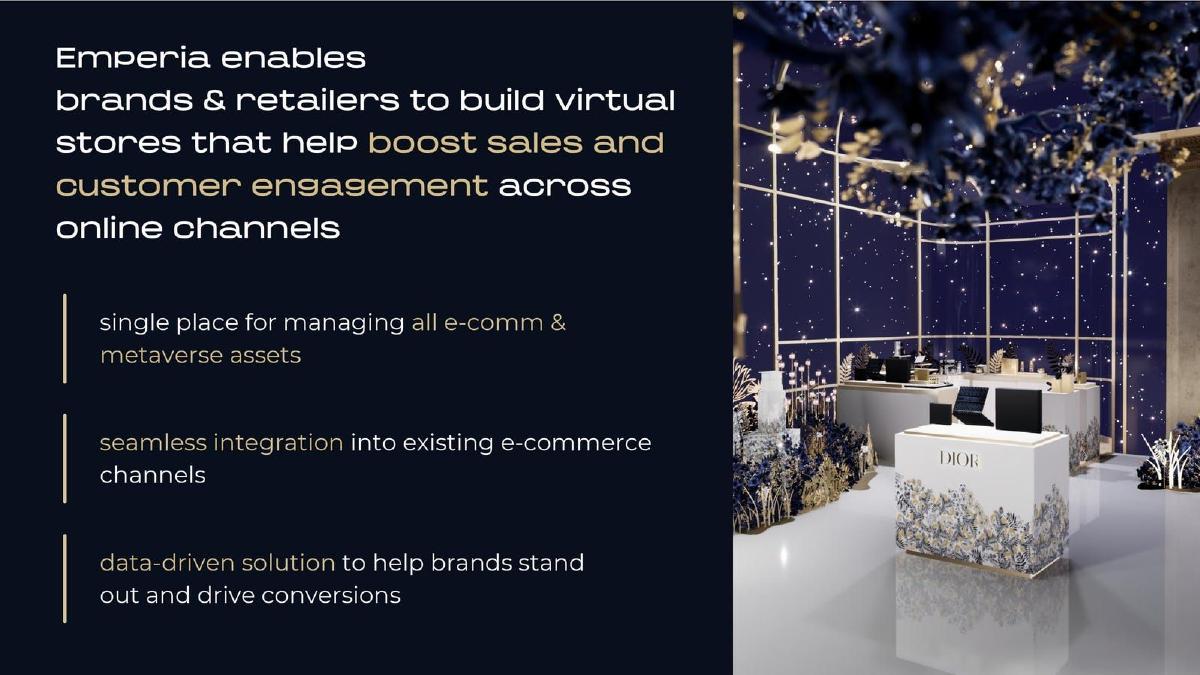
Virtual stores for brands and retailers. One statement, three benefits and a render of a virtual store. Partial.
Emperia deck, slide 5. Exact stored slide matched to this analysis.
Our analysis: It names the customer and shows the product, and says it fits existing channels, but the benefits are generic claims.
Evidence and limitation: No figures.
What a founder can adapt: Replace "boost sales" with one measured result from a store you built.
Supporting analysis
What the deck claims: "Emperia enables brands & retailers to build virtual stores that help boost sales and customer engagement across online channels." "Single place for managing all e-comm & metaverse assets." "Seamless integration into existing e-commerce channels." "Data-driven solution to help brands stand out and drive conversions."
Presentation choice: Kept as partial: the render makes the product concrete, the text could describe many tools.
When it does not fit: "Seamless" and "data-driven" add nothing; say which platforms it integrates with.
Online store for baby products. Three numbered lines beside a light-bulb illustration. Weak on purpose.
Kiddo deck, slide 3. Exact stored slide matched to this analysis.
Our analysis: Three intentions with no mechanism: nothing on how vendors are chosen, how delivery works or what "no time" means.
Evidence and limitation: No figures.
What a founder can adapt: Show the store and one number: brands stocked, delivery time in hours, or trips saved per month.
Supporting analysis
What the deck claims: "Solution." "01 Gather multi vendors in one trusted platform to ease the shopping." "02 Build that platform to allows the consumer to choose among the best brands online." "03 Deliver organized orders in no time without paying any extra time or effort."
Presentation choice: It shows the minimum an e-commerce solution slide needs: where it fits, what it removes, what changes.
When it does not fit: A light bulb says "idea", not "product"; lines 1 and 2 describe the same platform.
Whether each slide says where the product fits, what work it removes, and what result it promises.
Example
Where it fits
Work removed
Result stated
DRF (Pop Shop)
Yes (network of physical stores)
Yes (for brands and retailers)
Partly ("money's worth")
Calico
Yes (beside Shopify and Stripe)
Yes (supply chain setup)
Partly ("in mere minutes")
Fakespot
Yes (five named marketplaces)
Yes (vetting sellers and reviews)
Unmeasured
Honey
Yes (checkout)
Yes (finding coupon codes)
No
QaShops
Yes (marketplaces, 3 steps)
Yes (listing, shipping, returns)
No
Ecommerce Technology
Partly (a resource)
Partly
Unmeasured
Emperia
Partly (existing channels)
No
Unmeasured
Kiddo
No
No
No
Key Takeaways
Say where you plug in: checkout, store platform, marketplaces, fulfilment, the physical store.
Name the tools merchants already use (Shopify, Stripe, Amazon) and show you sit beside them, not instead of them.
Answer the problem slide line by line; if the problem had two sides, the solution needs two.
State the work removed or the result in the merchant's terms: minutes to launch, fewer bad purchases, sales lift.
Intentions ("gather", "build", "deliver") are not a solution until you show how.
Build your e-commerce solution slide
Where it plugs in, what it removes, what changes.
Plugs into. Which part of selling online: checkout, store platform, marketplaces, fulfilment, the physical store? Name the tools you sit beside.
Removes. Which task from your problem slide does the merchant or shopper no longer do?
Changes. What result, in the merchant's units: minutes to launch, sales lift, refunds or cancellations avoided?
Shows. Which screen or output makes it visible in one glance?
Copyable framework: [Product] plugs into [store platform / step] alongside [existing tools]. Merchants no longer [task]; [result with number]. (Source: [pilot or customer].)
Illustrative example 1 — written by us
Before: An all-in-one platform that makes selling online easy for merchants.
After: A Shopify app that syncs stock to Amazon and eBay every five minutes. Merchants stop updating three dashboards by hand; pilot stores cut cancelled orders from 4% to 0.5%. (Source: 12-store pilot.)
What improved: Our illustrative rewrite; the figures are invented for the example. It names where it plugs in, the task removed and a measured result.
What this guide adds
The e-commerce problem guide covers how these startups describe the loss. This guide covers the next slide: how they describe the fix. The consumer and marketplace solution guides cover products bought by individuals and two-sided platforms; this one covers tools and services around the online store — checkout, catalog syncing, supplier setup, showrooms, fraud checks and virtual stores.
Merchants already run a stack of tools. The first question an e-commerce investor asks of a solution slide is where it fits in that stack, and whether a merchant can switch it on without replacing what they have.
Three things an e-commerce solution slide proves
Where it fits: Calico's three logos, Fakespot's "integrates seamlessly with the leading eCommerce marketplaces", QaShops' three numbered steps from catalog to shipping.
What the user stops doing: Honey applies codes "automatically"; QaShops also takes care of "shipping, customer service, returns".
What changes: Calico's "in mere minutes", Fakespot's "saves money, time, and frustration". Only a few slides make the result measurable, and none prove it on this slide.
Common mistakes
Replacing the stack. Merchants rarely rip out Shopify or Stripe; show how you fit beside them.
Not answering the problem slide. If the problem named brands and retailers, the solution needs both.
Intentions instead of mechanism. "Gather", "build" and "deliver" say what you hope to do, not how.
Generic benefits. "Seamless", "data-driven" and "boost sales" fit any tool.
Relying on a video. The slide must work when the deck is read without the video.
Diagnostic checklist
It says where the product plugs in and names tools merchants already use.
It answers each point of the problem slide.
It names the task the merchant or shopper no longer does.
It states one result in the merchant's units.
It shows the product or its output, readable at slide size.
Frequently asked questions
How we chose these examples
Corpus: published pitch deck teardowns on StartupFundraising.com. Founder-uploaded private decks are excluded.
Selection (2026-09-25): we searched slides 3–6 for solution slides mentioning e-commerce, merchants, online stores, Shopify, retailers or brands. Ten stored images were inspected. DRF slide 4 was set aside because slide 3 states the solution and slide 4 describes the campaign steps; Popping slide 3 was set aside because it serves market stalls rather than online selling; payment decks (Dash, dLocal, Coinleap, Digitzs, Fluid) were left out as fintech. Ecommerce Technology and Emperia are marked partial; Kiddo is kept as a weaker contrast.
Overlap check: none of these eight slides appears in another guide. Fakespot's slide 5 appears in the consumer team guide and Honey's slide 6 in the marketplace business model guide; this guide uses Fakespot slide 3 and Honey slide 3. The e-commerce problem guide uses the problem slides of Honey, DRF, QaShops, Ecommerce Technology and Kiddo; this guide uses their solution slides so readers can compare the pair.
Review: all eight stored slide images were inspected on 2026-09-25 and matched to company, deck and slide number (editorial model review). No person has yet completed an editorial review of this page.
Claims are as shown on the slides; we have not verified them. We make no claim that any slide caused a fundraising outcome.