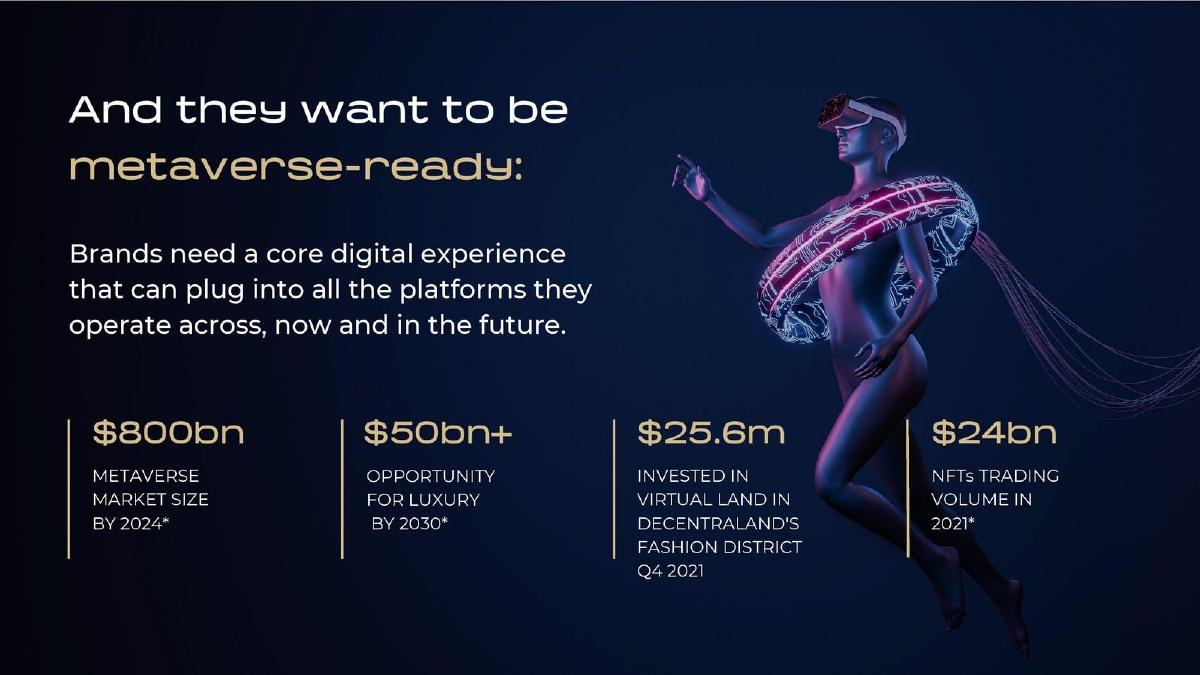
Emperia’s 11-slide deck (of which 6 are analyzed here) serves as a masterclass in visual storytelling for a high-aesthetic industry. By positioning their virtual store platform as 'E-commerce 3.0,' the company moves away from the 'metaverse' hype and toward tangible ROI. The deck highlights a significant jump from a sub-2-minute average engagement time in traditional e-commerce to a 14-minute average on their platform. With $4.7M in total sales processed through the platform at the time of the deck's creation, Emperia successfully bridged the gap between immersive 3D technology and practical…
Key takeaways
- The deck defines the problem as a lack of differentiation in a crowded market where engagement times are under 2 minutes (Slide 2).
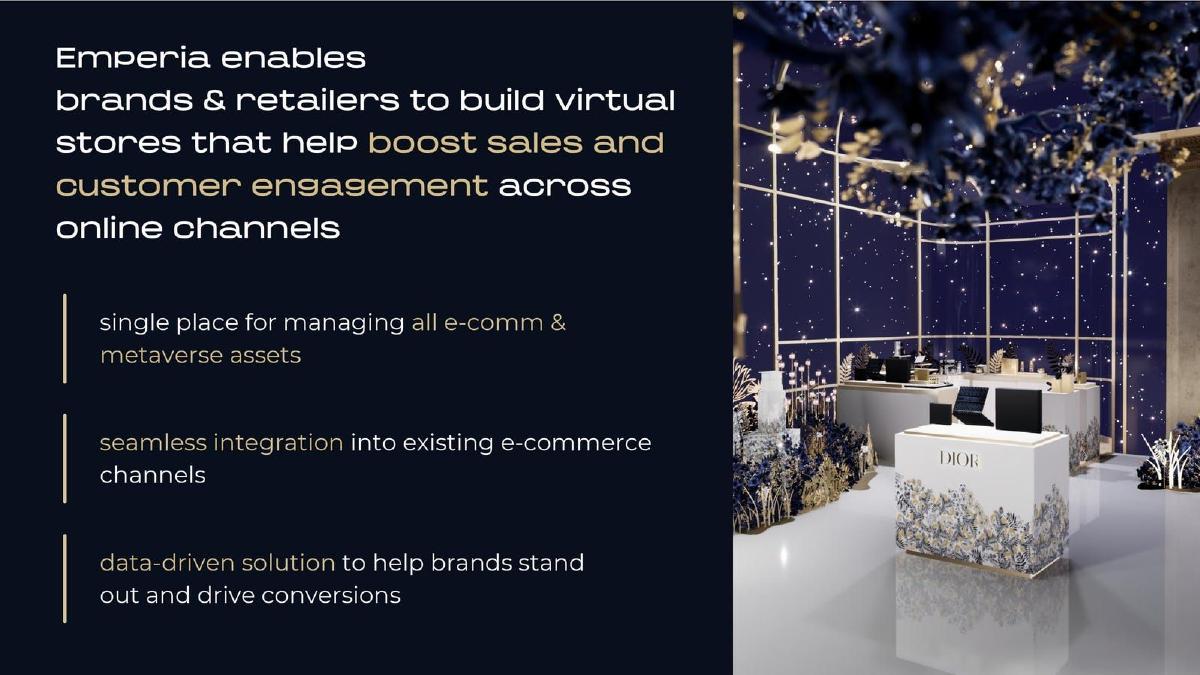
- Emperia positions itself as a 'single place' for managing both e-commerce and metaverse assets, emphasizing integration over replacement (Slide 3).
- Visual social proof is used heavily, featuring a virtual Dior storefront to signal high-market positioning (Slide 3).
- The product workflow is simplified into three steps: Create, Add Products, and Publish, emphasizing a 'no downloads required' accessibility (Slide 4).
- Platform performance is anchored by a 14-minute average engagement time, a massive increase over the industry baseline (Slide 5).
- The deck claims a 450% average ROI for brands using the platform (Slide 5).
- Total sales through the platform reached $4.7M, providing a concrete transaction-based metric for a VR-adjacent product (Slide 5).
- The deck omits a team slide, financial projections, and a specific 'Ask' or use of funds in the provided selection.
The Narrative: Moving from Utility to Experience
Emperia’s pitch deck is built on a single, powerful thesis: traditional e-commerce is failing to engage modern consumers. By labeling their solution 'E-commerce 3.0,' they distance themselves from the technical jargon of 'VR' or 'Metaverse' and instead focus on the evolution of retail. The deck is visually lush, mirroring the luxury brands they serve, and uses data to justify what could otherwise be seen as a 'nice-to-have' marketing gimmick.
Slide 1: Title and Positioning
The cover slide is minimalist, featuring the Emperia logo in a gold-on-black color scheme that screams 'luxury.' The subtitle, "Sales-boosting virtual stores for fashion, art & retail," is a critical piece of positioning. It doesn't say 'VR software' or '3D modeling.' It leads with the outcome (sales-boosting) and the specific verticals they serve. This immediately tells an investor that the company understands its niche and its value proposition.
Slide 2: The Problem – The Engagement Gap
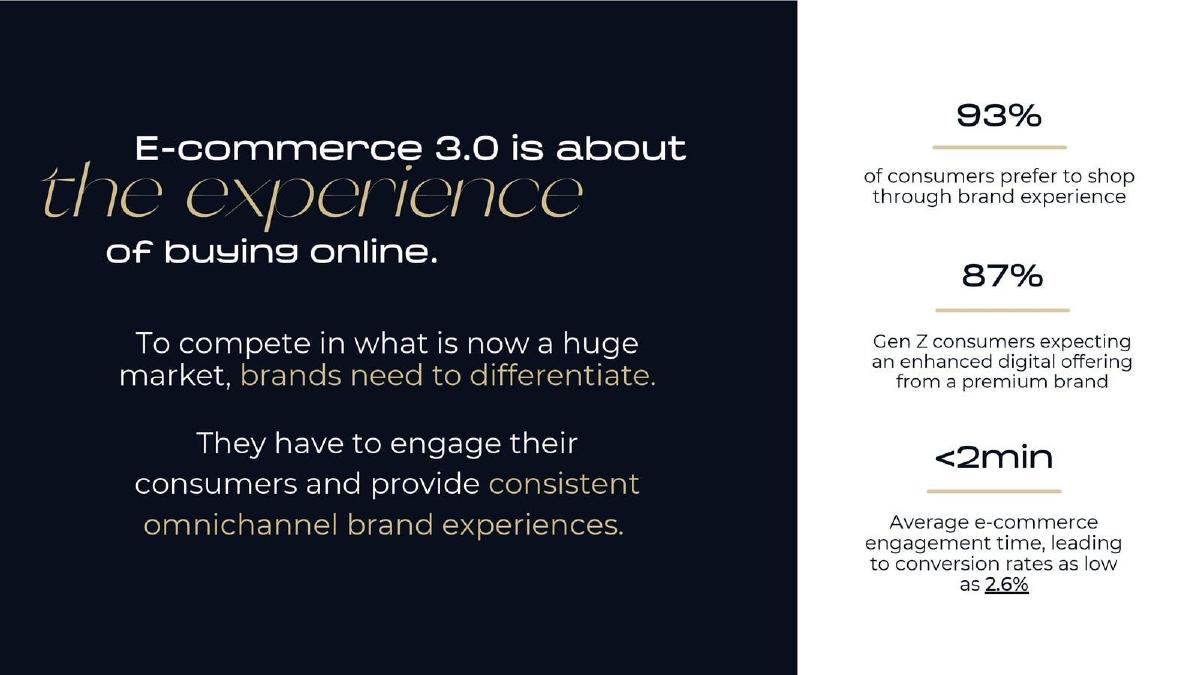
Slide 2 sets the stage by defining the current state of online shopping. It claims that "E-commerce 3.0 is about the experience of buying online." The slide presents three compelling statistics to build urgency: 93% of consumers prefer to shop through brand experience, and 87% of Gen Z consumers expect an enhanced digital offering from premium brands. The 'villain' of the story is introduced at the bottom: an average engagement time of <2min , which leads to conversion rates as low as 2.6% . This sets up a clear benchmark for Emperia to beat in the following slides.
Slide 3: The Solution – The Integrated Virtual Store
Slide 3 introduces Emperia as the enabler for brands to build virtual stores. It highlights three key features: a "single place for managing all e-comm & metaverse assets," "seamless integration," and a "data-driven solution." The right side of the slide is dominated by a high-quality render of a virtual Dior store. This is a powerful use of social proof. Even before the investor sees a traction slide, they see that a world-class luxury brand is already using the technology. It validates the aesthetic quality of the platform, which is the biggest hurdle for luxury brands entering the digital space.
Slide 4: The Product – Simplicity and Accessibility
One of the biggest fears investors have regarding VR/3D tech is friction—the need for headsets or heavy downloads. Slide 4 addresses this head-on. It breaks the process down into three steps: 1. Create a virtual space (using templates or unique 3D copies), 2. Add products (connecting to existing check-out systems), and 3. Publish on any device . The note "no downloads required" is perhaps the most important text on this slide. It confirms that the product is web-based and accessible to anyone with a browser, significantly expanding the potential user base.
Slide 5: Traction and ROI
This is the 'money slide.' Emperia returns to the metrics introduced on Slide 2 to show how they solve the engagement problem. The results are stark: an 14 min average engagement time (a 7x increase over the 2-minute industry average cited earlier) and a +73% conversion rate increase. They also claim an 450% average ROI and $4.7m in total sales through the platform. By showing that people are actually buying products inside these virtual environments, Emperia proves that their platform is a sales channel, not just a PR stunt. The inclusion of a dashboard screenshot on a Mac monitor reinforces the 'SaaS' nature of the business.
Slide 6: Closing and Contact
The final slide in this selection is a 'Thank You' slide featuring a virtual display for Dom Pérignon (Lady Gaga edition). It includes a direct contact email for 'Olga,' likely one of the founders. While it serves its purpose, it misses an opportunity to reiterate the 'Ask' or the vision for the Series A round.
What Emperia Does Exceptionally Well
Metric Anchoring: The deck uses a 'before and after' narrative with its data. By stating the industry standard for engagement is under 2 minutes on Slide 2 and then showing their own 14-minute average on Slide 5, they create a clear, quantifiable reason for a brand to switch to their platform.
High-End Social Proof: The use of Dior and Dom Pérignon imagery is not accidental. In the world of luxury retail, brands follow the leaders. Showing that they can meet the exacting aesthetic standards of LVMH-tier brands is a stronger argument than any technical specification list.
Friction Reduction: The deck proactively answers the 'how do people use this?' question by emphasizing cross-device compatibility and the lack of downloads. This moves the product from a 'niche VR tool' to a 'broad e-commerce upgrade.'
What is Missing from the Deck
The Team: In the 11-slide sequence, the absence of a team slide in this selection is a major gap. For a Series A, investors need to know why this specific team is qualified to build for the luxury sector. Do they have backgrounds in 3D gaming, retail, or SaaS?
Market Size (TAM): While the deck mentions a "huge market," it never quantifies it. Investors want to see the Total Addressable Market for virtual retail software. Is this a $100M niche or a $10B shift in how all goods are sold online?
Competition: The deck operates as if Emperia is the only player in the space. Acknowledging competitors like Obsess or Matterport and explaining Emperia's specific advantages (e.g., better e-commerce integration or higher fidelity) would strengthen the case.
The Ask: The publisher reports a $10M raise, but the deck doesn't specify how that capital will be deployed. Will it go toward R&D, sales team expansion in the US, or building out more templates?
Founder's Playbook: What to Copy
Use 'Outcome-First' Language: Emperia doesn't sell '3D rendering.' They sell 'Sales-boosting virtual stores.' Founders should always frame their technology in terms of the business result it delivers for the customer.
Visual Consistency: If you are selling to a specific industry (like luxury retail), your deck must look like it belongs in that industry. Emperia’s use of dark backgrounds, gold accents, and high-fashion imagery makes the deck feel like a premium product itself.
Bridge the Gap: If your product is 'futuristic' (like the metaverse), anchor it in 'now' metrics. Emperia uses standard e-commerce KPIs—conversion rates, engagement time, and total sales—to make a futuristic concept feel grounded and investable.
Frequently asked questions
- What is the primary value proposition Emperia offers to retailers?
- Emperia offers a SaaS platform that allows brands to build immersive 3D virtual stores. The goal is to increase customer engagement time and conversion rates by providing a 'brand experience' rather than a flat, transactional website. According to Slide 5, this results in a 14-minute average engagement time and a 73% increase in conversion rates.
- How does Emperia handle the technical barrier of Virtual Reality?
- The platform emphasizes accessibility. Slide 4 explicitly states that their virtual stores require 'no downloads' and can run stand-alone or integrated into existing websites. They support multiple devices, including mobile, desktop, and VR headsets, ensuring that the 'metaverse' experience doesn't exclude users without specialized hardware.
- What metrics does Emperia use to prove product-market fit?
- Emperia relies on four key 'ROI-driven' metrics shown on Slide 5: a 14-minute average engagement time, a 73% conversion rate increase, a 450% average ROI, and $4.7M in total sales processed through the platform. These figures directly address the skepticism often associated with virtual retail by showing real-world spending.
- Which industries is Emperia targeting?
- The deck specifically targets 'fashion, art & retail' (Slide 1). The visual examples throughout the deck feature premium and luxury brands, such as Dior (Slide 3) and Dom Pérignon (Slide 6), suggesting a focus on high-margin sectors where brand storytelling is critical to the sales process.
- What are the most notable omissions in this pitch deck?
- The provided 11-slide deck is missing several standard venture components, including a Team slide, a Competitor landscape, and a clear 'Ask' slide detailing how the $10M will be spent. While the narrative is strong on product and traction, the lack of founder background and market sizing (TAM/SAM/SOM) is a notable gap in this specific selection.