Embat’s Series A deck is a lean, 14-slide presentation that prioritizes traction and product utility over abstract vision. By highlighting '+20bn Euros' flowing through their platform annually (Slide 2) and showcasing a robust client list including Cabify and Wallapop (Slide 7), the company establishes immediate credibility. The deck effectively bridges the gap between complex banking infrastructure and user-friendly SaaS by using 3D diagrams to explain their connectivity between banks and ERP systems. While it lacks a dedicated team slide or explicit financial projections in the public versi…
Key takeaways
- The deck leads with massive scale, citing +20bn Euros in annual flow and 3M transactions per year on Slide 2.
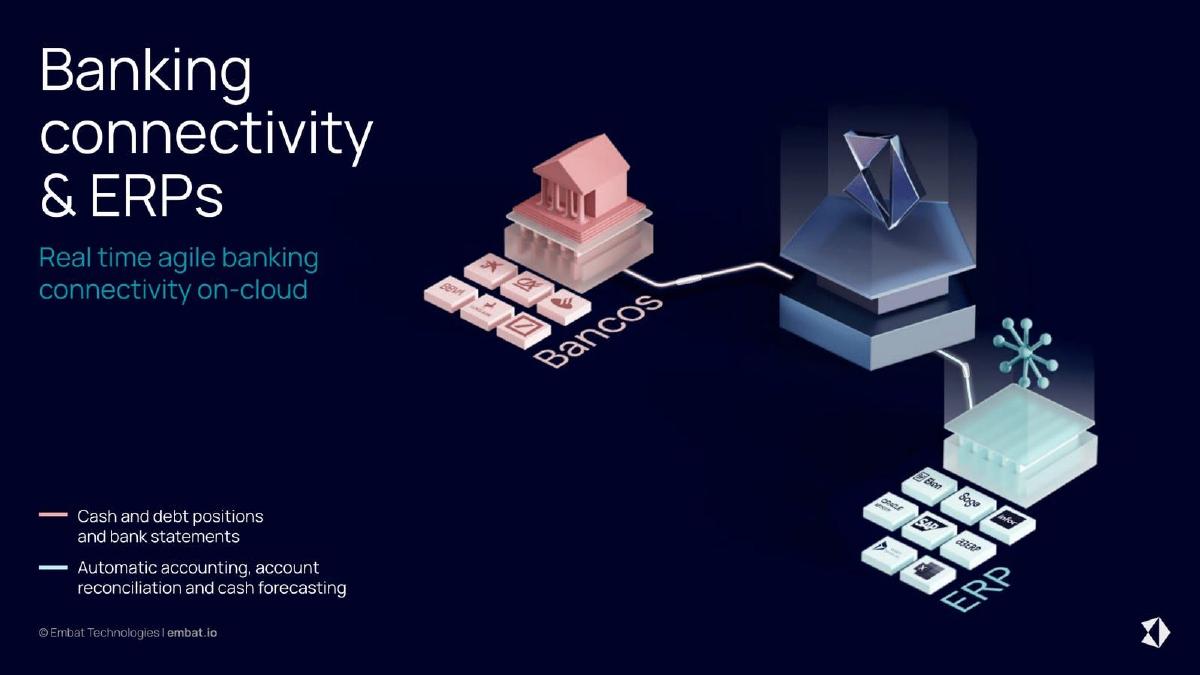
- Embat positions itself as the bridge between 'Bancos' (banks) and 'ERP' systems through real-time cloud connectivity on Slide 3.
- Product screenshots are used on Slides 4 and 5 to demonstrate the 'Treasury analytics' and 'Automated accounting' interfaces.
- The problem statement is integrated directly into feature slides, highlighting 'Poor visibility of cash' and 'Time wasted on manual processes' (Slide 4).
- Traction is validated by a logo wall of over 40 companies, including notable Spanish tech firms like Cabify and Wallapop on Slide 7.
- The value proposition is distilled into three core benefits: saving time, improving quality of life, and avoiding human error (Slide 6).
- The deck emphasizes AI-driven automation for treasury accounting and bank reconciliation on Slide 5.
- Business Insider reports the company raised $16M in 2024, confirming the effectiveness of this traction-first narrative.
The New Era of Corporate Treasury: An Analysis of Embat's Series A Deck
Embat’s pitch deck is a clinical example of how to present a fintech solution to sophisticated investors. Rather than spending time on the 'why' of the market, it dives straight into the 'what' and 'how much.' As reported by Business Insider, the company raised $16M in 2024 to expand its cloud-based treasury management products. The deck reflects a company that has moved past the experimental phase and is now focused on scaling a proven utility. With a headquarters in Europe and a focus on medium-to-large businesses, the deck emphasizes reliability, connectivity, and massive volume.
Slide 1: Title Slide
The deck opens with a minimalist title slide featuring the tagline: 'The new era of corporate treasury.' The branding is dark, professional, and tech-forward, utilizing a 3D render of a glass-like surface. This sets a tone of modern enterprise software rather than a scrappy consumer startup. The inclusion of the URL 'embat.io' and the copyright 'Embat Technologies' establishes the formal corporate identity immediately.
Slide 2: Embat in Numbers
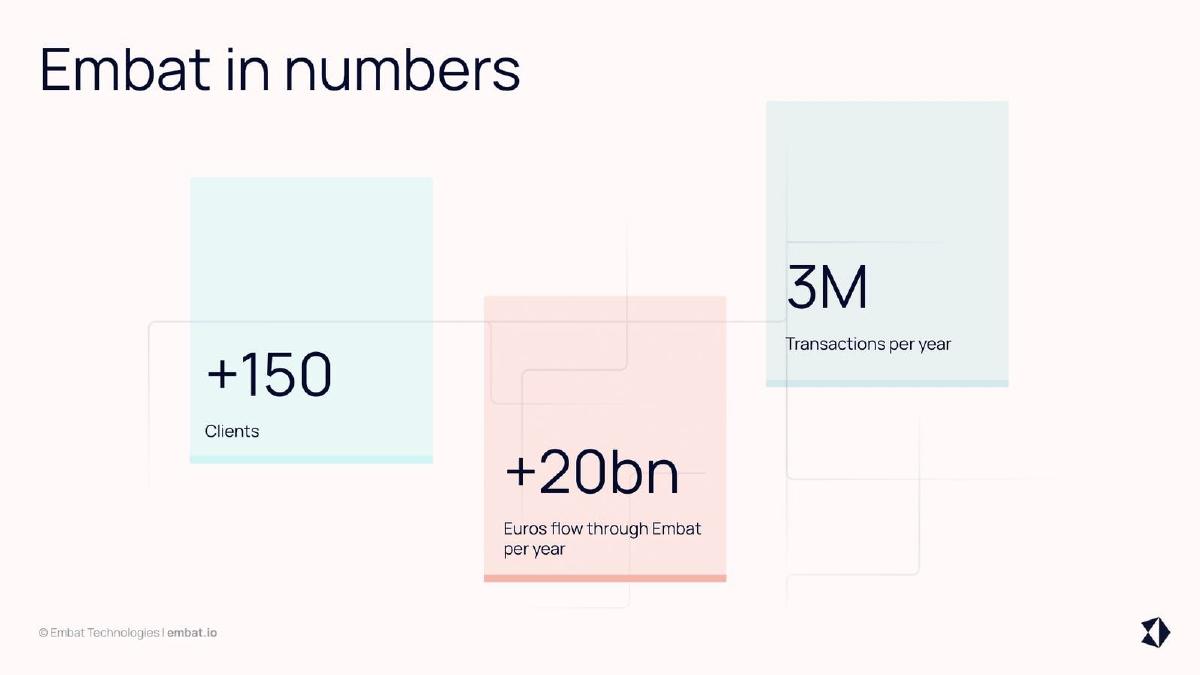
This is arguably the most important slide in the deck. Instead of leading with a problem statement, Embat leads with proof. They list three critical metrics: '+150 Clients,' '+20bn Euros flow through Embat per year,' and '3M Transactions per year.' By placing these figures on Slide 2, the founders immediately de-risk the investment. A platform handling 20 billion Euros is no longer a 'project'; it is critical infrastructure. The use of large, clear typography against pastel blocks makes the data the undisputed hero of the page.
Slide 3: Banking Connectivity & ERPs
Slide 3 addresses the technical 'moat' and utility of the product. It uses a 3D isometric diagram to show how Embat sits between 'Bancos' (banks) and 'ERP' (Enterprise Resource Planning) systems. The slide explicitly mentions 'Real time agile banking connectivity on-cloud.' By showing the logos of major ERPs like SAP, Oracle, and Sage, Embat communicates that it integrates seamlessly into the existing workflows of large corporations. The legend at the bottom left clarifies the data flow: cash and debt positions coming from banks, and automatic accounting and forecasting flowing into the ERP.
Slide 4: Treasury Analytics & Reporting
This slide introduces the first product screenshot, focusing on the user interface for treasury management. It follows a 'Problem vs. Functionality' structure. The problems listed include 'Poor visibility of cash and debt positions' and 'Complexity in categorising bank movements.' The functionalities listed as solutions include 'Real time control of cash and debt positions,' 'Customised bank pool reports,' and 'Notifications and alerts of overdrawn positions.' The screenshot itself shows a clean, tabular view of cash flow ('Tesoreria'), reinforcing the 'real-time' claim made in the text.
Slide 5: Automated Accounting & Reconciliation
Continuing the product deep-dive, Slide 5 focuses on the back-office automation. The problem stated is 'Multiple banking and payment platforms with data that is not uniform,' which leads to accounting errors and delays. The solution offered is 'Automated treasury accounting by means of rules and artificial intelligence.' The screenshot on this slide shows a ledger-style view with specific transaction lines, dates, and amounts, demonstrating that the software can handle the granular detail required for professional accounting. This slide targets the CFO’s pain point: the month-end close.
Slide 6: Benefits
Slide 6 distills the value proposition into three high-level buckets: Time, Quality, and Errors. It promises to 'Save your team’s time,' 'Improve your team’s quality of life,' and 'Avoid human error.' While these are standard SaaS promises, in the context of the previous slides showing 20 billion Euros in volume, the 'Avoid human error' claim carries significant weight. The design remains consistent, using three simple boxes to categorize the impact of the software.
Slide 7: They Trust Us
The final slide in the provided sequence is a massive social proof engine. It features over 40 logos of companies that use Embat. Notable names include Cabify, Wallapop, and Cooltra. The diversity of the logos—ranging from hospitality (JS Hotels) to construction (Grupo Construcia) to modern tech—proves that the treasury problem is horizontal and affects every industry. This slide serves as the 'closing argument' for the company's market fit.
What Embat Does Well
The primary strength of this deck is its focus on scale . By leading with the 20 billion Euro figure, Embat shifts the conversation from 'will this work?' to 'how big can this get?' The deck is also visually superior to many fintech pitches; the use of 3D diagrams to explain complex data flows (Slide 3) is much more effective than a standard bulleted list. Furthermore, the integration of 'Problems' and 'Functionalities' on the same slides (4 and 5) allows the investor to see the solution in the context of the pain point immediately, rather than having to flip back to a 'Problem' slide at the beginning of the deck.
What is Missing from the Deck
Based on the 7 slides provided out of the 14-slide total, there are several standard venture capital components missing. There is no Team Slide , which is critical for a Series A raise where the pedigree of the founders (often ex-bankers in fintech) is a major selling point. There is also no Market Size (TAM/SAM/SOM) slide, though the traction slide implies a large market. Most notably, there is no Financial Projections or The Ask slide in this sequence. While these may be in the remaining 7 slides not shown, their absence here means the deck relies entirely on current traction rather than future roadmap or specific funding requirements.
What Founders Should Copy
Founders in the B2B SaaS or Fintech space should emulate Embat’s 'Traction First' approach. If you have impressive numbers, do not bury them on Slide 10; put them on Slide 2. Additionally, the way Embat visualizes their 'place' in the ecosystem on Slide 3 is a best practice. Investors need to know exactly where your software sits in a client's existing tech stack. By showing the logos of the banks on one side and the ERPs on the other, Embat makes their value as a 'connector' undeniable. Finally, the use of high-fidelity product screenshots that actually show data (rather than blurred-out mockups) builds trust that the product is mature and ready for enterprise deployment.
Frequently asked questions
- What is the core problem Embat solves?
- According to Slide 4 and Slide 5, Embat addresses the lack of visibility into cash and debt positions, the time wasted on manual treasury processes, and the errors inherent in non-uniform data across multiple banking and payment platforms. They solve this by automating the categorization of bank movements and providing real-time reporting.
- How much traction did Embat have at the time of their Series A?
- Slide 2 reports that Embat had over 150 clients, processed more than 3 million transactions per year, and saw over 20 billion Euros flow through their platform annually. This high volume of capital flow is a key indicator of their utility for large-scale corporate treasury departments.
- What integrations does the Embat platform support?
- Slide 3 illustrates connectivity between major banks (labeled as 'Bancos') and various ERP systems. The slide displays logos for major enterprise software providers including Oracle, SAP, Sage, Infor, and Microsoft Dynamics, positioning Embat as a central hub for financial data synchronization.
- What specific automation features does Embat highlight?
- Slide 5 focuses on 'Automated accounting & reconciliation.' The platform uses rules and artificial intelligence to handle treasury accounting, direct accounting entries for items like bank commissions and tax settlements, and automated settlements of documents to reduce the manual workload for finance teams.
- Who are Embat's notable customers?
- Slide 7 features a comprehensive logo wall of over 40 clients. High-profile companies listed include the ride-hailing giant Cabify, the marketplace Wallapop, and other recognizable brands like Vicio, Hoff, and Cooltra, demonstrating broad adoption across different sectors in the Spanish and European markets.