The elopage pitch deck is a masterclass in demonstrating product-market fit through historical resilience and clear market positioning. Founded in 2016 and profitable since 2018, the company used this 16-slide deck to secure a $38M Series A in August 2021. The narrative shifts from the 'Rise of a New Middle Class' in the creator economy to a technical solution that replaces a fragmented stack of six or more providers. With 40,000 digital entrepreneurs and over 3 million end customers already on the platform at the time of the deck, the data points to a validated, scalable engine. The deck eff…
Key takeaways
- The company achieved profitability in 2018, just two years after foundation, and maintained it through their 2021 fundraise (Slide 14).
- elopage positions itself as a 'synergy of SaaS and Fintech,' moving beyond simple EdTech into full commerce infrastructure (Slide 2).
- The platform claims to reduce the 'time to first sale' from 6 months to just 1 day by consolidating fragmented tools (Slide 9).
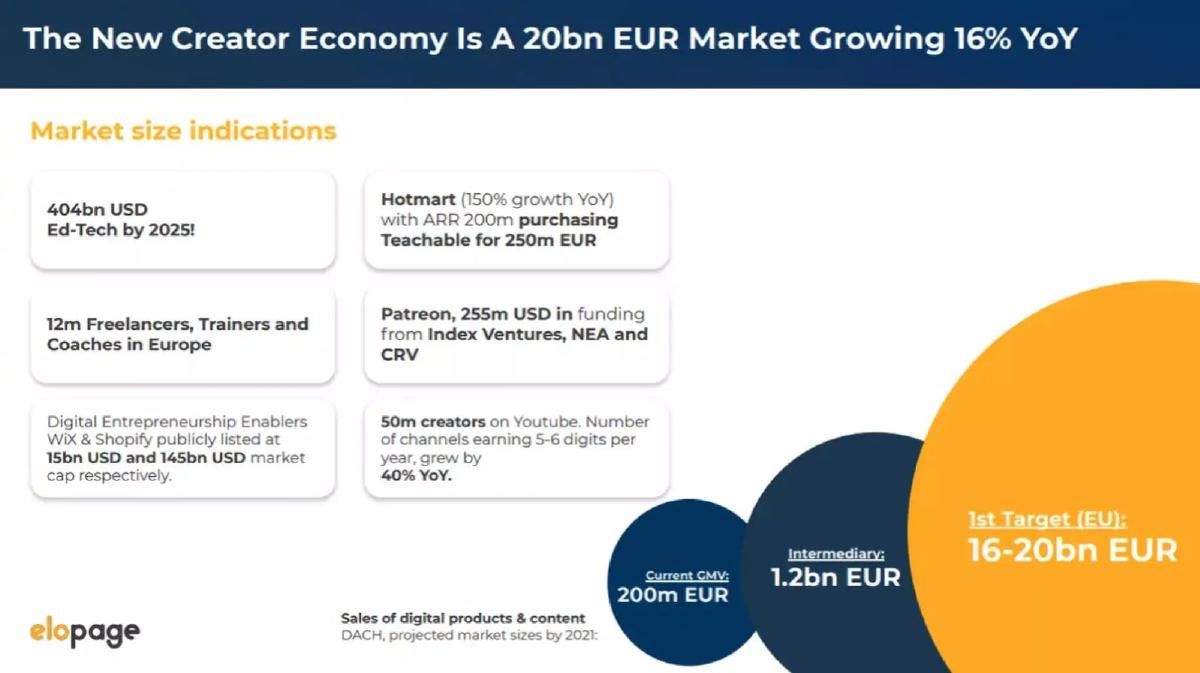
- Market sizing is calculated through a '1st Target (EU)' of 16-20bn EUR, supported by a current GMV of 200m EUR (Slide 6).
- The deck highlights a massive jump in headcount, growing from 70 employees to a projected 190 by the end of 2021 (Slide 14).
- Customer traction is significant, with over 40,000 entrepreneurs managing 130,000 digital products (Slide 7).
- The 'Before elopage' visual effectively illustrates the pain point of managing a minimum of 6 different software providers (Slide 9).
- The deck omits a specific 'Use of Funds' slide, though the Series A amount is stated as $38m in the summary (Slide 14).
Introduction: The Transition from Bootstrap to Venture
The elopage pitch deck from August 2021 represents a pivotal moment for the Berlin-based company. After five years of organic growth and three years of profitability, the founders sought to accelerate their international expansion with a $38 million Series A. This teardown examines how a company with significant existing traction uses a deck not to prove that their idea works, but to prove that it is ready for massive scale.
Slides 1-3: The Vision and Value Proposition
Slide 1 is a standard title slide featuring the logo and the tagline: "We empower entrepreneurs." It establishes the date as August 2021.
Slide 2 introduces the core thesis of the business: "The Powerful Synergy of SaaS and Fintech." This is a strategic positioning move. By labeling themselves as part Fintech, elopage justifies a higher valuation multiple than a pure-play EdTech or SaaS company might receive. The left side of the slide clarifies their target: digital products, courses, memberships, and subscriptions.
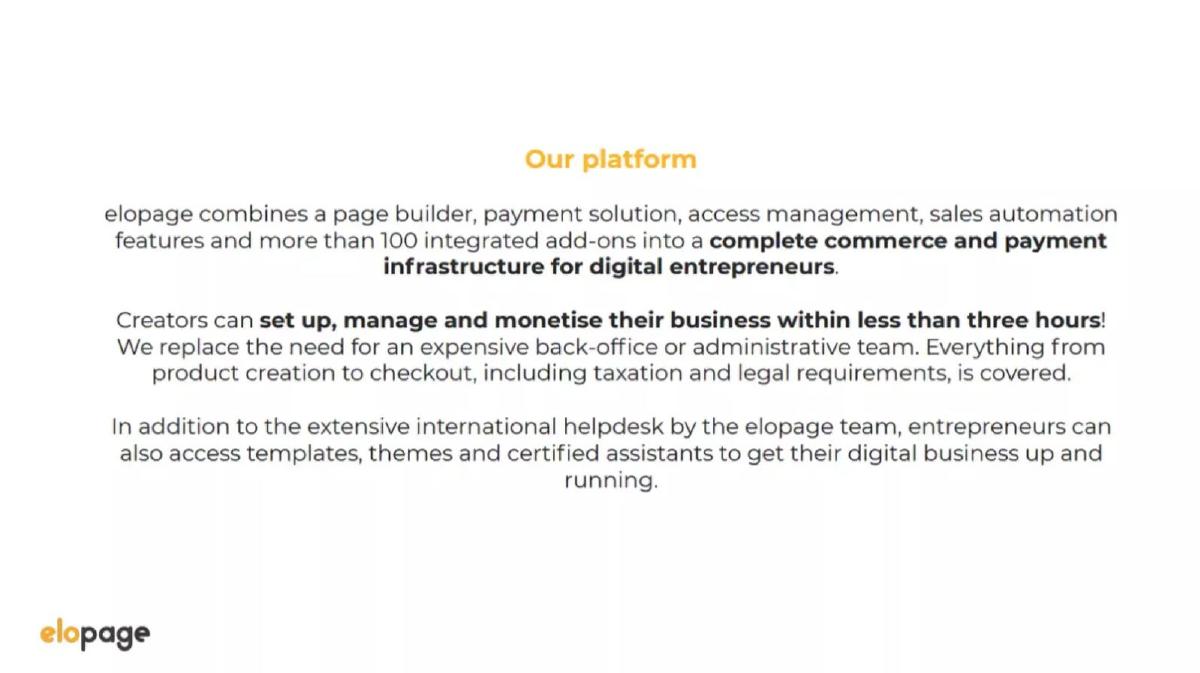
Slide 3 provides the first detailed look at the platform. It describes elopage as a "complete commerce and payment infrastructure." Key features listed include a page builder, payment solution, access management, and sales automation. The boldest claim here is that creators can set up and monetize their business in "less than three hours," replacing the need for an expensive back-office team.
Slides 4-6: Market Dynamics and Sizing
Slide 4 serves as a transition, titled "The Market: Rise Of a New Middle Class." This suggests that elopage isn't just chasing the top 1% of influencers, but a broader segment of professional service providers.
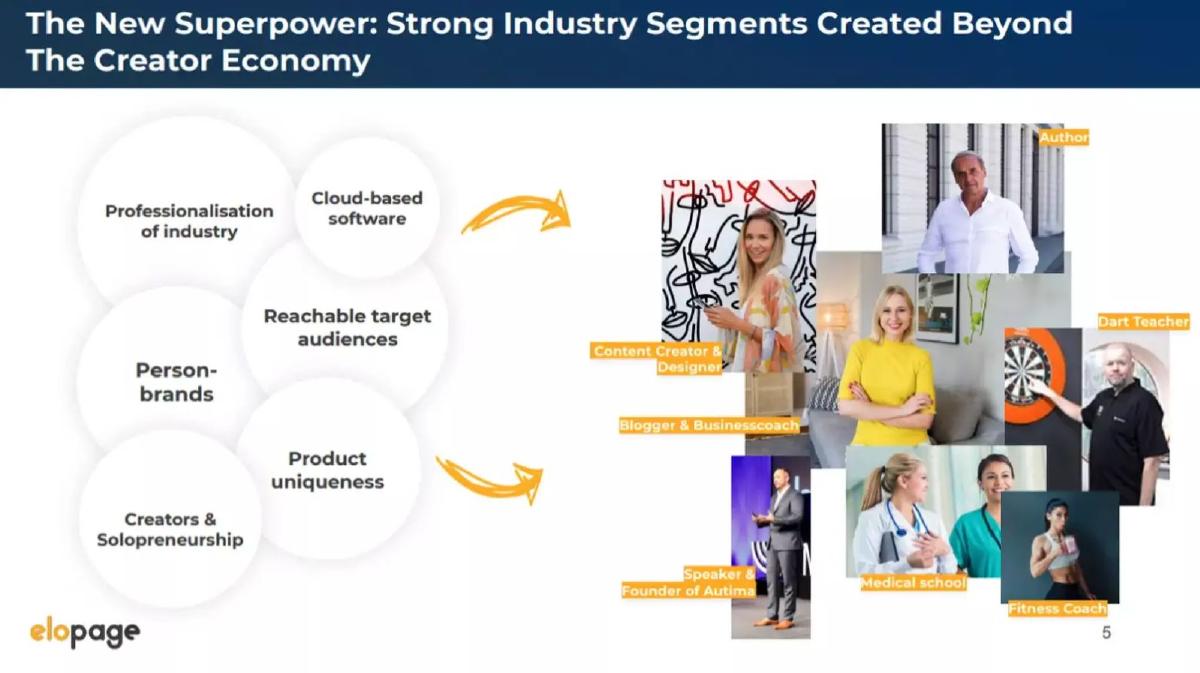
Slide 5 visualizes this "New Superpower." It lists drivers like the professionalization of the industry, person-brands, and cloud-based software. The right side of the slide features real-world examples of their users: a Content Creator & Designer, a Blogger & Businesscoach, a Speaker, a Fitness Coach, and even a Dart Teacher. This humanizes the data and shows the breadth of the platform's utility.
Slide 6 delivers the hard numbers. It identifies a 20bn EUR market growing at 16% YoY. To provide context, it lists industry benchmarks: a 404bn USD Ed-Tech market by 2025, 12m freelancers in Europe, and the success of peers like Hotmart (purchasing Teachable for 250m EUR) and Patreon ($255m in funding). The slide concludes with a "1st Target (EU)" of 16-20bn EUR, contrasted against their "Current GMV" of 200m EUR. This 200m figure is a critical proof point of their current scale.
Slide 7: Traction and Social Proof
Slide 7 focuses on "Our customers." It states that over 40,000 digital entrepreneurs trust the platform, managing 130,000 digital products. The slide includes logos of prominent German media brands like Sport1, Hubert Burda Media, and MacLife. This mix of high-volume solopreneurs and established enterprise publishers demonstrates the platform's versatility.
Slides 8-11: Product Depth and Competitive Advantage
Slide 8 is a simple transition slide: "The Product: Our Position to Become The Market Leader."
Slide 9 is perhaps the most effective slide in the deck. It uses a "Before elopage" vs. "elopage" comparison. The "Before" state shows a confused emoji surrounded by a web of at least six providers (Website builder, Billing software, Checkout provider, etc.). The "elopage" state shows a clean dashboard with a revenue graph showing 72,984.52€. The headline claim is a reduction in "time to first sale" from 6 months to 1 day.
Slide 10 breaks down the platform into four micro-service pillars: Payments & Billing, Access Management, Sales Automation, and Elopages (the builder). Below this, it mentions "100+ Apps & Add-ons," including integrations for Facebook, email, and CRM. This illustrates that while they are an all-in-one solution, they are not a closed ecosystem.
Slide 11 takes the competitive comparison further by listing the specific logos elopage replaces. It groups competitors into Website builders (Squarespace, Wix, WordPress), Checkout providers (Checkout.com, Clickbank), Marketing software (ActiveCampaign, Keap), Billing (Avalara, Taxfix), and Payment methods (Stripe, PayPal). By positioning themselves against this entire stack, elopage frames its pricing as a massive cost saving for the entrepreneur.
Slides 12-14: Company History and Milestones
Slide 12 marks the shift to the company's internal story: "Bootstrapped Until Today. Now ready to scale."
Slide 13 provides a chronological history. Founded in 2016, the company reached break-even in 2018. It shows a steady climb in headcount: 20 employees in 2019, 60 in 2020, and a projected 190 by the end of 2021. This trajectory signals that the business model is self-sustaining and that the capital injection is for acceleration, not survival.
Slide 14 is a "Quick facts" summary. It reiterates the most impressive metrics: $38m Series A, 40,000 entrepreneurs, >3 million customers in 2020, 25 localizations, and the crucial note: "2018 Profitability, ever since." This slide serves as the executive summary for the entire fundraise.
Slides 15-16: Team and Contact
Slide 15 introduces the founders: Özkan Akkilic (CEO) and Tolga Önal (CGO). Unlike many decks that include a full page of advisors and junior VPs, this deck keeps the focus on the two individuals who led the company through its bootstrapped phase. No prior company experience or educational background is listed on the slide, which is an unusual omission for a Series A deck, though their success with elopage likely spoke for itself.
Slide 16 is the contact slide with the company address in Berlin and the website URL.
What Works in This Deck
The Profitability Narrative: In a venture capital world often dominated by "growth at all costs," elopage's ability to highlight profitability since 2018 is a massive de-risking factor. It proves the unit economics work and that the founders are disciplined operators.
The 'Unbundling' Visual: Slide 9 and Slide 11 are highly effective. They don't just say they are an "all-in-one" solution; they show the specific, painful complexity of the alternative. By naming competitors like Stripe, Wix, and ActiveCampaign, they define exactly which budgets they are capturing.
Clear Market Segmentation: By identifying the "New Middle Class" of entrepreneurs, they avoid the trap of being seen as just another tool for influencers. They are positioning themselves as the infrastructure for the future of professional work.
What Is Missing
Use of Funds: The deck mentions the $38m Series A, but it never explicitly states how that money will be spent. Will it go toward R&D, international marketing, or acquisitions? Investors generally want to see a high-level allocation of the capital.
Detailed Unit Economics: While they mention GMV and profitability, the deck lacks standard SaaS metrics like Customer Acquisition Cost (CAC), Lifetime Value (LTV), or Churn rates. For a Series A, these are usually expected to prove the efficiency of the growth engine.
Team Depth: The team slide only features the two founders. For a company scaling to 190 employees, showing the "Second Layer" of management (CTO, Head of Sales, etc.) would provide confidence in the organizational structure.
What a Founder Should Copy
The 'Time to Value' Metric: elopage's claim of moving from "6 months to 1 day" for a first sale is a perfect example of a value-based metric. Founders should look for the one metric that defines the 'pain' they are removing and highlight it as clearly as elopage does on Slide 9.
The Synergy Play: If your startup sits at the intersection of two lucrative sectors (like SaaS and Fintech), call it out explicitly. It helps investors categorize you and understand your potential revenue streams (e.g., subscription fees plus transaction take-rates).
Historical Context: Use a timeline slide like Slide 13 to show resilience. If you have survived for several years and reached milestones on your own dime, that history is a competitive advantage that proves you won't waste venture capital.
Frequently asked questions
- What is elopage's core value proposition?
- elopage positions itself as an all-in-one infrastructure for digital entrepreneurs. According to Slide 3 and Slide 9, they replace the need for an expensive back-office by combining a page builder, payment solution, access management, and sales automation. Their primary claim is reducing the technical setup time for a digital business from six months to a single day.
- How does elopage define its market opportunity?
- The company looks beyond the traditional 'Creator Economy' to what they call a 'New Middle Class' of professionalized person-brands (Slide 4). They cite a 20bn EUR market growing at 16% YoY, specifically targeting 12 million freelancers, trainers, and coaches in Europe (Slide 6).
- What was elopage's financial status at the time of the Series A?
- Unusually for a Series A startup, elopage was already profitable. Slide 14 notes they reached profitability in 2018 and have maintained it 'ever since.' They operated as a bootstrapped entity from 2017 until the 2021 Series A round, which totaled $38 million.
- Who are elopage's typical customers?
- Slide 5 and Slide 7 show a range of customers from individual 'solopreneurs' (fitness coaches, dart teachers, authors) to large media brands like Sport1, Hubert Burda Media, and MacLife. They manage over 130,000 digital products for 40,000 entrepreneurs.
- What is missing from the elopage pitch deck?
- The deck lacks a detailed 'Use of Funds' breakdown, a traditional 'Competition' matrix (though they show logos they replace), and specific unit economics like CAC or LTV. It also omits a detailed roadmap of future product features, focusing instead on the existing '100+ Apps & Add-ons' (Slide 10).