Eloquent AI’s Seed deck is a masterclass in momentum-driven storytelling. By leading with a staggering traction metric—$500k ARR within four weeks of launch—the company immediately validates its market fit before explaining its technical architecture. The deck identifies a specific 'reliability gap' in general-purpose AI for financial services, positioning its proprietary Oratio LLMs as the solution for regulated workflows like KYC and AML. While the deck is notably missing a team slide, competition analysis, and a specific financial ask, the strength of the initial traction and the clarity o…
Key takeaways
- The deck leads with a high-impact traction slide, claiming $500k ARR just four weeks after product launch (Slide 2).
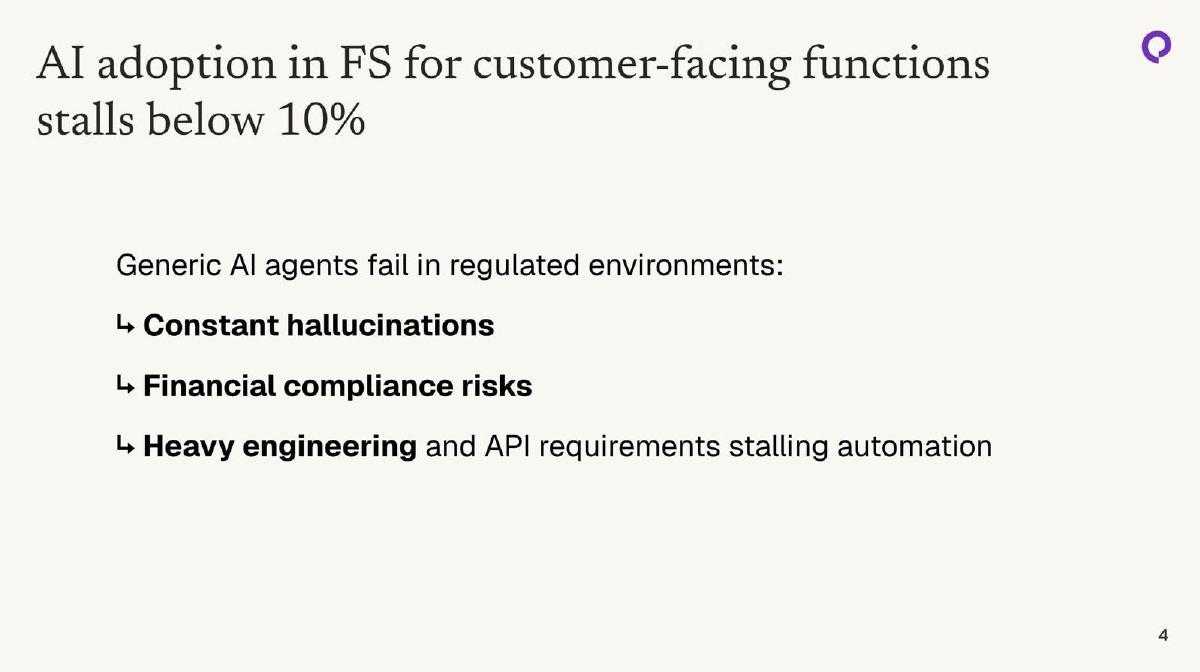
- It identifies a specific market failure: AI adoption in customer-facing financial services stalls below 10% due to compliance risks (Slide 4).
- The product offers a unique 'no-code' implementation where customers screen-record SOPs to generate workflows (Slide 7).
- Eloquent AI positions its proprietary 'Oratio' models as a technical moat, with specific versions for banking, insurance, and lending (Slide 8).
- The solution targets complex, regulated operations such as AML/KYC checks and account unblocking rather than just basic chat support (Slide 6).
- The deck cites a massive $1.05 trillion market opportunity, emphasizing the scale of financial services operations (Slide 9).
- There is a complete absence of a team slide, which is highly unusual for a $7.4M Seed round.
- The deck omits a 'The Ask' slide, failing to specify how much capital was being raised or the intended use of funds within the slides themselves.
Introduction: The Power of Immediate Traction
Eloquent AI’s pitch deck is a lean, 10-slide presentation that prioritizes speed and vertical specialization. In an era where 'AI for X' decks are ubiquitous, Eloquent AI differentiates itself by leading with a metric that is difficult for investors to ignore: $500k in Annual Recurring Revenue (ARR) achieved within just one month of launching. This teardown examines how the company used this momentum to secure a $7.4M Seed round in 2024, focusing on their strategy of replacing generic LLMs with domain-specific models for the highly regulated financial services sector.
Slide 1: The Vision Statement
The title slide is minimalist, featuring the company logo and the tagline: "The AI Operator for Financial Services." The use of the word 'Operator' is a deliberate choice. It suggests that the software does not just talk to customers; it performs actions. The date '2025' is prominently displayed at the bottom, likely indicating the forward-looking nature of the strategy or the fiscal year the deck was intended for.
Slide 2: The Hook – $500k ARR
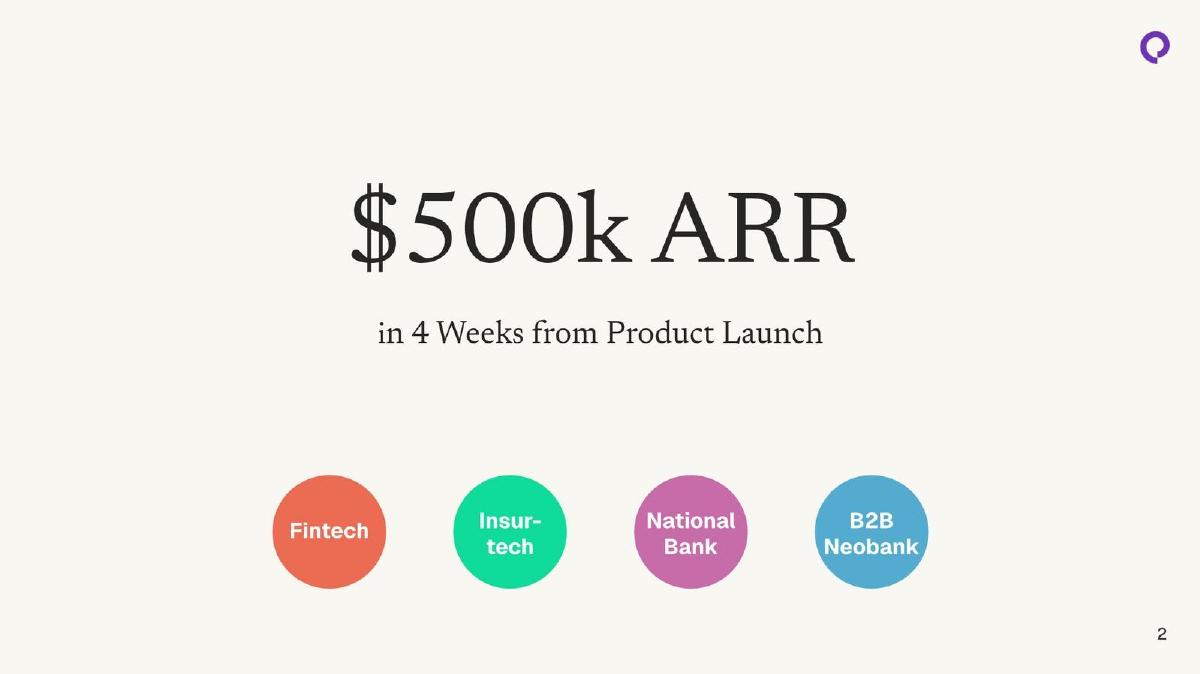
Slide 2 is arguably the most important slide in the deck. It contains very little text but delivers a massive impact: "$500k ARR in 4 Weeks from Product Launch." Below this, four circles represent their early customer segments: Fintech, Insurtech, National Bank, and B2B Neobank. By placing this slide immediately after the title, Eloquent AI bypasses the traditional 'problem' setup to first establish that they have already found product-market fit. For a Seed round, this level of velocity is exceptional and serves to de-risk the technical claims that follow.
Slide 3: The Reliability Gap
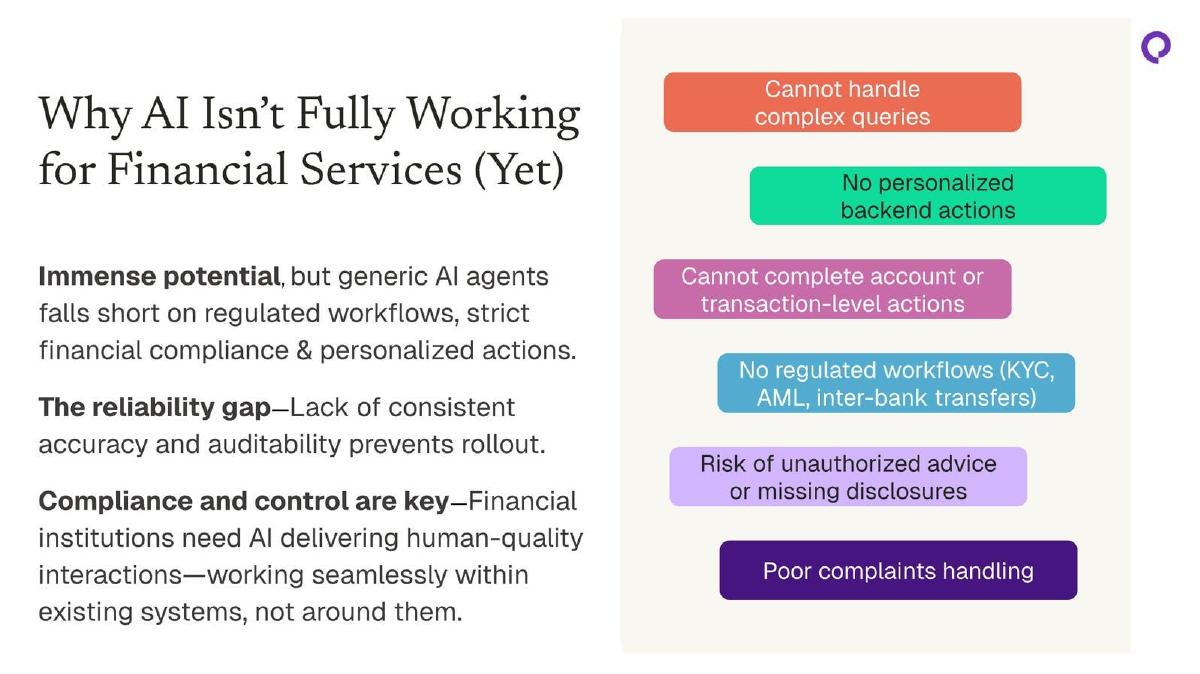
Having established that the product sells, Slide 3 explains why it is necessary. Titled "Why AI Isn't Fully Working for Financial Services (Yet)," it identifies the 'reliability gap.' The slide lists several pain points for generic AI: inability to handle complex queries, lack of personalized backend actions, and the risk of unauthorized advice or missing disclosures. It emphasizes that financial institutions need 'human-quality interactions' that work within existing systems, not around them. This sets the stage for a solution that is deeply integrated rather than a superficial chatbot layer.
Slide 4: The Adoption Stagnation
Slide 4 provides a data point to support the problem: "AI adoption in FS for customer-facing functions stalls below 10%." It attributes this to three factors: constant hallucinations, financial compliance risks, and heavy engineering/API requirements. This last point—the engineering burden—is a key setup for their 'no-code' solution introduced later in the deck. By quantifying the failure of generic agents, Eloquent AI creates a specific 'why now' for a specialized alternative.
Slide 5: The Solution Introduction
Slide 5 is a simple transition slide: "Introducing Eloquent AI: An AI team member built for financial customer operations." The phrasing 'AI team member' reinforces the 'Operator' theme from Slide 1, positioning the software as a digital employee rather than a tool.
Slide 6: Beyond Frontline Support
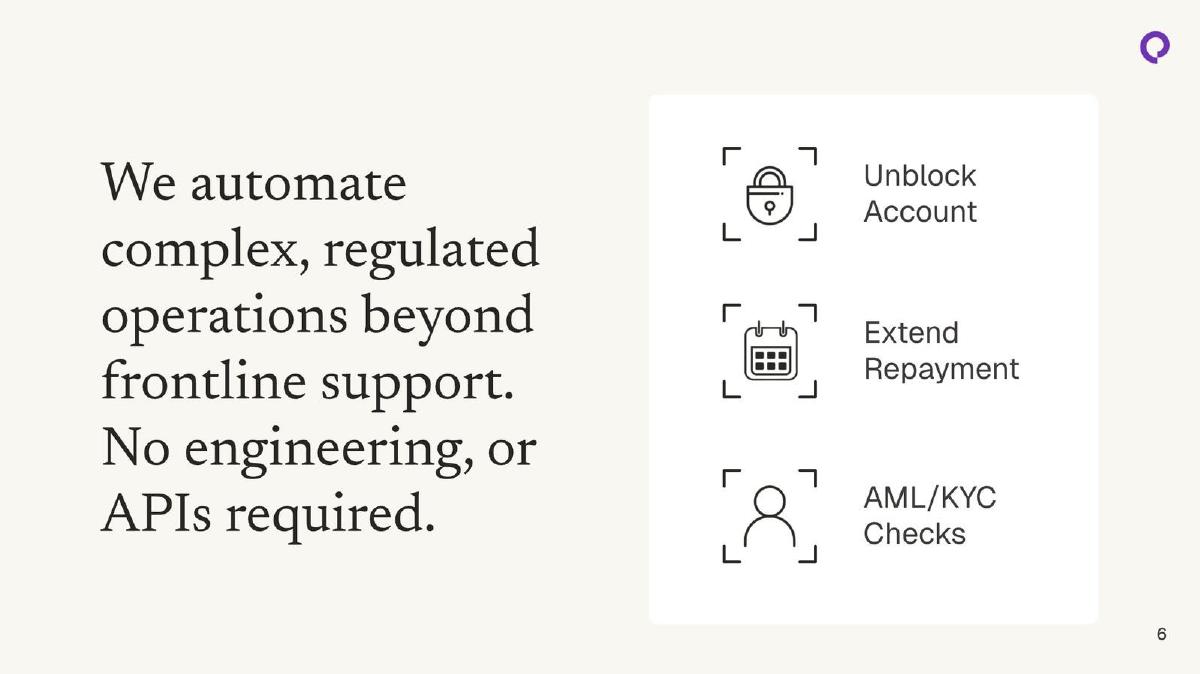
Slide 6 defines the product's scope. It states, "We automate complex, regulated operations beyond frontline support. No engineering, or APIs required." The slide features icons for three specific use cases: Unblock Account, Extend Repayment, and AML/KYC Checks. This is a critical distinction; while many AI startups focus on answering FAQs, Eloquent AI is targeting high-stakes, regulated processes that usually require human oversight and manual data entry.
Slide 7: The 'Magic' – Screen-Recorded SOPs
Slide 7 explains the implementation process, which is a major selling point for legacy financial institutions. "Customers screen-record their SOPs, and we automatically generate workflows." The slide breaks this down into three pillars: Compliant (embedded regulations), Reliable (self-healing technology), and Turnkey (browser and computer-use powered by multimodal LLMs). The promise of 'instant deployment' via screen recording addresses the 'heavy engineering' barrier mentioned on Slide 4.
Slide 8: The Technical Moat – Oratio LLMs
Slide 8 introduces "Oratio LLMs: Our Proprietary Models Trained for Financial Services." This slide is designed to answer the 'why can't OpenAI do this?' question. It lists three advantages: Full Visibility & Control (access to model weights), Business-Focused Training (reward modeling and reinforcement learning), and Domain-Specific Advantage (outperforming generalist models). A sidebar shows the 'Domain-Specific Model Family,' including Oratio Banking, Insurance, Lending, Trading, and Payments. This suggests a platform play where the company can expand across the entire financial sector.
Slide 9: The Market Opportunity
Slide 9 presents the Total Addressable Market (TAM). It claims a "$1.05 Trillion Market Opportunity." While the slide does not provide a source or a breakdown for this figure, the sheer scale is intended to show that even a small percentage of the market represents a multi-billion dollar business. The headline calls it a 'vertically-specialized solution,' doubling down on the niche strategy.
Slide 10: Closing
The final slide is a simple logo slide with a video play button, likely leading to a product demo. In many modern decks, the demo is the 'closer' that proves the claims made in the previous nine slides.
What Works in This Deck
Traction First: Leading with $500k ARR in four weeks is a power move. It forces the investor to pay attention to the 'how' because the 'what' is already proven to be in demand. · Specificity of Use Cases: By naming AML/KYC and account unblocking, the founders show they understand the actual day-to-day pain points of a bank's operations team, not just the marketing department's desire for a chatbot. · Technical Moat Positioning: The 'Oratio' branding for their models creates a sense of proprietary intellectual property. Even if the models are fine-tuned versions of open-source architectures, the 'proprietary' framing is effective for venture capital fundraising. · Implementation Simplicity: The 'screen-record your SOP' pitch is a brilliant way to counter the objection that financial services integrations take years. It promises the speed of a consumer app with the security of an enterprise tool.
What Is Missing from This Deck
The Team Slide: This is the most glaring omission. In a $7.4M Seed round, the pedigree of the founders is usually a primary driver of the investment. The absence of their backgrounds, previous exits, or technical credentials is highly unusual. · The Ask: The deck never specifies how much money is being raised or what the milestones for the next 18 months are. While this information is often shared in the email body or the meeting, its absence in the deck makes the presentation feel like a teaser rather than a complete investment proposal. · Competition: There is no mention of other vertical AI competitors or legacy RPA (Robotic Process Automation) players like UiPath. Investors will inevitably ask how Eloquent AI defends against incumbents who are also adding LLM capabilities to their workflow tools. · Unit Economics: While the ARR is impressive, there is no mention of the cost to acquire these customers (CAC), the length of the sales cycle, or the gross margins associated with running proprietary LLMs at scale.
Founder Lessons: What to Copy
Use a 'Traction Hook': If you have revenue growth that looks like a vertical line, put it on Slide 2. Do not bury it at the end of the deck. Momentum is the best antidote to skepticism. · Define the 'Reliability Gap': If you are building in a regulated industry, explicitly state why general-purpose tools (like ChatGPT or Claude) are insufficient. Eloquent AI did this well by focusing on 'hallucinations' and 'auditability.' · Productize Your Implementation: One of the biggest hurdles in enterprise SaaS is the 'time to value.' By pitching a 'screen-record to automate' feature, Eloquent AI turns a boring implementation phase into a high-tech product feature. · Verticalize Your Branding: Instead of saying 'we fine-tune models,' they created the 'Oratio' brand. This makes the technology feel like a cohesive product rather than a service project.
Frequently asked questions
- How did Eloquent AI justify its technical moat?
- The company introduced 'Oratio LLMs,' a family of proprietary models trained specifically for financial services. Slide 8 claims these models provide 'full visibility and control' through direct access to model weights and outperform generalist models on specialized tasks like banking, lending, and trading.
- What is the primary user experience for implementing Eloquent AI?
- According to Slide 7, the implementation is 'turnkey.' Instead of complex API integrations or heavy engineering, customers simply screen-record their Standard Operating Procedures (SOPs). The platform then uses multimodal LLMs to automatically generate the corresponding automated workflows.
- What specific financial workflows does the platform automate?
- Slide 6 explicitly lists three high-value examples: unblocking accounts, extending repayment schedules, and performing AML/KYC (Anti-Money Laundering/Know Your Customer) checks. This moves the value proposition beyond simple frontline customer support into regulated back-office operations.
- Why does the deck claim generic AI is failing in fintech?
- Slides 3 and 4 argue that generic AI agents suffer from 'constant hallucinations' and a 'lack of consistent accuracy.' Because financial institutions require strict auditability and compliance, these generic tools fail to handle regulated workflows or personalized backend actions, leading to low adoption rates.
- Is there a breakdown of the $500k ARR mentioned in the deck?
- Slide 2 lists four customer categories—Fintech, Insurtech, National Bank, and B2B Neobank—but does not provide a specific breakdown of contract values or the number of customers. The slide focuses entirely on the speed of the revenue generation (4 weeks) rather than the composition of the deals.