ElWafeyat raised $100,000 in 2013 with a concise 7-slide deck targeting the 'death tech' space in the Middle East. The deck identifies a specific cultural and economic pain point: the high cost of newspaper obituaries in Egypt (averaging $1.5k per post) and the lack of digital tools for sending condolences. By positioning itself as a platform for obituaries, memorials, and funeral service facilitation, the company aimed to capture a market of 300 million Arabic speakers. While the deck is visually simple and lacks a formal 'Ask' slide or detailed financial projections, it effectively communic…
Key takeaways
- The platform is positioned as the first online platform for obituaries and memorials in its region (Slide 1).
- The problem is framed as a lack of tools for families to honor loved ones and for friends to send condolences (Slide 2).
- Traditional newspaper obituaries in Egypt are cited as costing an average of $1.5k per post (Slide 3).
- Only 1% of deaths in Egypt result in newspaper obituaries due to high costs and low penetration (Slide 3).
- The target market includes a wider Arabic-speaking population of 300 million people (Slide 3).
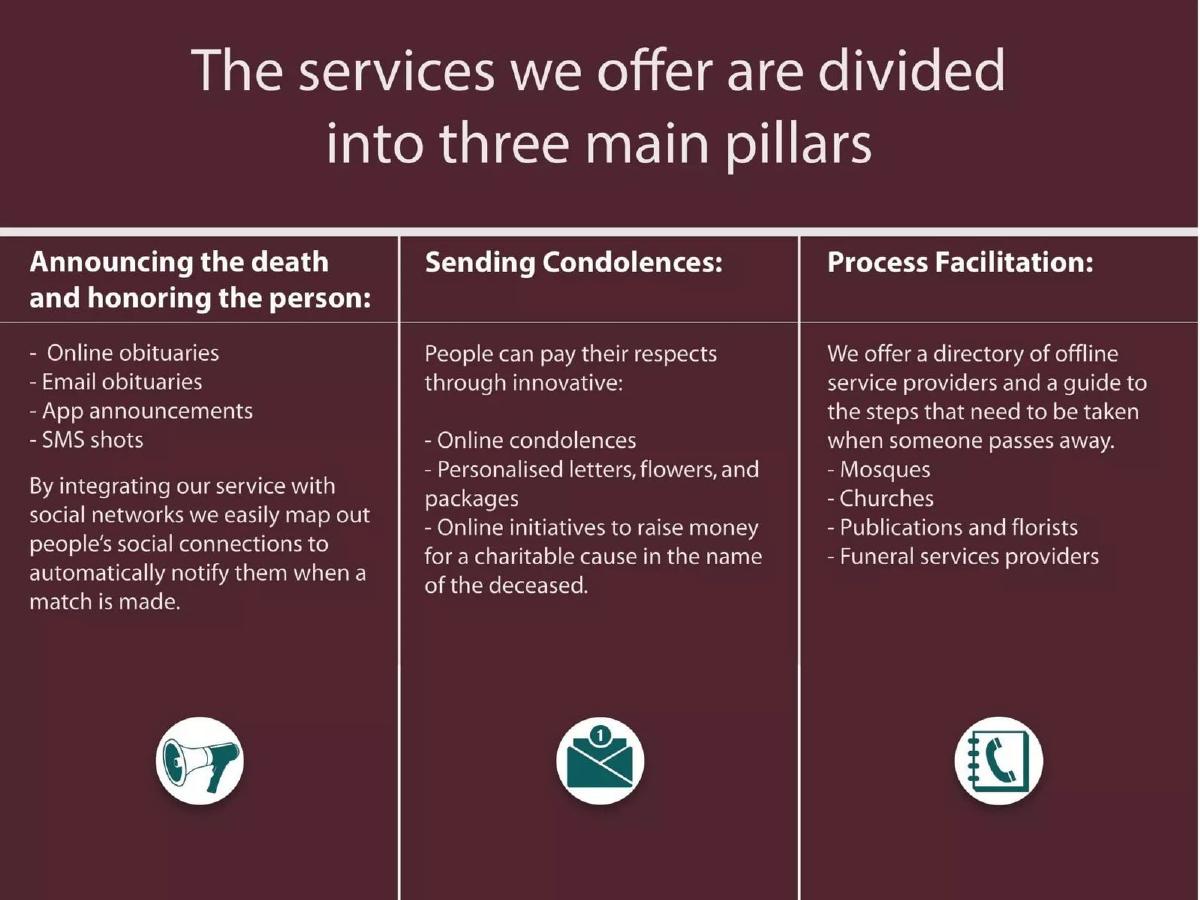
- The service model is built on three pillars: Announcing, Sending Condolences, and Process Facilitation (Slide 4).
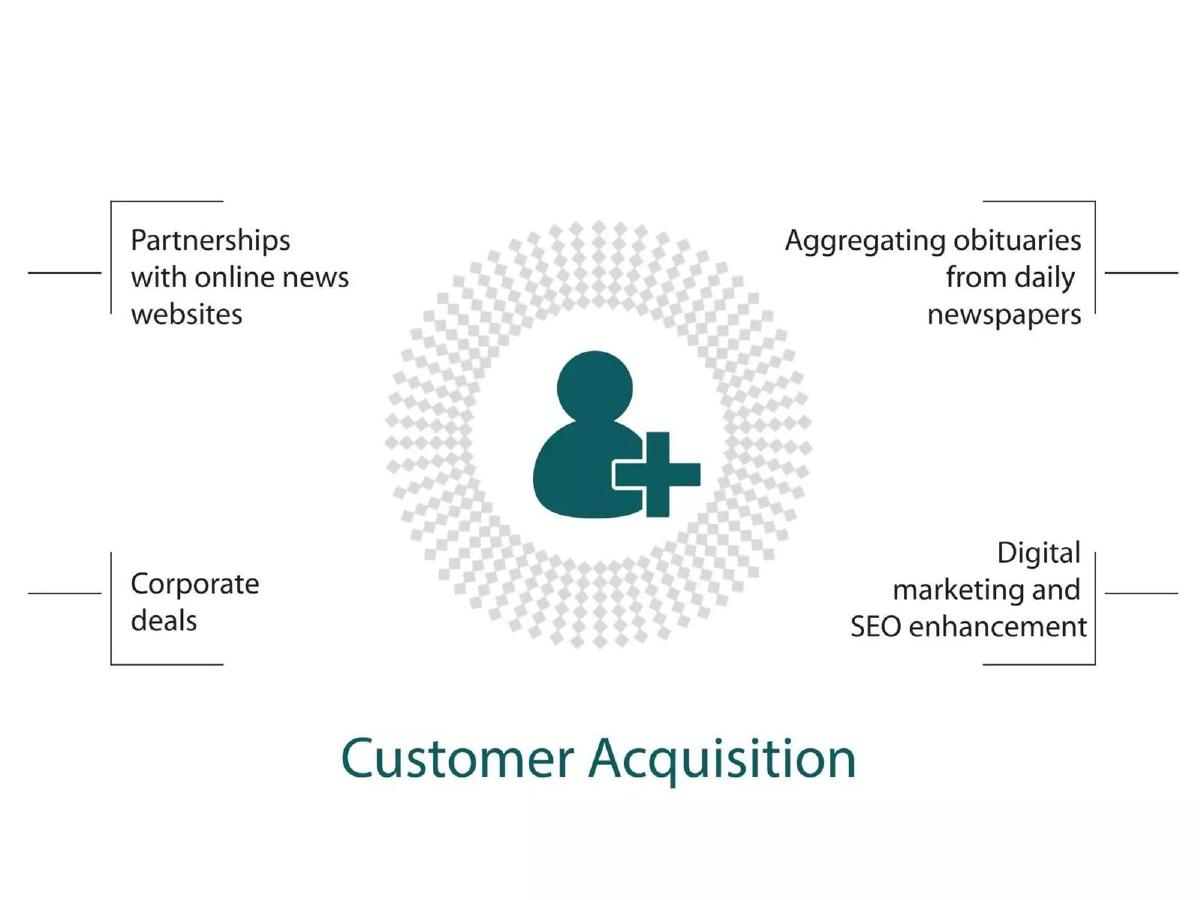
- Customer acquisition relies on aggregating obituaries from daily newspapers and forming partnerships with news websites (Slide 5).
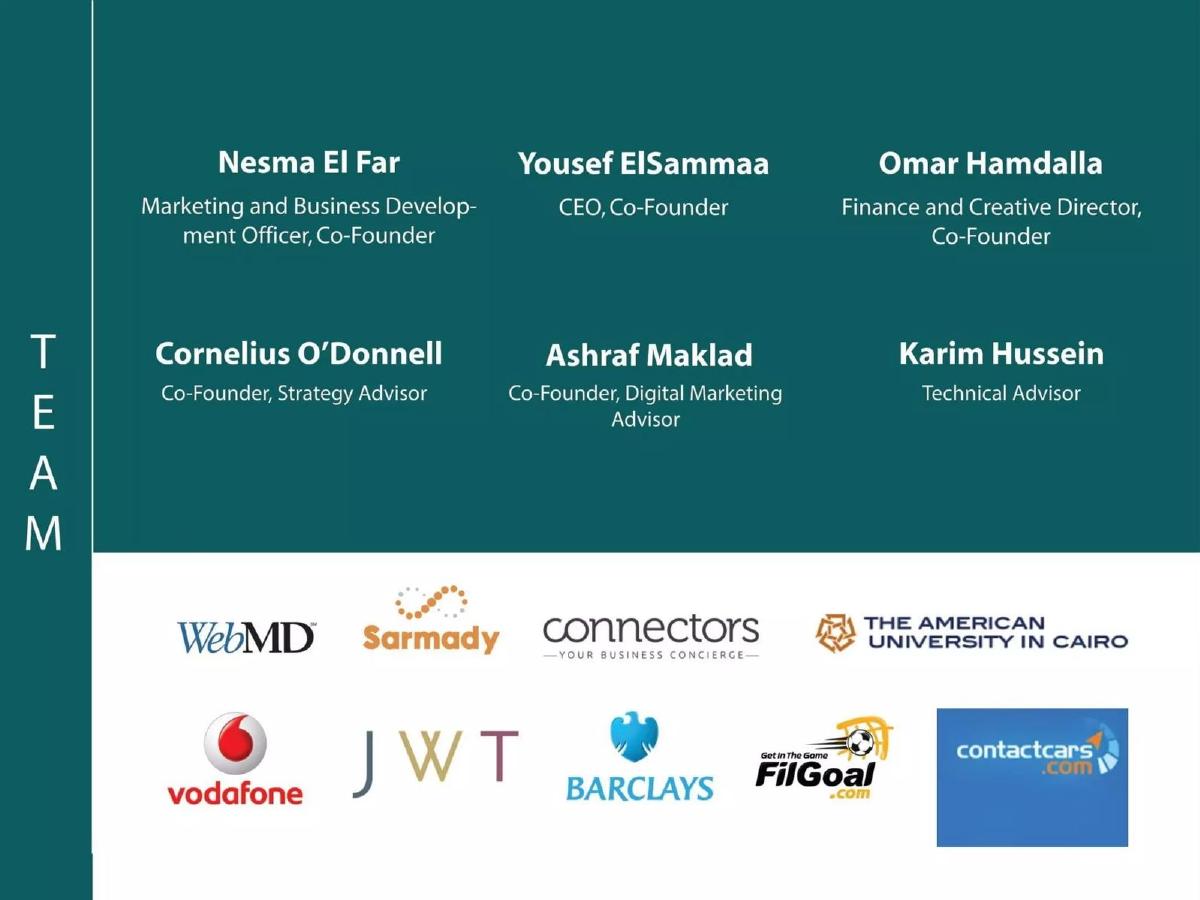
- The team includes six members with experience at companies like Vodafone, JWT, and Barclays (Slide 6).
What this deck is: A 7-slide entry into Middle Eastern Death Tech
The ElWafeyat pitch deck, used for their 2013 seed round, is a remarkably brief document. At only seven slides, it focuses heavily on the cultural context of the Middle East and the economic inefficiency of the status quo. The deck is less about complex financial modeling and more about a clear transition from offline to online behavior in a sensitive but universal market: death and grieving. The company raised $100,000 following this period, suggesting that the core thesis—that obituaries were too expensive and condolences too fragmented—resonated with early-stage investors.
Slide 1: Title and Value Proposition
The deck opens with a clean, culturally resonant design. The logo incorporates Arabic calligraphy and a tree motif, which is mirrored on the final slide. The value proposition is stated directly: "elwafeyat.com is the first online platform for obituaries, memorials and condolences." By claiming the "first" position, the founders are signaling a first-mover advantage in a specific geographic and linguistic market.
Slide 2: The Problem
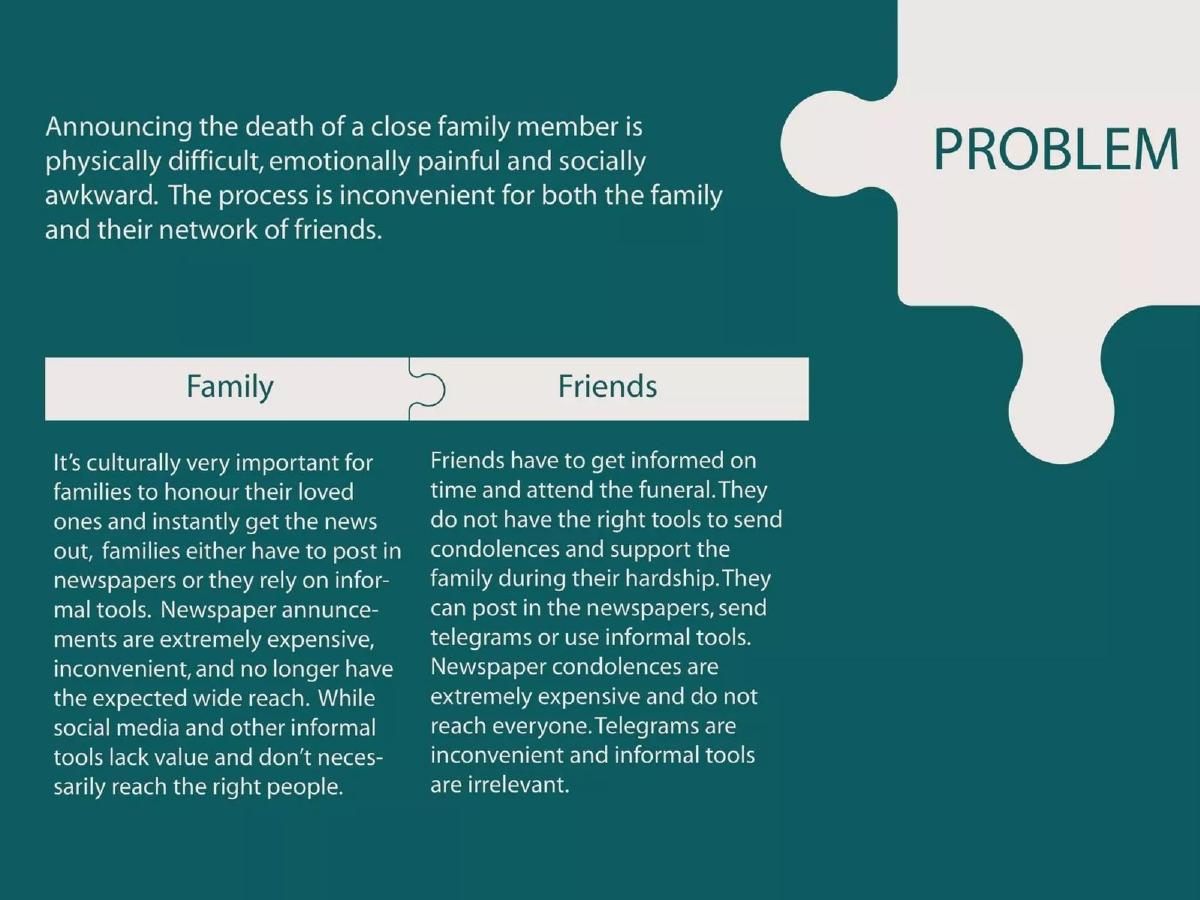
Slide 2 breaks the problem down into two segments: Family and Friends. For families, the deck notes that newspaper announcements are "extremely expensive" and "no longer have the expected wide reach." For friends, the deck highlights a lack of tools to send condolences and support. The use of a puzzle piece graphic suggests that the current market is fragmented and that ElWafeyat is the missing link that connects these two groups. This slide is effective because it addresses both the emotional and practical hurdles of the grieving process.
Slide 3: Market Size and Economics
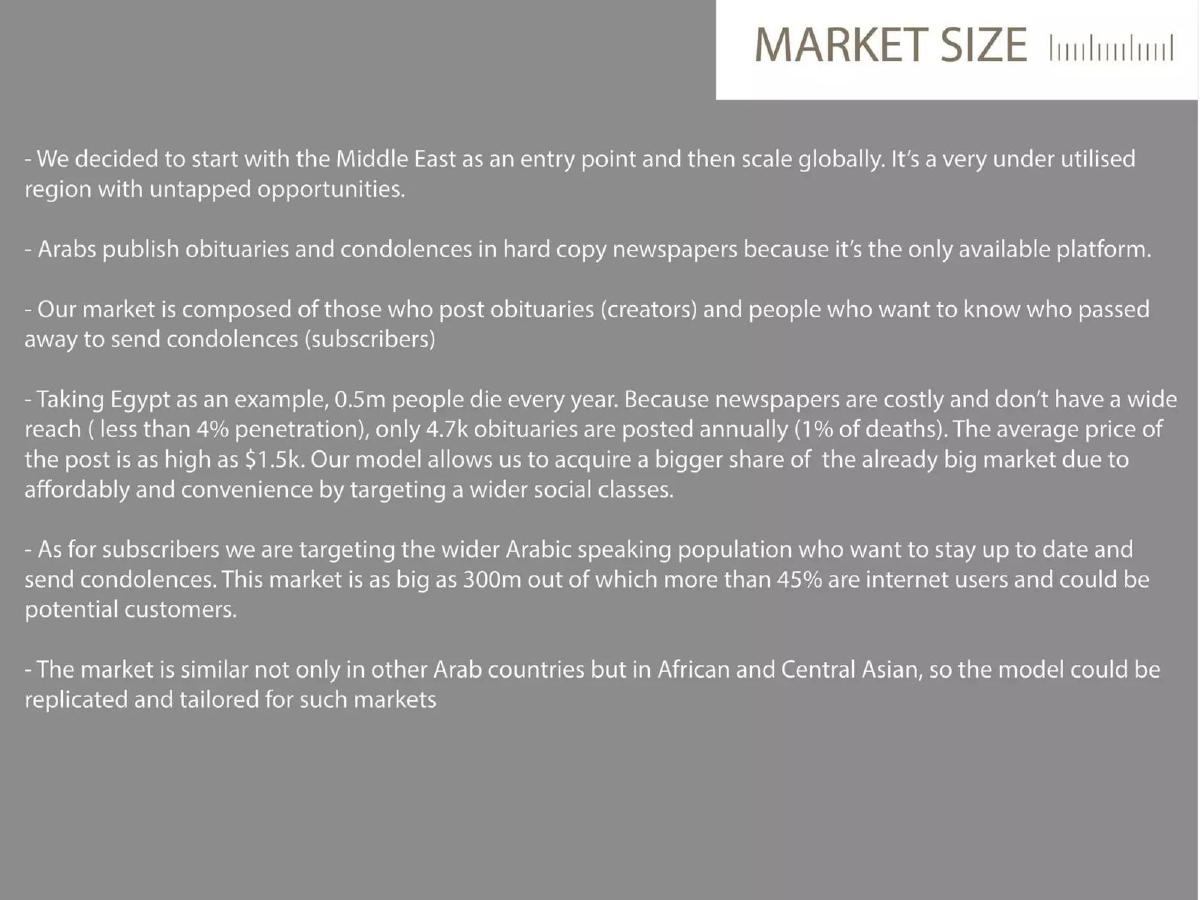
This is arguably the strongest slide in the deck. It provides hard figures to back up the "expensive" claim made on the previous slide. Specifically, it states that in Egypt, 0.5m people die annually, yet only 4.7k obituaries are posted (1% of deaths). The reason provided is the cost: an average of $1.5k per post. This creates a clear opportunity for a lower-cost digital alternative. The slide also defines the market as 300m Arabic speakers, 45% of whom are internet users. This helps investors visualize the scale beyond just the Egyptian borders, mentioning potential replication in African and Central Asian markets.
Slide 4: The Three Pillars of Service
Slide 4 outlines the product offering. It is divided into: Announcing the death (online obituaries, SMS shots, social network integration), Sending Condolences (online condolences, flowers, charitable donations), and Process Facilitation (a directory of mosques, churches, and funeral service providers). This slide serves as the business model proxy. While it doesn't list prices, it identifies the various touchpoints where the company can provide value and potentially capture revenue through e-commerce or lead generation.
Slide 5: Customer Acquisition
The acquisition strategy is presented as a four-pronged approach. The most interesting element here is "Aggregating obituaries from daily newspapers." This indicates a strategy to build a content moat by digitizing existing offline data to attract users. The other channels—partnerships with news sites, corporate deals, and SEO—are standard but necessary for a platform that relies on being found during specific, high-intent search moments.
Slide 6: The Team
The team slide lists six individuals: three co-founders and three advisors. Rather than detailed biographies, the slide uses a "wall of logos" to establish credibility. Logos include global giants like Vodafone , Barclays , and WebMD , alongside regional players like Sarmady and The American University in Cairo . This is a common tactic in seed decks to borrow authority from established brands where the team members previously worked or studied.
Slide 7: Vision and Contact
The final slide reiterates the vision: to become the "number one go-to place for all post-death interactions." It emphasizes maintaining customs and traditions in the modern age. Notably, the contact email provided is for a different domain (taqalid.com), which may suggest a parent company or a previous iteration of the brand name. As noted, there is no "Ask" slide here, which is a significant omission for a fundraising document.
What works in this deck
The deck excels at identifying a massive pricing inefficiency. By citing the $1.5k cost of a newspaper obituary against a 1% penetration rate, the founders make a compelling case for market expansion through affordability. The segmentation of the problem (Family vs. Friends) also shows a deep understanding of the social dynamics of their target market. The visual design is consistent and professional, avoiding the clutter that often plagues early-stage decks.
What is missing from this deck
The most glaring omission is the Financials and Ask . There is no information on how much money the company is seeking, what the valuation is, or how the $100k (which they eventually raised) would be spent. Furthermore, there is no Traction slide. While this may have been a pre-launch deck, even early user numbers, partnership LOIs, or website traffic would have strengthened the case. The Competition slide is also absent; while they claim to be the "first," investors would likely want to know about indirect competitors like social media groups or traditional funeral homes.
What a founder should copy
Founders should emulate the way ElWafeyat used local market data to prove a global concept. Instead of just saying "death care is a big market," they proved that the current solution in their specific geography was broken and overpriced. The Three Pillars structure on Slide 4 is also an excellent way to categorize a multi-sided platform's features without overwhelming the reader with a list of bullet points. Finally, the use of recognizable logos on the team slide is a highly effective way to build instant trust when the founders themselves might not be household names.
Final Thoughts
ElWafeyat's deck is a product of its time—2013 was an era where a clear problem and a credible team could secure a $100k seed check with minimal financial forecasting. Today, a founder would need to supplement these seven slides with at least five more covering unit economics, competitive landscape, and a detailed use-of-funds breakdown. However, as a masterclass in identifying a "broken" traditional industry and proposing a digital fix, this deck remains a strong example of clear, concise communication.
Frequently asked questions
- What is the primary problem ElWafeyat aims to solve?
- According to Slide 2, the process of announcing a death is 'physically difficult, emotionally painful and socially awkward.' The deck highlights that families currently rely on extremely expensive newspaper announcements or informal tools that lack reach, while friends lack the proper tools to send condolences and support the family during their hardship.
- How does ElWafeyat plan to acquire users?
- Slide 5 outlines four acquisition channels: partnerships with online news websites, corporate deals, digital marketing/SEO enhancement, and the aggregation of obituaries from daily newspapers. This last point suggests a 'scraping' or manual entry strategy to ensure the platform has content that draws in the 'subscribers' mentioned on Slide 3.
- What are the specific revenue streams suggested in the deck?
- While a dedicated business model slide is missing, Slide 4 implies revenue through 'Personalised letters, flowers, and packages' and a directory of offline service providers including mosques, churches, and florists. This suggests a mix of e-commerce for condolences and lead generation for funeral service providers.
- What market data is provided to justify the opportunity?
- Slide 3 provides specific data for Egypt: 0.5 million deaths annually, but only 4.7k obituaries (1%) are posted because the average price is $1.5k. The company argues that by making these announcements affordable, they can acquire a larger share of the market. They also cite a 300 million person Arabic-speaking market with over 45% internet penetration.
- Is there a clear funding ask in this deck?
- No. The 7-slide deck ends with a vision statement and contact information (Slide 7). It does not specify how much capital is being raised, the valuation, or how the funds will be allocated. Founders using this as a template should be aware that a modern seed deck typically requires a specific 'The Ask' slide.