Elokenz is a content marketing analytics platform that targets the 'uncertainty' and 'motivation' issues faced by bloggers. The deck, used for the Le Grand Sprint competition in 2015, follows a standard early-stage structure: problem, value chain, mission, demo, business model, competition, team, and objectives. With a three-tier pricing model ranging from 0€ to 99€, the company aimed to capture individual bloggers, freelancers, and agencies. The deck is notable for its extreme brevity and lack of historical financial data, focusing instead on future milestones like reaching 2,500 signups and…
Key takeaways
- The problem is defined as two recurring issues for bloggers: Uncertainty and Long-term motivation (Slide 2).
- The product is positioned as a guide across the entire Content Marketing Value Chain: Plan, Create, Distribute, and Analyze (Slide 3).
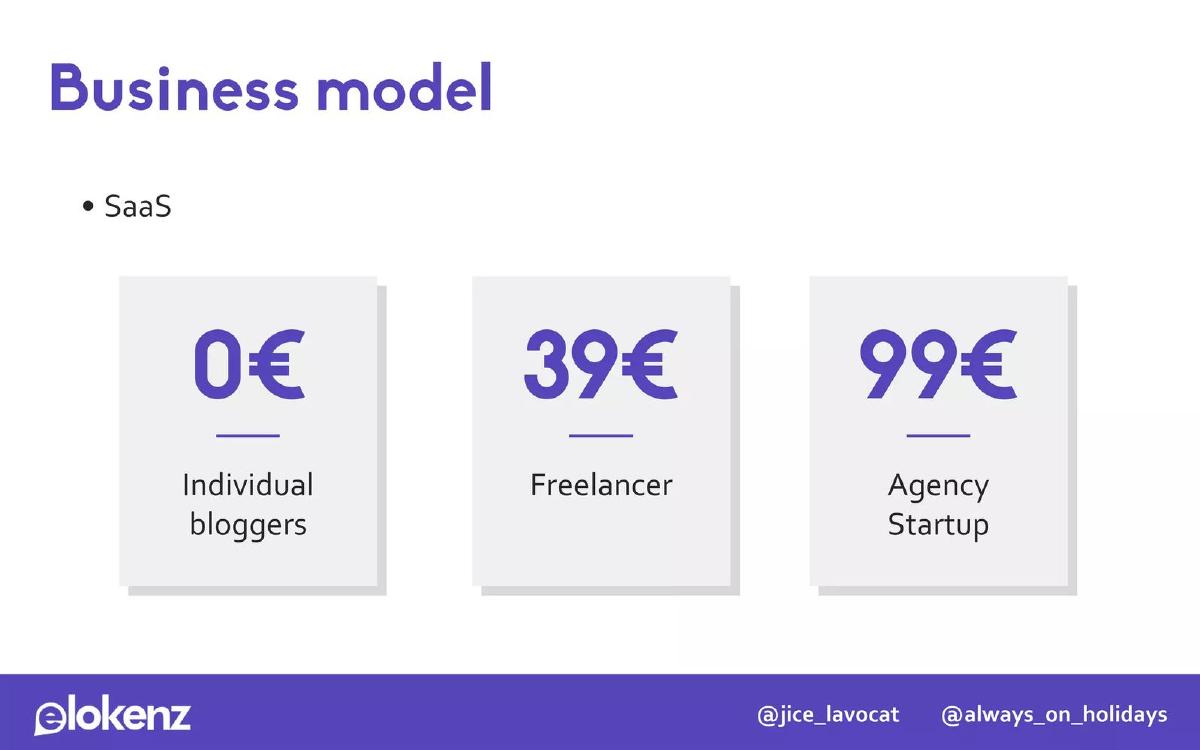
- The business model is a standard SaaS play with three tiers: 0€ for individuals, 39€ for freelancers, and 99€ for agencies/startups (Slide 6).
- The competition radar places Elokenz in the 'Innovation' category, distinct from social automation tools like Buffer or Hootsuite (Slide 7).
- The team consists of two members, Jean-Christophe Lavocat and Fanny Arles, covering dev, marketing, SEO, and design (Slide 8).
- Milestones include a target of 2,500 signups and 300 Weekly Active Users (WAU) by the end of the sprint (Slide 10).
- The company set a goal to reach its first paying users by the end of 2015 (Slide 10).
- The long-term funding goal was to raise a Seed or Series A round by the end of 2016 (Slide 10).
Introduction and Branding
Slide 1: Title Slide
The deck opens with a minimalist title slide featuring the Elokenz logo—a purple speech bubble containing a lowercase 'e' followed by the company name in a bold, black sans-serif font. The bottom of the slide includes the Twitter handles for the two founders: @jicelavocat and @alwaysonholidays. There is no tagline or mission statement on the cover; it relies entirely on visual branding.
The Problem Space
Slide 2: Market Problem
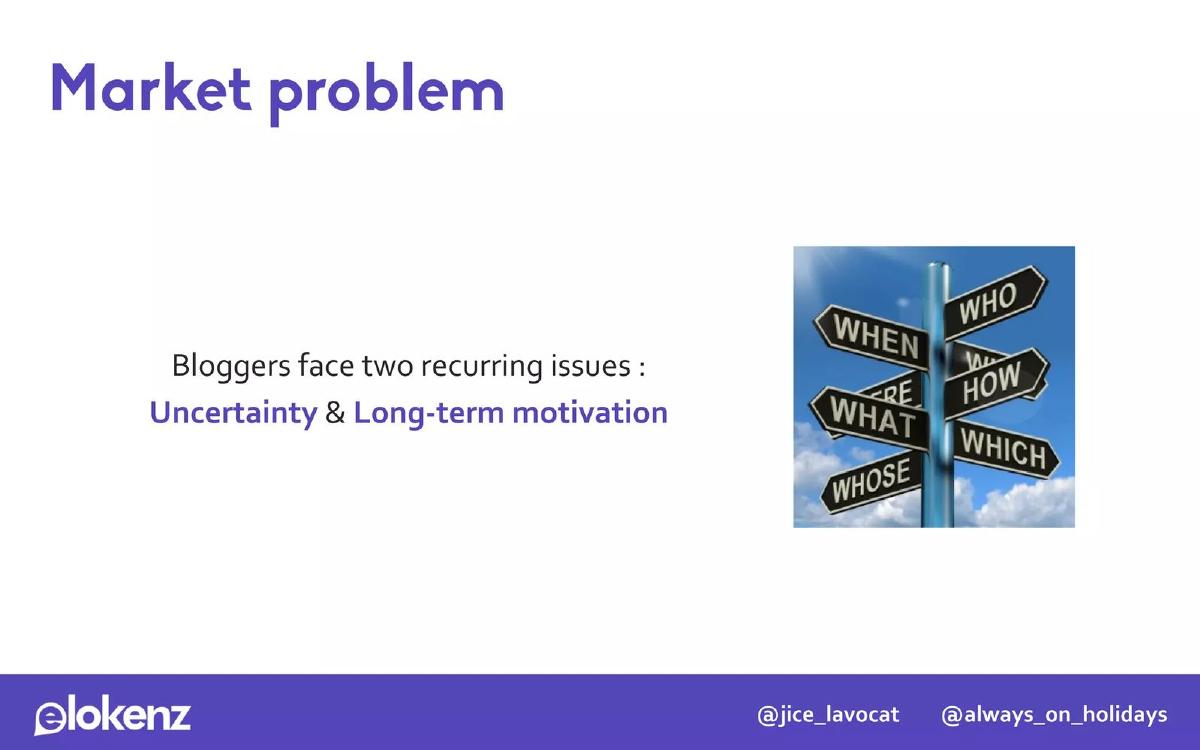
Elokenz identifies the 'Market problem' as two recurring issues for bloggers: Uncertainty and Long-term motivation . The slide uses a stock image of a signpost with multiple directions (Who, When, What, How, Which, Whose) to represent the confusion content creators face. This slide is high-level and emotional rather than data-driven, focusing on the psychological state of the user rather than market size or financial loss.
Slide 3: Content Marketing Value Chain
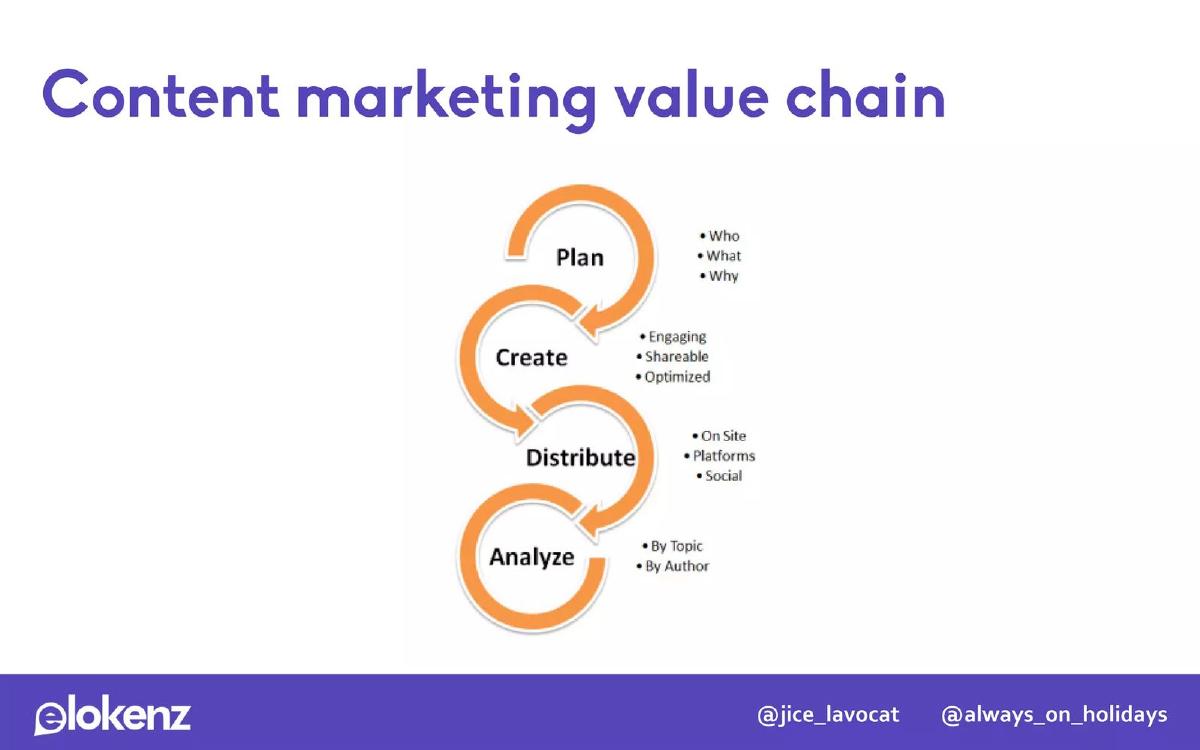
This slide provides a conceptual framework for the product. It breaks down content marketing into four cyclical steps: Plan (Who, What, Why), Create (Engaging, Shareable, Optimized), Distribute (On Site, Platforms, Social), and Analyze (By Topic, By Author). This serves to show where the software will intervene, though it does not yet specify which parts of the chain Elokenz automates.
Slide 4: Mission Statement
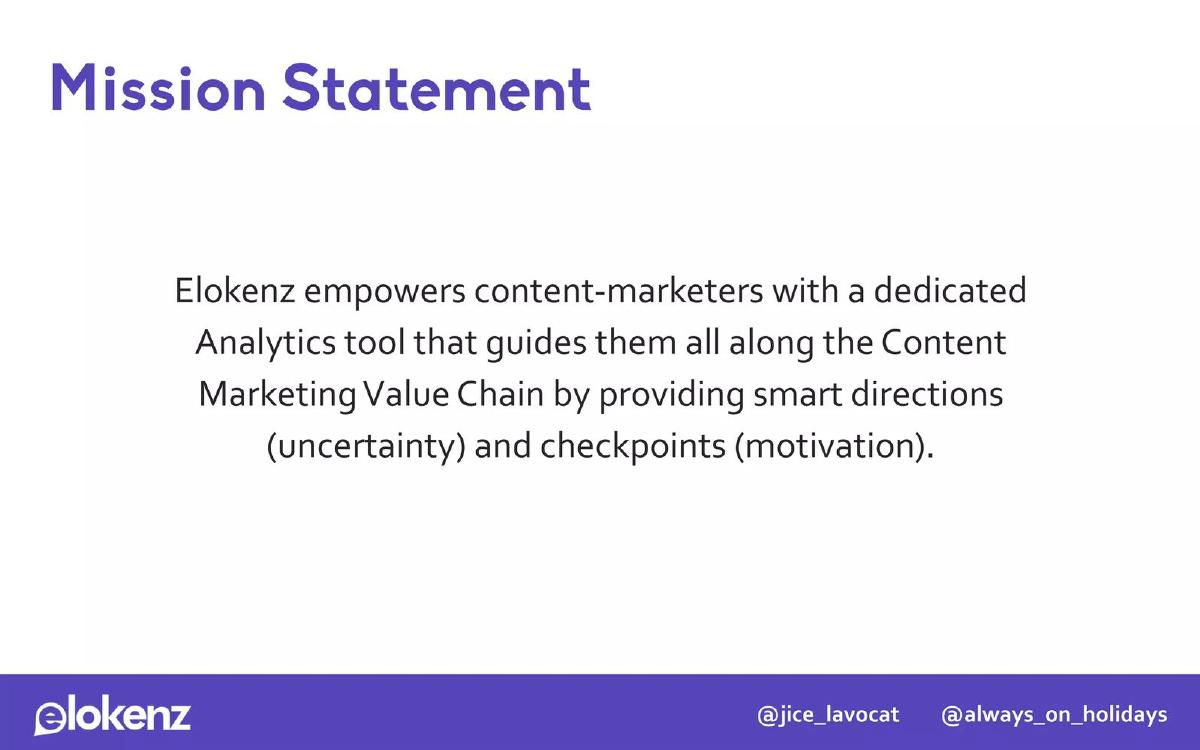
The mission statement bridges the problem and the solution. It states: 'Elokenz empowers content-marketers with a dedicated Analytics tool that guides them all along the Content Marketing Value Chain by providing smart directions (uncertainty) and checkpoints (motivation).' This slide explicitly links the product features (analytics/checkpoints) back to the problems identified on slide 2.
The Solution and Product
Slide 5: Demo
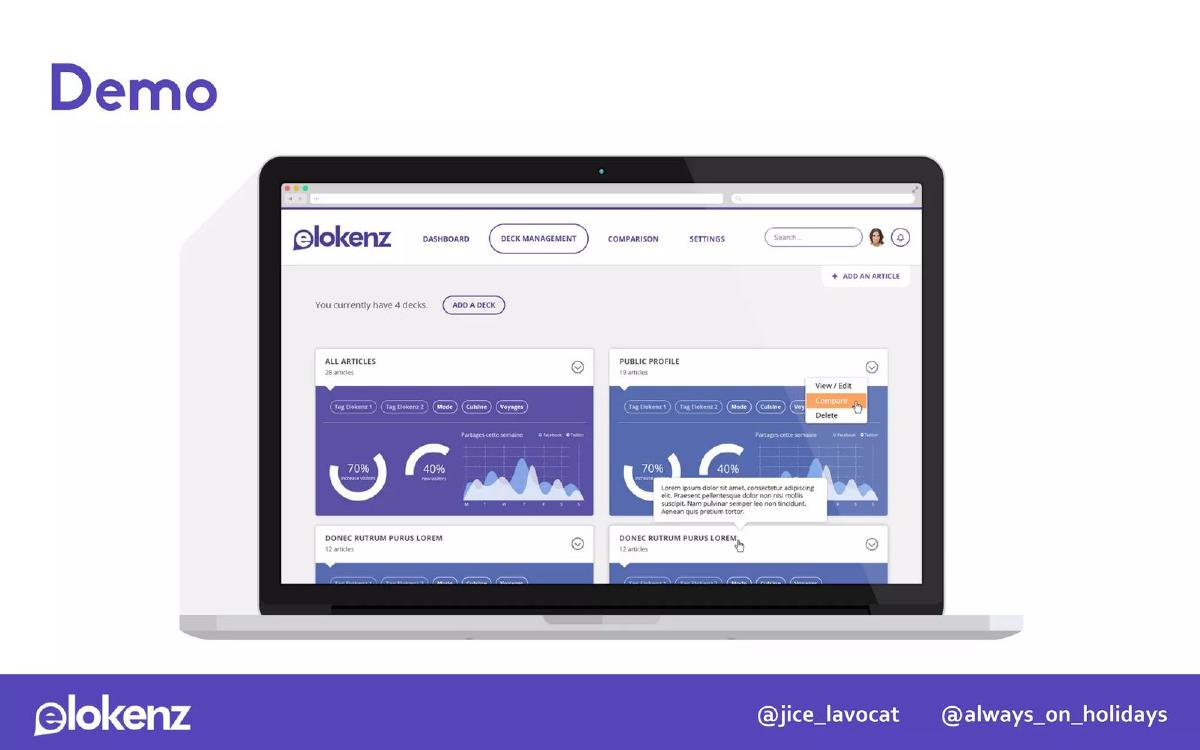
Slide 5 displays a mockup of the Elokenz dashboard on a laptop screen. The interface shows 'Deck Management' with cards for different article groups. Metrics visible in the mockup include '70% increase visitors' and '40% new visitors,' along with a line graph showing 'Partages cette semaine' (shares this week) for Facebook and Twitter. The UI appears clean, using the brand's purple and white color palette.
Business and Competition
Slide 6: Business Model
The business model is a straightforward SaaS subscription plan. It lists three price points: 0€ for Individual bloggers, 39€ for Freelancers, and 99€ for Agencies and Startups. The slide does not detail the feature differences between these tiers, but the segmentation suggests a volume-based or seat-based pricing strategy common in the marketing tech industry.
Slide 7: Competition Radar
This slide attempts to map the landscape of content marketing tools. Elokenz is placed on the far left under the label 'Innovation.' The radar includes three 'circles' of competitors. Circle 1 includes tools like Raven, BuzzSumo, and Scribe. Circle 2 features heavyweights like HubSpot, Google Analytics, Buffer, and Hootsuite. Circle 3 includes specialized tools like Traackr, TapInfluence, and BuzzStream. The slide notes that 'Authors should be assisted (guided) to act smarter in daily content marketing tasks,' suggesting that the competitors are either too broad or too automated, whereas Elokenz is 'guided.'
The Team
Slide 8: The Team (Professional)
The team consists of two people. Jean-Christophe Lavocat is credited with Dev, Marketing, and SEO. Fanny Arles is credited with Design, Marketing, and 'Rédaction web' (web writing). This slide establishes that the core competencies required to build and market a SaaS tool are covered by the founding pair.
Slide 9: The Team (Personal)
In a move typical of early-stage 'sprint' or 'demo day' decks, slide 9 provides personal details about the founders. Jean-Christophe is described as 'Tech/Science, Expat, Extreme sports, Doberman owner.' Fanny is described as 'Graphic arts, Future expat, Brunch addict, Cat lover.' While these details do not provide professional validation, they are intended to build rapport with the audience.
Future Outlook
Slide 10: Objectives
The final content slide outlines three phases of growth. Phase 1 (End of Le Grand Sprint): 2,500 signups, 300 WAU (Weekly Active Users), and 10% monthly growth. Phase 2 (End of 2015): First paying users. Phase 3 (End of 2016): Seed or Serie A. This slide provides the only hard metrics in the deck, though they are targets rather than historical performance data.
Slide 11: Closing Slide
The deck concludes with a repeat of the title slide, featuring the logo and the founders' social media handles. There is no 'Contact Us' slide with email addresses or a phone number, nor is there a specific 'Ask' regarding the amount of capital they are looking to raise.
What Works and What is Missing
What Works: The deck is visually consistent and extremely easy to read. By focusing on the 'Content Marketing Value Chain,' the founders demonstrate a clear understanding of their users' workflow. The pricing model is simple and aligns with industry standards for 2015, making the path to revenue easy for an investor to visualize. The competition radar is well-populated, showing that the founders have done their homework on the crowded MarTech landscape.
What is Missing: The most significant omission is the lack of current traction data. While slide 10 sets targets, the deck does not state how many users or how much revenue the company had at the time of the presentation. There is no 'Ask' slide; we do not know how much money they are raising or how they plan to spend it. Furthermore, the deck lacks a 'Market Size' (TAM/SAM/SOM) slide, which is usually necessary to justify a 'Serie A' goal. The product demo is limited to a single screenshot, leaving the actual 'smart directions' and 'checkpoints' mentioned in the mission statement largely to the imagination.
Founder Takeaways
Focus on the 'Why': Elokenz does a good job of identifying a psychological pain point (lack of motivation) rather than just a technical one. Founders building tools for creators should note how this helps differentiate a product in a saturated market. Milestone Clarity: Slide 10 is a model of clarity for early-stage startups. Instead of vague promises, it sets specific numbers (2,500 signups) and specific dates (End of 2015). Even if a founder hasn't launched yet, showing exactly what the 'win' looks like for the next 6-12 months is helpful for investors. Personalization: While not for every deck, the 'Personal' team slide (Slide 9) can be effective in a pitch competition setting where the audience sees dozens of companies and needs a 'hook' to remember the individuals behind the software.
Frequently asked questions
- What specific problem does Elokenz solve?
- According to slide 2, Elokenz addresses two specific psychological and operational hurdles for bloggers: Uncertainty and Long-term motivation. The deck suggests that bloggers struggle with knowing 'who, what, when, how, and which' regarding their content, leading to a loss of motivation over time. The tool aims to provide 'smart directions' and 'checkpoints' to mitigate these issues.
- How does the pricing model work?
- Slide 6 outlines a three-tier SaaS subscription model. The entry-level tier is 0€ for individual bloggers, likely serving as a lead magnet or freemium acquisition strategy. The mid-tier is 39€ per month for freelancers. The top-tier is 99€ per month, targeted at agencies and startups who likely require more volume or advanced features.
- Who are the primary competitors identified by Elokenz?
- Slide 7 features a 'Competition radar' with three circles of influence. Major names include HubSpot, Google Analytics, Buffer, Hootsuite, and BuzzSumo. Elokenz positions itself on the far left under 'Innovation,' claiming to assist authors in daily content marketing tasks more directly than general social media analytics or automation tools.
- What are the team's qualifications?
- Slides 8 and 9 introduce the two-person team. Jean-Christophe Lavocat handles Development, Marketing, and SEO, with a background in Tech/Science. Fanny Arles manages Design, Marketing, and Web Writing (Rédaction web), with a background in Graphic Arts. The deck also includes personal trivia, such as pet ownership and hobbies, to humanize the founders.
- What were the company's growth targets for 2015-2016?
- Slide 10 lists specific objectives: reaching 2,500 signups and 300 Weekly Active Users (WAU) with 10% monthly growth by the end of the 'Grand Sprint.' By the end of 2015, they aimed for their first paying users, and by the end of 2016, they intended to raise a Seed or Series A round.