Ellis utilizes a text-heavy, memo-style pitch deck to articulate a complex 'compound startup' strategy. Rather than focusing on a single point solution, the company aims to become a centralized platform for international students by bundling banking, mobile services, and immigration paperwork automation. The deck argues that B2C CACs are rising, making traditional digital marketing unsustainable; instead, Ellis leverages a unique distribution model through international education agencies. By onboarding users four months before their relocation, Ellis builds a high-barrier-to-entry relationsh…
Key takeaways
- Ellis defines its mission as building the migration infrastructure for 'One Billion Americans' on slide 3.
- The product roadmap includes banking, mobile plans, lease co-signing, and automated immigration paperwork (slides 4-6).
- A core competitive advantage is onboarding students four months before relocation, a feat traditional banks like Chase or BofA cannot perform online (slide 10).
- The distribution strategy bypasses digital ads in favor of international education agencies and consultants (slide 12).
- Market timing is driven by the transition of university immigration forms (I-20/DS-2019) from physical to digital PDF formats (slide 13).
- Ellis utilizes 'Fintech-as-a-Service' providers like Bond and Unit to rapidly launch financial products (slide 14).
- The deck mentions a signed Master Service Agreement (MSA) with T-Mobile to build a Mobile Virtual Network Operator (MVNO) on slide 15.
- The Seed raise goal includes building an agent network to reach 25,000 students per year (slide 16).
The Memo-Style Pitch: A Narrative Deep Dive
The Ellis pitch deck, dated 2022, is not a traditional visual presentation. It is a text-heavy 'Seed Memo' that prioritizes strategic narrative over flashy graphics. This format is often used by founders who want to demonstrate deep intellectual rigor and a comprehensive understanding of complex market dynamics. For a company operating at the intersection of Fintech and Immigration—two highly regulated and operationally intense sectors—this format serves to build credibility through detail.
Slide 1: Cover and Confidentiality
The deck opens with a minimalist cover page. It identifies the document as the Ellis Technologies Seed Memo and notes it was prepared by Sampei Omichi, CEO . A standard confidentiality notice is included, emphasizing the proprietary nature of the information. Notably, there is no tagline or high-level value proposition on this slide.
Slides 2-3: Mission and the 'Modern Ellis Island'
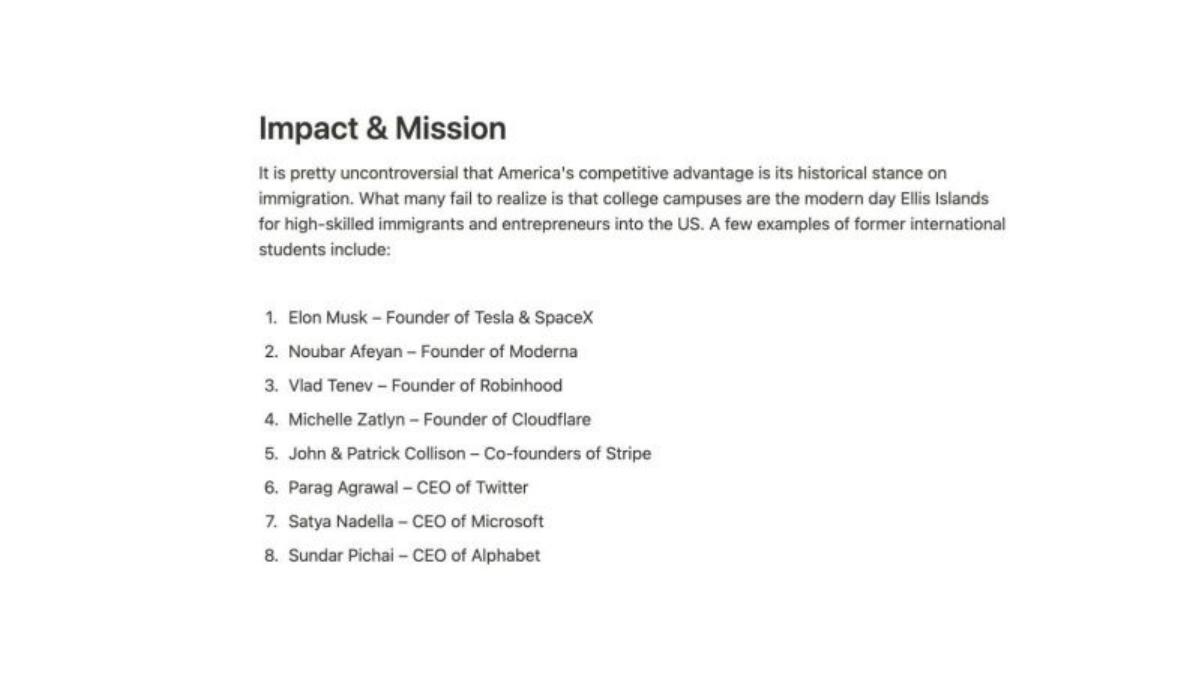
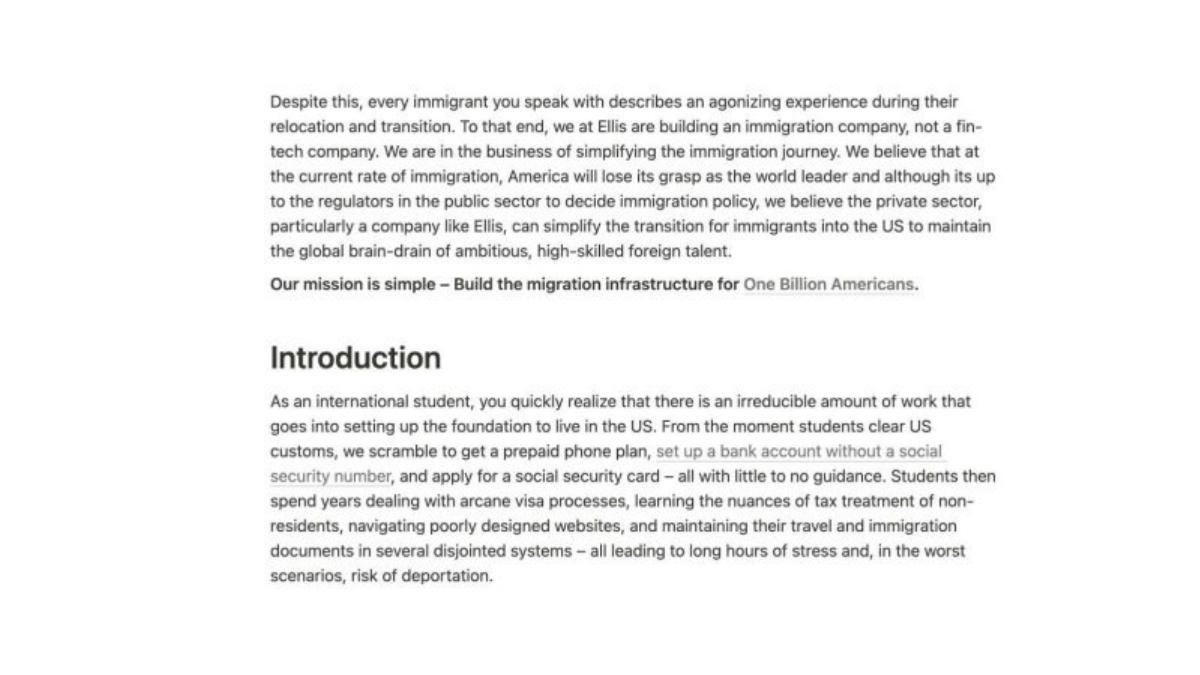
Ellis begins by framing immigration as America's primary competitive advantage. Slide 2 lists high-profile immigrant founders and CEOs, including Elon Musk (Tesla) , the Collison brothers (Stripe) , and Satya Nadella (Microsoft) . This establishes the 'high-skilled' nature of their target demographic. On slide 3, the company defines its mission: 'Build the migration infrastructure for One Billion Americans.' They explicitly state they are an 'immigration company, not a fintech company,' signaling that financial services are merely a wedge into a larger logistical problem.
Slides 4-6: The Product Suite and Roadmap
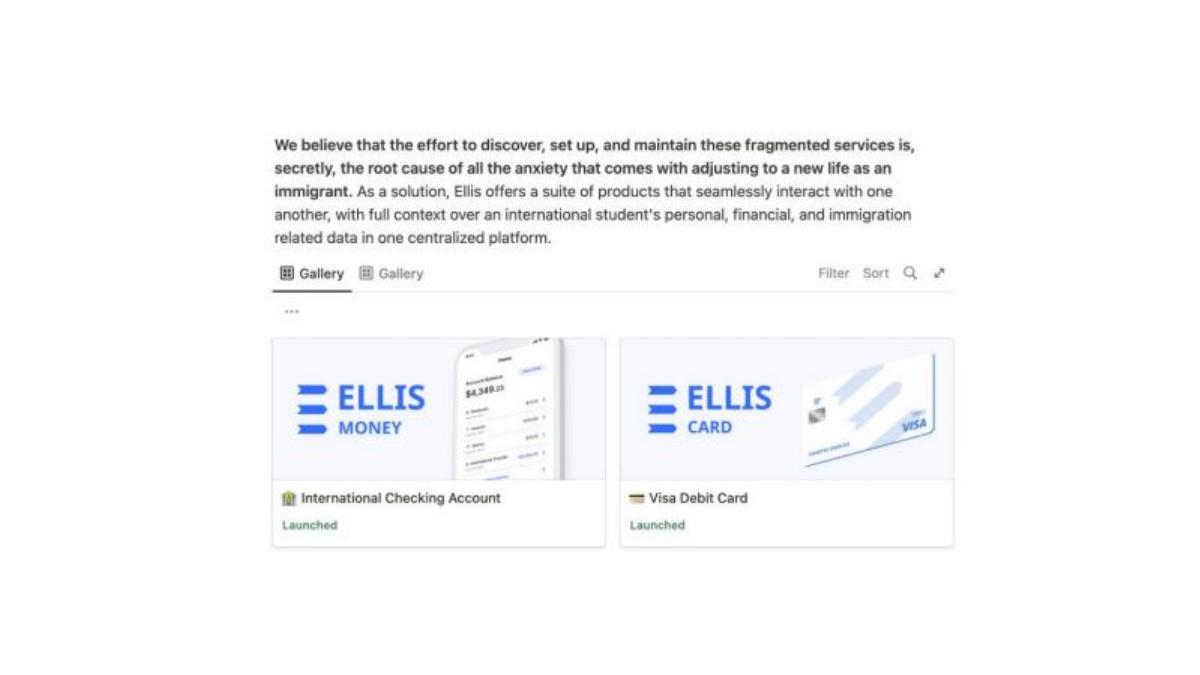
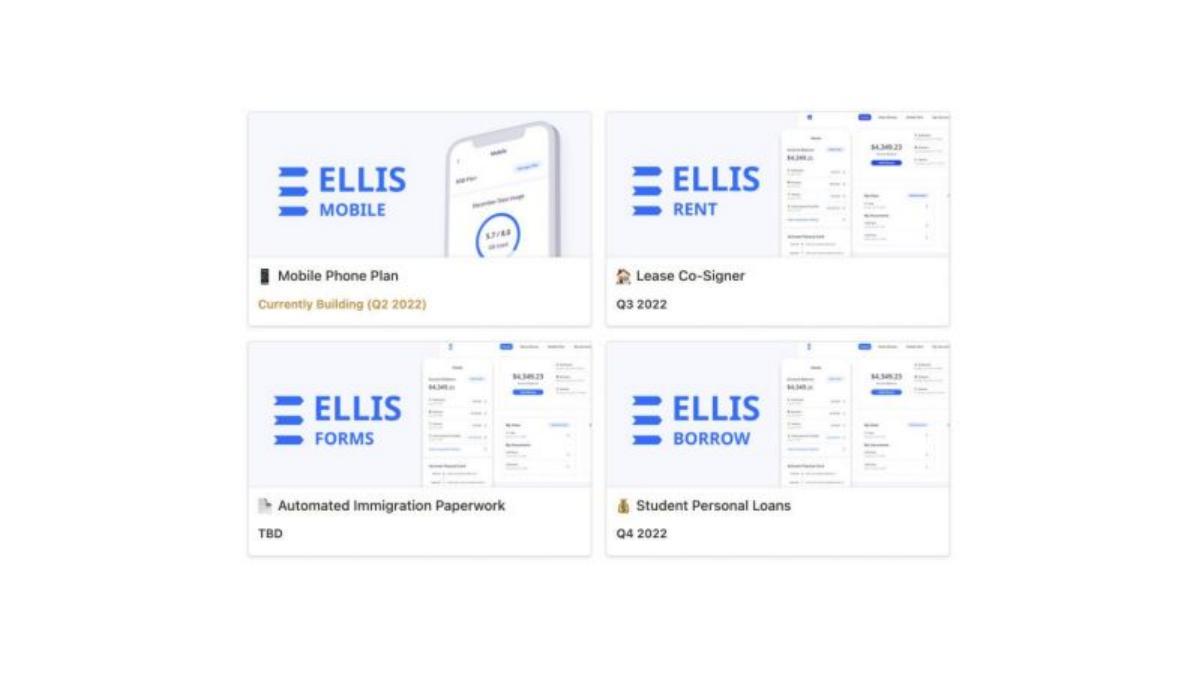
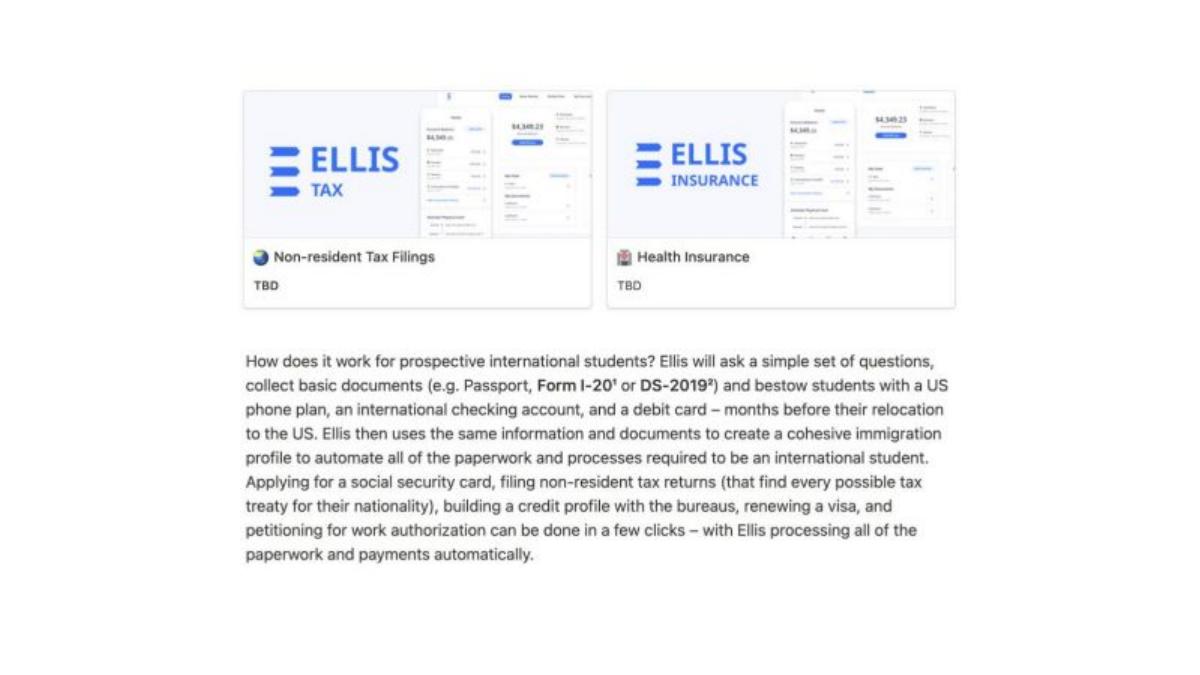
These slides introduce the 'Gallery' of products. Slide 4 shows that Ellis Money (Checking Account) and Ellis Card (Visa Debit) have already launched. Slide 5 outlines the near-term roadmap: Ellis Mobile (Q2 2022) , Ellis Rent (Q3 2022) , and Ellis Borrow (Q4 2022) . Slide 6 adds Ellis Tax and Ellis Insurance to the long-term vision. The core value proposition is centralization: using one set of documents (Passport, Form I-20) to unlock a suite of services months before the student arrives in the US.
Slides 7-8: Strategy Part I & II - Capturing the Ingress
Slide 7 argues that owning the customer relationship at the very start of the journey is the most valuable part of the business. International students are described as 'affluent' and 'eager for technology-driven alternatives.' Slide 8 focuses on data automation. By becoming the 'single access point for immigration data,' Ellis can automate taxes and government paperwork. They describe a 'simple formula': pick the most inefficient process, automate it, and move to the next.
Slides 9-11: Strategy Part III - The Power of Bundling
Ellis leans heavily into the 'Compound Startup' philosophy. Slide 9 quotes Jim Barksdale on bundling and unbundling. The company argues that bundling gives them 'Pricing Power' ; they can underprice individual products (like phone plans) because they maximize the value of the total bundle. Slide 10 highlights a major competitive moat: 'Acquire users 4 months before any other bank can.' Traditional banks require physical presence; Ellis uses digital immigration forms to onboard users remotely. Slide 11 discusses using cash flow data for better loan underwriting, bypassing the need for traditional credit history.
Slides 12-13: Distribution and 'Why Now'
Slide 12 addresses the 'Fintech CAC' crisis, noting that B2C CACs rose 60% from 2014 to 2019 . Ellis's solution is to partner with international education agencies. These agencies onboard students during pre-departure orientations. Slide 13 provides the technical 'Why Now': the shift from physical to digital PDF immigration forms (I-20/DS-2019) and the post-COVID acceptance of mail-in/online government applications (like Social Security cards).
Slide 14: Market Evolutions
This slide credits the 'Fintech-as-a-Service' ecosystem for making Ellis possible. They name-drop Bond and Unit for banking, T-Mobile for MVNO infrastructure, and Stilt for lending licenses. This slide is crucial as it explains how a small startup can manage such a broad product surface area without building every backend from scratch.
Slide 15: Progress to Date
The company lists three major milestones: 1) Building the internationally focused neo-bank, 2) Signing an MSA with T-Mobile , and 3) Signing MOUs with 'X' educational agencies . Note: The deck uses 'X' and 'Y' as placeholders for student volume, suggesting this version of the memo may have been a template or redacted for broader circulation.
Slide 16: The Seed Raise
The final content slide outlines the goals for the capital. Ellis intends to build the MVNO and expand the agent network to reach 25,000 students per year . The focus is on validating the upstream distribution strategy and identifying the 'fully loaded customer acquisition cost' in that channel.
What Works in the Ellis Deck
The 'Compound Startup' Narrative: Ellis does an excellent job of justifying why they are building so many products at once. In a venture landscape that often demands 'focus,' they successfully argue that focus on a single point solution (like just a bank account) would lead to failure due to high CAC and low defensibility.
Clear Distribution Advantage: The strategy of partnering with international agencies is a compelling answer to the 'how do you grow' question. It turns a high-friction process (moving countries) into a captive acquisition channel.
Strong 'Why Now': Linking their existence to a specific regulatory/technical change (the digitalization of I-20 forms) gives investors a reason to believe that this opportunity didn't exist five years ago and won't be open forever.
What is Missing from the Ellis Deck
The Team Slide: This is the most glaring omission. Investors at the Seed stage typically bet on the 'who' as much as the 'what.' While the CEO is named, there is no information on the engineering team, legal/compliance experts (critical for immigration), or previous startup experience.
Unit Economics and Financials: While the deck discusses 'Pricing Power' and 'LTV,' it provides no actual numbers. There are no projections for revenue, margins on the MVNO vs. banking products, or the specific cost of the agency commissions.
Competitive Landscape: The deck mentions 'traditional banks' and 'point solution competitors' generally, but it does not name or analyze other startups in the cross-border fintech space (e.g., Nova Credit, Stilt, or Deserve).
What Founders Should Copy
The Strategy-First Approach: If you are building a complex business, don't be afraid of the memo format. It allows you to walk an investor through your logic step-by-step, which is often more persuasive than a series of disconnected bullet points on a slide.
Identifying Infrastructure Partners: Slide 14 is a masterclass in showing how to leverage the 'API economy.' By listing their infrastructure partners (Unit, T-Mobile, Stilt), Ellis proves they can be capital-efficient while offering a 'full-stack' experience.
The 'Ingress' Concept: Every founder should be able to identify the 'ingress' of their customer's journey. Ellis's realization that the journey starts four months before arrival—and that they can own that window—is a powerful lesson in finding untapped market entry points.
Frequently asked questions
- What is the 'compound startup' approach mentioned in the deck?
- As described on slide 11, the compound startup approach involves building a suite of integrated products rather than a single point solution. Ellis bundles banking, mobile plans, and tax filings to create a unified experience. This allows them to underprice individual services and increase customer lifetime value (LTV), making them more competitive against startups that only solve one part of the immigration journey.
- How does Ellis acquire customers without high digital marketing costs?
- Slide 12 explains that Ellis avoids expensive digital channels where B2C CACs have risen 60%. Instead, they partner with international education agencies and consultants. These agents onboard students during 'pre-departure orientations' in their home countries. Ellis pays these agencies a commission, effectively 'piggybacking' on the existing trust between the student, their parents, and the agency.
- What specific problem does Ellis solve for international students?
- According to slide 3, international students face an 'irreducible amount of work' upon arrival, including setting up phone plans and bank accounts without a Social Security Number. Ellis provides these services four months before the student leaves their home country. They also automate the 'arcane' process of filing non-resident taxes and applying for work authorizations (slide 8).
- What is the significance of the I-20 and DS-2019 forms in the deck?
- Slide 13 identifies the digitalization of these forms as a key 'Why Now' factor. Because universities now issue these immigration forms as digital PDFs, Ellis can use them for Know Your Customer (KYC) requirements remotely. This allows them to verify identities and open US bank accounts for students while they are still abroad, which was previously impossible with physical documents.
- Does the deck provide any information about the founding team?
- No. The deck is highly unusual in that it lacks a dedicated team slide. The only individual mentioned is Sampei Omichi, identified as the CEO on the cover slide. There is no mention of co-founders, previous experience, or technical advisors, which is rare for a $5M Seed round pitch.