Canva’s 12-slide seed deck from 2012 focuses heavily on the 'Why' and the 'How' of market disruption. Rather than leading with complex features, the deck centers on a $138.4 billion market opportunity currently served by 'frustrating products' like Adobe InDesign and Microsoft Publisher. The narrative is anchored by the founders' previous success with Fusion Books, providing immediate credibility. Key highlights include a detailed virality map showing how search engines and workplace sharing drive growth, and a multi-tiered monetization strategy targeting everyone from students to small busin…
Key takeaways
- The deck identifies a total addressable market of $138.4 billion, broken down into specific segments like the $80B print industry and $24B design service industry (Slide 12).
- Canva positions itself as a hybrid of Adobe InDesign's power and Google Docs' collaboration (Slide 4).
- The business model relies on a freemium approach with average yearly spends ranging from $40 for students to $700 for small business owners (Slide 8).
- A detailed virality loop explains how 'tentacles' on search engines lead users to the editor, eventually driving workplace adoption (Slide 7).
- The team slide leverages a quote from Lars Rasmussen, co-founder of Google Maps, to validate the technical vision (Slide 10).
- The 'History' slide provides critical de-risking by showing that the founders already built a profitable predecessor, Fusion Books (Slide 9).
- The deck omits a formal 'Ask' slide, focusing instead on the product roadmap and market expansion (Slide 11).
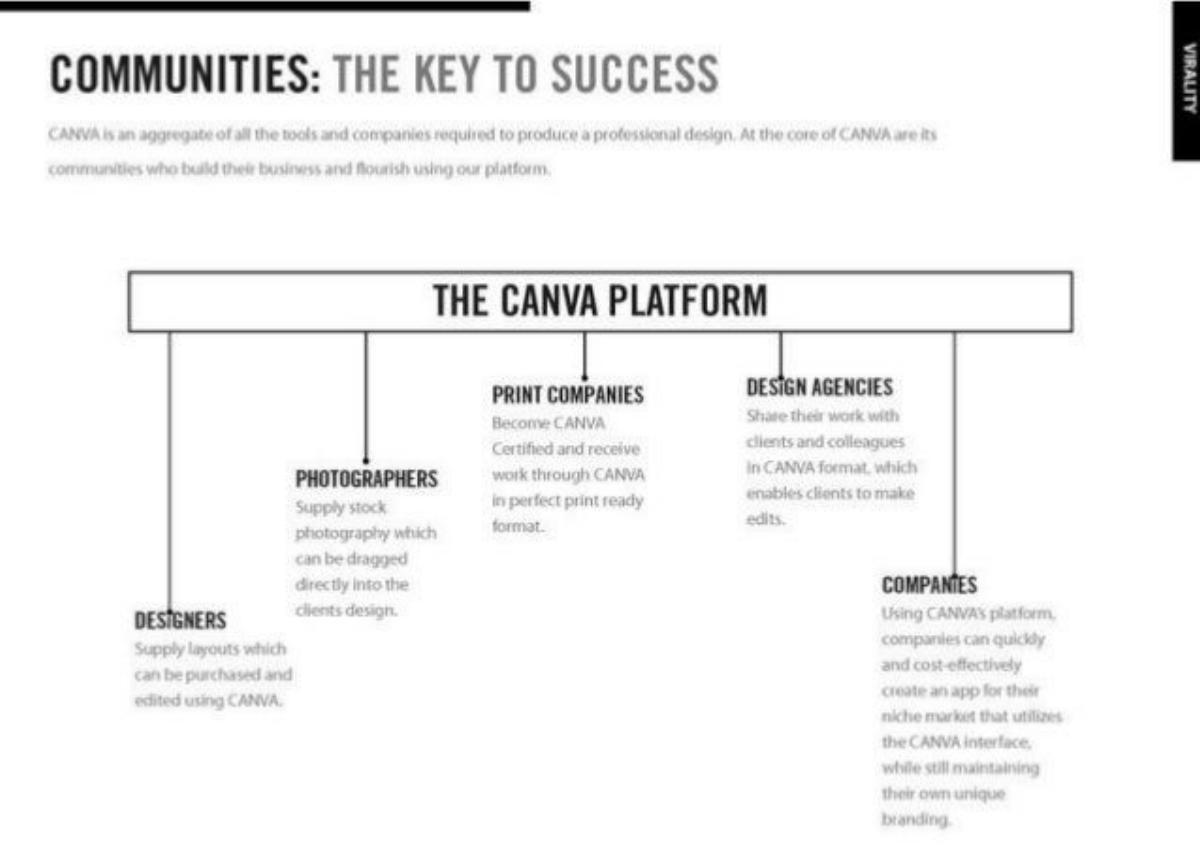
- Canva defines its platform as an aggregate of designers, photographers, and print companies, creating a full-stack ecosystem (Slide 6).
The Narrative of Market Inevitability
Canva’s 2012 seed deck is a study in simplicity and market-first storytelling. At a time when professional design was gated behind expensive software and steep learning curves, Canva presented a vision of democratization. The deck doesn't just pitch a tool; it pitches the end of a frustrated era of desktop publishing. By the time an investor reaches the final slide, the company has framed its success not as a possibility, but as a 'matter of magnitude' within a massive, stagnant industry.
Slide 1: Title and Vision
The cover slide is minimalist, featuring the Canva logo and the tagline: "Empowering extraordinary design." It includes the date (April 2012) and contact information for Melanie Perkins, CEO & Founder. The inclusion of a "STRICTLY CONFIDENTIAL" watermark suggests a standard early-stage fundraising posture.
Slide 2: The 'Why'
Slide 2 sets the stage before defining the product. It introduces the $138.4 billion desktop publishing market and makes a bold claim: the dominant players are relics of the pre-Facebook, pre-Wikipedia era. This slide establishes the 'Why' by noting that the world has changed, but design software hasn't. Crucially, it mentions that the founders have already turned this idea into a profitable product in a niche market, signaling that they are ready for the "world stage."
Slide 3: The Problem
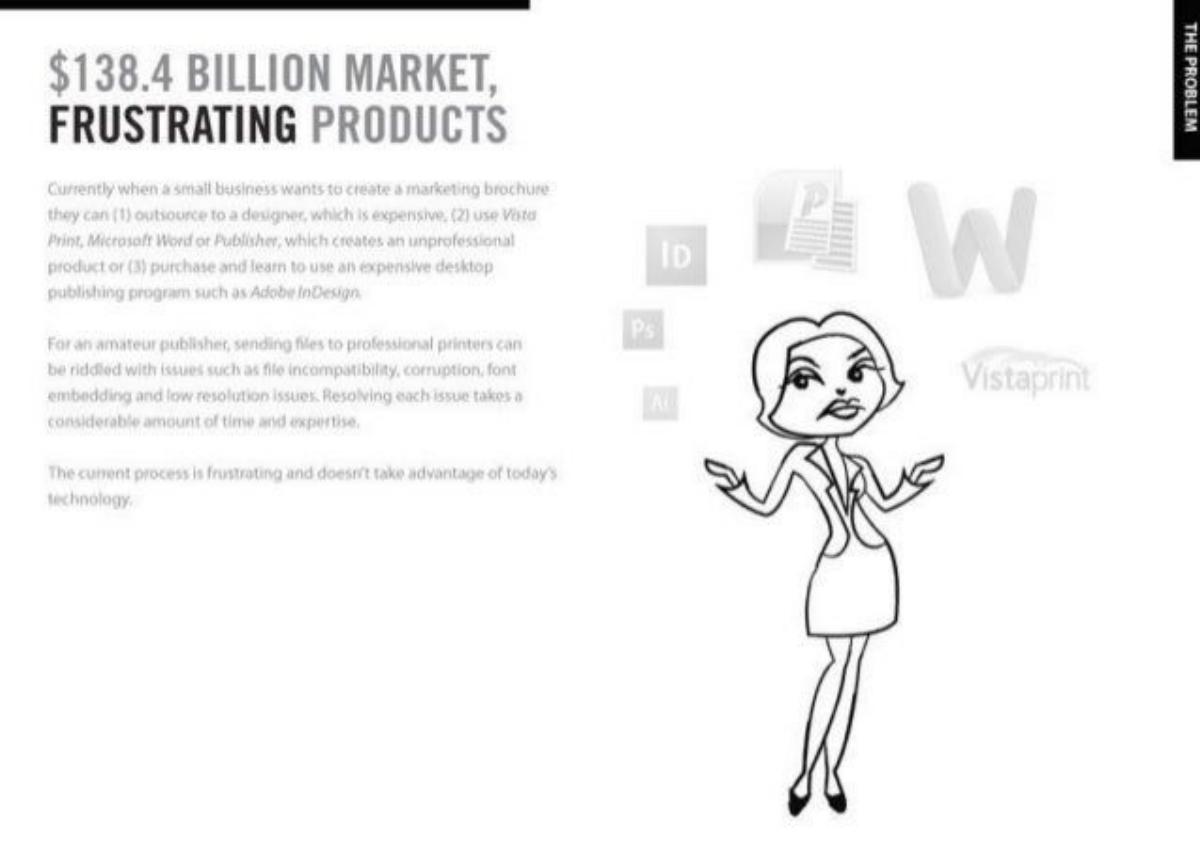
Titled "$138.4 Billion Market, Frustrating Products," this slide uses a cartoon illustration of a frustrated professional to personify the pain points. It lists three current, suboptimal options for small businesses: expensive outsourcing, unprofessional DIY tools (Vistaprint, Microsoft Word), or complex professional software (Adobe InDesign). It specifically calls out technical hurdles like "file incompatibility, corruption, font embedding and low resolution issues" as time-consuming barriers for amateurs.
Slide 4: The Solution
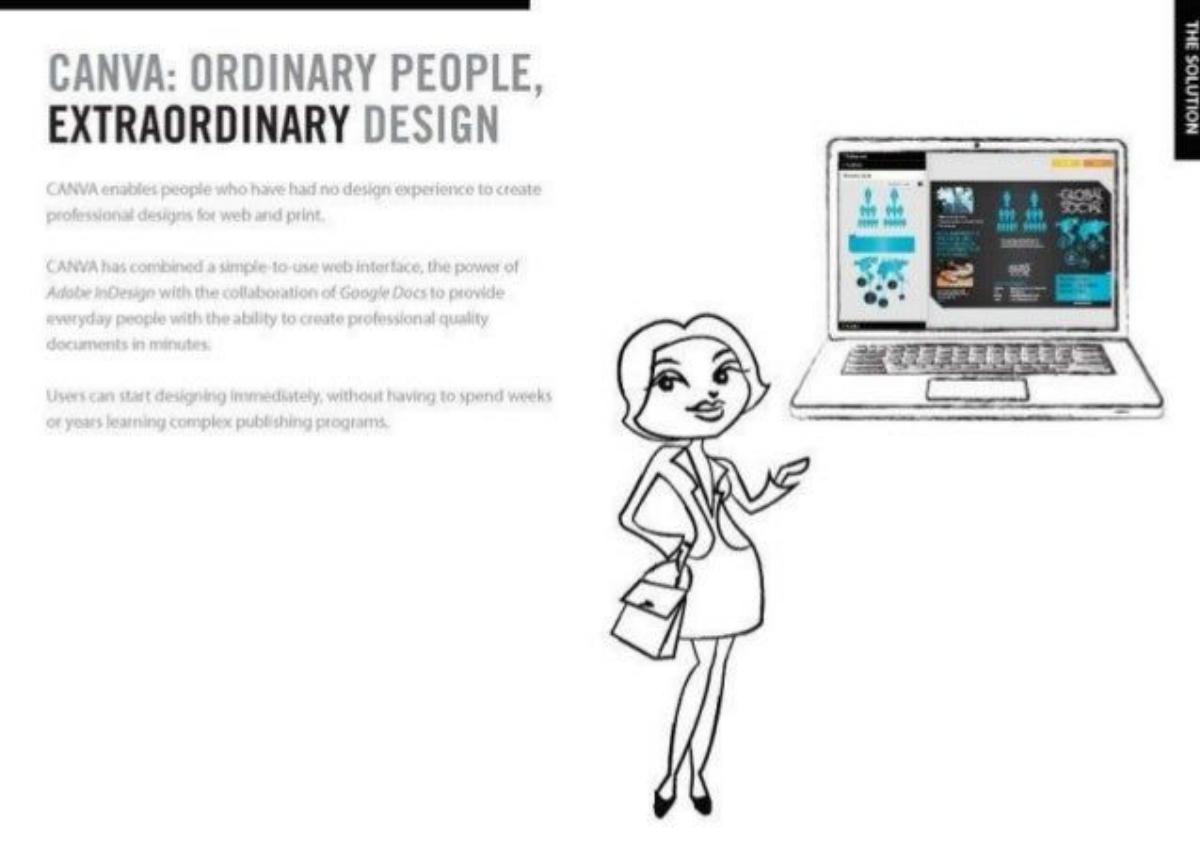
Canva introduces itself as the bridge between professional quality and ease of use. The slide explicitly compares the product's utility to a combination of "the power of Adobe InDesign with the collaboration of Google Docs." The value proposition is clear: professional designs in minutes without years of learning. A laptop mockup shows a clean, web-based interface, reinforcing the accessibility of the tool.
Slide 5: Print and Social Integration
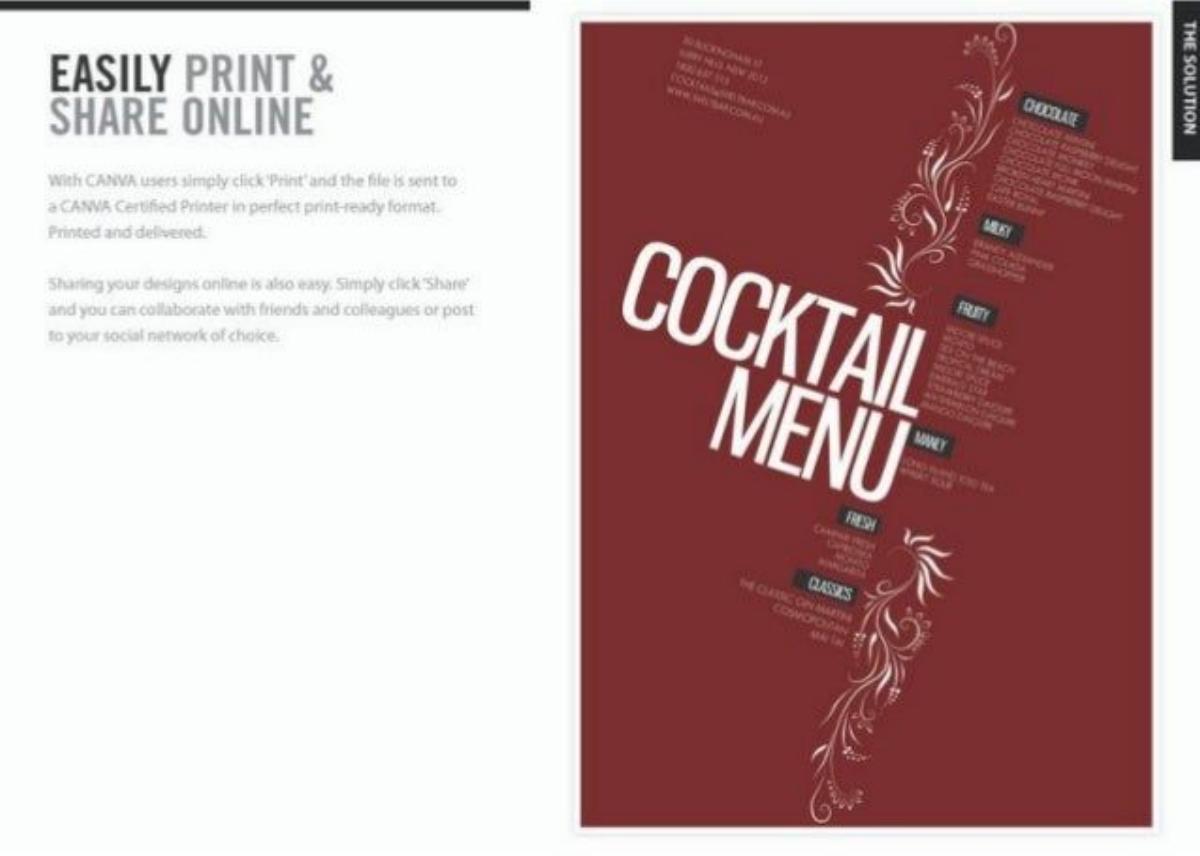
This slide focuses on the output. It claims users can simply click 'Print' to send files to a "CANVA Certified Printer" or click 'Share' to post to social networks. By including a high-quality cocktail menu as a visual example, the deck demonstrates that the output is indistinguishable from professional agency work.
Slide 6: The Ecosystem Aggregate
Under the heading "Communities: The Key to Success," Canva explains its platform model. It positions itself as an aggregate for five groups: Designers (supplying layouts), Photographers (supplying stock photos), Print Companies (receiving work), Design Agencies (sharing editable work with clients), and Companies (creating branded content). This slide shifts Canva from a simple SaaS tool to a central hub for the entire design industry.
Slide 7: Virality and Growth
This is one of the most detailed slides in the deck. It explains the "Tentacles" strategy: millions of photos and layouts indexed by search engines. The flow chart shows a six-step user journey: Search -> Find -> Play -> Account -> Share with Friends -> Intros to Workplace. This demonstrates a clear understanding of low-cost customer acquisition and the potential for bottom-up enterprise adoption.
Slide 8: Monetization Strategy
Canva outlines a freemium model where users are "hooked before they have to pay." The slide provides a table of "Average Yearly Spend by User Group," ranging from $40 for students to $700 for small business owners. Revenue sources include "Sliced Art," backgrounds, printing, and an annual subscription ($15/month) specifically targeted at graphic designers. This diversified model shows multiple paths to profitability.
Slide 9: The Fusion Books Pedigree
To de-risk the investment, Slide 9 highlights the founders' previous venture, Fusion Books. It describes it as an online publishing system for school yearbooks used by hundreds of schools in Australia, France, and New Zealand. The key takeaway here is that Fusion Books will give Canva "full use of all its Intellectual Property," providing a technological head start.
Slide 10: The Team
The team slide features Melanie Perkins and Cliff Obrecht, emphasizing their experience with Fusion Books. It also introduces Olivier Bierlaire as Lead Developer and Lars Rasmussen as Technical Advisor. The slide includes a powerful testimonial from Rasmussen (co-founder of Google Maps), stating that Melanie and Cliff "have the chops to pull it off," which provides significant third-party validation.
Slide 11: Roadmap and Milestones
Titled "Canva's Path to Success," this slide provides a Gantt chart covering May 2012 through mid-2013. Key milestones include building the stock photography and layout libraries, launching the Beta in February 2013, and commencing customer acquisition. It sets clear expectations for the development timeline and the transition from research to launch.
Slide 12: Market Segmentation (Appendix)
The final slide is a hierarchical breakdown of the $138.4 billion market. It segments the industry into the Print Industry ($80B), Desktop Publishing ($32.6B), Design Services ($24B), and Stock Photos ($1.8B). It further breaks down the Desktop Publishing segment into Adobe InDesign ($11.9B) and Microsoft Word/Publisher ($20.7B). This level of granularity proves the founders have done deep homework on where exactly their revenue will come from.
What Works in the Canva Deck
The 'Power of X + Ease of Y' Framing: Comparing the product to Adobe InDesign (power) and Google Docs (collaboration) is a brilliant shorthand. It immediately tells an investor what the product does and how it feels to use it without requiring a live demo.
Proof of Execution: Many seed decks are purely theoretical. By including the history of Fusion Books, Canva proved they could build software, acquire customers, and generate profit. This significantly lowers the perceived risk for an early-stage investor.
The Virality Map: Slide 7 is a standout. It doesn't just say "we will go viral"; it explains the mechanics of SEO 'tentacles' and the transition from individual use to workplace adoption. This shows a sophisticated go-to-market strategy that goes beyond simple paid advertising.
What is Missing from the Canva Deck
The Financial Ask: Surprisingly, the deck does not include a slide stating how much money they are raising or how they plan to allocate the funds. While the catalogue facts state they raised $6.6M, the deck itself leaves the 'ask' for the conversation.
Unit Economics: While Slide 8 projects average yearly spend, it lacks data on Customer Acquisition Cost (CAC) or Lifetime Value (LTV). For a freemium model, these metrics are usually critical, though perhaps less expected in a 2012 seed-stage deck.
Competitive Landscape: The deck mentions Adobe and Microsoft as 'frustrating products,' but it doesn't include a traditional competitive matrix. It assumes that being the only 'easy' and 'collaborative' tool is enough of a differentiator.
What Founders Should Copy
Market Sizing by Segment: Don't just throw out a trillion-dollar number. Copy Canva’s Appendix slide (Slide 12). Break the market down into specific sub-sectors and existing competitors to show exactly whose lunch you are eating.
Leveraging Niche Success: If you have built a smaller version of your vision, highlight it. Canva used Fusion Books to prove they understood the 'niche' before asking for capital to tackle the 'world stage.'
Focus on the Ecosystem: Canva didn't just pitch a design tool; they pitched a platform that connects photographers, designers, and printers. Founders should look for ways to frame their product as the 'connective tissue' of an industry rather than just another standalone app.
Visual Consistency: Despite being a deck from 2012, the slides are clean, use consistent fonts, and avoid clutter. For a design company, the deck itself must be a testament to the product's vision, and Canva succeeded here by keeping the focus on the message rather than over-designed graphics.
Frequently asked questions
- What was the primary problem Canva identified in 2012?
- Canva identified that the $138.4 billion desktop publishing market was dominated by 'frustrating products.' They highlighted three expensive or inefficient paths for small businesses: outsourcing to designers, using unprofessional tools like Microsoft Word, or learning complex software like Adobe InDesign. Slide 3 specifically notes that amateur publishers struggle with technical issues like font embedding and file incompatibility.
- How did Canva plan to acquire users according to the deck?
- Canva's growth strategy, detailed on Slide 7, relied on 'Search Engines & Virality.' They planned to create a library of millions of photos and layouts that act as 'tentacles' on search results. Once a user clicks into the editor, they must create an account to save or share, which then leads to social sharing and eventual introduction into the workplace.
- What was the significance of Fusion Books in this pitch?
- Fusion Books was the founders' first company, a niche publishing system for school yearbooks. On Slide 9, the deck explains that Fusion Books would give Canva full use of its Intellectual Property. This served as a 'proof of concept,' showing investors that the team had already turned an idea into a profitable product in a niche market.
- How did Canva intend to make money?
- Slide 8 outlines a freemium model with diverse revenue streams. Revenue comes from 'micropayments' for digital assets (sliced art, backgrounds) and a percentage of printing services. The deck projects different average yearly spends per user group: Small Business Owners ($700), Graphic Designers ($380), Consumers ($80), and Students ($40).
- Who were the key team members mentioned in the seed deck?
- The team included Melanie Perkins (CEO & Founder) and Cliff Obrecht (Founder), both of whom co-founded Fusion Books. They were joined by Lead Developer Olivier Bierlaire, who had experience at Orange and Amadeus, and Technical Advisor Lars Rasmussen, the co-founder of Google Maps (Slide 10).