Investigate Washington is a non-profit initiative proposed in collaboration with the Philip Merrill School of Journalism at the University of Maryland. The deck outlines a service-based model providing localized data and research assistance to regional, freelance, and student journalists. Its primary value proposition is the 'extra hands' of J-school students who receive stipends and experience in exchange for assisting professional reporters. Financially, the model is heavily reliant on foundation grants, which are projected to cover over 80% of Year 1 expenses. While the deck identifies a c…
Key takeaways
- The organization operates as a non-profit in collaboration with the Philip Merrill School of Journalism at UMD (Slide 2).
- The core service offering includes a website, personal research services, and localized data sets (Slide 2).
- A sample data set provided shows detailed lease information, including addresses, square footage, and annual rent figures (Slide 3).
- The target market is segmented into local/regional reporters, freelancers, and journalism students (Slide 4).
- The proposed Board of Directors consists of 'possible members' from the Fund for Investigative Journalism and Investigative News Network (Slide 6).
- Year 1 operations are budgeted at $80,700, with total annual salaries fixed at $170,000 for the first three years (Slide 7).
- Student stipends are allocated $25,000 annually across the three-year projection (Slide 7).
- Revenue is highly dependent on foundation grants, starting at $226,700 in Year 1 and decreasing to $179,450 by Year 3 (Slide 7).
Executive Summary: The Regional Reporting Gap
Investigate Washington addresses a structural decline in the American media landscape: the disappearance of regional bureaus in the nation's capital. As local newspapers have shuttered their D.C. offices, the ability to track how federal policy and spending affect specific municipalities has diminished. This deck proposes a centralized portal to bridge that gap, using a non-profit, university-affiliated model to provide the research labor that local newsrooms can no longer afford.
Slide 1: Title and Mission
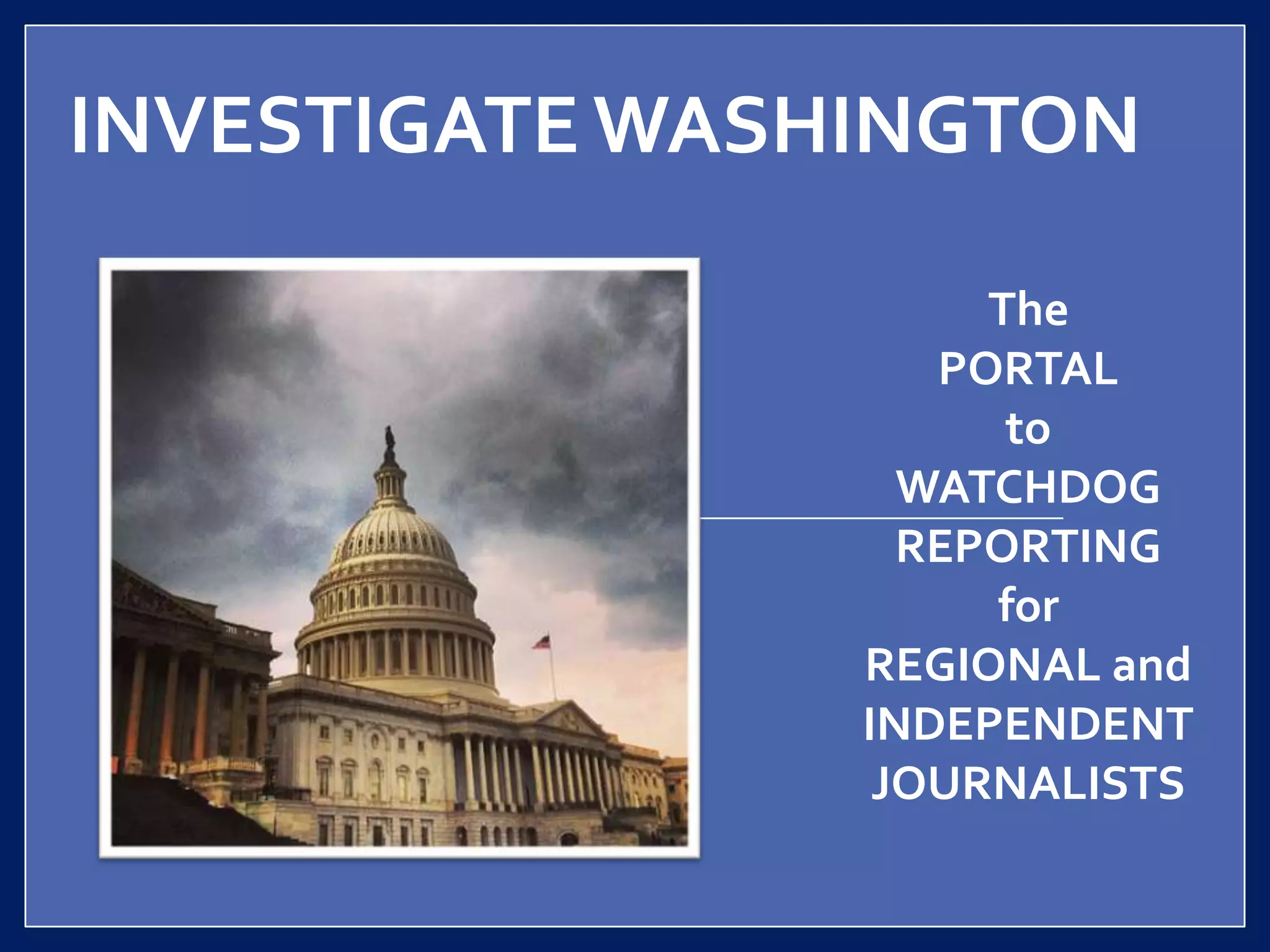
The opening slide establishes the brand identity: "Investigate Washington." It defines itself as "The PORTAL to WATCHDOG REPORTING for REGIONAL and INDEPENDENT JOURNALISTS." The imagery of the U.S. Capitol under a stormy sky reinforces the "watchdog" and "investigative" nature of the project. The value proposition is clear from the outset: it is a service for those outside the D.C. bubble who need access to the information within it.
Slide 2: The Solution and UMD Collaboration
Slide 2 introduces the organizational structure. Investigate Washington is a non-profit working in collaboration with the Philip Merrill School of Journalism. The solution is broken down into three pillars: Website and Personal Service , Localized Data , and Extra Hands of UMD J-School Students . This slide is critical because it moves the project from a vague concept to a specific resource-sharing model. The inclusion of the University of Maryland (UMD) provides immediate institutional credibility.
Slide 3: Our Services - Localized Data Example
To demonstrate the "Localized Data" pillar, Slide 3 shows a spreadsheet of real estate lease data. The table includes fields such as Lease Number, Address, City, Square Feet, Annual Rent, and Lessor Name. The locations listed (Westbury, Hempstead, Holtsville) suggest a focus on regional impact. By showing a raw data set, the deck proves it has the capability to extract and organize specific, actionable information that a regional reporter could turn into a story about government spending or local real estate trends.
Slide 4: Market and Marketing
The market is segmented into three tiers: Local and Regional Reporters, Freelance Reporters, and Journalism Students. The marketing strategy is lean, focusing on "Recruiting Through Organizations" and "Networking Across J-Schools." This suggests a B2B2C approach, where the organization reaches individual journalists by partnering with existing professional bodies (like IRE or SPJ, though not named on this slide).
Slide 5: The Sales Pitch
This slide reiterates the benefits for both the users and the student workers. For reporters, the draw is "Needed Localized Data." For the students, the draw is "Experience and Stipend." This creates a circular value proposition: the students get paid to learn, and their work provides the data that makes the service valuable to professional reporters. It positions the organization as a talent incubator as much as a data clearinghouse.
Slide 6: Board of Directors (Prospective)
The deck lists four "Possible members" for the Board of Directors. These include Sandy Bergo (Executive, Fund For Investigative Journalism), Ken Davis (CEO, Investigative News Network), Lucy Dalglish (Dean, UMD Merrill College), and Deborah Nelson (Associate Professor, UMD). While these are high-authority names in the industry, the qualifier "Possible members" is a significant caveat. It shows the founders know who they need to attract but haven't secured the formal commitments required to claim a fully formed board.
Slide 7: The Three-Year Financial Plan
The final slide provided offers a detailed breakdown of expenses and revenue. Expenses: Salaries are the largest line item at a flat $170,000 per year. Operations start at $80,700 in Year 1 and drop to $45,450 in subsequent years. Student stipends are set at $25,000 annually. Revenue: The model is grant-heavy. Foundation grants are projected at $226,700 in Year 1, $187,450 in Year 2, and $179,450 in Year 3. Membership dues and service fees are nominal, starting at a combined $8,000 and growing to $20,000 by Year 3. UMD provides a consistent $41,000 in in-kind support.
What Works in This Deck
Clear Institutional Alignment: The partnership with the University of Maryland is the deck's strongest asset. It solves the problem of expensive labor by utilizing students who are already incentivized to do this type of work for credit and experience. This makes the "Extra Hands" value proposition highly believable.
Specific Data Examples: By including Slide 3, the founders move past abstract promises. Showing a specific table of lease data proves they understand what "watchdog reporting" actually looks like at the granular level. It shows they are focused on the "boring" but essential data that often hides the best stories.
Transparent Financials: The financial slide does not attempt to hide the project's reliance on grants. By breaking out "in-kind" support vs. cash revenue, the founders provide a realistic look at how a journalism non-profit actually functions in its early years.
What Is Missing From This Deck
The "Ask": The provided slides do not include a specific funding request. While the budget shows a need for ~$226k in Year 1 grants, there is no slide stating, "We are seeking $X to fund the first 18 months of operations."
The Core Team: While the board is listed, the actual day-to-day operators are not. Who is the Executive Director? Who is managing the students? In a service-based non-profit, the pedigree of the management team is as important as the board.
Sustainability Strategy: The revenue from membership and ads stays extremely low (under 10% of the total budget) through Year 3. There is no indication of how the organization survives if foundation interest wanes after the initial launch period. A "Path to Sustainability" slide is a common requirement for non-profit pitches.
Technology Stack: The deck mentions a "Website," but for a data-heavy portal, there is no mention of how the data is stored, searched, or delivered. Is this a custom build or a third-party platform?
Founder Lessons and Takeaways
Be Honest About Board Status: Investigate Washington correctly labeled their board as "Possible members." Founders often make the mistake of listing advisors or board members who have only had a casual coffee with them. Being transparent about the "prospective" nature of the board builds trust with sophisticated donors who will likely back-channel those individuals.
Leverage In-Kind Partnerships: If you are a social impact startup, finding a university or government partner can subsidize your biggest costs. The $41,000 in-kind support from UMD is a significant portion of their total "revenue" and makes the grant request more palatable because the founders have already secured institutional buy-in.
Show, Don't Just Tell, the Data: Many journalism or data startups talk about "insights." This deck actually shows a spreadsheet. For a technical or specialized audience, seeing the format of the output is more convincing than a dozen slides of marketing copy. If your product produces a report or a data set, put a screenshot of that report in the deck.
Address the Labor Problem: The "Extra Hands" concept is a clever way to handle the high cost of investigative research. Founders should always look for ways to align their labor needs with the educational or professional goals of their workforce. By paying stipends instead of full salaries for research assistants, they keep their burn rate manageable while fulfilling a secondary mission of training the next generation of journalists.
Frequently asked questions
- What is the primary business model for Investigate Washington?
- Investigate Washington operates as a non-profit entity. Its financial model is built on a foundation of philanthropic support, with grants accounting for the vast majority of its budget. It also projects minor revenue streams from membership dues, service fees, and advertising, alongside in-kind support from the University of Maryland.
- How does the organization utilize university resources?
- The collaboration with the Philip Merrill School of Journalism is central to the pitch. The university provides 'in-kind' support valued at $41,000 annually. More importantly, journalism students provide the labor force ('extra hands') to help reporters process data, gaining professional experience and a stipend in return.
- Who are the intended customers or users of this service?
- The deck identifies three primary user groups: local and regional reporters who lack a D.C. presence, freelance journalists who need research support, and journalism students looking for real-world investigative experience. The 'sales pitch' focuses on providing these groups with localized data that is otherwise difficult to obtain.
- Is the Board of Directors finalized in this deck?
- No. Slide 6 explicitly lists the names under the heading 'Possible members.' This indicates that while the founders have identified high-profile individuals from the investigative journalism community, these individuals had not yet formally committed to the board at the time of the presentation.
- What are the biggest financial risks identified in the projections?
- The primary risk is the heavy reliance on foundation grants, which make up roughly 82% of the Year 1 budget. While the deck projects a slight increase in membership dues and service fees by Year 3, these internal revenue streams remain insufficient to cover even the basic operations cost, let alone salaries.