Board of Directors Slide: Real Pitch Deck Examples
Should a startup show its board in a pitch deck, and how? Six real board of directors slides compared: investor seats, independent directors.
Board of Directors Slide: Real Pitch Deck Examples
Six board of directors slides from real startup pitch decks, shown in full, compare what a board slide tells an investor about who controls the company and who is helping it.
TL;DR
A board slide tells investors who holds formal control of the company: who votes on budgets, new rounds, executive hiring and a sale. So the useful version says what each seat is, not just who sits in it. The clearest example below (Healx) labels every director by seat type: founding director, investor director with the fund named, independent-style board director, and chairman. Investors can see straight away which funds already have a seat. The weakest board slides list possible members who haven't agreed to join (Investigate Washington), or spend a whole slide on one director's biography (Airium). Most seed-stage startups don't need a separate board slide at all; if the board is just the founders, say so on the team slide. Add a board slide when the board includes outside investors or experienced independent directors, and label each seat.
Board of directors slides from real pitch decks
Each example shows the exact page from the original deck above its analysis and links to the full teardown. Names, titles and affiliations are reproduced as printed on the slides; we have not checked them against company filings. Page numbers are PDF pages.
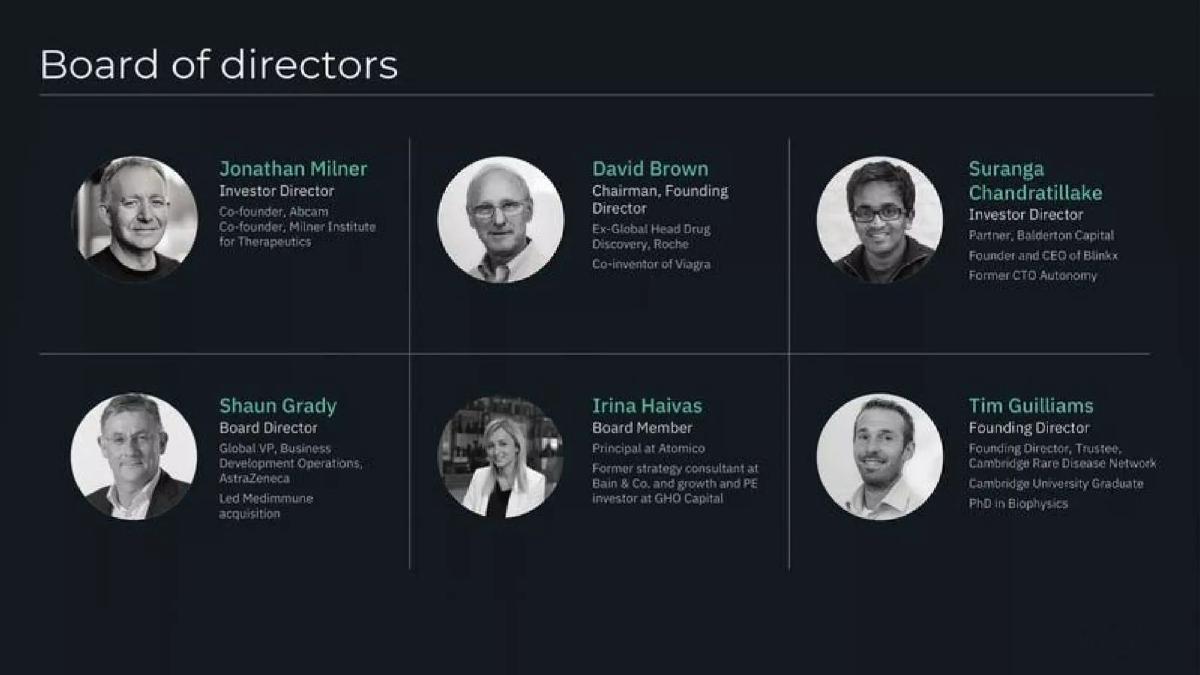
Healx team slide — slide 14
AI drug discovery for rare diseases. Stage and year are not stated on the slide.
Healx deck, slide 14. Exact stored slide matched to this analysis.
Our analysis: Every seat is labelled, so an investor can see who represents founders, who represents which fund, and who brings industry experience. The chairman's drug-discovery background matches the business.
Evidence and limitation: "Board Director" and "Board Member" are used for different people without explanation; Haivas is from Atomico, so her seat may be an investor seat or an observer seat. Use one set of labels and say which seats vote.
What a founder can adapt: Give every director a seat label and, for investor seats, name the fund.
Supporting analysis
What the deck claims: Six directors, each with a seat label: Jonathan Milner, "Investor Director" (co-founder, Abcam); David Brown, "Chairman, Founding Director" (ex-Global Head Drug Discovery, Roche; co-inventor of Viagra); Suranga Chandratillake, "Investor Director" (Partner, Balderton Capital); Shaun Grady, "Board Director" (Global VP, Business Development Operations, AstraZeneca); Irina Haivas, "Board Member" (Principal at Atomico); Tim Guilliams, "Founding Director".
Presentation choice: Every seat is labelled, so an investor can see who represents founders, who represents which fund, and who brings industry experience. The chairman's drug-discovery background matches the business.
When it does not fit: "Board Director" and "Board Member" are used for different people without explanation; Haivas is from Atomico, so her seat may be an investor seat or an observer seat. Use one set of labels and say which seats vote.
Online marketplace. The deck is filed as a $550K angel round in our library; stage and year are not stated on the slide.
Mio Marketplace deck, slide 15. Exact stored slide matched to this analysis.
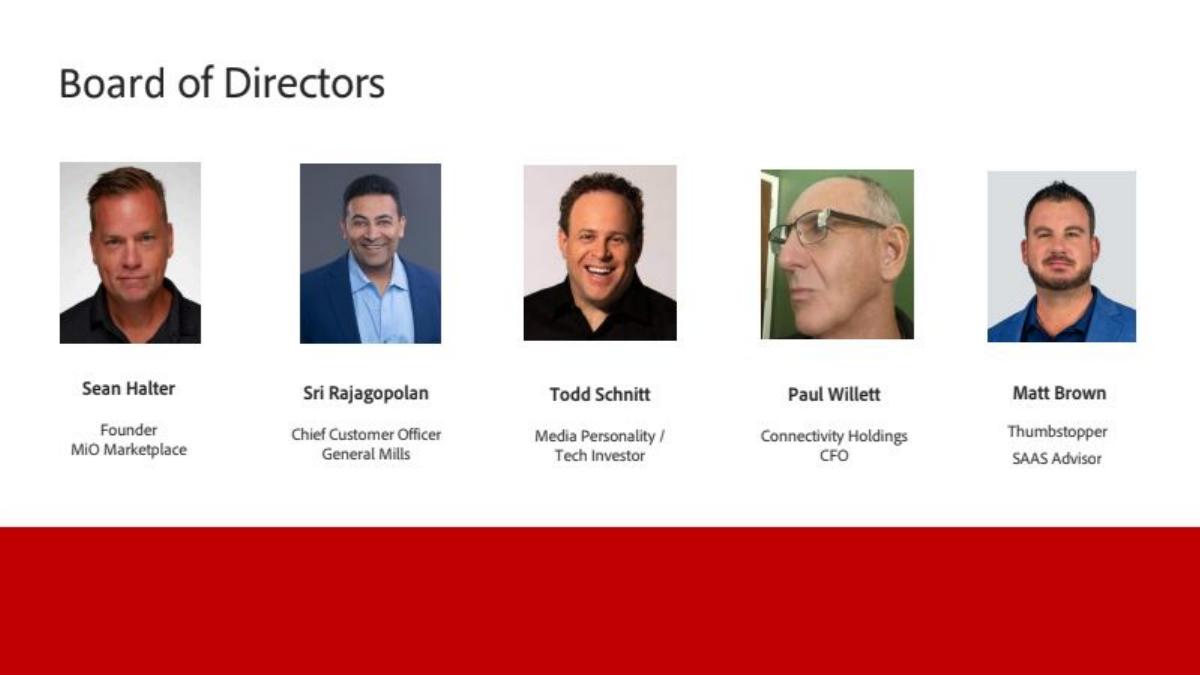
Our analysis: It is short and scannable, and naming a senior customer executive at a large consumer company signals relevant experience.
Evidence and limitation: No seat types are given, so investors can't tell who invested, who is independent, or whether this is a formal board at an angel stage. Add a label for each, and confirm that everyone listed holds a formal board seat rather than an advisory role.
What a founder can adapt: Keep the one-line format, but make the line say why the person is on this board.
Supporting analysis
What the deck claims: "Board of Directors": five photos with one line each: Sean Halter (Founder, MiO Marketplace), Sri Rajagopolan (Chief Customer Officer, General Mills), Todd Schnitt (Media Personality / Tech Investor), Paul Willett (Connectivity Holdings CFO), Matt Brown (Thumbstopper, SAAS Advisor).
Presentation choice: It is short and scannable, and naming a senior customer executive at a large consumer company signals relevant experience.
When it does not fit: No seat types are given, so investors can't tell who invested, who is independent, or whether this is a formal board at an angel stage. Add a label for each, and confirm that everyone listed holds a formal board seat rather than an advisory role.
Healthcare scheduling software, UK limited company. The board section runs across three slides (35 to 37); this is the first.
PatientSchedulingApp deck, slide 35. Exact stored slide matched to this analysis.
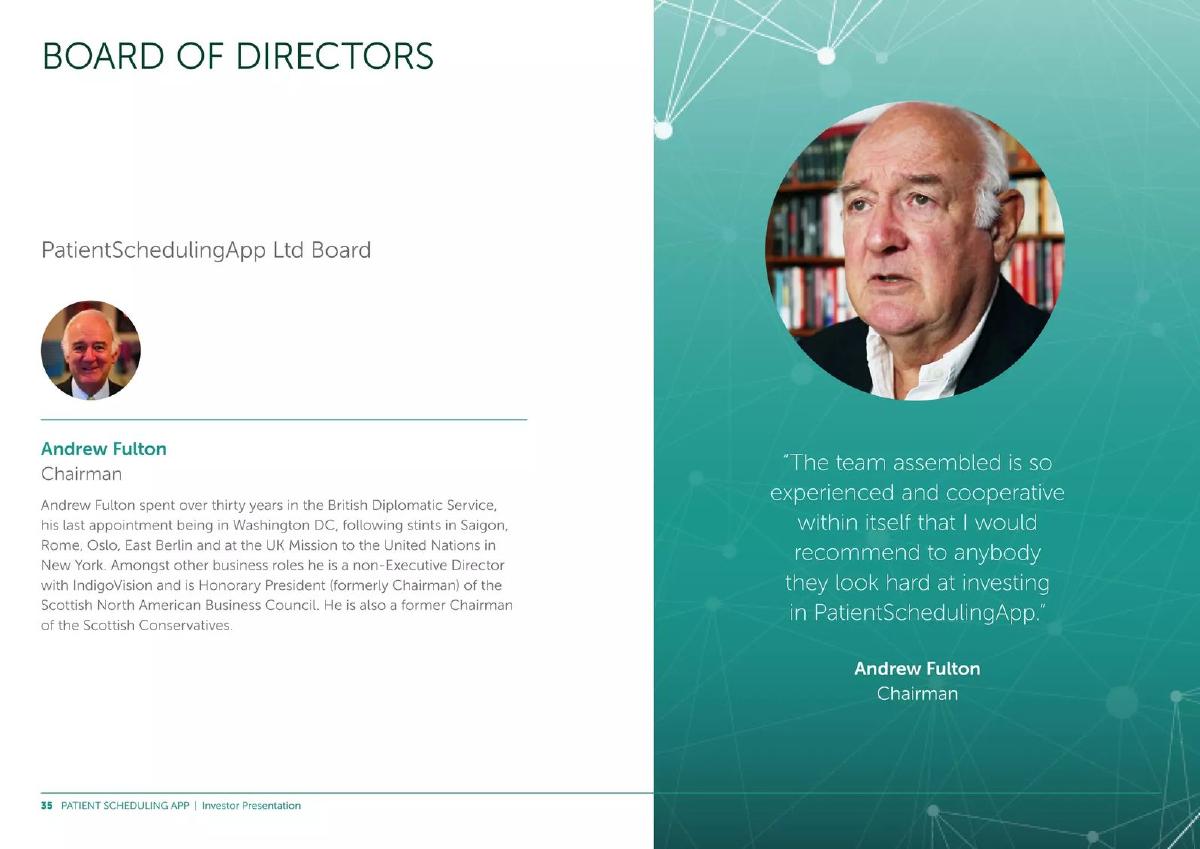
Our analysis: It names the chair, the legal entity whose board it is, and his other non-executive role.
Evidence and limitation: The chairman's quote is an insider recommending the investment, so investors will give it little weight. His diplomatic career is not obviously relevant to healthcare scheduling; say what he does for this board. Fitting the whole board onto one slide would save two pages.
What a founder can adapt: Naming the company entity is a good habit when a group has more than one company.
Supporting analysis
What the deck claims: "PatientSchedulingApp Ltd Board": Andrew Fulton, Chairman, "spent over thirty years in the British Diplomatic Service", non-executive director with IndigoVision, honorary president of the Scottish North American Business Council. Beside it, a large quote from him: "The team assembled is so experienced and cooperative within itself that I would recommend to anybody they look hard at investing in PatientSchedulingApp."
Presentation choice: It names the chair, the legal entity whose board it is, and his other non-executive role.
When it does not fit: The chairman's quote is an insider recommending the investment, so investors will give it little weight. His diplomatic career is not obviously relevant to healthcare scheduling; say what he does for this board. Fitting the whole board onto one slide would save two pages.
Proposed investigative journalism venture. Stage and year are not stated on the slide.
Investigate Washington deck, slide 11. Exact stored slide matched to this analysis.
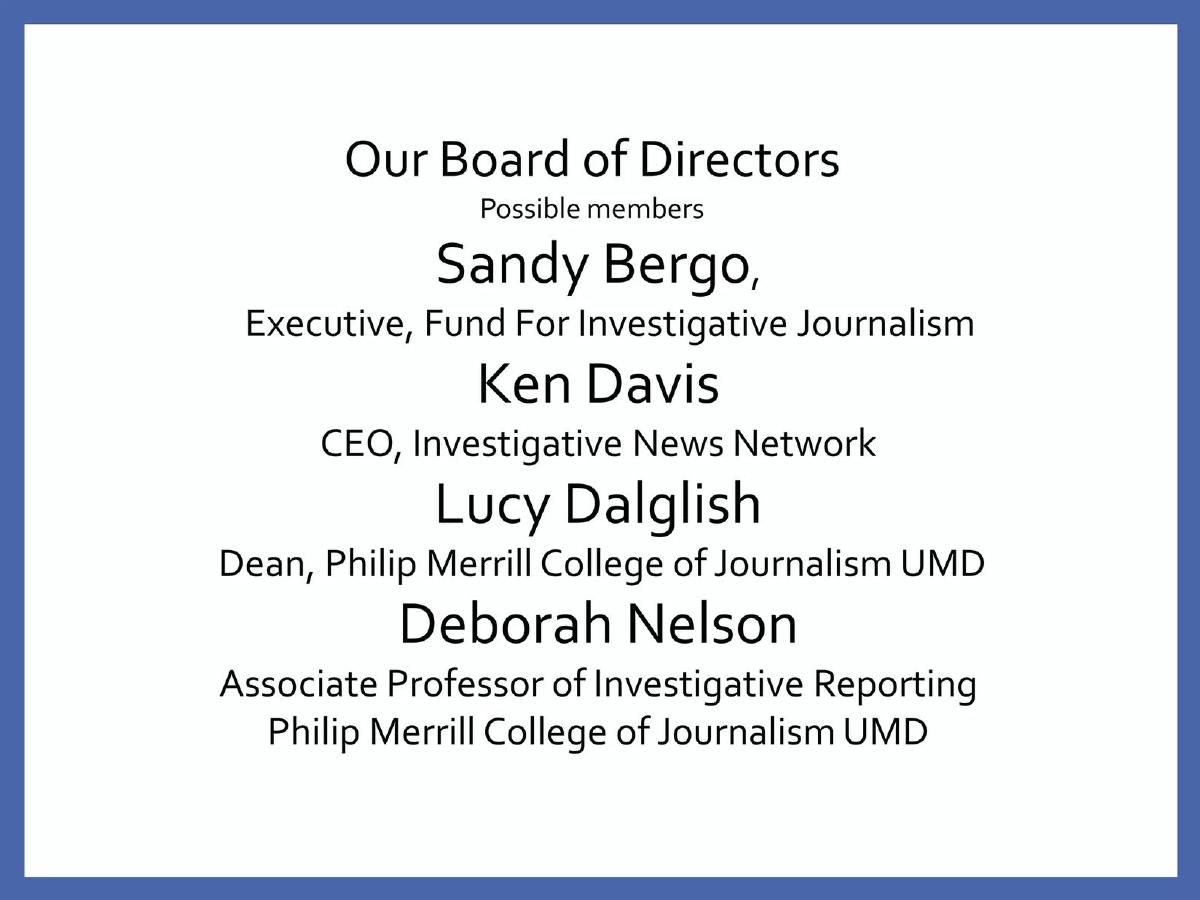
Our analysis: The names are relevant to the field, and the slide does say they are only possible members.
Evidence and limitation: The headline says "Our Board" but nobody listed has agreed to serve. An investor who calls one of them may find they've never heard of the venture.
What a founder can adapt: Treat this as a slide to avoid. If you are recruiting a board, say so in words ("We are recruiting two independent directors with newsroom experience") without naming people who haven't agreed.
Supporting analysis
What the deck claims: "Our Board of Directors" with the subtitle "Possible members", followed by four names and titles: Sandy Bergo (Executive, Fund For Investigative Journalism), Ken Davis (CEO, Investigative News Network), Lucy Dalglish (Dean, Philip Merrill College of Journalism UMD), Deborah Nelson (Associate Professor of Investigative Reporting, Philip Merrill College of Journalism UMD).
Presentation choice: The names are relevant to the field, and the slide does say they are only possible members.
When it does not fit: The headline says "Our Board" but nobody listed has agreed to serve. An investor who calls one of them may find they've never heard of the venture.
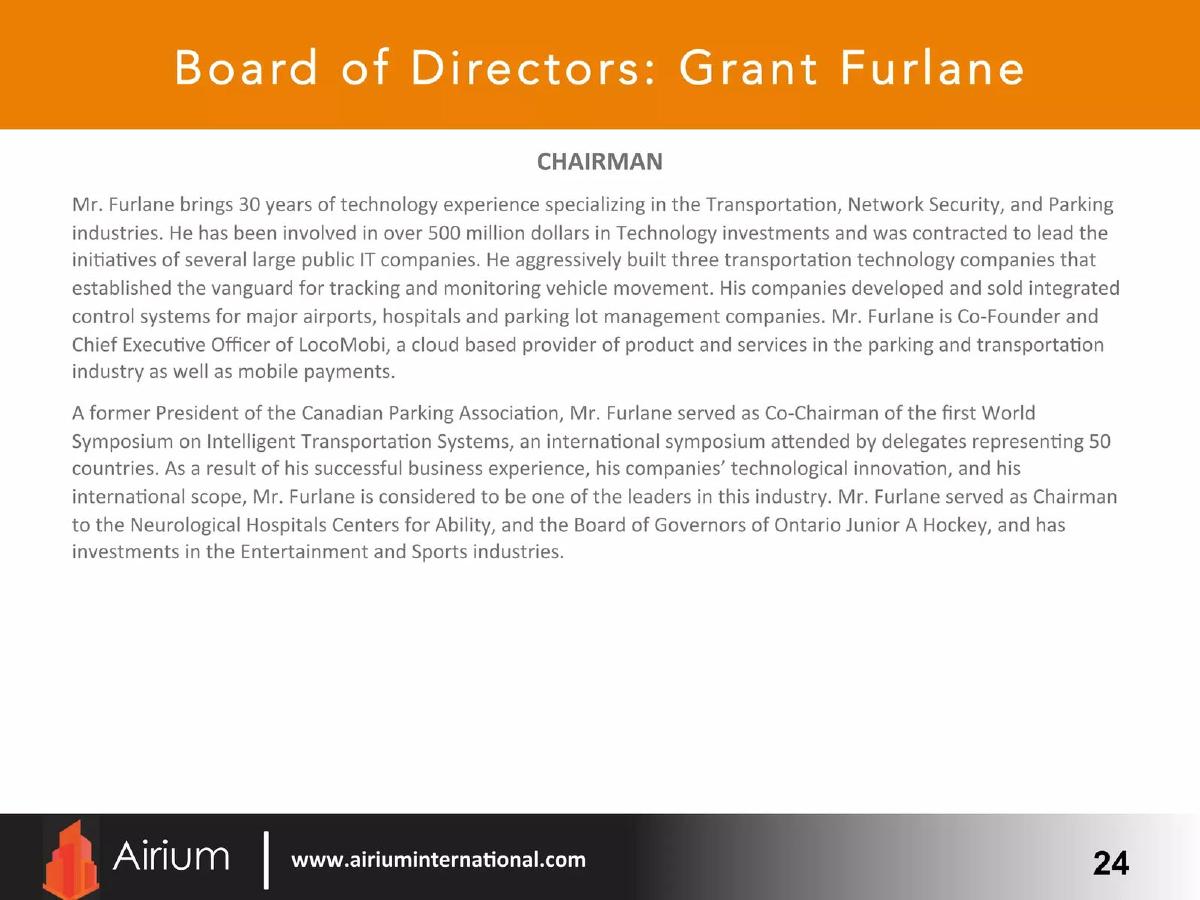
Cloud hotel management software. The deck is dated June 2015 on its cover and was used for crowdfunding; the board runs across four slides (24 to 27) in the appendix.
Airium deck, slide 24. Exact stored slide matched to this analysis.
Our analysis: Putting full biographies in the appendix keeps the main deck short, and the chair's parking and payments background relates to building technology products.
Evidence and limitation: One director per slide makes the board hard to see as a whole. "Involved in over 500 million dollars in Technology investments" doesn't say whether he invested, raised or advised on that money; state what the figure is or remove it.
What a founder can adapt: Keep long biographies in an appendix, as Airium does, but put a one-line summary of every director on one slide in the main deck.
Supporting analysis
What the deck claims: "Board of Directors: Grant Furlane — CHAIRMAN", followed by about 200 words: 30 years of technology experience in transportation, network security and parking; "involved in over 500 million dollars in Technology investments"; co-founder and CEO of LocoMobi; former President of the Canadian Parking Association.
Presentation choice: Putting full biographies in the appendix keeps the main deck short, and the chair's parking and payments background relates to building technology products.
When it does not fit: One director per slide makes the board hard to see as a whole. "Involved in over 500 million dollars in Technology investments" doesn't say whether he invested, raised or advised on that money; state what the figure is or remove it.
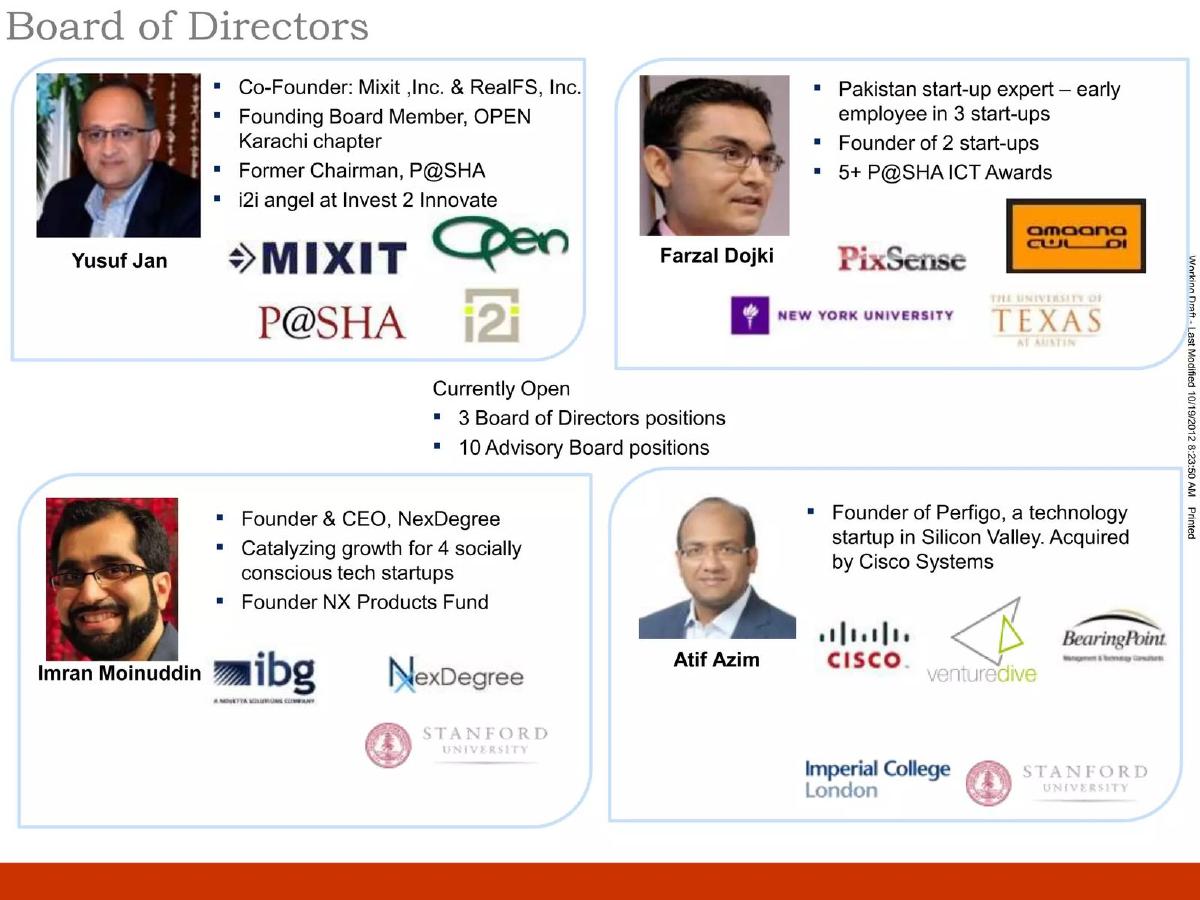
Startup accelerator in Karachi, formerly Karachi Plug and Play. The slide's margin shows a working-draft date of 10/19/2012.
DotZero deck, slide 6. Exact stored slide matched to this analysis.
Our analysis: Saying openly that three board seats are vacant tells an incoming investor a seat is available, and keeps board and advisory roles separate.
Evidence and limitation: Three open board seats beside four filled ones is a lot to leave empty; investors may ask why. Say what profile each open seat is for. Remove draft stamps before sharing a deck.
What a founder can adapt: If you have open seats, say how many and what kind of person you want in each.
Supporting analysis
What the deck claims: Four directors with bullet points and logos: Yusuf Jan (co-founder Mixit and RealFS; founding board member, OPEN Karachi; former chairman, P@SHA; i2i angel), Farzal Dojki (early employee in 3 start-ups; founder of 2; 5+ P@SHA ICT awards), Imran Moinuddin (founder & CEO, NexDegree), Atif Azim (founder of Perfigo, "Acquired by Cisco Systems"). In the centre: "Currently Open: 3 Board of Directors positions, 10 Advisory Board positions".
Presentation choice: Saying openly that three board seats are vacant tells an incoming investor a seat is available, and keeps board and advisory roles separate.
When it does not fit: Three open board seats beside four filled ones is a lot to leave empty; investors may ask why. Say what profile each open seat is for. Remove draft stamps before sharing a deck.
Each cell reports only what the slide itself states. "Not stated" means the page doesn't say.
Example
Seat type per person
Investor seats named
Board separated from management
Everyone confirmed
Healx
Yes (mixed labels)
Yes (Balderton, Atomico)
Yes
Yes
Mio Marketplace
Not stated
Not stated
Yes
Not stated
PatientSchedulingApp
Chairman only
Not stated
Yes
Yes
Investigate Washington
Not stated
Not stated
Yes
No ("Possible members")
Airium
Chairman, one per slide
Not stated
Yes
Yes
DotZero
Not stated
Not stated
Yes
Yes, plus 3 open seats
Key Takeaways
Label the seat, not just the person. Healx marks each director as founding, investor, chairman or board director, and names the fund behind each investor seat (Balderton, Atomico).
Investor seats are information. When a deck shows which funds already have board seats, a new investor can see who they'll be sitting with and what governance rights are already promised.
Separate the board from management. If executives and outside directors share one slide, say who holds a board seat (general guidance, not drawn from the examples below).
Only list people who have agreed. Investigate Washington headlines "Our Board of Directors" and then says "Possible members"; none of the four is confirmed.
Open seats can be stated honestly. DotZero shows four directors and says "Currently Open: 3 Board of Directors positions", which tells an incoming investor a seat may be available.
A director's quote isn't a customer reference. PatientSchedulingApp's chairman recommends investing in the company; he is an insider, so investors will discount it.
Write your board slide
One line per director, then one line on open seats if you have any.
Seat. Founding, investor (which fund), independent, chair or observer?
Vote. Does this person vote, or attend as an observer?
Relevance. What one past role makes them useful to this company?
Confirmed. Have they formally accepted the seat?
Open seats. Will the new lead investor get a seat? Are any other seats open, and for what profile?
Copyable framework: [Name] — [Seat type: Investor Director, [Fund]] — [one relevant past role]. Board after this round: [x] founders, [y] investors, [z] independent.
Illustrative example 1 — written by us
Before: Jane Doe — 20 years' experience, many boards, passionate about innovation
After: Jane Doe — Independent Director — former head of US sales, [Relevant Company]. Board after this round: 2 founders, 2 investors, 1 independent.
What improved: Our illustrative rewrite, not any company's text. It states the seat type and one relevant role, and shows the board's make-up after the round; bracketed values are placeholders.
Board slide, team slide or advisor slide?
The team slide shows who runs the company day to day. The advisor slide shows people who give advice but hold no formal power. The board is different: directors have legal duties to the company and vote on major decisions, including approving the budget, issuing new shares, hiring or firing the CEO, and agreeing to a sale. Many term sheets give the lead investor a board seat, so the board slide also hints at who already has governance rights.
That is why a board slide answers questions the other two don't. Who already has a vote? Is the board controlled by founders, by investors, or balanced with an independent director? Are there open seats the new lead might take? If your board is only the founders, which is common before a priced round, there is nothing for a separate slide to show. Put "Board: the two co-founders" on the team slide, or leave it to the data room.
Add a board slide when it carries information: an investor director from a known fund, an independent director with directly relevant experience, or a chairman who has built and sold a company in your market. Life sciences and hardware decks use board slides more often than software decks, because experienced directors help with regulators, manufacturing partners and later fundraising. Healx, a health company, is an example below.
What each seat type tells an investor
Founding director: a founder who sits on the board. This shows founders keep a vote, which most early investors expect.
Investor director: a partner from a fund that has invested. Naming the fund, as Healx does for Balderton and Atomico, tells a new investor which earlier backers have a vote and will be in the room. It also hints at the protective rights in earlier term sheets, which a new lead will ask to see.
Independent director: someone who is neither a founder nor an investor's representative. Independents are often added after a Series A to break ties and bring operating experience. Say what the person is independent of, and why they're on this board: a former head of a relevant business unit is more useful than a long list of unrelated directorships.
Chairman: the person who runs board meetings. If the chair is not the CEO, investors will want to know who they are and what they've done; Healx's chairman is a former global head of drug discovery at Roche, which is directly relevant to an AI drug-discovery company.
Observer: someone who attends board meetings without a vote, often a smaller investor. If your deck lists observers, label them as observers; calling them directors overstates their role.
What not to put on a board slide
Unconfirmed names. Listing people who have not agreed to serve, even with "possible" in small type, invites a reference call that will not go well. Wait until they have accepted, then add them.
Long biographies. A board slide should let an investor scan who holds each seat in seconds. Airium gives one director a whole slide and about 200 words, and repeats the pattern across four slides. Move full biographies to an appendix or the data room, and keep one line per director on the slide.
Unsupported claims. Airium's chairman is described as "involved in over 500 million dollars in Technology investments". It isn't clear whether that is money he invested, raised, or advised on. If you include a figure, say what it is.
Endorsements from directors. A board member praising the company is not independent evidence. Keep customer and expert voices for the testimonial slide, and let directors' track records speak for themselves.
Common mistakes
Listing people who haven't agreed. "Possible members" invites a reference call that will go badly.
Mixing board and management. Say who holds a board seat; a combined slide hides who has a vote.
No seat types. Label founding, investor (with fund), independent, chair and observer.
One director per slide. Show the whole board on one slide; move biographies to the appendix.
Vague figures in biographies. "Involved in $500M of investments" needs to say what the money was.
Director endorsements. Insiders praising the company aren't independent evidence.
Diagnostic checklist
Every director has a seat label, and investor seats name the fund.
Board members are clearly separated from executives and advisors.
Everyone listed has formally accepted the seat.
The whole board fits on one slide, one line per person.
The board's make-up after this round is stated, including any seat for the new lead.
Long biographies are in the appendix or data room.
Frequently asked questions
Do I need a board slide in a seed pitch deck?
Usually not. Before a priced round, many boards are just the founders, and a separate slide adds nothing. Mention the board on the team slide in one line. Add a dedicated slide when the board includes an investor director, an independent director or a chair whose experience matters to investors.
Should I say which investors have board seats?
Yes. A new investor will find out in diligence anyway, and seeing it up front shows you're open about governance. Healx names Balderton and Atomico beside their directors. If the new lead will take a seat, say what the board will look like after the round.
What's the difference between a board member and an advisor?
A director has legal duties to the company and votes on major decisions such as budgets, new shares, CEO hiring and a sale. An advisor gives advice and has no vote. Keep them on separate slides or clearly labelled, as DotZero does by counting open board and advisory positions separately.
Can I list people who've agreed in principle but haven't signed?
Only if you say exactly that, and only if they've agreed to be named. "Possible members" (Investigate Washington) suggests nobody has agreed. "Joining as independent director on closing" is clearer, if it's true.
Is a famous name on my board worth highlighting?
Only if their experience fits the company. A former executive from a large company in your own market is directly relevant. A well-known name from an unrelated field adds less, and investors may ask how much time they actually give the company.
How we chose these examples
Search (2026-10-01): the durable corpus index (docs/seo/artifacts/corpus-search, 70,729 unique pages, deduplicated by deck-file sha256 + page) was searched for "board of directors"; 262 pages matched. Existing team and advisor guides do not cover boards.
Removed in v2 (2026-10-05): Maui Imaging, because a page of its deck carries a restriction notice. Left out: listed or public companies (most matches, including mining, pharmaceutical and cannabis issuers), 1-Page (June 27 deck: "For personal use only" stock-exchange announcement), and Flow Water (board with independent directors and committee chairs matching the listed Flow Beverage Corp). Nine pages were rendered from the original deck files; seven were kept. None of these pages is used in another guide.
Our explanations: what board seat types mean and what directors vote on are general knowledge about startup governance, not stated on the slides.
How we built this: drafted and checked with AI assistance (editorial model review against the original slide images); no human editor has reviewed this guide. Names and titles are as printed on the slides and have not been checked against company filings.