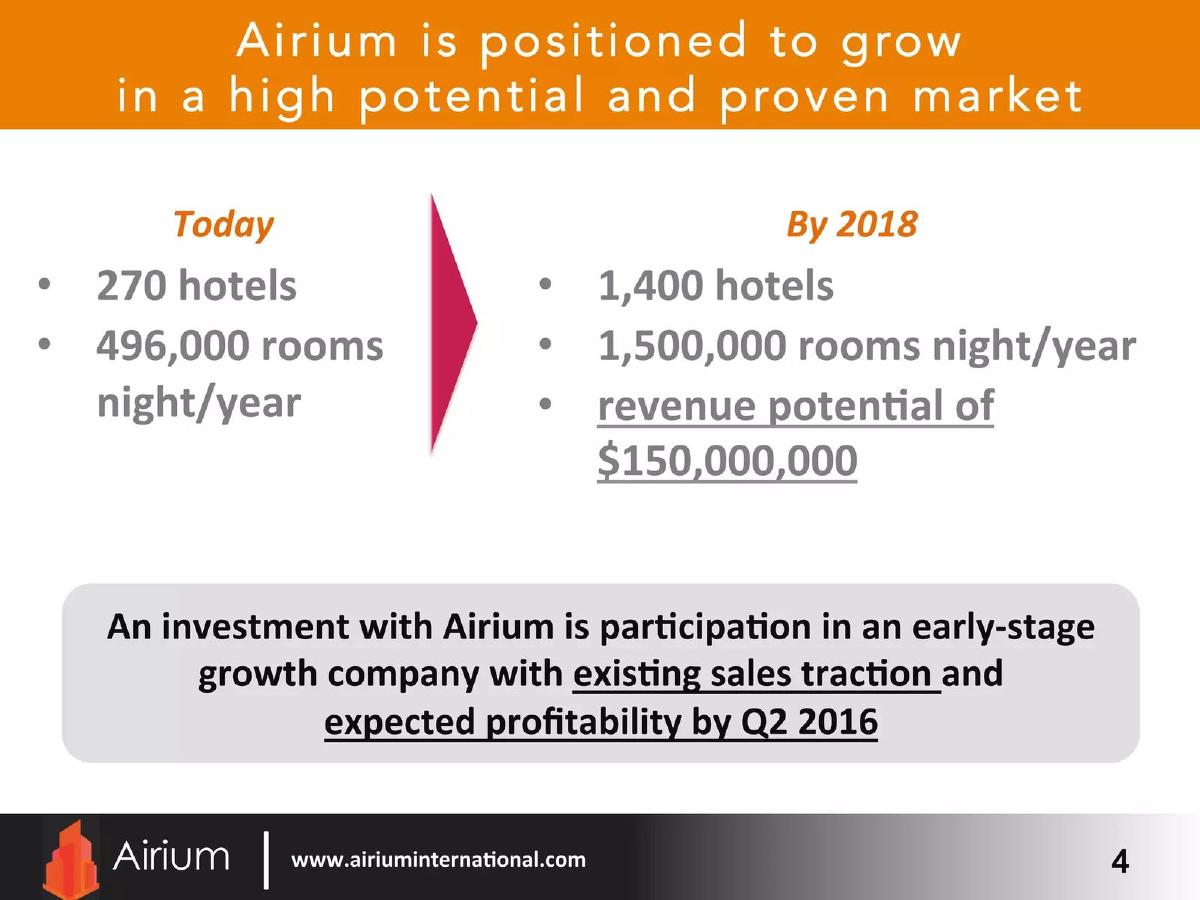
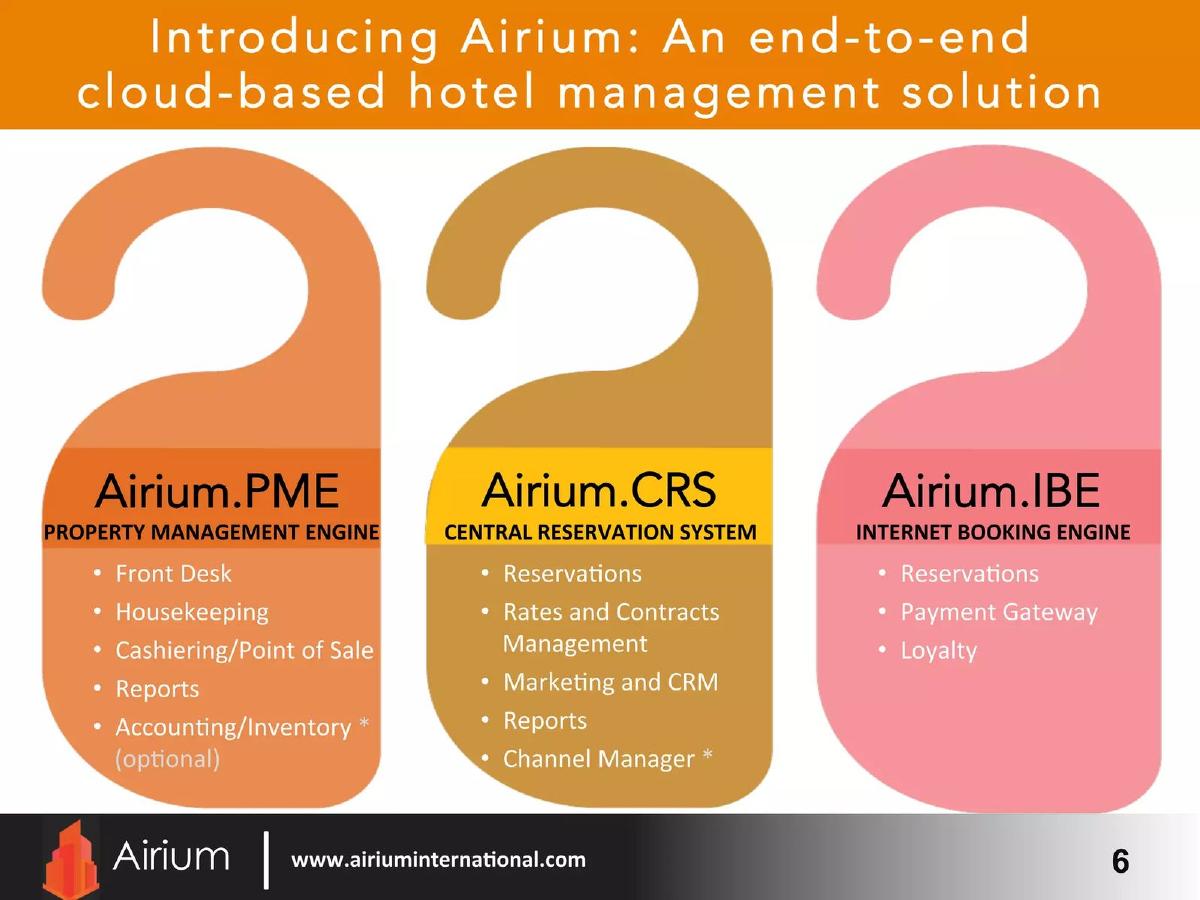
Airium’s 2015 presentation serves as a case study in leveraging corporate heritage to build startup credibility. By spinning off from John Keells, the company launched with 270 active hotel clients and 35 hotel chains already on the platform. The deck focuses heavily on the 'underserved' midscale and boutique segments in Asia and South America, regions where global rooms revenue exceeds $6 billion. While the product suite—covering Property Management (PME), Central Reservation (CRS), and Internet Booking Engines (IBE)—is standard for the industry, the inclusion of high-profile board members l…
Key takeaways
- Airium originated as a spin-off of the hotel management division of John Keells, the largest conglomerate in Sri Lanka (Slide 21).
- The company launched with significant traction, claiming 35 hotel chains and 270 hotels as active clients within its first year of operation (Slide 21).
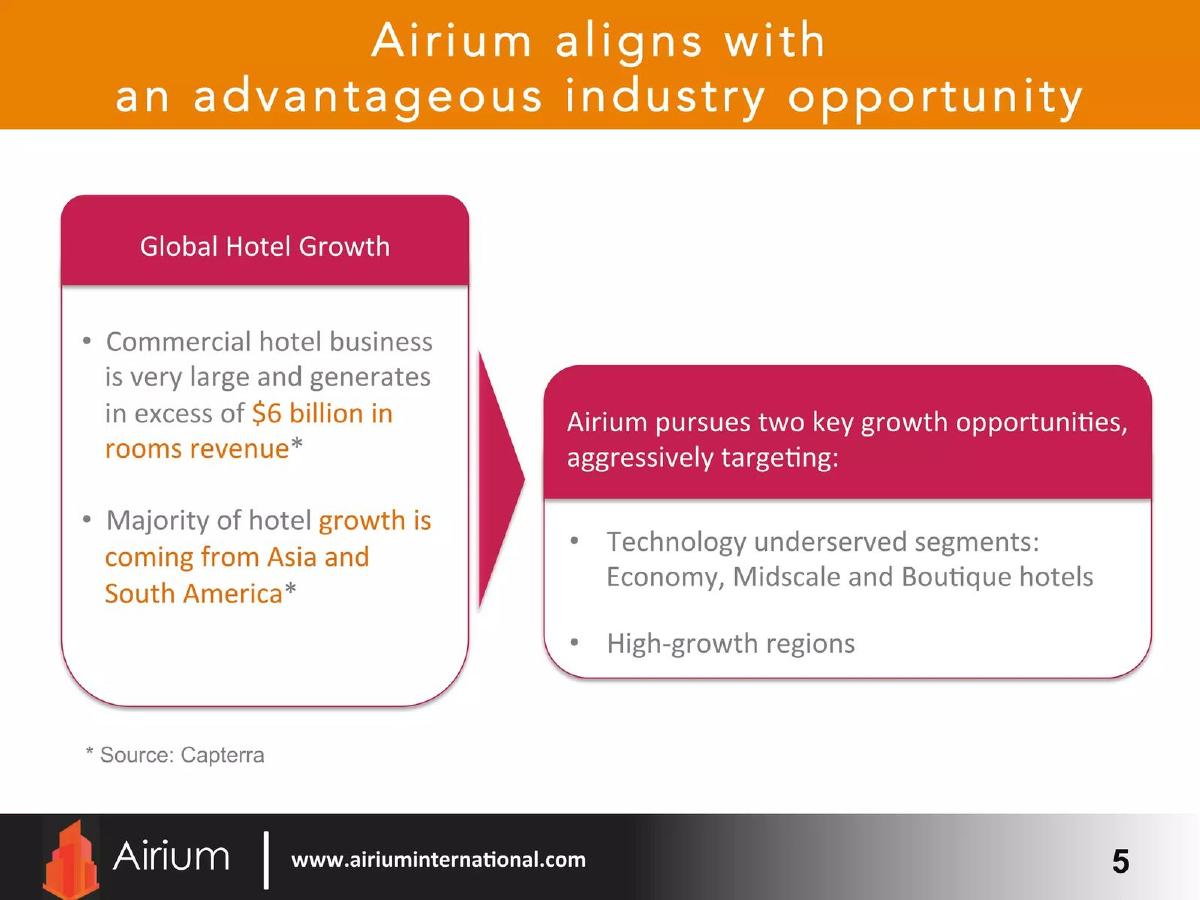
- Market targeting is focused on 'technology underserved segments' including economy, midscale, and boutique hotels in Asia and South America (Slide 5).
- The product suite includes a Central Reservation System (CRS) that allows hotels to manage multiple rate plans and segmented guest profiles (Slide 33).
- Airium cites Capterra data showing the commercial hotel business generates in excess of $6 billion in rooms revenue (Slide 5).
- The leadership team features Luce Veilleux (President & CEO) and Paul Glavine (Senior VP), supported by a regional team for Asia Pacific (Slide 17).
- Barney Pell, a former Microsoft Search Strategist and NASA technologist, serves as Vice Chairman, providing high-level technical and investment credibility (Slide 25).
- The deck identifies MICROS as the market leader with 23,700 customers, positioning Airium against established incumbents (Slide 13).
Airium Pitch Deck Analysis: The Conglomerate Spin-Off Strategy
The Airium investor presentation from June 2015 is a professional, high-traction deck that focuses on the transition from a regional division to a global SaaS player. By leveraging its history as a spin-off from John Keells, Airium avoids the typical pitfalls of early-stage startups—namely, the lack of a proven product and a customer base. The deck is structured to show that the technology is already 'battle-tested' in the field.
Slide 1: Title and Positioning
The cover slide establishes Airium International as a provider of 'Tailored Cloud Based Hotel Management Solutions.' It uses three specific descriptors: Boutique, Bluetooth Enabled, and Budget Efficient. The mention of 'Bluetooth Enabled' is a notable technical differentiator for 2015, suggesting hardware-software integration for room access or guest services.
Slide 5: The Market Opportunity
Airium uses Capterra data to frame a $6 billion+ rooms revenue opportunity. The strategic focus is clearly defined: targeting 'technology underserved segments' (Economy, Midscale, and Boutique hotels) in 'high-growth regions' like Asia and South America. This is a classic 'blue ocean' strategy, moving away from the saturated enterprise hotel markets of North America and Europe to capture emerging markets where legacy systems have less penetration.
Slide 9: The Product Suite (IBE)
This slide breaks down the 'Airium Hospitality Suite,' which includes PME (Property Management), CRS (Central Reservation System), and IBE (Internet Booking Engine). The focus here is on the IBE, which is designed to turn a hotel's static website into a revenue-generating tool. Key features mentioned include loyalty program activation and the ability for guests to build itineraries across multiple affiliated hotels, which is a critical feature for smaller chains trying to compete with global brands.
Slide 13: Competitive Landscape
Airium provides a transparent look at the competition, citing a Capterra infographic. MICROS is listed as the clear leader with 23,700 customers, followed by MSI and ASI. By showing this, Airium acknowledges the scale of the incumbents while implicitly suggesting that there is a massive market remaining for a modern, cloud-native solution that caters to the thousands of hotels not yet served by these top ten vendors.
Slide 17: The Management Team
The team slide presents a balance of corporate experience and regional expertise. CEO Luce Veilleux brings a background in financial services and payments, while Senior VP Paul Glavine is identified as a Canadian entrepreneur. Crucially, the deck highlights specific leadership for the Asia Pacific region, reinforcing the company's commitment to its primary growth market.
Slide 21: Traction and Heritage
This is arguably the most important slide in the deck. It reveals that Airium is a spin-off of the hotel management division of John Keells, Sri Lanka's largest conglomerate. It lists impressive day-one metrics: 35 hotel chains and 270 hotels as active clients. The slide includes logos and photos of properties like Cinnamon Hotels & Resorts and The Wallawwa, providing visual proof of the platform's real-world application.
Slide 25: Board of Directors - Barney Pell
To bolster its technical and investment credibility, Airium dedicates a full slide to Vice Chairman Barney Pell. His pedigree—Founder/CEO of Powerset (acquired by Microsoft), Search Strategist for Bing, and NASA technologist for the Mars Exploration Rovers—serves as a massive signal to investors that the company's technology and strategy are overseen by a top-tier industry veteran.
Slide 29 & 33: Financials and Product Depth
Slide 29 introduces the appendix for financial projections, though the specific data is not in the provided selection. Slide 33 provides a deep dive into the CRS (Central Reservation System) interface. The mockup shows a sophisticated dashboard with occupancy rates (81%), average dollar rates ($224), and actual vs. forecast revenue tracking. This slide demonstrates that the software is not just a booking tool, but a comprehensive business intelligence platform for hotel managers.
What Airium Does Well
The deck excels at establishing credibility through association . By repeatedly mentioning John Keells and featuring a high-profile board member like Barney Pell, Airium positions itself as a 'safe' investment compared to a typical seed-stage startup. The clarity of their geographic and segment focus is also a strength; they aren't trying to win the whole world at once, but rather the underserved boutique markets in Asia and South America.
What is Missing from the Deck
Based on the provided slides, there are several key omissions:
The Ask: There is no slide detailing how much capital is being raised or the intended use of funds. · Unit Economics: While the deck mentions 270 hotels, it does not disclose the Average Revenue Per User (ARPU), Customer Acquisition Cost (CAC), or Churn rates. · Implementation Timeline: For a cloud-based solution replacing legacy systems, the 'time to value' or implementation speed is a major selling point that is not addressed here. · Hardware Details: The cover mentions 'Bluetooth Enabled,' but there is no further explanation of the hardware requirements or the cost of the 'Bluetooth door kits' mentioned on Slide 21.
Founder's Guide: What to Copy
Use a 'Traction First' approach: If your startup is a spin-off or has a pilot partner, lead with those numbers. Airium's mention of 270 active hotels (Slide 21) immediately changes the investor's mindset from 'will this work?' to 'how big can this get?'
Segment your product features: Instead of a messy list of everything the software does, Airium groups features into logical buckets like PME, CRS, and IBE (Slide 9). This makes a complex enterprise product much easier to digest during a quick pitch.
Leverage third-party data for market sizing: Rather than making up 'Total Addressable Market' numbers, Airium uses Capterra (Slide 5 and 13) to provide objective context for the industry's size and the competitive landscape. This builds trust with the reader.
Frequently asked questions
- What is Airium's primary value proposition for hotels?
- Airium provides a 'Tailored Cloud Based Hotel Management Solution' specifically designed for boutique and budget-efficient hotels. According to Slide 9, their Internet Booking Engine (IBE) allows hotels to convert corporate websites into 24/7 reservation centers, activate loyalty programs, and enable guests to build custom travel itineraries across affiliated hotel chains. The goal is to maximize revenue through better demand-based pricing and centralized guest management.
- How does Airium differentiate itself from large competitors like MICROS?
- While Slide 13 acknowledges MICROS as the dominant player with over 23,000 customers, Airium differentiates by targeting 'technology underserved segments' in high-growth regions like Asia and South America. They position themselves as a more agile, cloud-based alternative for midscale and boutique hotels that may find legacy systems like MICROS too cumbersome or expensive for their specific regional needs.
- What is the significance of the John Keells spin-off?
- The spin-off is central to Airium's 'established platform' narrative. As noted on Slide 21, being born out of Sri Lanka's largest conglomerate gave Airium immediate access to 270 hotels. This effectively eliminated the 'cold start' problem most SaaS startups face, providing the company with a proven track record and a stable revenue base from day one of its independent operations.
- Who are the key members of the Airium leadership team?
- The team is led by CEO Luce Veilleux, a former financial services executive, and Senior VP Paul Glavine, a Canadian entrepreneur. The deck also highlights a dedicated Asia Pacific team, including Nawoda Herath (Operations) and Xenos Wahid (Sales). The presence of Vice Chairman Barney Pell, who has a PhD from Cambridge and experience at NASA and Microsoft, adds significant technical depth to the board.
- What financial information is included in the deck?
- The provided slides are light on specific historical financials but include an appendix for 'Financial Projection Details by Region' (Slide 29). Slide 33 shows a dashboard mockup for a 'W Hotel' indicating actual versus forecast figures, such as a monthly actual of $422,312 against a forecast of $486,013. However, these appear to be illustrative of the software's reporting capabilities rather than the company's consolidated P&L.