Materials Nexus utilizes a 24-slide presentation to pitch a platform that accelerates the discovery of net-zero materials. The deck contrasts traditional, slow laboratory 'guessing' with their 'MatNex' process, which uses AI predictions and genetic algorithm screening to identify new materials before physical testing. The company highlights a management team with deep technical expertise, including a CSO with over 45 patent applications. While the deck effectively communicates the technical workflow and the value proposition of speed-to-market, it includes a significant section of slides rela…
Key takeaways
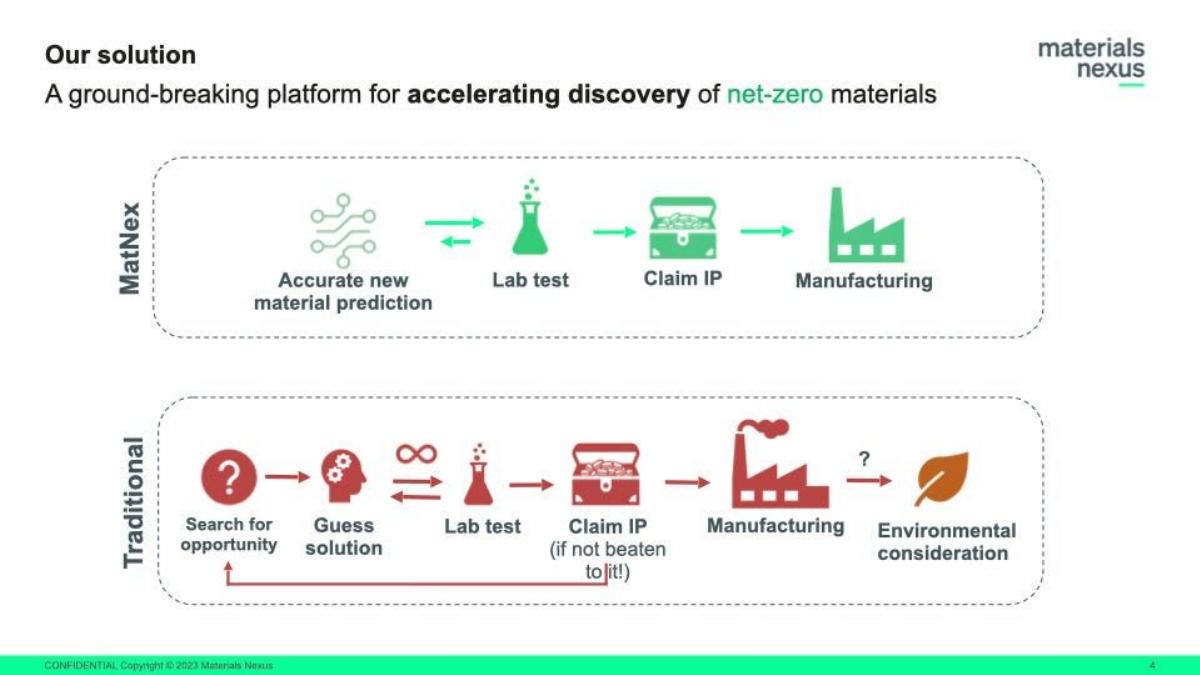
- The platform aims to replace traditional 'guess and test' methods with accurate new material prediction (Slide 4).
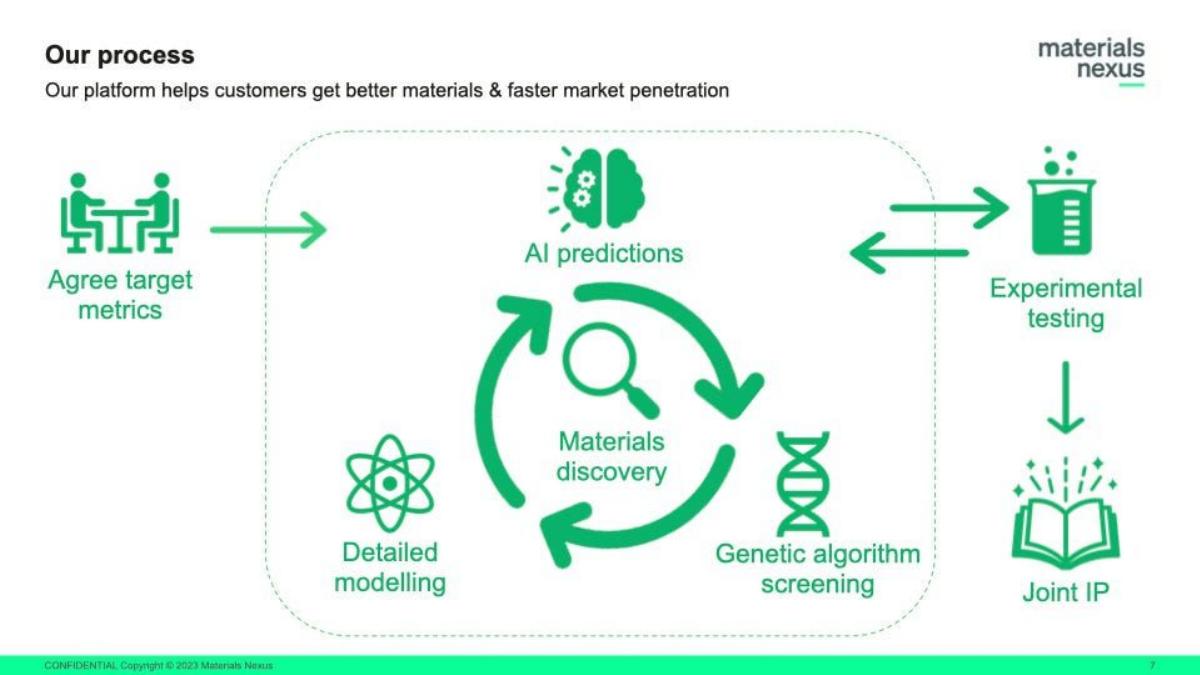
- The 'MatNex' process includes detailed modeling, AI predictions, and genetic algorithm screening (Slide 7).
- The company emphasizes a joint IP model where experimental testing leads to shared intellectual property (Slide 7).
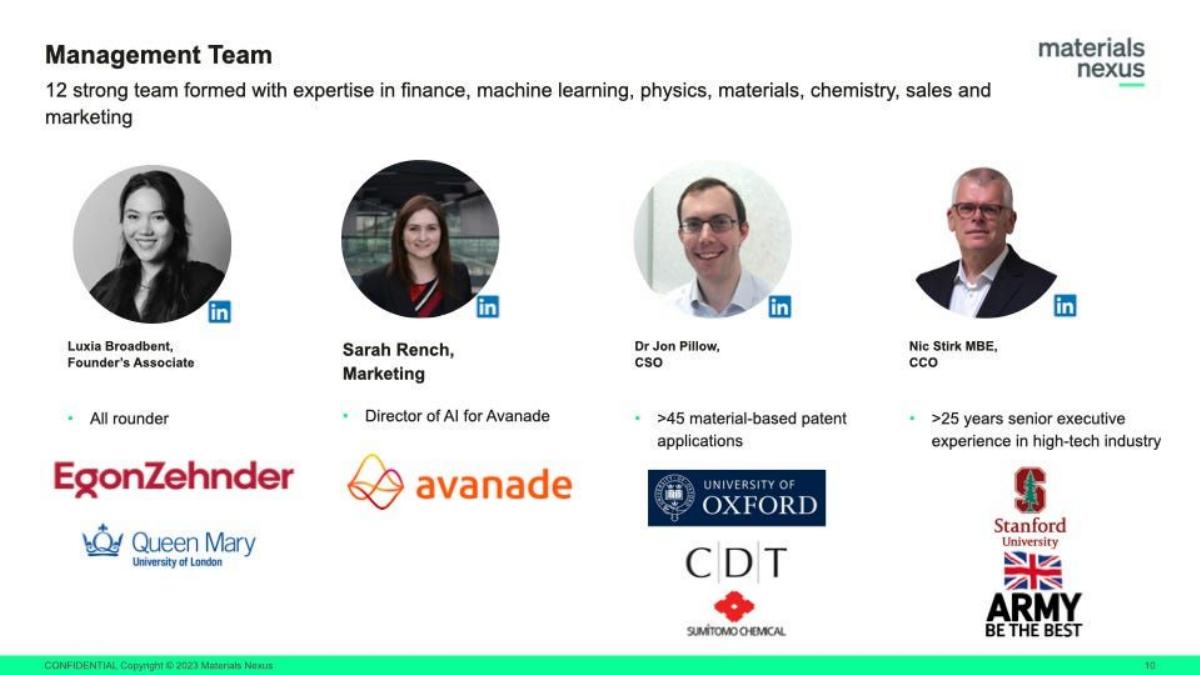
- The management team features Dr. Jon Pillow (CSO), who holds over 45 material-based patent applications (Slide 10).
- Nic Stirk (CCO) brings over 25 years of high-tech industry experience and a background with Stanford University and the British Army (Slide 10).
- The deck claims the platform helps customers achieve 'faster market penetration' by optimizing the discovery phase (Slide 7).
- A significant portion of the deck (Slides 12-24) transitions to a different company, Utopi, focusing on ESG data for real estate.
- Materials Nexus raised $2.8M in a 2024 Seed round to advance their AI-driven discovery platform (Publisher-reported).
Materials Nexus: The Computational Path to Net-Zero
Materials Nexus entered the market with a clear mission: to solve the material scarcity problem that threatens the global transition to green energy. The traditional method of finding new alloys or magnets involves years of laboratory trial-and-error. Materials Nexus proposes a shift to a 'digital-first' approach, using quantum mechanics and AI to predict material properties before a single gram is synthesized in a lab. This teardown examines the 24-slide deck used to secure a $2.8M Seed round in 2024.
Slide 1-3: Introduction and Branding
The deck opens with a minimalist aesthetic. Slide 1 establishes the brand identity with a black background and the tagline 'accelerating change.' The company name, Materials Nexus, is positioned in the top right. Slides 2 and 3 serve as internal dividers, maintaining the 'Company Overview' theme. This slow start suggests a deck designed for a guided presentation rather than a standalone read, as it takes three slides to reach the first piece of substantive content.
Slide 4: The Solution - MatNex vs. Traditional
Slide 4 is the most critical conceptual slide in the first half of the deck. It presents a side-by-side comparison of the 'MatNex' process versus the 'Traditional' process. The traditional path is depicted as a series of red icons starting with a question mark ('Search for opportunity') and moving through 'Guess solution,' 'Lab test,' and 'Claim IP (if not beaten to it!).' Crucially, it shows 'Environmental consideration' as a late-stage step with a question mark, implying that traditional methods often result in materials that aren't sustainable.
In contrast, the MatNex process is shown in green. It replaces the 'Guess' phase with 'Accurate new material prediction.' The workflow is streamlined: prediction leads directly to lab testing, IP claims, and manufacturing. By front-loading the discovery with AI, the company argues they can eliminate the circular 'guess-and-test' loop that plagues the industry.
Slide 7: The Discovery Process
Slide 7 provides a technical deep dive into the 'MatNex' engine. The process begins with 'Agree target metrics' with the customer. The engine itself is a loop consisting of three pillars: AI predictions , Detailed modelling (represented by an atom icon, likely referring to quantum mechanics), and Genetic algorithm screening . This loop feeds into 'Experimental testing,' which ultimately results in 'Joint IP.' The visual representation emphasizes that the platform is not just a database, but an active discovery cycle that reduces the time to market for new materials.
Slide 10: Management Team
The team slide highlights four key members, emphasizing a mix of academic rigor and corporate experience. Luxia Broadbent (Founder's Associate) is noted as an 'All rounder' with experience at Egon Zehnder. Sarah Rench (Marketing) is credited as the former Director of AI for Avanade. The technical weight comes from Dr. Jon Pillow (CSO), who boasts over 45 material-based patent applications and a background at the University of Oxford. Finally, Nic Stirk MBE (CCO) provides senior executive experience from the high-tech industry and the British Army. The slide effectively uses logos (Oxford, Stanford, Avanade) to build immediate credibility.
Slides 12-24: The Utopi Transition
Starting at Slide 12, the deck undergoes a complete shift in focus to a company called Utopi . While the publisher reports this as a Materials Nexus deck, this section describes a 'specialist ESG technology platform for BTR and Co-Living real estate.' Slide 12 notes a '£5 million investment' for Utopi, which is distinct from the $2.8M Seed round reported for Materials Nexus.
Slide 13 ('About Utopi') claims the company has collected 2.5 billion ESG data points and is backed by the Scottish National Investment Bank. Slide 16 ('ESG Reporting') identifies the problem: accessing reliable, granular data for multi-tenant real estate is currently a manual, annual task. Utopi's solution is a 'unique 5D data model' that allows for real-time performance measurement, reportedly reducing consumption and emissions by an average of 30%.
Slide 18 ('ESG Alignment') provides a feature checklist, showing how the Utopi platform tracks utility metering, emissions, resident apps, and space utilization across the Environmental, Social, and Governance pillars. Slide 20 ('Use Utopi to drive profits') attempts to link sustainability to ROI, claiming that prioritizing 'green' can enhance asset value by 3.7% for every increase in EPC rating.
What Materials Nexus Does Well
The Materials Nexus portion of the deck (Slides 1-11) is highly effective at visualizing a complex, 'deep tech' process. By using a simple red-vs-green comparison on Slide 4, the founders make the value proposition of AI-driven discovery accessible to non-technical investors. They successfully frame the 'Traditional' method as a gamble ('Guess solution') and their own method as a predictable pipeline. The emphasis on 'Joint IP' on Slide 7 is also a strong signal to investors that the company is building a defensive moat through shared ownership of the materials they discover.
What is Missing from the Materials Nexus Deck
The most glaring omission is the lack of specific case studies or 'proof of concept' data. While the deck explains how the process works, it does not show a specific material that has been successfully discovered, tested, and moved toward manufacturing using the MatNex platform. There is also no slide detailing the specific market size (TAM/SAM/SOM) for the materials they are targeting, such as rare-earth-free magnets or high-efficiency battery components. Furthermore, the 'Ask' slide—detailing how the $2.8M would be spent—is not present in the provided sequence.
The Utopi Disconnect
The inclusion of 13 slides for Utopi within a Materials Nexus deck is highly unusual. It is possible these companies share a parent entity, a founder, or were part of a joint pitch to a specific ESG-focused fund. However, for a founder looking to copy this deck, the lesson is one of focus. Mixing two distinct business models (AI material discovery and PropTech ESG data) in one deck can confuse the narrative. A pitch deck should ideally tell one cohesive story; here, the transition at Slide 12 creates a jarring break in the investment thesis.
Founder Takeaways
Visualizing the 'Before and After': Use the Slide 4 approach to show why the current industry standard is inefficient. Labeling the status quo as 'guessing' is a powerful way to position your technology as the logical successor. · Credentialing Deep Tech: If you are in a science-heavy field, your team slide must lead with 'hard' metrics. Dr. Jon Pillow’s '45+ patent applications' is a more compelling data point than a list of university degrees alone. · The Workflow Loop: Slide 7 is a great template for companies with a 'platform' play. It shows that the value isn't just in the AI, but in the integration of AI, modeling, and physical testing. · Avoid Narrative Splitting: Ensure your deck remains focused on a single company. If you must include information on a sister company or a previous success, keep it to a single 'Track Record' slide rather than a full 13-slide takeover.
Frequently asked questions
- What is the core technology behind Materials Nexus?
- Materials Nexus uses a combination of AI predictions, detailed quantum modeling, and genetic algorithm screening. As shown on Slide 7, this creates a 'Materials Discovery' loop that informs experimental testing, moving away from traditional trial-and-error methods to find sustainable alternatives for industrial materials.
- How does the Materials Nexus business model work regarding IP?
- According to Slide 7, the company follows a 'Joint IP' model. They agree on target metrics with a customer, run their discovery and modeling process, and then conduct experimental testing. The resulting intellectual property is shared between Materials Nexus and the customer.
- Who are the key technical leaders at Materials Nexus?
- The management team is led by technical experts like Dr. Jon Pillow (CSO), who has a background with the University of Oxford and over 45 patent applications. The team also includes Sarah Rench, who served as Director of AI for Avanade (Slide 10).
- Why is there information about 'Utopi' in this deck?
- Slides 12 through 24 focus entirely on Utopi, a specialist ESG technology platform for real estate. While the Materials Nexus portion ends at Slide 11, the inclusion of Utopi suggests a combined presentation or a shared investment context, though the two companies operate in different sectors (AI/Materials vs. PropTech).
- What problem is Materials Nexus solving for the green transition?
- The company addresses the 'Traditional' bottleneck of material discovery, which involves manual searches and environmental considerations that often come too late in the process. By predicting net-zero materials upfront, they aim to reduce the reliance on environmentally damaging mining (Slide 4).