Matchory is a German enterprise software startup that raised a $1.6M Seed round in 2022 to automate supplier discovery. The deck centers on the transition from manual, static procurement lists to a real-time, AI-driven database. By aggregating data from web crawling, trade data, and existing platforms like SAP Ariba and EcoVadis, Matchory claims to cover 90% of the market with over 10 million supplier profiles. The strategy relies on a two-sided monetization model, charging buyers for sourcing solutions and suppliers for premium profiles. While the deck effectively communicates technical supe…
Key takeaways
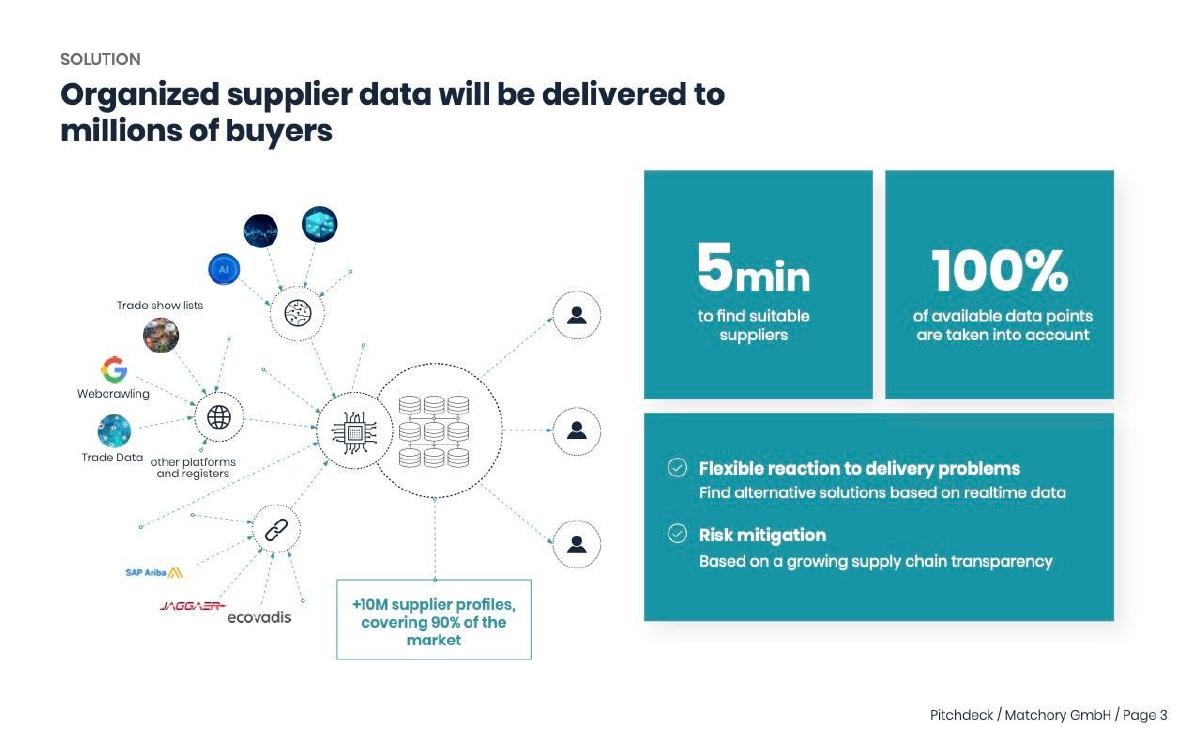
- Matchory claims to have indexed over 10 million supplier profiles, covering an estimated 90% of the market (Slide 3).
- The platform reduces the time to find suitable suppliers to just 5 minutes by taking 100% of available data points into account (Slide 3).
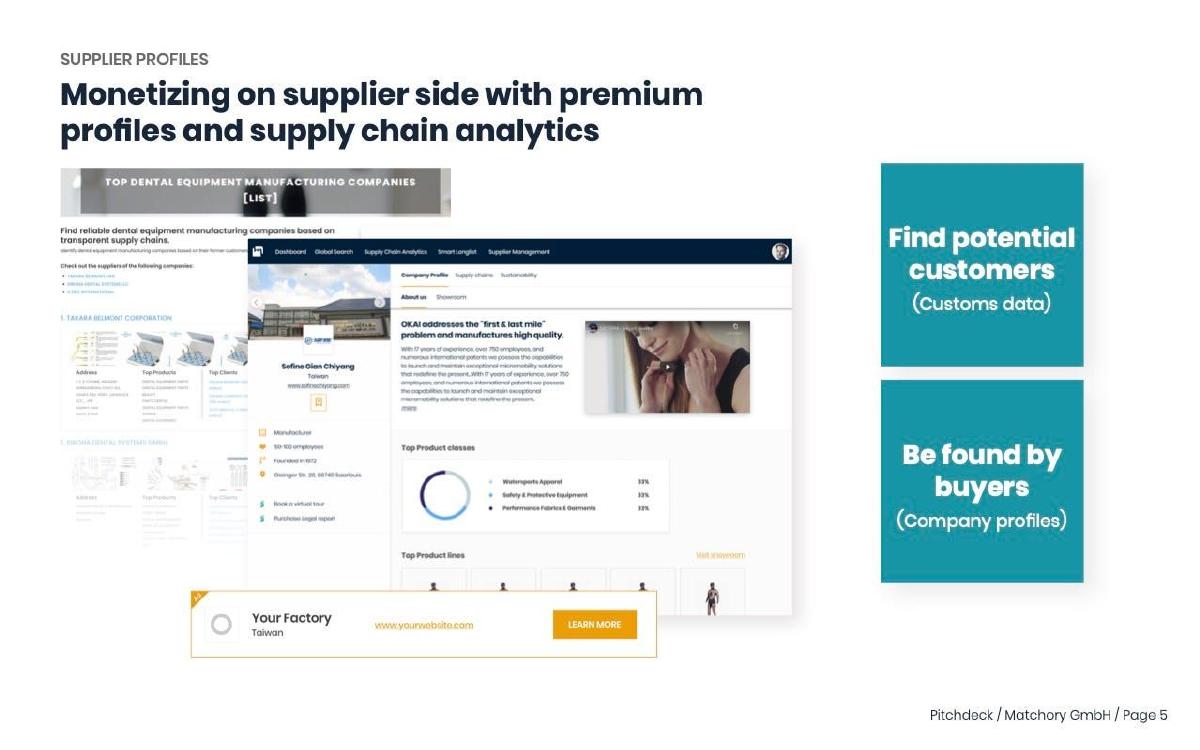
- A two-sided monetization strategy is employed, targeting buyers for sourcing and suppliers for premium analytics and visibility (Slide 5).
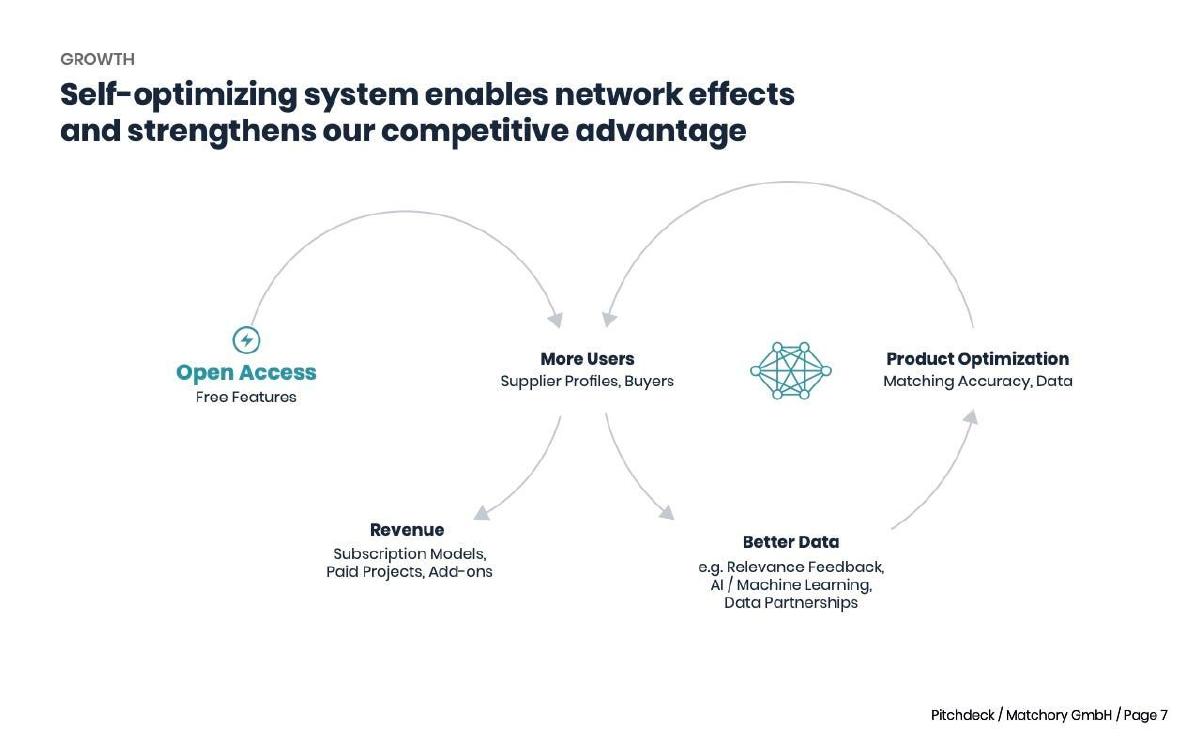
- The growth strategy relies on a flywheel where open access leads to more users, which generates better data feedback for AI optimization (Slide 7).
- Matchory differentiates itself from competitors by offering 'Realtime' Big Data/AI processing, whereas competitors are cited at 24h to 72h speeds (Slide 8).
- The unit economics slide identifies two distinct revenue streams: Sourcing Solutions and Supplier Profiles, though specific dollar values were redacted in this version (Slide 10).
- The founding team combines backgrounds in Product Development (TU Darmstadt), Industrial Design (FH Joanneum Graz), and Software Engineering (FU Berlin) (Slide 12).
- The deck emphasizes integration with existing procurement giants like SAP Ariba, Jaggaer, and EcoVadis to enhance supply chain transparency (Slide 3).
Matchory Pitch Deck Analysis
Matchory, a German-based enterprise software startup, raised $1.6M in Seed funding in 2022. Their pitch deck focuses on the automation of strategic supplier sourcing, a critical pain point in global supply chain management. The deck is structured to move from the technical capability of their data engine to the business logic of a two-sided marketplace.
Slide 1: Title Slide
The deck opens with a minimalist title slide stating 'Real-time Supplier Discovery' and the mission statement: 'We structure the world’s supplier information.' This immediately positions the company as a data-first organization, drawing a subtle parallel to Google’s mission of organizing the world's information, but applied specifically to the B2B procurement sector.
Slide 3: The Solution and Data Scale
Slide 3 is the core technical value proposition. It illustrates how Matchory ingests data from web crawling, trade data, and trade show lists, as well as integrations with SAP Ariba, Jaggaer, and EcoVadis. The slide highlights three key metrics: 5 minutes to find suitable suppliers, 100% of available data points considered, and a database of +10M supplier profiles covering 90% of the market. This slide effectively addresses the 'Why Now' by focusing on risk mitigation and the need for flexible reactions to delivery problems through real-time data.
Slide 5: Supplier Profiles and Monetization
This slide shifts the focus to the supplier side of the marketplace. Matchory explains how they monetize the supplier side through 'premium profiles and supply chain analytics.' The visual shows a dashboard where suppliers can 'Find potential customers' using customs data and 'Be found by buyers' through optimized company profiles. This demonstrates that Matchory is not just a tool for buyers, but a platform where suppliers have a vested interest in maintaining their data, which helps keep the central database accurate.
Slide 7: Growth and Network Effects
Slide 7 introduces a double-loop flywheel. The first loop shows how 'Open Access' (free features) leads to more users, which drives revenue through subscriptions and paid projects. The second loop shows how more users lead to 'Better Data' (via relevance feedback and AI), which results in 'Product Optimization' and higher matching accuracy. This is a classic venture-scale argument: the product gets better and the competitive moat gets wider as more people use it.
Slide 8: Competitive Market Analysis
The competitive matrix on Slide 8 compares Matchory against 'AI-based Supplier Search' competitors and 'Yellowpages' concepts. The standout differentiator claimed here is 'Realtime' Big Data/AI processing. While other AI competitors are listed as having 24-hour or 72-hour lag times, Matchory claims instantaneous data availability. They also highlight their 'Public Platform' and 'Partner Integrations' as unique combinations that competitors lack.
Slide 10: Unit Economics
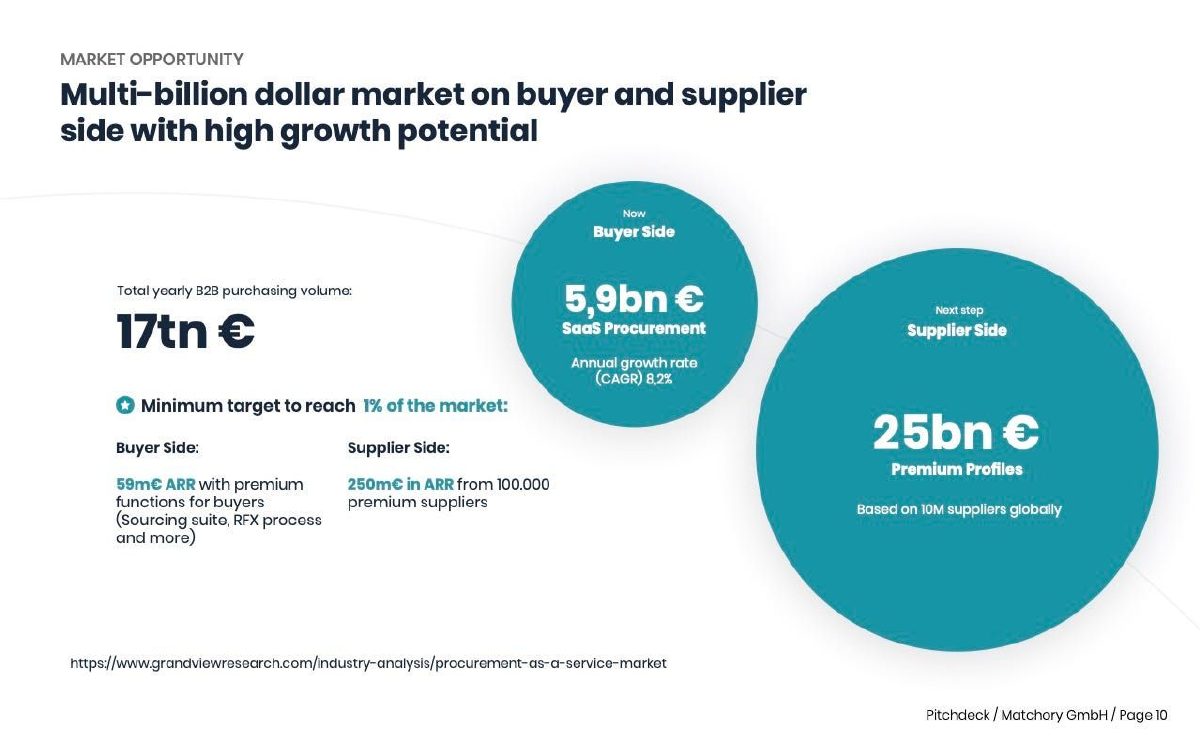
Slide 10 breaks down the business model into two segments: Sourcing Solutions (Buyer side) and Supplier Profiles (Supplier side). It lists columns for Pricing, CLTV (Customer Lifetime Value), CAC (Customer Acquisition Cost), and Acquisition Channels. While the specific figures are redacted in this version of the deck, the structure shows a sophisticated approach to tracking unit economics across a two-sided platform. The inclusion of 'CLTV/CAC' as a highlighted metric suggests the founders are focused on capital efficiency.
Slide 12: The Founders
The team slide features the three founders: Aiko Wiegand (CEO), Nils Liskien (CCO), and Martin Konradi (CTO). The slide lists their specific roles and educational backgrounds. Aiko Wiegand holds an M.Sc. from TU Darmstadt, Nils Liskien has a background in Industrial Design from FH Joanneum Graz, and Martin Konradi brings software engineering expertise from FU Berlin. The team appears balanced between technical execution, product design, and business development.
What Matchory Does Well
The deck excels at visualizing a complex data pipeline. By showing exactly where the data comes from (Slide 3) and how it flows into a self-optimizing system (Slide 7), the founders demystify the 'AI' label. They provide concrete numbers—10 million profiles and 90% market coverage—that give investors a sense of the scale already achieved. The two-sided monetization strategy is also a strength, as it suggests multiple paths to revenue and a way to lower acquisition costs through a 'freemium' supplier side.
What is Missing from the Deck
The most notable omission in the provided slides is a clear 'Ask' slide. While we know from publisher reports that they raised $1.6M, the deck itself does not state the amount being sought, the valuation, or the specific milestones that the funding will enable. Additionally, there is no detailed financial roadmap or historical revenue growth chart. While Slide 10 mentions unit economics, the lack of actual performance data (even if redacted here, it should have been present in the original) makes it difficult to assess the current traction of the business beyond the size of the database.
Founder Takeaways
Quantify your data advantage: Don't just say you have a large database; state the exact number of profiles and the estimated percentage of the total market you cover, as seen on Slide 3. · Map the flywheel: If your product uses machine learning, show the loop of how user feedback directly improves the algorithm, creating a competitive moat (Slide 7). · Differentiate on speed: In enterprise software, 'Realtime' is a powerful differentiator. If your competitors have a 24-hour lag, highlighting that specific gap can be more effective than general claims of being 'faster' (Slide 8). · Show the two-sided value: If you are building a marketplace, demonstrate value for both the buyer and the seller. Matchory’s Slide 5 shows how suppliers benefit from the platform, which is essential for long-term data health.
Frequently asked questions
- What is Matchory's core value proposition for procurement teams?
- Matchory focuses on speed and data depth. According to Slide 3, the platform allows buyers to find suitable suppliers in 5 minutes by processing 100% of available data points. This is positioned as a solution for risk mitigation and flexible reaction to delivery problems, providing real-time alternatives when supply chains are disrupted.
- How does Matchory acquire and structure its supplier data?
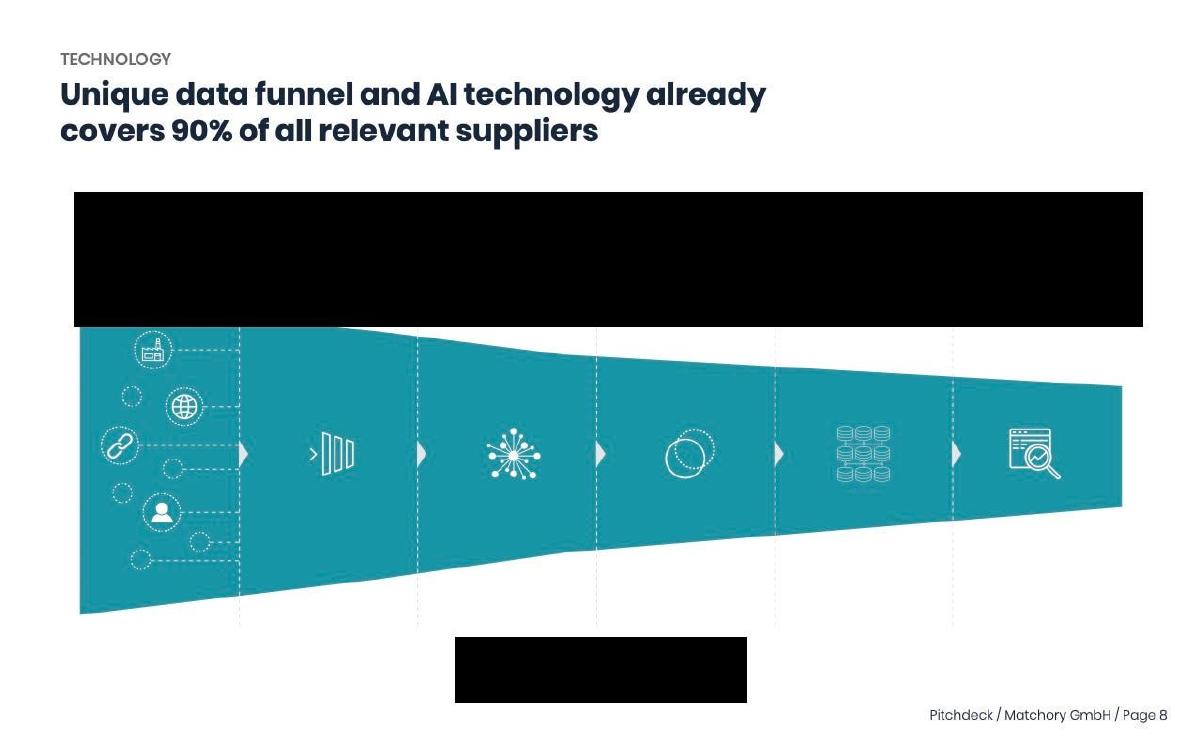
- As shown on Slide 3, the company aggregates data from multiple sources including web crawling, trade show lists, trade data, and other registers. It also integrates with third-party platforms like SAP Ariba and EcoVadis. This data is then processed through an AI engine to create a structured database of over 10 million profiles.
- What is the 'Open Access' strategy mentioned in the growth slide?
- Slide 7 outlines a network effect model where 'Open Access' (free features) attracts a high volume of supplier profiles and buyers. This user growth generates revenue through subscriptions and paid projects, but more importantly, it provides 'Relevance Feedback' that feeds back into the AI/Machine Learning models to optimize matching accuracy.
- How does Matchory compare itself to traditional 'Yellowpages' concepts?
- On Slide 8, Matchory uses a competitive matrix to show that while traditional 'Yellowpages' concepts have public platforms and paid profiles, they lack global databases, AI-driven real-time updates, and independent supplier rankings. Matchory claims to be the only player offering all these features simultaneously.
- Who are the founders of Matchory?
- The team consists of CEO Aiko Wiegand (Product & Customer Development), CCO Nils Liskien (Product Owner), and CTO Martin Konradi (Software Engineering). Their academic backgrounds span TU Darmstadt, FH Joanneum Graz, and FU Berlin, covering the necessary mix of engineering, design, and business logic (Slide 12).