Mattermark’s 2014 Series A deck successfully raised $6.5M by leveraging a powerful 'X for Y' analogy, positioning itself as the 'Google for Business People.' At the time of the pitch, the company boasted $125K in MRR and an impressive 377% CAGR. The deck is notable for its transparency regarding customer concentration—showing that 54% of revenue came from Venture Capital—while simultaneously pitching a roadmap to move beyond that niche into sales, marketing, and research. By using screenshots of failed Google searches for specific business data, the founders clearly illustrated a massive gap…
Key takeaways
- The deck uses a bold anchor statement on Slide 2: 'Mattermark is Google for Business People.'
- Growth is the primary validator, with Slide 6 showing a 377% CAGR and reaching $125K MRR by September 2014.
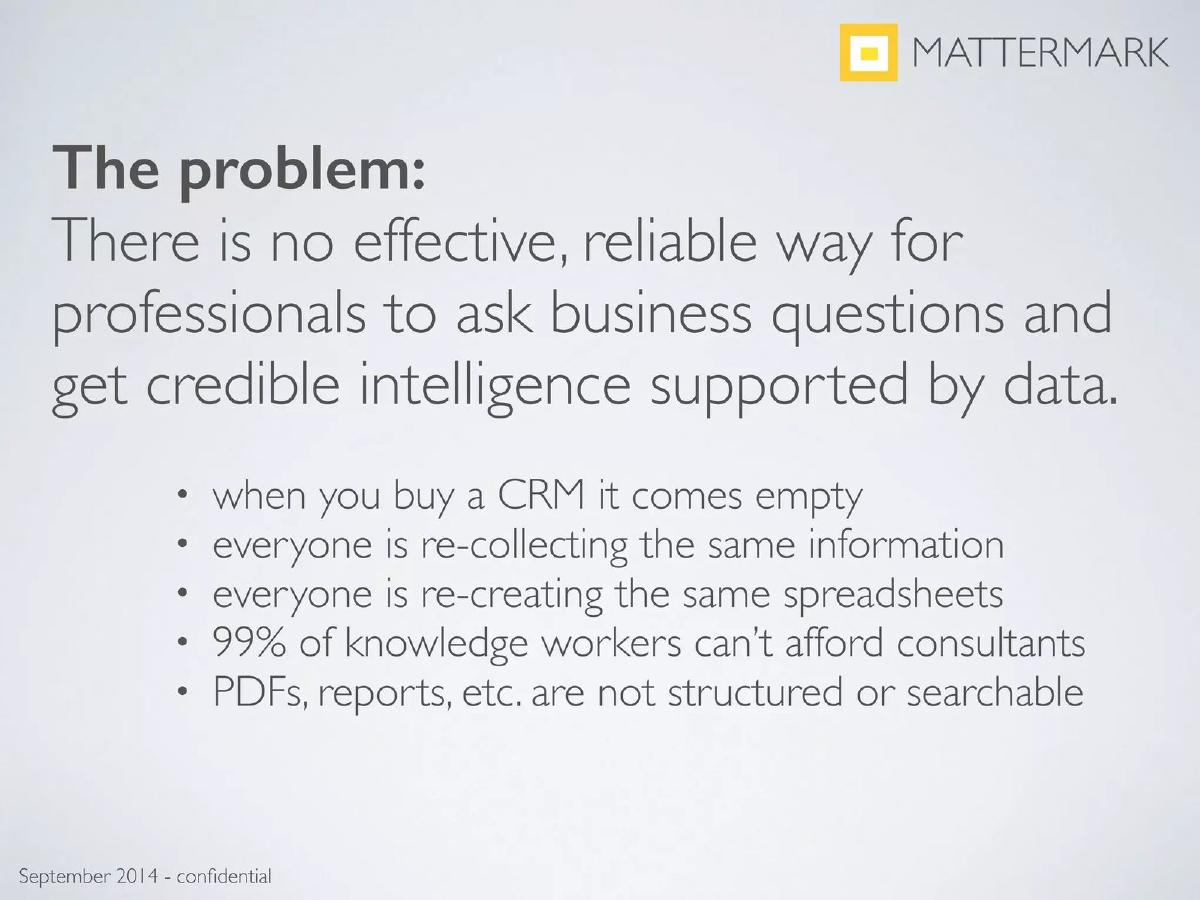
- The 'Problem' is visualized through screenshots of Google search results failing to answer complex business queries (Slides 3-4).
- The company admits to high customer concentration, with 54% of revenue coming from the Venture Capital sector (Slide 7).
- The roadmap (Slide 5) outlines a clear transition from a niche tool for VCs to a broad utility for all 'knowledge workers.'
- The team slides (Slides 13-15) emphasize high-signal past employers like Microsoft, Palantir, and Kabam to build technical credibility.
- The deck lacks a specific 'Ask' slide or use of funds breakdown in the provided 15-slide sequence.
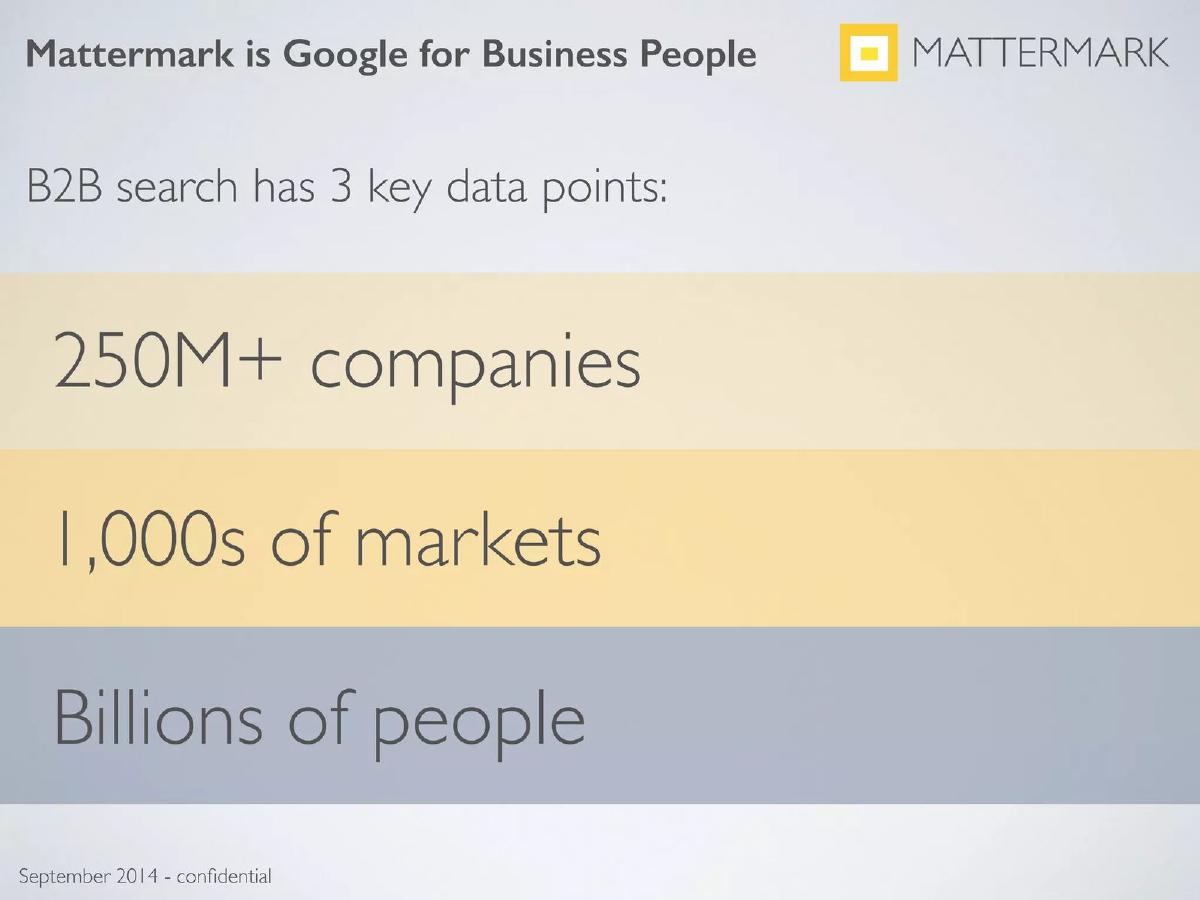
- Market size is framed by the volume of data points: 250M+ companies and billions of people (Slide 2).
The Narrative Strategy: Becoming a Utility
Mattermark’s 2014 Series A deck is a classic example of 'The Great Game' in startup fundraising. It takes a functional product—a database of startup metrics—and wraps it in a narrative of global proportions. By 2014, Mattermark was already a darling of the Silicon Valley ecosystem, largely because its founders were vocal about their own metrics and the data-driven nature of the venture industry. The deck reflects this transparency and confidence.
Slides 1-2: The Vision and the Hook
The deck opens with a clean title slide (Slide 1) featuring the tagline: 'organizing the world’s business information.' This is a deliberate echo of Google’s own mission statement. Slide 2 hammers this home with the bold claim: 'Mattermark is Google for Business People.'
This slide establishes the scale of the ambition. It isn't just about tracking startups; it's about 250M+ companies , 1,000s of markets , and billions of people . By framing the company around these massive numbers, they move the conversation away from being a 'VC tool' and toward being a 'global search engine.'
Slides 3-4: Defining the Gap
To justify the 'Google for Business' moniker, the deck shows where Google fails. Slide 3 shows a search for 'what is the market size of saas,' which returns generic articles. Slide 4 shows a more complex query: 'startups growing headcount 20% month over month.' The results are blog posts and Wikipedia entries, not data.
This is a highly effective way to demonstrate a Problem . It shows that the current dominant tool for information retrieval (Google) is incapable of handling structured business data queries. It sets the stage for Mattermark as the necessary solution for anyone needing quantitative business intelligence.
Slides 5-7: Traction and Market Expansion
Slide 5 provides the roadmap for customer acquisition. It categorizes their journey into four stages: First 6 Months (VCs and Founders), Today (Sales and Marketing), Tomorrow (Consultants and Analysts), and Someday (all knowledge workers). This slide is crucial because it addresses the 'niche' risk. Investors often fear that tools for VCs have a low ceiling; Mattermark counters this by showing VCs were merely the entry point.
Slide 6 is the 'money slide.' It shows $125K MRR and a 377% CAGR . The chart shows a slight dip in growth rate around January '14, but a steady climb in absolute MRR through September '14. Highlighting a 20% month-over-month growth rate at the end of the chart provides the 'up and to the right' momentum investors crave.
Slide 7 shows Revenue by Use Case . It is an incredibly honest slide, admitting that 54% of revenue comes from VC customers . However, the stacked area chart shows the 'Business Development' and 'Corporate Development' segments growing as a percentage of the total, proving the expansion thesis from Slide 5 is already happening.
Slides 8-11: The Future State
Slide 8 acts as a transition: 'Core Questions to Answer.' This leads into Slide 9, which features a circular diagram of 'Data We Need.' It lists complex business needs like 'Suppliers Manufacturers Distributors,' 'M&A Recruiting,' and 'New Product Development.'
Slide 10 and 11 are minimalist. Slide 10 uses the phrase 'a.k.a BUSINESS PEOPLE' to redefine their target market as anyone in management, investment, or R&D. Slide 11 simply states: 'WE FOUND A WAY TO GO FASTER.' This implies a proprietary technological breakthrough or a data ingestion engine that allows them to scale their database faster than competitors or manual researchers.
Slides 12-15: The Leadership Team
The team section (Slide 12) introduces the key players. Mattermark chose to give each leader a dedicated slide, emphasizing their 'pedigree.' Slide 13 features Kevin Morrill (CTO & Co-founder) , highlighting his 10 years at Microsoft and his experience as a founder. Slide 14 introduces Bryan Tsao (Director of Product) , noting his 6 years at Kabam helping grow it to a $1 Billion+ valuation.
Slide 15 features Sarah Catanzaro (Data Team Lead) , with high-signal names like Palantir and Cyveillance . This team composition—spanning big tech (Microsoft), high-growth startups (Kabam), and elite data analytics (Palantir)—is designed to convince Series A investors that the company has the technical and operational maturity to scale the product globally.
What Works in This Deck
The Analogy: 'Google for Business People' is a perfect high-concept pitch. It is easy to remember, easy to share, and immediately explains the value proposition. · Visualizing the Problem: Using actual screenshots of Google search results (Slides 3-4) makes the pain point tangible. It’s not a theoretical problem; it’s a daily frustration for the target user. · Honesty about Concentration: By showing that 54% of revenue is from VCs, they build trust. They don't hide the fact that they are currently a niche tool, but they use the growth of other segments to prove they are outgrowing that niche. · Velocity: The 377% CAGR on Slide 6 is the primary driver for a Series A. At this stage, investors are buying growth, and Mattermark had it in spades.
What is Missing
The Ask: In the 15 slides provided, there is no mention of how much they are raising or what the valuation expectations are. While this is often left for the verbal pitch, a 'Use of Funds' slide is standard. · Unit Economics: There is no mention of LTV (Lifetime Value), CAC (Customer Acquisition Cost), or Churn. For a SaaS company at $125K MRR, investors would typically want to see that the growth is efficient and the customers are sticking around. · Competitive Landscape: The deck mentions Google as a 'failed' competitor for this use case, but it ignores direct competitors like Capital IQ, Bloomberg, or Crunchbase. A slide addressing why Mattermark's data is superior to these incumbents is a notable omission. · Product Deep Dive: We see what the data can answer, but we don't see the actual interface or the 'magic' of the platform. The deck relies heavily on the vision rather than the product experience.
What a Founder Should Copy
The Roadmap Slide (Slide 5): This is a perfect way to show how a 'small' idea becomes a 'big' company. Start with a beachhead (VCs) and show the logical progression to the mass market. · The 'Core Questions' Transition: Using a slide to pause and ask 'What are the questions we are actually answering?' helps reset the investor's focus before moving into the future vision. · High-Signal Team Slides: If your team has worked at 'gold standard' companies (Microsoft, Palantir), use their logos prominently. It acts as a proxy for quality and reduces the perceived risk of the investment. · Data-Driven Problem Statements: Don't just say 'Search is hard.' Show a search failing. Visual evidence of a problem is always more persuasive than a bulleted list.
Frequently asked questions
- How much did Mattermark raise with this deck?
- Mattermark raised $6.5 million in a Series A round in 2014 using this presentation. This followed their earlier seed funding and preceded a total capital raise of over $17 million before their eventual acquisition by FullContact in 2017.
- What was Mattermark's revenue at the time of the Series A?
- According to Slide 6, Mattermark had reached $125,000 in Monthly Recurring Revenue (MRR) by September 2014. The slide also highlights a 377% Compound Annual Growth Rate (CAGR) to demonstrate rapid traction to investors.
- Who was the primary customer for Mattermark in 2014?
- Slide 7 explicitly states that 54% of Mattermark's revenue came from Venture Capital customers. The deck acknowledges this niche start but uses Slide 5 to argue that the product is already expanding into sales, marketing, and business development professionals.
- How did the deck define the 'Google for Business' analogy?
- The deck uses Slides 3 and 4 to show that while Google is great for general web search, it fails at structured business queries like 'startups growing headcount 20% month over month.' Mattermark positioned itself as the structured data layer that answers what Google cannot.
- What happened to Mattermark after this raise?
- Despite the successful Series A and reaching significant revenue milestones, Mattermark struggled to scale beyond the VC and high-end sales niche into the 'every knowledge worker' vision pitched on Slide 5. The company was sold to FullContact in 2017 in what was widely reported as a disappointing outcome for later-stage investors.