Maybe's 2022 crowdfunding pitch deck presents a vision for modern, software-driven financial planning and wealth management, targeting a multi-billion dollar market. The deck clearly articulates the problem of opaque and expensive traditional financial services, offering a solution centered on empowerment through accessible tools and education. It highlights a recurring revenue business model based on feature usage, not assets under management, and positions itself against financial advisors, spreadsheets, and robo-advisors. The product is showcased with a compelling dashboard visualization,…
Key takeaways
- The deck clearly identifies the problem as financial planning and wealth management being 'broken' due to opacity, high fees, and outdated approaches (Slide 2).
- Maybe proposes a solution of 'Modern financial planning & wealth management tools accessible to everyone,' explicitly stating, 'We're replacing financial advisors' (Slide 3).
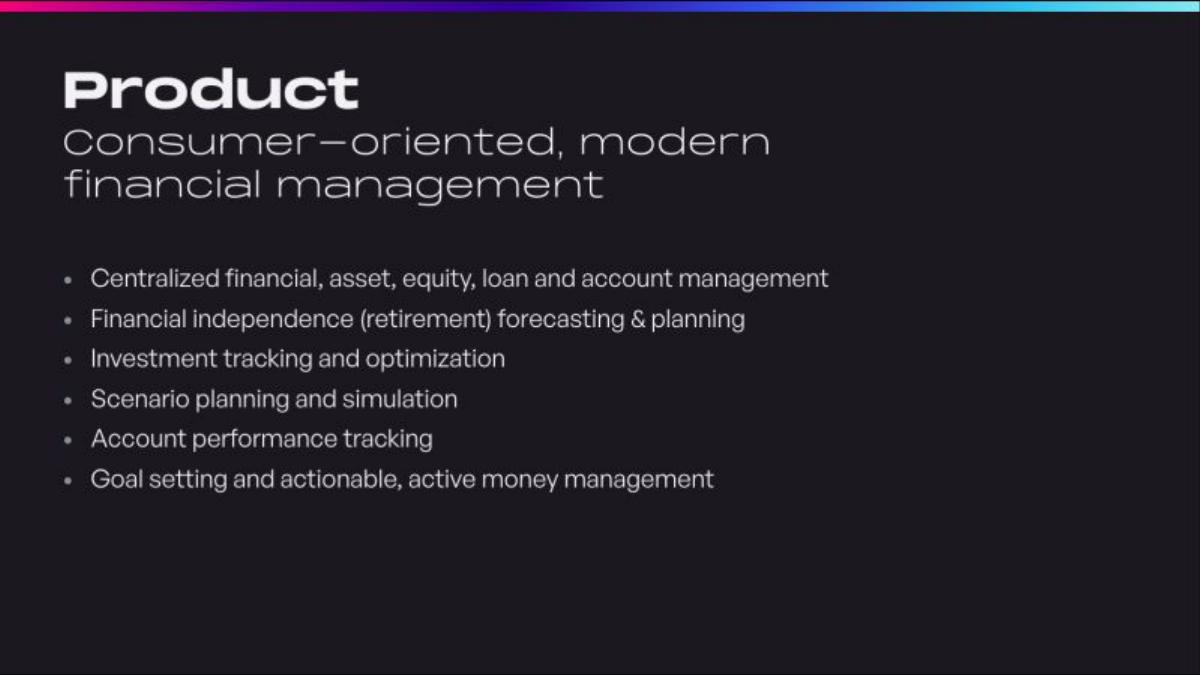
- The product is described as 'Consumer-oriented, modern financial management,' offering centralized tools for forecasting, tracking, and scenario planning (Slide 4).
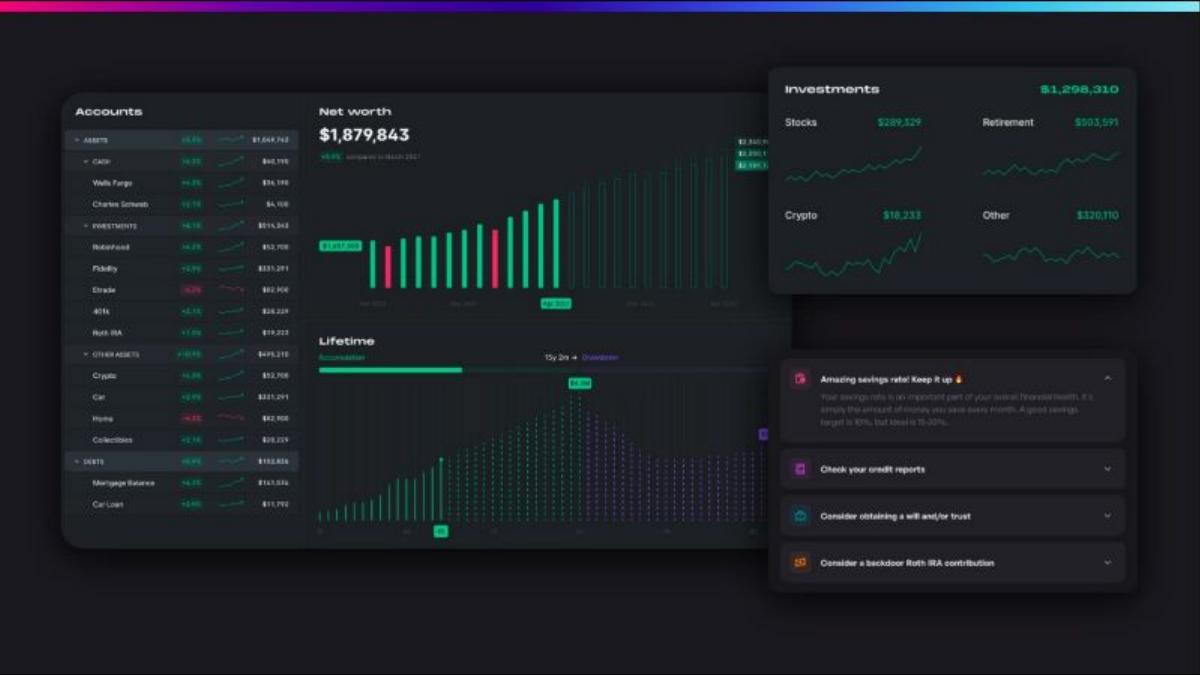
- A product screenshot visually demonstrates the platform's capabilities, showing net worth tracking, investments, and actionable advice (Slide 5).
- The business model is based on 'Recurring revenue' through a flat monthly/annual fee, emphasizing clear pricing not tied to assets under management (Slide 7).
- The market is presented as a '$52.9bn 2021 US financial planning market' with 3.5% growth, indicating a significant opportunity (Slide 8).
- The competition slide effectively positions Maybe against traditional financial advisors, spreadsheets, and robo-advisors by highlighting their respective shortcomings (Slide 9).
- The funding slide clearly states a '$1,000,000+' funding goal, a '$10,000,000' valuation cap, and a SAFE security type, along with a $100,000 founder investment (Slide 11).
Maybe Pitch Deck Teardown: Modernizing Financial Planning & Wealth Management
This teardown analyzes the 2022 crowdfunding pitch deck for Maybe, a fintech company aiming to revolutionize financial planning and wealth management. The deck was used to raise $1.4 million from multiple individual investors through Republic Reg CF and AngelList RUV. Maybe positions itself as a modern, accessible alternative to traditional financial services, leveraging software and education to empower users. The analysis will proceed slide-by-slide, examining the content, structure, and effectiveness of each section, followed by a summary of what works well, what is missing, and key takeaways for other founders.
Slide 1: Title Slide
The first slide introduces the company with its logo, 'maybe,' prominently displayed in white against a dark background. Below the logo, the tagline reads, 'Modern financial planning & wealth management.' The design is clean and contemporary, utilizing a gradient color bar at the top that hints at a digital, tech-forward aesthetic. This slide effectively communicates the company's name and its core offering immediately, setting a professional tone for the presentation.
Slide 2: Problem
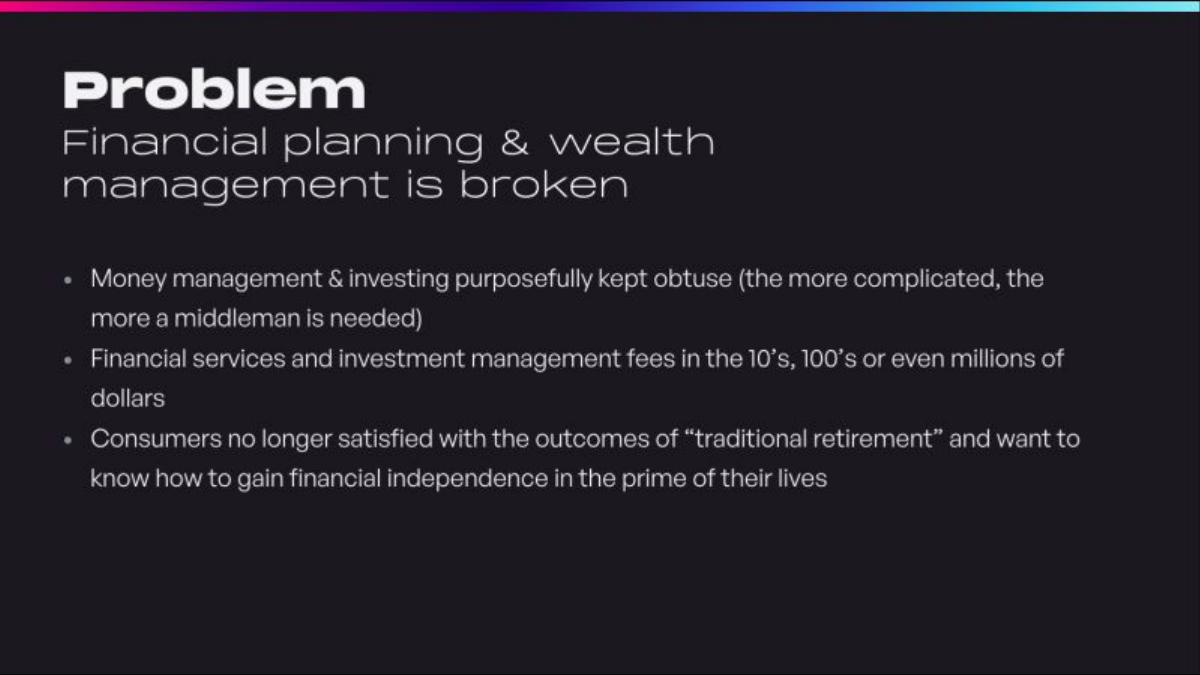
Titled 'Problem,' this slide asserts that 'Financial planning & wealth management is broken.' It lists three bullet points to elaborate on this claim:
'Money management & investing purposefully kept obtuse (the more complicated, the more a middleman is needed)' · 'Financial services and investment management fees in the 10's, 100's or even millions of dollars' · 'Consumers no longer satisfied with the outcomes of “traditional retirement” and want to know how to gain financial independence in the prime of their lives'
This slide clearly articulates the pain points Maybe aims to address. It highlights the opacity, high cost, and misalignment with modern consumer aspirations inherent in the existing financial landscape. The language is direct and impactful, framing the problem as systemic and ripe for disruption.
Slide 3: Solution
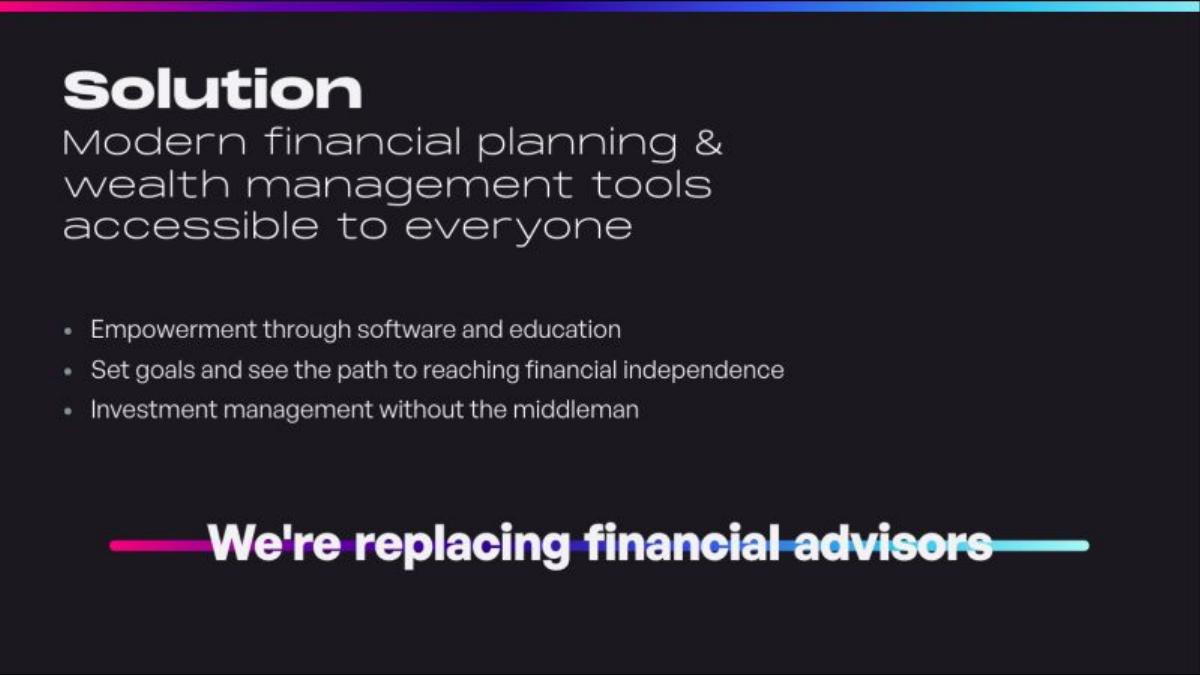
Following the problem, Slide 3, titled 'Solution,' presents 'Modern financial planning & wealth management tools accessible to everyone.' The solution is broken down into three key aspects:
'Empowerment through software and education' · 'Set goals and see the path to reaching financial independence' · 'Investment management without the middleman'
A bold, underlined statement at the bottom declares, 'We're replacing financial advisors.' This slide directly addresses the problems outlined previously, emphasizing accessibility, user empowerment, and the elimination of intermediaries. The explicit declaration about replacing financial advisors is a strong, confident statement of intent, positioning Maybe as a disruptive force rather than a complementary tool.
Slide 4: Product
The 'Product' slide describes Maybe's offering as 'Consumer-oriented, modern financial management.' It details the functionalities provided by the platform:
'Centralized financial, asset, equity, loan and account management' · 'Financial independence (retirement) forecasting & planning' · 'Investment tracking and optimization' · 'Scenario planning and simulation' · 'Account performance tracking' · 'Goal setting and actionable, active money management'
This list provides a comprehensive overview of the product's features, demonstrating its breadth and depth. It suggests a holistic approach to personal finance, covering everything from basic account management to advanced forecasting and optimization, all designed for the end consumer.
Slide 5: Product Screenshot
This slide features a detailed screenshot of the Maybe platform's user interface. It displays a dashboard with sections for 'Accounts,' 'Net worth,' 'Lifetime Accumulation,' 'Investments,' and a panel for 'Amazing savings rate!' and other actionable advice like 'Check your credit reports' and 'Consider obtaining a will and/or trust.' The 'Net worth' section shows a graph with a total of '$1,879,843' as of 'March 2021.' The 'Investments' section breaks down holdings into 'Stocks,' 'Retirement,' 'Crypto,' and 'Other.' This visual representation is highly effective, immediately conveying the product's sophistication, user-friendliness, and the depth of financial insights it offers. It validates the claims made on the previous 'Product' slide and provides a tangible sense of what users can expect.
Slide 6: Customers
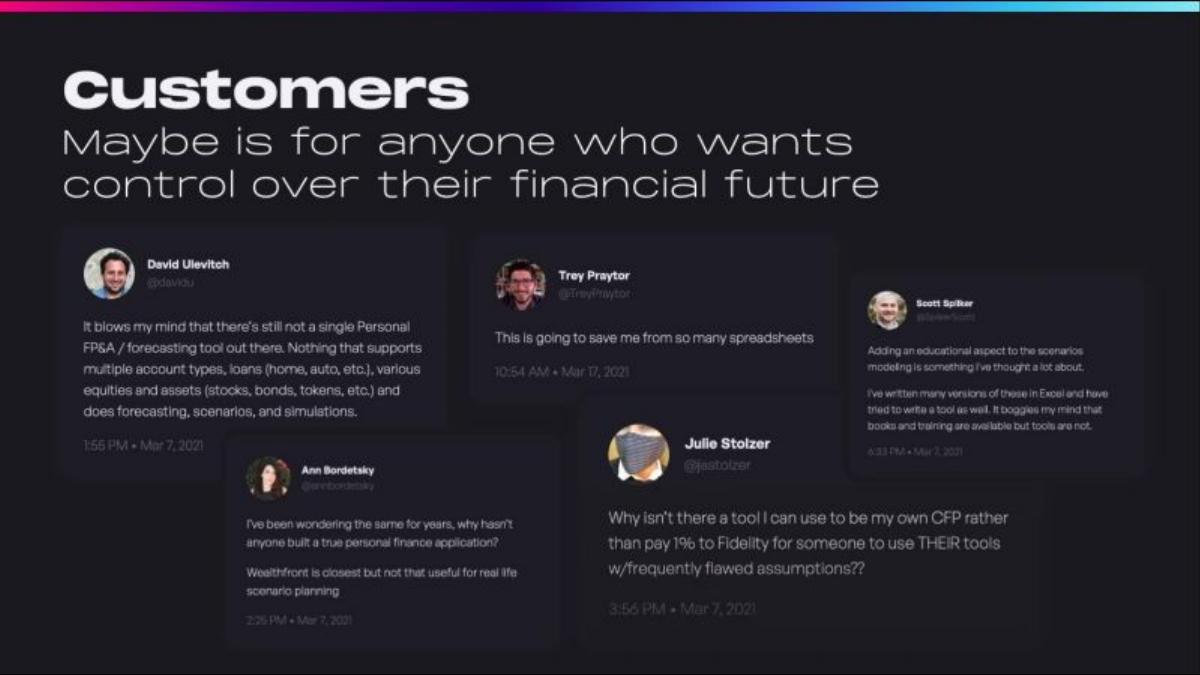
Titled 'Customers,' this slide states, 'Maybe is for anyone who wants control over their financial future.' It features five testimonials from individuals, presented as social media posts with names and handles (e.g., 'David Ulevitch @davidu,' 'Trey Praytor @TreyPraytor'). The testimonials praise the product for its ability to consolidate financial data, save users from spreadsheets, provide scenario modeling, and offer a better alternative to expensive financial advisors. The dates on the testimonials are 'Mar 7, 2021,' indicating they are from a specific point in time. This slide provides social proof and demonstrates a clear demand for the product from early users or beta testers, reinforcing the problem-solution fit.
Slide 7: Business Model
The 'Business Model' slide states 'Recurring revenue' as its core. It outlines three key aspects:
'Flat monthly/annual recurring fee for access to a suite of tools' · 'Clear pricing based on feature usage, not assets under management' · 'No harassing the user to upsell on financial services'
This slide clearly defines how Maybe generates revenue, emphasizing a transparent, subscription-based model. By explicitly stating that pricing is not based on assets under management, Maybe further differentiates itself from traditional financial advisors and robo-advisors, aligning with its mission to remove the 'middleman' and avoid conflicts of interest.
Slide 8: Market
The 'Market' slide declares, 'A multi-billion dollar market, ripe for disruption.' It presents two key figures:
'$52.9bn 2021 US financial planning market' · '3.5% 2021 US market growth'
Below these figures, two bullet points provide additional context:
'This is just the US market. We will be focused on supporting users all over the world.' · 'Financial management has become increasingly democratized and we believe all ages and all income levels can benefit from methodical, technology-enabled financial advice, not just the wealthy.'
This slide establishes the significant market opportunity and Maybe's ambition to expand beyond the US. It reinforces the idea of democratization of financial advice, aligning with the company's mission of accessibility.
Slide 9: Competition
Titled 'Competition,' this slide uses the phrase 'Out with the old, in with the new.' It identifies three main categories of competitors and critiques them:
'Financial Advisors: Incentivized towards complexity. Use outdated, unnecessarily difficult software with their clients.' · 'Spreadsheets: Difficult to set up, time consuming to manage and ripe for mistakes' · 'Roboadvisors: Don't solve the issue of financial literacy. You're still left unempowered and overcharged for asset management fees.'
A concluding paragraph states: 'Combine an industry set in outdated ways with consumers who are hacking together their own tools already and you've got a scenario that's ripe to be solved with a modern, technology-focused offering.' This slide effectively positions Maybe by highlighting the shortcomings of existing solutions and reinforcing the need for a new approach. It demonstrates an understanding of the competitive landscape and Maybe's unique value proposition.
Slide 10: Vision
The 'Vision' slide is titled 'Launch the tools to visualize your future.' It outlines Maybe's long-term aspirations:
'Holistic approach to financial management' · 'Accounting for things like income, savings, returns, inflation, historical data and time, we believe we can show customers what’s financially possible when they ask “maybe?” about their finances.' · 'Using this round of funding, we’ll be able to start answering the maybe’s of their life with our suite of financial planning & wealth management tools.'
This slide articulates the company's overarching goal: to provide comprehensive tools that help users understand and plan their financial future. It connects the product's capabilities to a deeper purpose of empowering users to make informed decisions about their lives, and explicitly links the current funding round to achieving this vision.
Slide 11: Funding
The 'Funding' slide, titled 'Terms of the deal,' presents the key financial details of the fundraising round:
'$1,000,000+ Funding Goals' · '$10,000,000 Valuation cap' · 'SAFE Security Type'
At the bottom, it adds: '$100,000 was put In by the Founder to start the company.' This slide is concise and direct, providing all essential information for potential investors. The founder's personal investment demonstrates strong commitment and belief in the venture, which is a positive signal for investors.
Slide 12: Founder
This slide introduces 'Josh Pigford, Founder & CEO.' It features a professional headshot of Josh and a brief biography:
'Josh Pigford has been building software companies for over 15 years, most recently as the founder and CEO of Baremetrics, a business analytics company he sold in 2020 that pioneered the way for SaaS companies to get accessible and actionable business insights with minimal effort.'
Contact information is provided: 'josh@maybe.co' and 'maybe.co.' This slide effectively establishes the founder's credibility, highlighting a successful entrepreneurial track record and relevant experience in building software companies and analytics tools. The prior exit with Baremetrics is a significant positive indicator for investors.
Slide 13: Team
The 'Team' slide introduces the 'Founding team behind Maybe.' It lists four key team members with their roles and brief descriptions:
'Travis Woods – CFP & CFA: Over a decade working as a certified financial planner and chartered financial analyst, building financial plans and investment strategies.' · 'Martin Rariga – Designer: Previously at Baremetrics as Lead Designer. Responsible for creating intuitive tools around massive data sets.' · 'Fried Filler – Engineer: Previously at Google, Codeable and Baremetrics. Wide skillset ranging from backend engineering to machine learning.' · 'Pieter Beulque – Engineer: Previously at Baremetrics as Frontend Engineer. Extensive experience building financial reporting and analysis tooling.'
This slide showcases a well-rounded team with expertise in finance, design, and engineering. The presence of a CFP & CFA provides crucial financial domain knowledge, while the engineers and designer bring strong technical and product development skills, with several having prior experience at the founder's previous company, Baremetrics, indicating a pre-existing working relationship and trust.
Slide 14: Call to Action / Best Pitch Deck Promotion
This final slide is not part of the Maybe pitch deck content but is a promotional slide for 'bestpitchdeck.com.' It encourages users to 'Browse the best pitch deck examples' and provides information about the platform. As this is not part of the company's pitch, it will not be analyzed in the context of Maybe's fundraising strategy.
What Works Well
Maybe's pitch deck demonstrates several strengths that contribute to its effectiveness in a crowdfunding context. Firstly, the problem statement on Slide 2 is clear, concise, and highly relatable. It taps into common frustrations with traditional financial services – opacity, high costs, and a lack of modern relevance – which resonates with a broad audience, including potential retail investors in a crowdfunding campaign. The solution on Slide 3 directly addresses these pain points, emphasizing accessibility, empowerment, and the bold claim of 'replacing financial advisors,' which immediately positions Maybe as a disruptive innovator.
The product visualization on Slide 5 is exceptionally strong. A detailed, clean, and modern UI screenshot provides immediate credibility and a tangible understanding of the platform's capabilities. It showcases key features like net worth tracking, investment breakdown, and actionable advice, making the abstract concept of 'modern financial management' concrete. This visual proof is crucial for engaging investors, especially in a crowdfunding setting where many may not have deep financial expertise but can appreciate a well-designed, functional product.
The inclusion of customer testimonials on Slide 6 provides valuable social proof. These short, impactful quotes from individuals who have experienced the problem and appreciate Maybe's solution lend authenticity and demonstrate early market validation. The fact that they are presented as social media posts adds to their perceived authenticity and relatability.
The business model on Slide 7 is clearly articulated and positions Maybe favorably against traditional competitors. The emphasis on a flat, recurring fee not tied to assets under management is a key differentiator that aligns with the 'without the middleman' ethos and appeals to consumers seeking transparency and control. This model is also attractive to investors as it implies predictable revenue streams.
The team slides (12 and 13) are a significant asset. The founder, Josh Pigford, brings a strong track record with a successful exit from Baremetrics, demonstrating entrepreneurial capability and domain expertise in building software companies. The rest of the team complements this with deep financial knowledge (CFP & CFA) and strong technical and design skills, with several members having worked with the founder previously. This indicates a cohesive and capable team, which is a critical factor for early-stage investment.
Finally, the funding slide (Slide 11) is direct and transparent, outlining the funding goal, valuation cap, and security type. The disclosure of the founder's personal investment of '$100,000' is a powerful signal of commitment and confidence, which can significantly sway investor sentiment, particularly in crowdfunding where personal conviction is highly valued.
What is Missing
Despite its strengths, Maybe's pitch deck has several areas where additional detail or strategic information would strengthen the overall narrative for investors. One notable omission is a detailed go-to-market strategy. While the deck mentions supporting users globally (Slide 8), it doesn't elaborate on how Maybe plans to acquire customers, what channels it will use, or its initial target segments beyond 'anyone who wants control over their financial future.' For a B2C product in a competitive fintech space, a clear plan for user acquisition and scaling is essential.
While the market size is stated as '$52.9bn' (Slide 8), the deck lacks a breakdown of the total addressable market (TAM), serviceable available market (SAM), and serviceable obtainable market (SOM). A more granular market analysis would provide investors with a clearer understanding of the specific segment Maybe is targeting and its realistic growth potential within that segment. This would also help to contextualize the 'multi-billion dollar market' claim.
The deck provides no financial projections or unit economics. For a company seeking funding, investors typically expect to see forecasts for revenue, user growth, customer acquisition costs (CAC), and customer lifetime value (LTV). Without these, it's difficult for investors to assess the company's financial viability, scalability, and potential return on investment. Even for a crowdfunding round, basic projections can demonstrate foresight and planning.
Although the team slide (Slide 13) is strong, it doesn't include an advisory board. For a fintech company, having experienced advisors in finance, regulation, or technology can add significant credibility and strategic guidance, especially for navigating a complex industry. Similarly, while the founder's previous exit is highlighted, more specific details on the company's traction to date – such as user numbers, growth rates, or revenue figures – would provide concrete evidence of progress and market acceptance.
Finally, while the 'Vision' slide (Slide 10) outlines the long-term goal, a more explicit roadmap or milestones slide could detail the company's planned development stages, key product releases, or strategic partnerships. This would give investors a clearer picture of how the funding will be utilized to achieve the stated vision and what milestones they can expect in the near to medium term.
What a Founder Should Copy
Founders can learn a great deal from Maybe's pitch deck, particularly in how it frames the problem and solution, visualizes the product, and presents the team. The direct and impactful problem statement on Slide 2, which clearly articulates the pain points of the target audience, is a model for any founder. By identifying a systemic flaw in an established industry ('Financial planning & wealth management is broken'), Maybe immediately establishes a compelling reason for its existence.
The solution slide (Slide 3) is equally effective, not just by offering a remedy but by making a bold, disruptive claim: 'We're replacing financial advisors.' This kind of confident, declarative statement can capture attention and clearly define the company's ambition. Founders should strive to articulate their solution with similar clarity and conviction, positioning themselves as innovators rather than incremental improvers.
The product screenshot on Slide 5 is an excellent example of 'show, don't tell.' Instead of merely listing features, Maybe provides a visually rich demonstration of its platform. This is critical for tech companies, as it allows investors to immediately grasp the user experience and the value proposition. Founders should invest in high-quality mockups or screenshots to illustrate their product's functionality and aesthetic.
The use of customer testimonials on Slide 6 is another highly effective element. Authentic feedback from early users provides powerful social proof and validates the market need. Founders should actively collect and strategically place such testimonials in their decks to build trust and demonstrate early traction. The format of social media posts adds a layer of authenticity that can be very persuasive.
The clear and transparent business model presented on Slide 7, emphasizing recurring revenue and pricing not tied to AUM, is a strong example of how to differentiate from competitors and appeal to modern consumer preferences. Founders should clearly define their revenue model and highlight how it creates value for both customers and the business.
Lastly, the team slides (12 and 13) are exemplary. Highlighting the founder's prior successful exit and showcasing a well-rounded team with relevant expertise, including previous working relationships, instills confidence. The founder's personal investment, explicitly stated on Slide 11, is a powerful signal of commitment. Founders should ensure their team's credentials, relevant experience, and personal investment (if applicable) are prominently featured to demonstrate capability and dedication.
Frequently asked questions
- What problem does Maybe aim to solve in the financial industry?
- Maybe aims to solve the problem of financial planning and wealth management being 'broken.' It identifies issues such as money management being purposefully kept obtuse, high financial services fees, and consumers' dissatisfaction with traditional retirement models, seeking financial independence earlier in life. The company believes the industry is outdated and ripe for disruption by modern, technology-focused solutions.
- How does Maybe differentiate its business model from traditional financial advisors?
- Maybe differentiates its business model by offering a flat monthly/annual recurring fee for access to its suite of tools, rather than charging based on assets under management (AUM). This approach aims for clear pricing and avoids the perceived conflict of interest where advisors might be incentivized by complexity or higher AUM. The deck explicitly states 'No harassing the user to upsell on financial services.'
- What is the stated market opportunity for Maybe?
- Maybe identifies a significant market opportunity, citing the '2021 US financial planning market' as $52.9 billion with a 3.5% growth rate. The deck also notes that this is just the US market, with intentions to support users globally. It emphasizes that financial management is becoming democratized, benefiting all income levels, not just the wealthy.
- What is the background of Maybe's founder?
- The founder and CEO of Maybe is Josh Pigford. He has been building software companies for over 15 years. Most recently, he was the founder and CEO of Baremetrics, a business analytics company that he sold in 2020. This prior experience is highlighted as pioneering accessible and actionable business insights for SaaS companies.
- What are the key terms of the funding round presented in the deck?
- The funding round presented in the deck has a funding goal of '$1,000,000+' and a valuation cap of '$10,000,000.' The security type is a SAFE (Simple Agreement for Future Equity). The founder also contributed '$100,000' to start the company, demonstrating early commitment and belief in the venture.