Matter Neuroscience’s 17-slide deck is a masterclass in narrative-driven biotech fundraising. Rather than leading with complex molecular biology, the deck establishes a high-stakes philosophical and medical problem: the global crisis of unhappiness. The company positions happiness not as a vague emotion, but as a manageable biological equilibrium defined by six neurotransmitters. By claiming a proprietary method to measure these biomarkers indirectly, Matter bridges the gap between a consumer wellness app and a clinical biotech firm. The deck successfully secured $26 million in Series A fundi…
Key takeaways
- The deck claims that feeling happy adds 10-15 healthy years to a person's life (Slide 4).
- Matter categorizes negative societal outcomes like war, criminality, and addiction as results of 'overcompensation' for unhappiness (Slide 3).
- The scientific thesis rests on happiness being defined by six specific neurotransmitters underlying human reward systems (Slide 9).
- The company admits that ideal biomarkers for happiness cannot be measured directly, necessitating their indirect measurement solution (Slide 10).
- The 'Matter Protocol' is described as an algorithm that learns from memory information to provide real-time recommendations (Slide 13).
- The product roadmap spans from consumer wearables and in-game currency to FDA-approved drug discovery (Slide 15).
- The deck omits a traditional team slide, though the intro identifies Dr. Axel Bouchon as Co-founder and CEO (Slide 1).
- There is no explicit 'Ask' slide detailing how the $26M will be allocated or what specific milestones it will fund.
The Narrative Arc: From Philosophy to Pharmacology
Matter Neuroscience’s pitch deck is a distinct departure from the data-heavy, chart-dense presentations typical of Series A biotech rounds. Instead, it utilizes a minimalist, high-contrast aesthetic to build a narrative that feels both inevitable and urgent. The deck moves from broad humanistic goals—curing unhappiness—to a specific technological solution: an algorithm that decodes the molecular basis of joy.
Slides 1-2: The Mission Statement
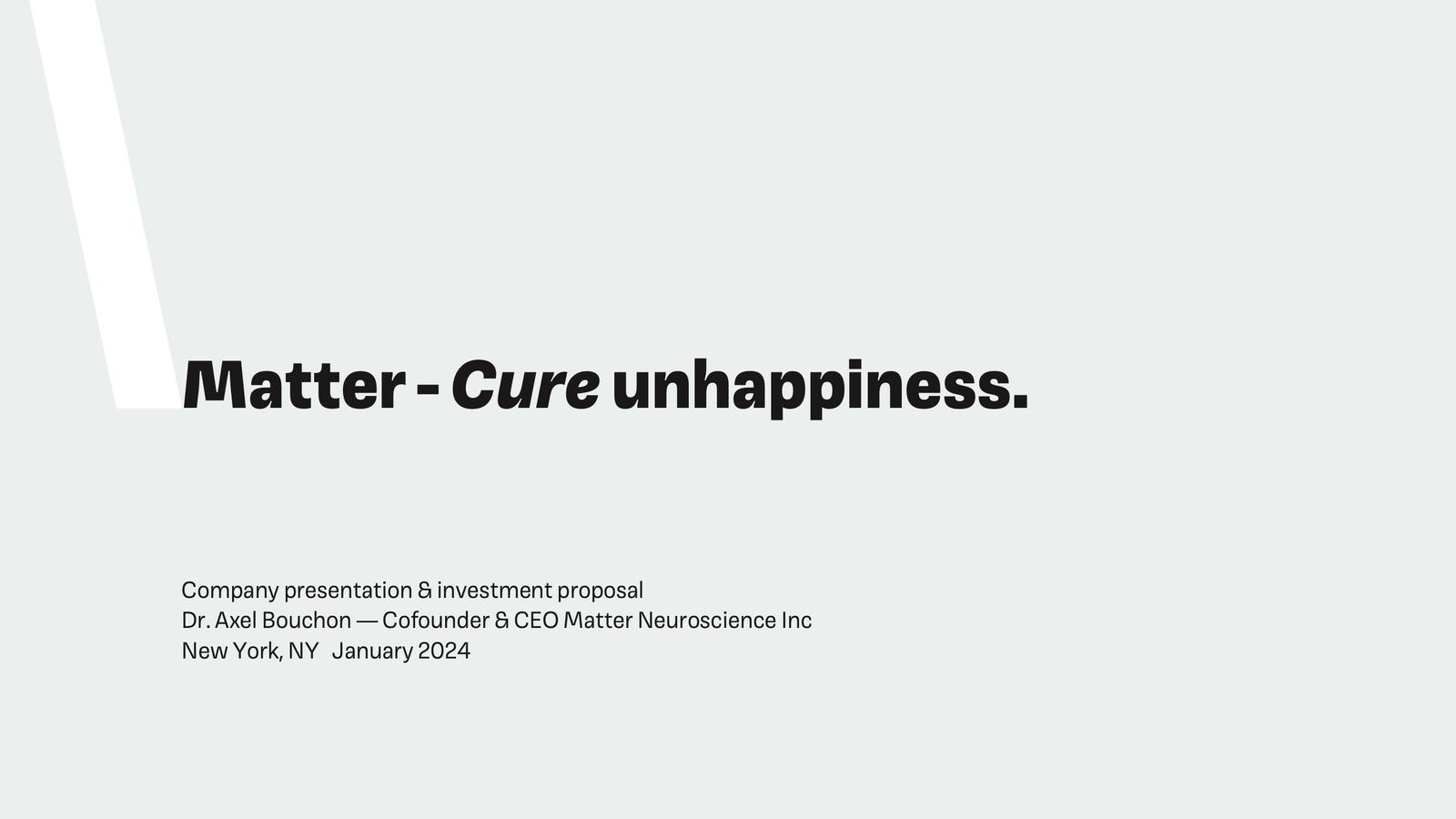
Slide 1 sets the tone immediately with the headline: Matter - Cure unhappiness. It identifies the presenter as Dr. Axel Bouchon, Co-founder & CEO, and dates the proposal to January 2024. Slide 2 provides a deck summary, though the specific text of that summary is not detailed in the visual breakdown, it serves as the transition into the 'Why Now' of the company's existence.
Slides 3-6: Quantifying the Cost of Unhappiness
Slide 3 is perhaps the most ambitious in the deck. It presents a 'Map of happiness to unhappiness' that attempts to link biological reward system activity to global crises. It lists staggering figures: 370 million people suffering from anxiety, 2.5 billion from insomnia, and 260 million from depression. More provocatively, it categorizes 'Overconsumption' (3+ billion people), 'Addiction' (1.3 billion), and even 'War' (426+ million impacted) as results of 'Overcompensation' for unhappiness. By framing war and criminality as biological failures of happiness regulation, Matter expands its Total Addressable Market (TAM) from a simple wellness app to a fundamental societal intervention.
Slide 4 reinforces the personal stakes, stating that 'Feeling happy adds 10-15 healthy years to your life.' Slides 5 and 6 conclude this section by asserting that unhappiness is the 'underlying cause for all mental and social diseases' and that prevention requires a scientific focus on unhappiness itself.
Slides 7-9: The Biological Thesis
Having established the problem, the deck moves to the science. Slide 7 introduces the concept of a 'happiness equilibrium' that can be managed through 'conscious reflection and learning.' This is a critical bridge between the biological and the behavioral. Slide 8 narrows the company's focus to the 'research of happiness,' and Slide 9 provides the molecular hook: 'On a molecular level, happiness is defined by six neurotransmitters... underlying our reward systems.' While the slide does not name the six neurotransmitters, it establishes a quantifiable framework for an otherwise subjective emotion.
Slides 10-11: The Technical Moat
Every biotech deck must address the 'How.' Slide 10 admits a significant hurdle: 'The problem is, we can't measure these ideal biomarkers directly.' This honesty builds credibility before Slide 11 delivers the solution: '...but after years of research & clinical studies we found a way to measure it indirectly.' This 'indirect measurement' is the core intellectual property of the company, though the deck remains light on the specific mechanics of that measurement, likely to protect trade secrets during the initial pitch phase.
Slides 12-14: The Product and The Protocol
Slide 12 and 13 introduce the 'Matter Protocol.' It is described as an 'algorithm that learns from your memory information' to provide personal recommendations in real-time. The claim is that this works 'both emotionally & molecularly.' Slide 14 reveals the current state of the company: a public beta app is already in the hands of users, serving as a data collection engine to fuel their ongoing clinical studies.
Slide 15: The Roadmap to a 'Huge' Option Space
Slide 15 is the 'Vision' slide. It divides the company's future into two distinct but related paths. The first is a 'real-world happiness network,' which includes consumer health claims, wearables, and community features. The second is 'personalized medicine,' which moves into the clinical realm with digital diagnostics, drug repurposing, and new drug discovery (Rx NCE). This dual-track strategy allows Matter to generate immediate consumer revenue while chasing the high-valuation upside of a traditional biotech firm.
Slides 16-17: The Emotional Close
The deck concludes with a minimalist slide (Slide 16) and a final quote from Abraham Lincoln on Slide 17: 'What matters most is not the years in your life, but the life in your years.' This brings the presentation back to the human element, reminding investors that despite the talk of algorithms and neurotransmitters, the goal is a fundamental improvement in the human experience.
What Works in the Matter Neuroscience Deck
The deck's primary strength is its narrative clarity. It avoids the 'feature soup' that plagues many consumer apps and the 'jargon wall' that ruins many biotech pitches. By focusing on a single, universally understood concept—happiness—and then applying a scientific lens to it, the founders create a compelling 'Why.'
The visual design is also highly effective. The use of high-contrast black and white slides, minimal text, and large typography forces the audience to listen to the presenter rather than reading complex charts. This is a deck designed for a high-level Series A conversation where the goal is to sell a vision of the future rather than just a set of current metrics.
Finally, the positioning of the 'Matter Protocol' as a proprietary algorithm (Slide 13) creates a sense of defensibility. In a crowded wellness market, claiming a clinical-grade, molecularly-validated algorithm sets the company apart from standard meditation or mood-tracking apps.
What is Missing from the Matter Neuroscience Deck
Despite raising $26 million, the deck omits several standard components that investors usually look for in a Series A. The most notable omission is a Team Slide. While Dr. Axel Bouchon is mentioned on the title slide, the lack of a slide highlighting the scientific pedigree of the researchers and the operational experience of the leadership team is unusual for a biotech raise.
There is also a lack of Unit Economics and Traction Data. While Slide 14 mentions a public beta, there are no figures regarding user retention, engagement, or the results of the 'clinical behavior studies' mentioned in the footnotes. Investors in 2024 typically demand more granular data on how the 'indirect measurement' actually correlates with biological outcomes.
Lastly, there is no Competitive Landscape slide. The 'happiness' and 'mental wellness' space is incredibly crowded, ranging from Calm and Headspace to more clinical players like Compass Pathways. Matter Neuroscience chooses to ignore these competitors entirely, relying on the uniqueness of their 'molecular' approach to justify their market position.
Founder Takeaways: The Biotech-Consumer Hybrid
Founders building at the intersection of consumer tech and biotech can learn a lot from Matter’s approach. First, lead with the 'Why.' Matter spends nearly half the deck (Slides 3-6) establishing the gravity of the problem before mentioning their product. This creates a 'moral imperative' for the investment.
Second, create a 'Bridge' technology. The Matter Protocol serves as a bridge between subjective user input (memory information) and objective biological states (neurotransmitters). If you are building in a space where direct measurement is impossible or too expensive, your proprietary 'indirect' method becomes your most valuable asset.
Third, sell the 'Option Space.' Slide 15 is a masterclass in showing how a single core technology can address multiple markets. By showing both a consumer path and a clinical path, the founders de-risk the investment. If the consumer app fails to gain traction, the drug discovery arm still holds value, and vice versa.
Frequently asked questions
- What is the core scientific claim of Matter Neuroscience?
- Matter Neuroscience claims that happiness is a biological state governed by six neurotransmitters within the brain's reward system. On Slide 9, they state that while these biomarkers cannot be measured directly (Slide 10), they have developed a proprietary 'Matter Protocol' algorithm that uses memory information to measure and manage this equilibrium indirectly (Slide 13).
- How does the company plan to monetize its technology?
- Slide 15 outlines a broad 'option space' for monetization. This includes a consumer-facing 'happiness network' featuring direct-to-consumer health claims, in-game purchases, and events. Long-term, they aim for a 'personalized medicine' model involving digital diagnostics, generic drug repurposing, and Rx NCE (New Chemical Entity) drug discovery supported by healthcare providers and reimbursement.
- What problem is Matter Neuroscience trying to solve?
- The deck frames unhappiness as the 'underlying cause for all mental and social diseases' (Slide 5). Slide 3 provides a map linking unhappiness to specific global issues, including 260 million cases of depression, 1.1 billion people impacted by criminality, and 426 million people impacted by war, positioning their solution as a preventative measure for these societal ills.
- Is there a product currently available to the public?
- Yes, Slide 14 states that a 'Matter public beta app' is currently available for users. The company uses this beta phase to continue their clinical studies while providing the algorithm's recommendations to early adopters to help them manage their 'happiness equilibrium' through conscious reflection.
- Who is leading Matter Neuroscience?
- The intro slide identifies Dr. Axel Bouchon as the Co-founder and CEO. While the provided 17-slide deck summary does not include a dedicated team slide with bios for the rest of the leadership or scientific advisory board, the presence of a PhD-led founding team is central to their biotech positioning.