Mathison’s Series A deck is a masterclass in demonstrating product-market fit through aggressive growth metrics and a clear competitive moat. Raising $25M in 2022, the company showcased a 4.3x YoY growth rate and an impressive $7.1M ARR projection for the end of 2022. The narrative centers on the transition from fragmented 'single point' DEI tools to a holistic, predictive SaaS platform. By highlighting 145% Net Revenue Retention (NRR) and a short 6-week sales cycle, Mathison proved high capital efficiency and customer stickiness. The deck successfully positions the company as the first end-t…
Key takeaways
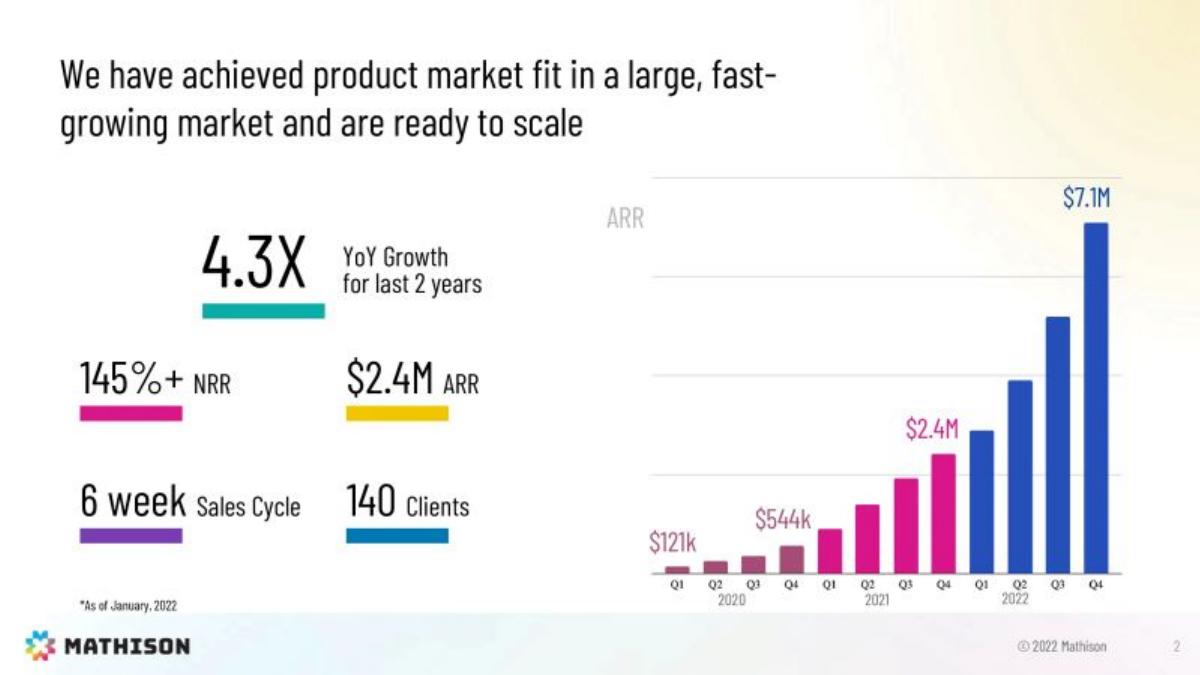
- Mathison reported a 4.3x YoY growth rate for the two years leading up to the raise (Slide 2).
- The company projected reaching $7.1M ARR by Q4 2022, up from $2.4M at the start of the year (Slide 2).
- A high Net Revenue Retention (NRR) of 145% indicates strong expansion within existing accounts (Slide 2).
- The deck identifies a massive market opportunity, with the combined DEI and recruiting market expected to reach $450B by 2027 (Slide 8).
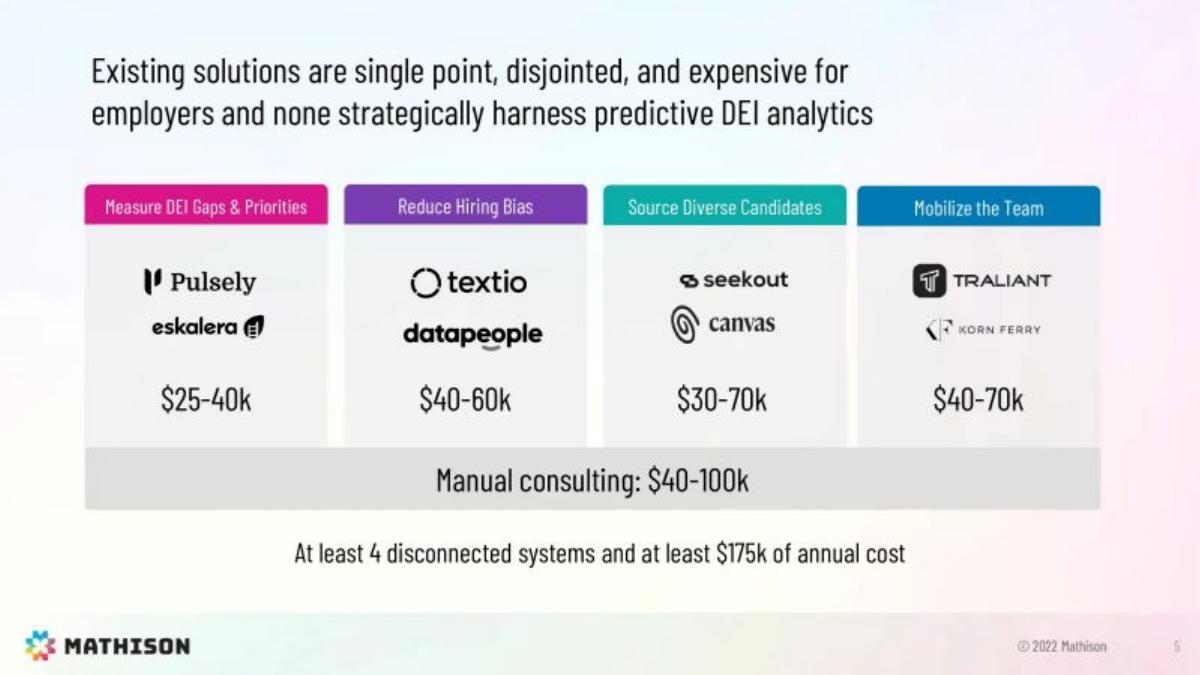
- Mathison positions itself against fragmented competitors whose combined costs exceed $175k annually (Slide 5).
- The platform boasts a 90% logo retention rate and a payback period of less than 3.5 months (Slide 17).
- Case studies show significant impact, such as reducing hiring bias by 98% for a Fortune 1,000 food delivery company (Slide 14).
- The Series A use of funds includes growing the team by 35 new critical hires across sales, marketing, and engineering (Slide 15).
The Mathison Series A Teardown
Mathison’s 2022 Series A deck is a compelling example of how to pitch a 'category-defining' platform in a crowded market. By the time they sought $25M, the company had already established significant momentum, moving from a niche DEI tool to a comprehensive SaaS platform. The deck focuses heavily on the inefficiency of the status quo and the financial efficiency of their own growth engine.
Slide 1: Title and Vision
The deck opens with a clean title slide featuring the Mathison logo and the vision statement: 'We envision a workforce that equally represents society.' The background uses a soft, multi-colored gradient that aligns with the brand’s focus on diversity. It establishes the company as a mission-driven tech firm from the outset.
Slide 2: The Traction 'Money Slide'
Mathison does not wait to show its hand. Slide 2 is a powerhouse of metrics. It claims 'product market fit' and readiness to scale. The figures are impressive: 4.3x YoY growth for the last two years, 145%+ NRR, a 6-week sales cycle, and 140 clients. Most notably, the bar chart shows ARR scaling from $121k in Q1 2020 to a projected $7.1M by Q4 2022. This slide alone justifies a Series A conversation by proving both demand and retention.
Slide 3: The Macro Problem
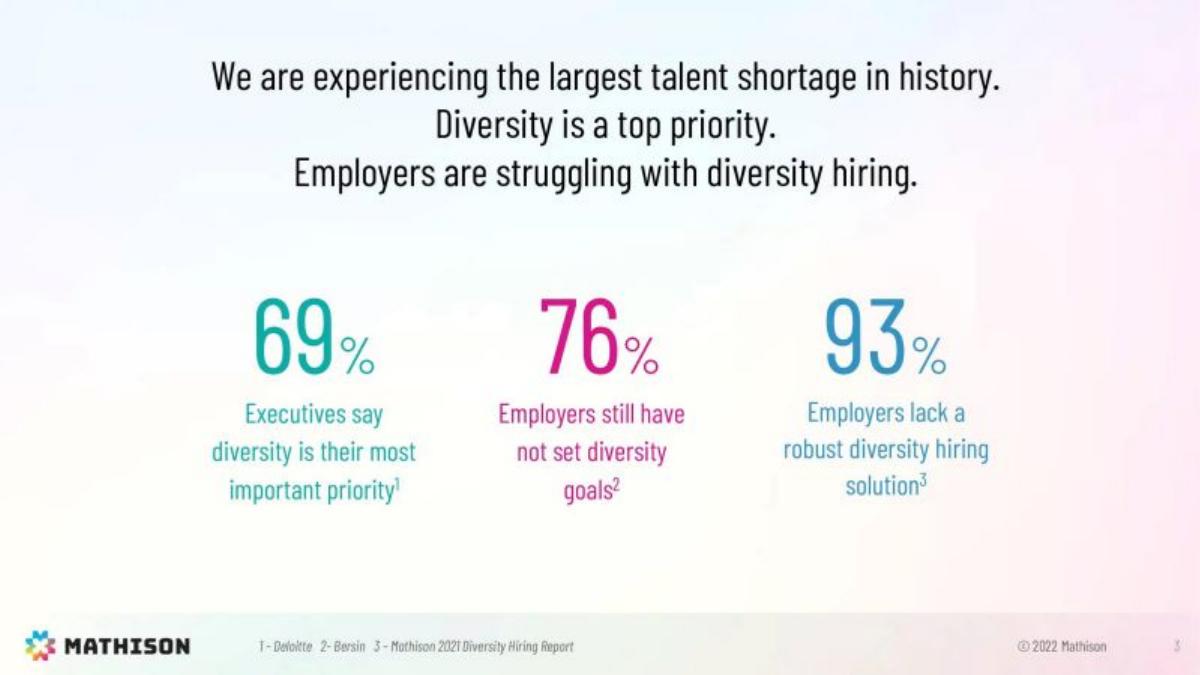
This slide contextualizes the business within the 'largest talent shortage in history.' It uses three key stats to build urgency: 69% of executives prioritize diversity, yet 76% have no goals, and 93% lack a robust hiring solution. This creates a 'gap' in the market that Mathison intends to fill.
Slide 4: The 'Driving Blind' Metaphor
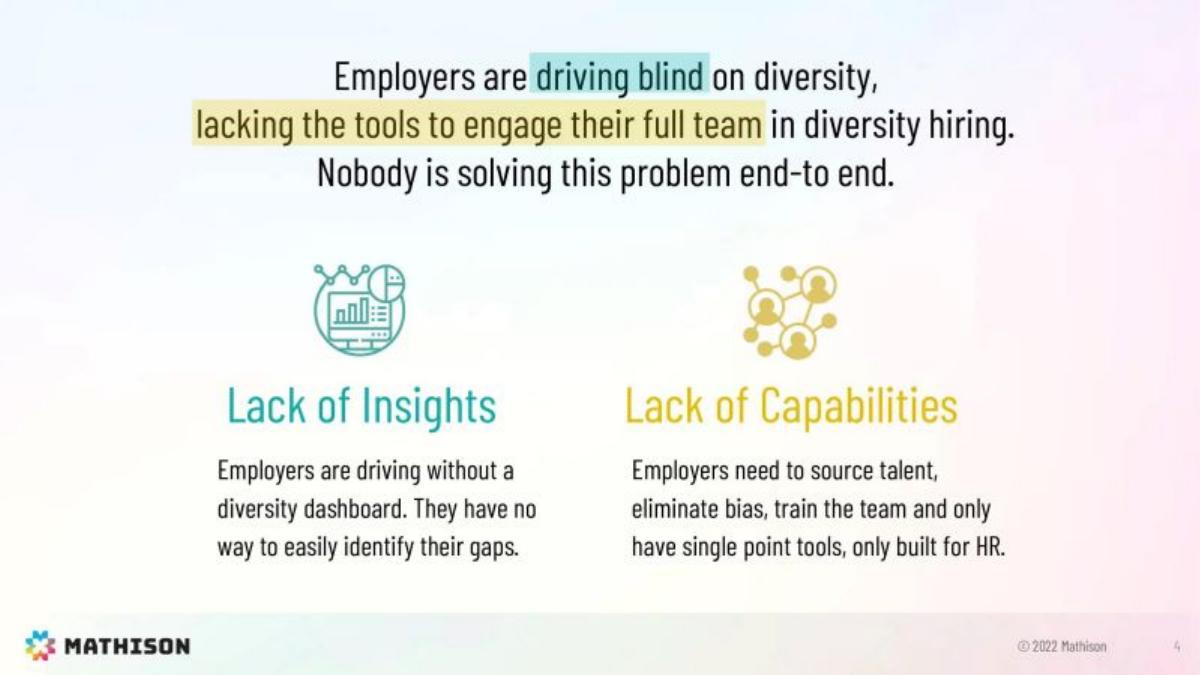
Slide 4 refines the problem. It argues that employers are 'driving blind' due to a lack of insights (dashboards) and a lack of capabilities (single point tools). It explicitly states that 'Nobody is solving this problem end-to-end,' setting up their unique value proposition.
Slide 5: The Competitive Landscape and Cost of Inaction
This is a highly effective competitive slide. Instead of a standard 2x2 grid, Mathison lists specific competitors across four categories: Measure, Reduce Bias, Source, and Mobilize. They list names like Pulsely, Textio, Seekout, and Traliant. By showing that an employer would need to spend $175k+ on four disconnected systems, Mathison positions its own platform as a cost-saving consolidation play.
Slide 6: The Integrated Solution
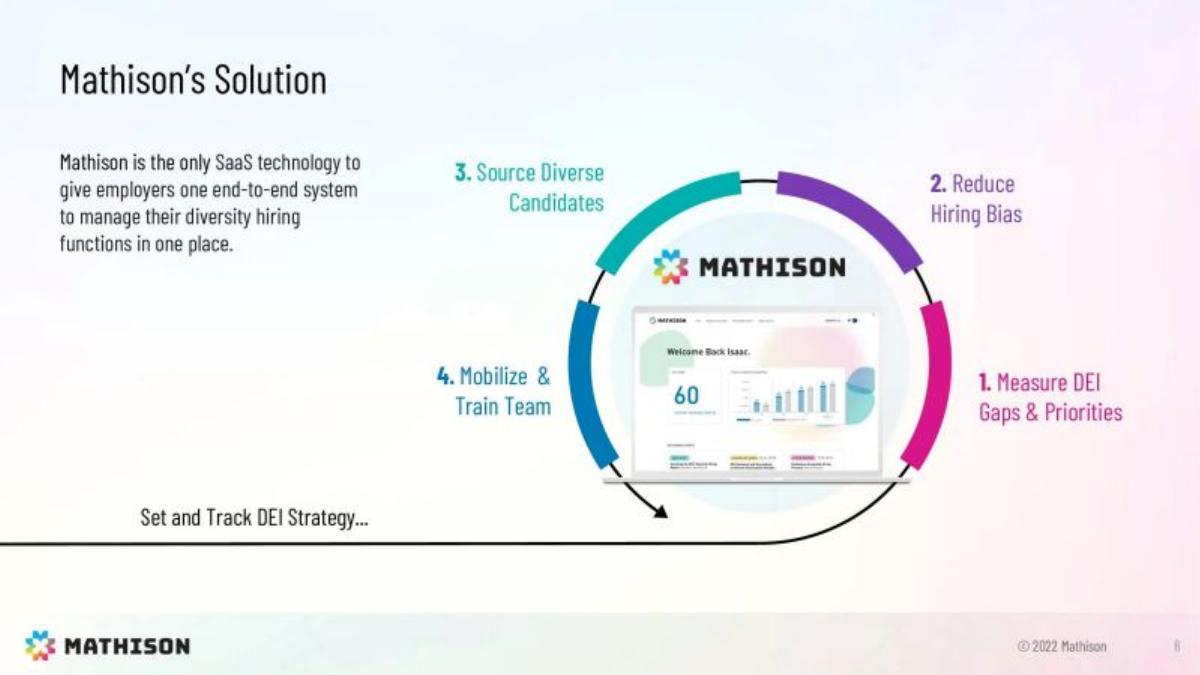
Slide 6 introduces the 'Mathison Solution' as a circular, end-to-end system. It visualizes the four pillars mentioned in the previous slide—Measure, Reduce Bias, Source, and Mobilize—as a continuous loop. This reinforces the 'one-stop-shop' narrative.
Slide 7: Predictive Analytics as a Moat
The deck moves from 'what we do' to 'how we are better.' Slide 7 focuses on predictive DEI analytics. It claims that single-point solutions fail to drive decisions. Mathison’s system integrates employee feedback, representation data, behavior, and policies to provide a '360 and predictive view.'
Slide 8: Market Size (TAM)
Mathison defines its market by combining DEI technology ($25B) and the broader recruiting market ($284B). They project the combined market to reach ~$450B by 2027. This demonstrates that they aren't just playing in a small DEI niche but are disrupting the massive global recruiting industry.
Slide 9: Domain Expertise
Slide 9 highlights the founders' credibility. It mentions they wrote the best-selling book 'Hiring for Diversity,' studied 500+ employers, and co-founded 'Out in Tech.' This 'founder-market fit' is crucial for a Series A, showing they aren't just building software but are thought leaders in the space.
Slide 10: The Leadership Team
The team slide is robust, featuring ten leaders with backgrounds from Indeed, Google, IDEO, and Adobe. A sidebar highlights their internal commitment to DEI: 50% People of Color, 50% Women, and 60% Working Parents. This proves they 'eat their own dog food.'
Slide 11 & 12: Product for Leaders and Teams
These slides break down the UI and specific benefits for different user groups. For leaders, it’s about analytics and benchmarking. For team members, it’s about sourcing and bias reduction. Both slides include powerful testimonials from a Fortune 1,000 Media Company and a Recycle Services Company.
Slide 13: Go-to-Market Strategy
The GTM strategy follows a 'Land, Expand, Evangelize' model. They land by solving an urgent pain point, expand by upselling seats and features, and evangelize by turning leaders into brand ambassadors. This is a standard but effective SaaS growth playbook.
Slide 14: Case Studies and ROI
Slide 14 provides hard data on customer success. A Fortune 1,000 food delivery company reduced hiring bias by 98% and saved 400+ hours. A Fortune 100 pharma company reduced bias by 30% and saved 500+ hours. These specific outcomes make the product's value proposition tangible.
Slide 15: The Ask and Use of Funds
The deck states they are raising a Series A to fuel growth. While the exact dollar amount isn't on the slide (the catalogue confirms $25M), the goals are clear: grow the team by 35 people, expand existing customers by $1M+, and build 20 new integrations. It also lists existing investors like Bain Capital Ventures and Gaingels.
Slide 16: The Origin Story
In a unique move, Slide 16 explains the name 'Mathison.' It’s a tribute to Alan Turing (whose middle name was Mathison), the father of data science who was persecuted for his identity. This adds an emotional and historical weight to the brand.
Slide 17: Unit Economics
Slide 17 returns to the hard numbers. It highlights a This slide shows a deep understanding of the enterprise sales process. It maps out decision-makers (Head of HR/TA) versus champions (DEI leaders/Business Unit leaders), identifying the specific priorities for each. This gives investors confidence in the sales team's ability to navigate complex organizations.
Slide 19: The Competitive Moat
The final content slide summarizes the 'moat': engaging the full team, deep system integration, and continuous measurement. It frames the product as 'embedded in everyone's workflow,' which is the ultimate goal for any SaaS platform seeking high retention.
Slide 20 & 21: Closing
The deck ends with a 'Thank you' slide including contact emails for the CEO, Co-Founder, and CPO, followed by a promotional slide for the pitch deck library.
What Mathison Does Well
Metric Density: The deck is packed with high-quality SaaS metrics (NRR, Payback Period, Sales Cycle) that are rarely seen in such detail in a Series A deck. · Consolidation Narrative: By showing the high cost and fragmentation of competitors, they make their 'end-to-end' platform feel like an inevitable evolution of the market. · Social Proof: The use of Fortune 100/1,000 case studies and testimonials provides immediate enterprise-grade credibility. · Founder-Market Fit: They successfully leverage their status as authors and community builders to prove they understand the nuances of DEI better than a generic software team.
What is Missing
Detailed Financial Projections: While they show ARR growth, they omit detailed projections for burn rate, EBITDA, or gross margins. · Product Roadmap: Beyond 'integrations,' there is little detail on what the next 2-3 years of product development look like. · Pricing Tiers: The deck mentions upselling but doesn't explicitly state their pricing model (per seat, per employee, or flat fee).
What Other Founders Should Copy
The 'Status Quo' Cost Slide: Slide 5 is a brilliant way to handle competition. Don't just list names; list the cost and complexity of using them all at once. The Traction-First Approach: Putting your best metrics on Slide 2 creates immediate interest and allows the rest of the deck to be read through a lens of success. Stakeholder Mapping: Including a slide like Slide 18 shows that you understand how to sell, not just how to build. This is a major green flag for VCs.
Frequently asked questions
- What is Mathison's core business model?
- Mathison operates as a B2B SaaS platform focused on diversity, equity, and inclusion (DEI). According to the deck, they provide an end-to-end system that allows employers to measure DEI gaps, reduce hiring bias, source diverse candidates, and train their teams. Their revenue model is based on a 'sticky expandable subscription' with a 145% Net Revenue Retention rate.
- How does Mathison differentiate itself from other HR tech tools?
- On Slide 5, Mathison argues that existing solutions are 'single point' and 'disjointed,' requiring employers to pay for at least four different systems at a cost of $175k+. Mathison differentiates by offering a holistic system that integrates across the talent lifecycle and uses 'predictive DEI analytics' to drive decisions, rather than just reporting historical data.
- What are the key growth metrics shared in the deck?
- The deck is heavy on traction. Key metrics include 4.3x YoY growth over two years, a 6-week sales cycle, 140 clients, and a jump from $2.4M ARR to a projected $7.1M ARR within one year. They also highlight a very efficient customer acquisition strategy with a sub-3.5 month payback period.
- Who are the target customers for Mathison's platform?
- Mathison targets enterprise-level organizations, specifically mentioning Fortune 100 and Fortune 1,000 companies in their case studies. Slide 18 details their stakeholder map, identifying the Head of HR and Head of Talent Acquisition as primary decision-makers, while DEI leaders and Business Unit leaders serve as champions.
- What was the purpose of the $25M Series A raise?
- The funds were earmarked for scaling the next phase of growth. Specific goals for 2022 included expanding existing customer revenue by $1M+, building 20 new integrations with ATS and HRIS systems, and hiring 35 new employees across key departments like engineering and sales.